
You may be in a familiar spot right now. You've tried shampoos, supplements, topical products, maybe even a consultation for a transplant, and instead of a clear answer you got a new frustration. Your donor area may be limited, your thinning may be too advanced, or you were told your options are narrower than you hoped.
That's usually when people start searching for a faster answer and come across artificial hair implants. Online, they're often presented as a direct path to density when natural hair can't be used. For a patient in the United States, especially in the Dallas-Fort Worth area, that's where the conversation needs to get more careful, not less.
Table of Contents
- The Search for a Hair Loss Solution in DFW
- What Exactly Are Artificial Hair Implants
- The Implantation Procedure Step by Step
- Safety Risks and the FDA Ban
- Implants vs Transplants A Critical Comparison
- Safer Alternatives Non-Surgical Regenerative Solutions
- Your Hair Restoration FAQs Answered
The Search for a Hair Loss Solution in DFW
Hair loss rarely feels like one problem. It's appearance, confidence, daily frustration, and the slow realization that common advice doesn't always fit your case. Many DFW patients reach a point where they aren't asking for perfection anymore. They just want something that feels medically sound and worth the risk.
That's important, because interest in hair restoration keeps growing worldwide. The global artificial hair integration market was valued at USD 2.2 billion in 2025 and is projected to grow at a 6.7% CAGR, reflecting strong demand across regions with very different safety standards and regulations, according to Future Market Insights on artificial hair integration market growth. Growing interest doesn't mean every option carries the same level of safety.
When common options stop feeling straightforward
A typical patient has already worked through basic steps before looking into implants:
- Topical care: They've used over-the-counter approaches and tried to stay consistent.
- Lifestyle changes: They've improved sleep, stress, nutrition, or hair-care habits.
- Transplant evaluation: They've explored whether moving their own follicles is realistic.
- Camouflage strategies: They've used styling tricks or cosmetic coverage to buy time.
Some of those basics still matter. Practical education can help people separate scalp care from unrealistic marketing, which is why resources like Morfose hair loss insights can be useful early on. But once significant hair loss is present, scalp-friendly habits alone usually won't answer the bigger procedural question.
The real question patients are asking
Most patients aren't asking, “What is the newest thing?” They're asking something more specific. If I'm not a strong transplant candidate, what can I still do that won't create a bigger problem later?
Practical rule: When a hair restoration option sounds like a shortcut around biology, it deserves extra scrutiny.
That's why many patients eventually look toward non-surgical regenerative care rather than a foreign-body implant. For readers evaluating medically supervised options in North Texas, REGENhair™ hair restoration in Colleyville is one example of a local regenerative pathway designed for people who want to avoid a high-risk procedure.
What Exactly Are Artificial Hair Implants
A patient with very limited donor hair will often ask a fair question. If my own follicles cannot be moved, can synthetic hair be implanted instead?
The answer is yes in a technical sense, but patients need to understand what is being placed into the scalp. Artificial hair implants use manufactured fibers that are inserted into the skin to create the appearance of fuller hair. They do not restore hair biology. They do not turn into living follicles. They function as cosmetic coverage.
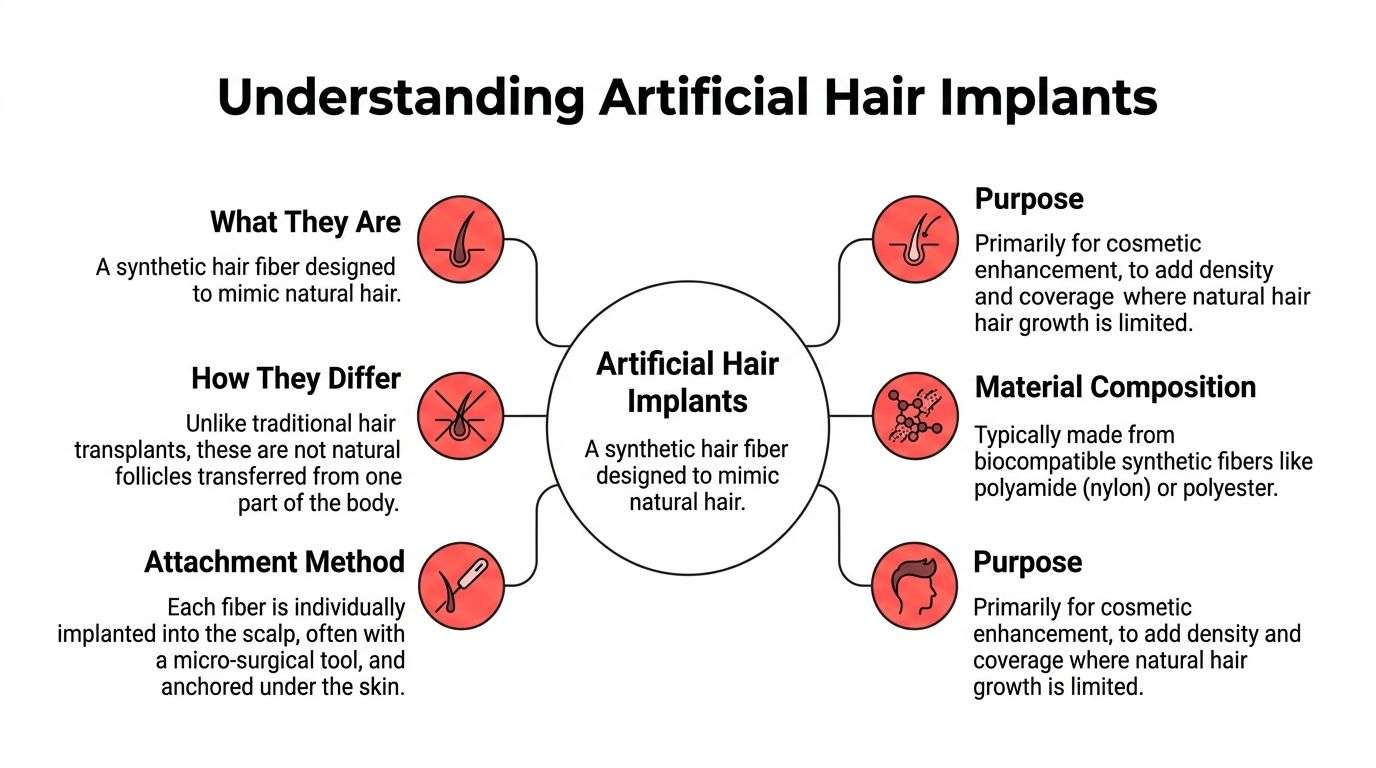
That distinction matters more in the United States than many patients realize. In practice, this is a distinct procedure from hair transplantation. A standard transplant redistributes your own living follicular units from a donor area to a thinning area. Artificial implantation places a foreign fiber into the scalp and depends on the scalp continuing to tolerate that material over time.
What the implanted fibers actually are
These fibers are synthetic strands designed to resemble natural hair in color, texture, and thickness. Manufacturers present them as medically engineered materials intended for implantation, but the clinical reality is straightforward. The scalp still recognizes them as foreign material.
That is the point many marketing descriptions soften. Patients hear words like implant, density, and minimally invasive, then assume the procedure is a substitute for transplant surgery. It is not a substitute in the biological sense. There is no follicle, no growth cycle, and no regenerative potential.
What patients are really getting
Artificial implants offer visual density from inserted fibers, not new hair growth. The cosmetic effect can be immediate, which explains the interest from patients who have advanced thinning, scarring, or poor donor supply.
The trade-off is just as important:
- No living follicle is restored
- No ongoing natural hair growth is created
- The result depends on retained synthetic fibers
- The scalp must tolerate a foreign body
From a medical standpoint, that last point carries the most weight. In the US context, artificial hair implantation is not a simple workaround for being a poor transplant candidate. It is a high-risk foreign-body procedure with a very different safety profile from transplanting your own hair.
Why this procedure still attracts attention
I understand why people look into it. Some patients want fast visible coverage. Others have been told they do not have enough donor hair for a traditional transplant and feel backed into a corner.
That does not make artificial implants the safer answer.
For patients with little or no donor supply, the better question is not, "Can something synthetic be placed in the scalp?" The better question is, "What option improves appearance without adding a long-term scalp problem?" In many cases, that pushes the conversation toward non-surgical regenerative treatment rather than synthetic implantation.
| Consideration | Artificial hair implants |
|---|---|
| Biological regrowth | No |
| Immediate visual density | Yes |
| Uses your own follicles | No |
| Foreign material in scalp | Yes |
| Primary role | Cosmetic coverage |
Patients usually feel more grounded once the procedure is described this plainly. Artificial hair implants are cosmetic fibers placed into the scalp. They can change how hair looks, but they do not restore living hair, and in the United States that distinction has serious safety implications.
The Implantation Procedure Step by Step
A typical patient considering artificial implants is looking for one thing: faster coverage in an area that feels increasingly hard to hide. The procedure is designed around that goal. It places synthetic fibers into the scalp one at a time for an immediate cosmetic change, but the process is more involved than many patients expect.
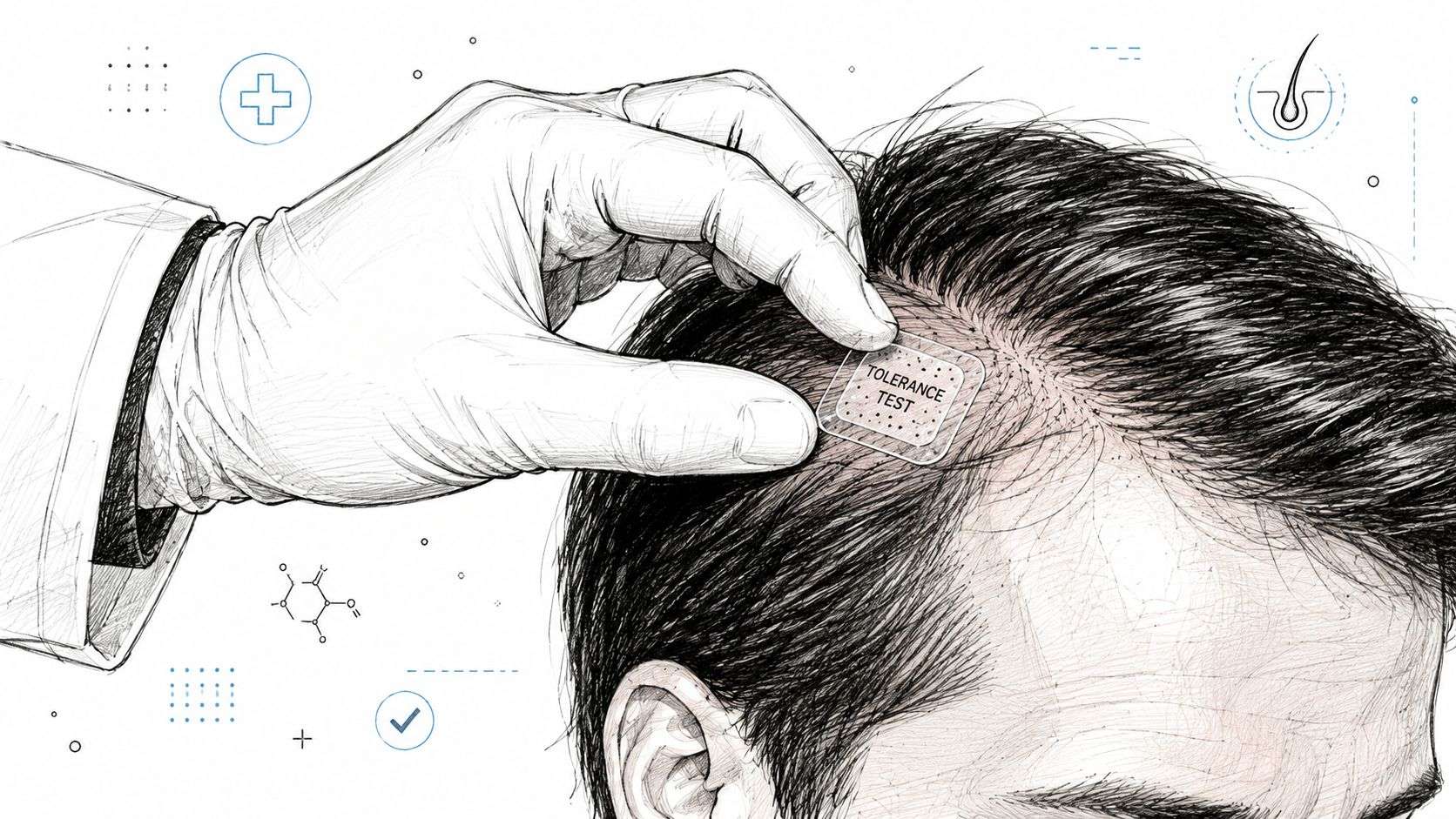
It starts with a test patch
Before any larger session, a small number of fibers are placed in the scalp and observed over time. The purpose is simple. The provider is checking whether the tissue shows irritation, poor retention, inflammation, or another sign that the scalp is not handling the material well.
From a clinical perspective, that step matters. A procedure that requires a tolerance test is acknowledging a real possibility of foreign-body reaction from the start.
The full procedure is usually done under local anesthesia
If the test area remains acceptable, the patient returns for a larger session. The scalp is cleaned, the pattern is mapped, and local anesthetic is used to numb the area. The provider then implants the fibers individually across the thinning zone.
That sounds straightforward, but it is still a repetitive implantation procedure involving many separate entry points in scalp tissue. In medicine, repeated puncture and placement of foreign material always deserves careful risk discussion. Patients who have read about foreign-material injection complications such as granulomas and nerve injury usually understand this principle quickly, even though the body area and technique are different.
What the appointment generally involves
Most sessions follow the same sequence:
- Scalp mapping and cleansing: The treatment area is outlined and prepared.
- Numbing the scalp: Local anesthesia is used for comfort.
- Individual fiber placement: Synthetic strands are inserted one by one.
- Immediate cosmetic coverage: The visual change is seen right away.
- Follow-up checks: The scalp is monitored for irritation, shedding, or poor acceptance.
The trade-off is clear. You can get instant visible density, but you are not getting living hair growth. You are getting cosmetic coverage that may require surveillance, maintenance, and sometimes removal if the scalp does not tolerate it well.
That distinction is especially important in the United States. For patients in my practice who are not good transplant candidates because donor hair is limited, I do not view artificial implantation as a simple substitute. I treat it as a higher-risk foreign-body procedure, which is why the conversation often shifts toward non-surgical regenerative options that aim to support scalp health without adding synthetic fibers.
Safety Risks and the FDA Ban
A patient with very limited donor hair can feel cornered. The promise of instant scalp coverage is attractive. In the United States, though, artificial hair implantation has to be judged against one hard fact. The FDA banned synthetic hair fibers in 1983 because of safety concerns, including infection and foreign-body reactions, as summarized in this review of synthetic hair transplant safety and FDA status.
That history still shapes the risk discussion today.
Patients often ask whether newer fibers solve the old problem. Sometimes the materials are different. The core issue is not. A synthetic strand anchored into the scalp is still foreign material, and the body may respond to it the same way it responds to other implanted substances. In practice, that can mean ongoing irritation, visible inflammation, poor retention, repeated maintenance, or removal.
The medical concern is broader than simple shedding. What matters is how the scalp tolerates the implant over time.
The risks patients need to understand
Complications reported with artificial hair implantation include:
- Infection: Each insertion site creates an opening in the scalp, and infected follicles or deeper scalp infections can be difficult to settle if the material remains in place.
- Extrusion: The body can push synthetic fibers back out, which reduces density and may trigger repeated re-implantation.
- Foreign-body reaction: Some patients develop persistent redness, tenderness, itching, or inflammatory nodules around the fibers.
- Scarring and scalp injury: Chronic inflammation can damage the local tissue and make future restoration planning harder.
- Maintenance burden: Even when the early cosmetic result looks acceptable, the patient may still face ongoing follow-up, loss of fibers, and periodic replacement.
I discuss artificial implants with the same caution I use for any elective procedure that leaves foreign material in tissue. Patients who want a broader example of how implanted or injected material can trigger lasting inflammatory problems can review these foreign-material injection complication risks. The anatomy is different, but the clinical lesson is similar. Once the body starts reacting to a foreign substance, treatment becomes more complicated.
Why the U.S. ban matters more than overseas availability
Some clinics outside the United States still offer synthetic hair implantation. That does not make it low risk. It means another regulatory system made a different decision.
For a U.S. patient, the FDA ban should not be treated as an outdated technical detail. It is a warning about the nature of the procedure itself. Artificial implants do not create living hair growth. They place permanent or semi-permanent synthetic material into a sensitive, visible area that can react unpredictably.
That distinction matters most for patients with little or no donor hair. They are often the people most tempted by artificial fibers, and they are also the people who need the most careful counseling. In my view, that situation calls for honesty. If the scalp is already fragile, inflamed, scarred, or medically complex, adding synthetic fibers may create a bigger problem than the thinning hair that brought the patient in.
A cosmetic result on day one is not the same as a safe long-term plan.
Implants vs Transplants A Critical Comparison
Patients often use the words “implant” and “transplant” as if they mean the same thing. They don't. One uses synthetic material. The other uses your own follicles.
That biological difference affects almost every practical outcome, from safety to maintenance to long-term planning.
The most important distinction
A standard hair transplant relies on autologous tissue, meaning your own hair is moved from a donor area to a thinning area. Artificial implants don't relocate living tissue at all. They place a synthetic strand where hair is missing.
Globally, patients still overwhelmingly pursue procedures built around their own hair. The hair transplant industry was valued at over $9 billion in 2025, with the market dominated by autologous procedures, according to Vera Clinic hair transplant statistics and global market data. That same source notes the average U.S. cost per graft is $5.44, while overseas options such as Turkey can be 70% to 80% cheaper, which explains why patients can feel pulled in many directions when comparing solutions.
Artificial Implants vs Traditional Transplants
| Feature | Artificial Hair Implants | Autologous Hair Transplant (FUE/FUT) |
|---|---|---|
| Source material | Synthetic fiber | Your own follicles |
| Biological activity | Does not grow | Grows as living hair |
| Purpose | Cosmetic coverage | Biological restoration |
| Maintenance | Ongoing replacement may be needed | Long-term plan is typically more stable |
| Safety profile | Risk of foreign body reaction | Uses your own tissue |
| Best fit | Very narrow, controversial use | Established option when donor supply is adequate |
What patients usually miss
The attraction of implants is easy to understand. They offer immediate visual density and don't require a donor harvest. But those advantages come with major compromises.
A transplant asks one difficult question up front: do you have enough suitable donor hair? An artificial implant skips that question and substitutes a different one: how well will your scalp tolerate a foreign object over time?
Bottom line: A transplant works with scalp biology. An artificial implant tries to work around it.
For patients with strong donor supply, the medical preference is clear. For patients with weak donor supply, the answer shouldn't automatically become synthetic implantation. That's where non-surgical and regenerative paths deserve serious attention.
Safer Alternatives Non-Surgical Regenerative Solutions
A common DFW consultation goes like this: the patient has visible thinning, donor hair is limited, and they are worried they have run out of legitimate options. That is the moment when artificial fibers can sound appealing. It is also the moment when good medical judgment matters most.
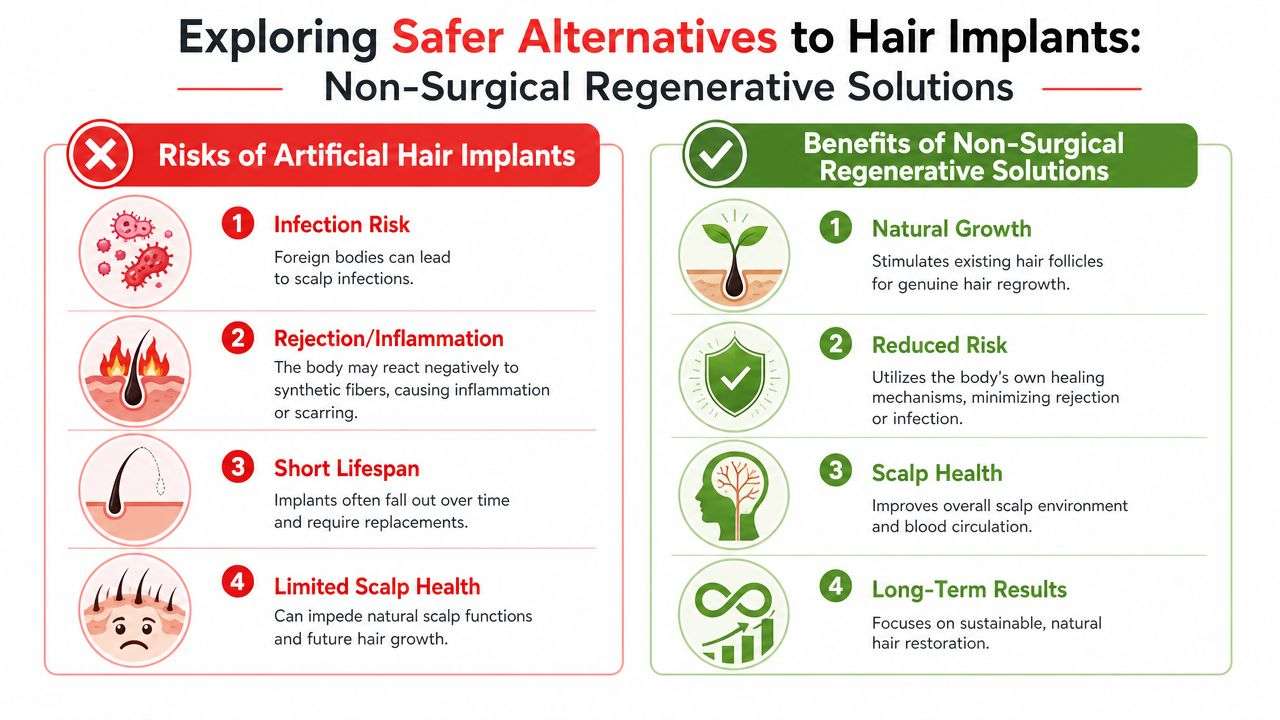
Patients with weak donor supply still have safer ways to improve appearance and support scalp health. In the U.S., I would rather build a plan around preserving the scalp than place a controversial synthetic material into it, especially when the procedure carries a long history of concern and is not FDA approved here.
What makes regenerative care different
Regenerative care aims to support the follicles you still have and improve the condition of the scalp itself. That is a very different goal from creating cosmetic density with implanted synthetic strands.
In practice, the options may include:
- Scalp-focused regenerative protocols: Used to support follicle function and improve the local scalp environment.
- Low-level laser therapy: A non-surgical option that may help appropriate candidates as part of a broader treatment plan.
- Scalp micropigmentation: A cosmetic way to create the look of density without placing fibers under the skin.
- Medical camouflage: Useful when a patient wants immediate visual improvement while deciding on longer-term care.
No single option fits every patient. That is the trade-off. Regenerative treatments can be slower and more gradual than a cosmetic implant procedure, but they avoid introducing a foreign body into the scalp. For many poor transplant candidates, that is the safer compromise.
Why this matters for the no-donor-hair patient
Patients with little or no usable donor hair often feel cornered. I take the opposite approach. First, define the goal clearly.
If the priority is better coverage, camouflage and scalp micropigmentation may help. If the priority is supporting miniaturizing follicles, regenerative treatment may be reasonable. If follicles are absent in an area, honest counseling matters, because no non-surgical treatment can recreate living hair where follicles no longer exist.
That clarity protects patients from chasing the wrong procedure out of frustration.
A more sensible decision path
A practical plan usually starts with four questions:
- What is happening in the scalp? Miniaturized follicles, scarring, and complete follicle loss call for different strategies.
- Is any donor hair still usable? Limited donor supply does not always rule out every surgical option, but it does change the plan.
- Is the main goal biological improvement or cosmetic coverage? Those are different problems and should be treated that way.
- Will this choice preserve future options? Scalp health matters, especially in a patient who may need ongoing treatment.
Patients who want to explore non-surgical options in more detail may find this discussion of peptide-based hair loss approaches helpful. Daily care also matters, and these tips for healthier hair can support better habits while a treatment plan is being built.
Your Hair Restoration FAQs Answered
Am I a candidate for any hair restoration procedure
Probably, but the right option depends on the cause of your thinning, the condition of your scalp, and whether you still have usable donor hair. Some patients are better suited for a transplant. Others are stronger candidates for non-surgical care, camouflage, or regenerative treatment. Artificial hair implants are not the default answer for a poor transplant candidate in the U.S.
Are artificial hair implants ever a good option in the United States
From a U.S. medical perspective, the FDA ban should carry real weight in your decision-making. If a treatment has a history of infection, rejection concerns, and ongoing failure risk, that's not where I'd want a patient to start when safer alternatives exist.
What about cost
Costs vary widely across hair restoration, and comparing sticker prices alone can be misleading. A lower upfront number doesn't help if the option creates ongoing maintenance or future scalp problems. The better comparison is value relative to safety, durability, and whether the approach preserves future choices.
How do I choose the right clinic in DFW
Look for a clinic that does three things well:
- Explains candidacy clearly: You should hear why you are or aren't a fit for each option.
- Prioritizes scalp health: Long-term tissue preservation matters.
- Offers conservative guidance: A good clinic won't push the most dramatic procedure just because you're frustrated.
It also helps to keep your expectations grounded with practical self-care. For readers who want supportive day-to-day guidance alongside medical evaluation, tips for healthier hair can be a useful companion resource.
If you're in Dallas-Fort Worth and feel stuck between “not enough donor hair” and “risky implant marketing,” the best next step is a consultation built around diagnosis first, not sales first.
If you want a medically guided, non-surgical conversation about hair restoration, Sexual Wellness Centers of America offers regenerative wellness care in Colleyville, including REGENhair™ for adults seeking safer options than artificial hair implants. A consultation can help clarify whether your scalp is best served by regenerative treatment, cosmetic support, or another personalized plan that protects long-term scalp health.