
A lot of men assume aspirin should help erections because erections depend on blood flow, and aspirin affects circulation. That sounds logical. It's also exactly where people get into trouble.
The answer to the aspirin erectile dysfunction question isn't a clean yes or no. The research is conflicted, the mechanism cuts both ways, and self-prescribing a blood-thinning medication for a sexual problem can distract from the bigger issue: erectile dysfunction is often a symptom, not the disease itself. If you try to “hack” the problem with aspirin, you may miss a vascular, hormonal, metabolic, or tissue-level cause that needs proper diagnosis.
That's why I don't advise patients to treat aspirin like an over-the-counter erectile aid. Before anyone experiments, it helps to understand what aspirin may do, what it may interfere with, and why a broader review of conditions that may contribute to erectile dysfunction matters more than internet shortcuts.
Table of Contents
- The Aspirin and ED Question
- How Aspirin Interacts with Erectile Function
- Decoding the Conflicting Evidence on Aspirin for ED
- Weighing Potential Benefits Against Serious Risks
- When to Consult a Clinician About Erectile Dysfunction
- Moving Beyond Pills A Modern Approach to Reversing ED
The Aspirin and ED Question
Men usually ask this in a very practical way: “If aspirin helps the heart and blood vessels, could it help erections too?” It's a reasonable question because many cases of ED involve blood flow problems. But reasonable isn't the same thing as medically sound.
The challenge is that aspirin sits in a gray zone here. Some findings suggest it may help certain men with vasculogenic ED, which means erectile dysfunction tied to blood vessel problems. Other findings point the other way and raise concern that aspirin use may be linked with worse erectile outcomes in some settings.
Why the simple answer fails
Aspirin is not an approved standalone treatment for erectile dysfunction. There's also no established dose that clinicians use specifically for ED, and no accepted protocol for men who are already taking aspirin for heart-related reasons and wondering whether it will help or hurt sexual performance.
That uncertainty matters. When the evidence is divided, self-treatment becomes a gamble, not a plan.
Practical rule: If a medication has unclear benefit for ED and known medical risks, it shouldn't be your first experiment at home.
What patients often miss
ED can be the first visible sign of a broader health problem. A man may focus on erections because that's what he notices, while the actual driver may be vascular disease, diabetes, hormone imbalance, medication effects, nerve dysfunction, sleep issues, or tissue changes in the penis itself.
Aspirin doesn't sort any of that out. It doesn't tell you whether the problem is poor arterial inflow, low testosterone, venous leak, inflammation, medication side effects, or a combination of factors.
That's why the aspirin erectile dysfunction discussion needs to stay grounded in clinical reality. The question isn't only “Could aspirin help?” The better question is “What is causing the ED, and is aspirin addressing that cause or just adding risk?”
How Aspirin Interacts with Erectile Function
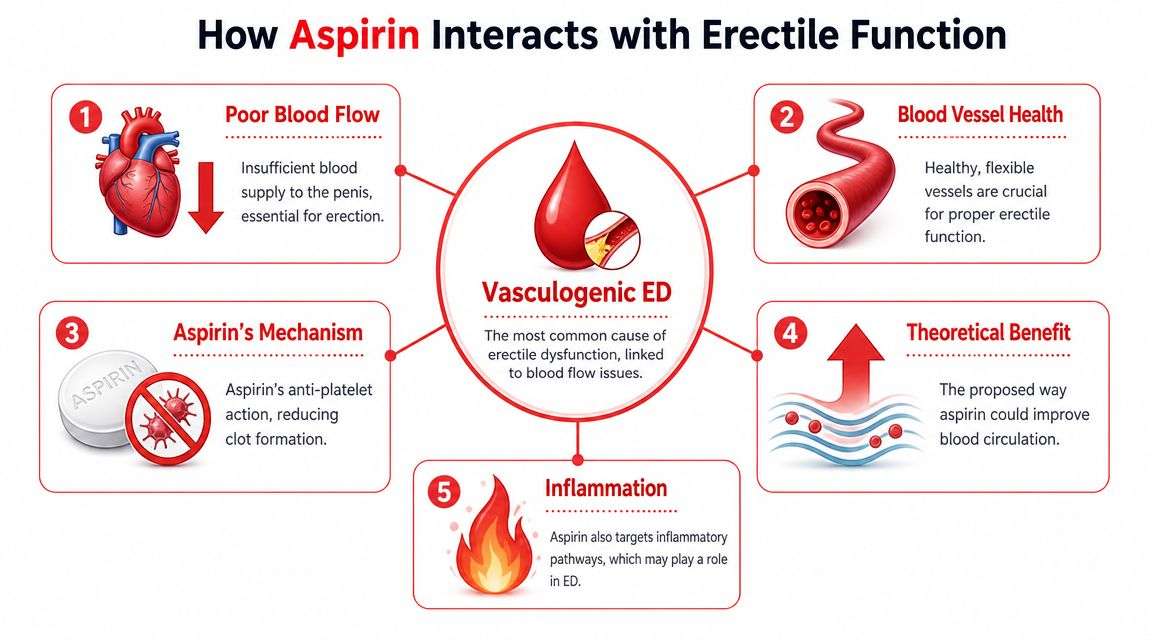
To understand why the science is mixed, you have to start with the biology. An erection depends on healthy blood vessels, good nerve signaling, responsive smooth muscle, and penile tissue that can trap blood effectively. If one part of that sequence underperforms, erections become weaker, less reliable, or harder to maintain.
The blood flow theory
Think of penile circulation like water moving through small, flexible pipes. When the lining of those vessels becomes unhealthy, or when blood components become too “sticky,” flow isn't as smooth. In men with vasculogenic ED, that reduced flow can make it difficult to create enough pressure inside the erectile tissue for a firm erection.
Aspirin is relevant because it affects inflammation and platelet activity. In plain language, it reduces the tendency of platelets to clump together, which is one reason it has a role in some cardiovascular settings.
If ED is being driven partly by vascular inflammation or platelet-related blood flow impairment, you can see why some researchers have considered aspirin a possible adjunct. That theory isn't irrational.
The double-edged mechanism
The problem is that aspirin doesn't only do one thing. It works by inhibiting the cyclooxygenase pathway, and while that reduces platelet aggregation, it also lowers vasodilatory prostaglandins that help the corpus cavernosum relax for an erection, as described in this Scientific Reports discussion of aspirin's COX pathway effects on erectile physiology.
That means aspirin may support one side of vascular health while undermining another part of erection biology.
Here's the clinical takeaway:
- Possible upside: Reduced platelet aggregation may improve flow in some vascular scenarios.
- Possible downside: Reduced prostaglandins may interfere with the tissue relaxation required for erection.
- Unresolved issue: A man's actual response may depend on the dominant cause of his ED, not on aspirin alone.
The same medication can look helpful in a simplified theory and disappointing in a real patient.
Why mechanism alone isn't enough
Many online explanations go off track. They stop at “aspirin improves blood flow,” which is incomplete. Erections are not just about thinner blood moving through open tubes. They depend on coordinated vascular relaxation, tissue compliance, nerve input, hormonal support, and the ability to retain blood once it arrives.
Aspirin doesn't reliably optimize that whole system.
So while the aspirin erectile dysfunction idea has a biological rationale, it also has a biological reason for caution. That's why treatment decisions should come from diagnosis, not from a single theory about circulation.
Decoding the Conflicting Evidence on Aspirin for ED
When patients ask whether aspirin helps ED, they deserve a balanced answer. The published evidence doesn't move in one direction.
What supports aspirin use
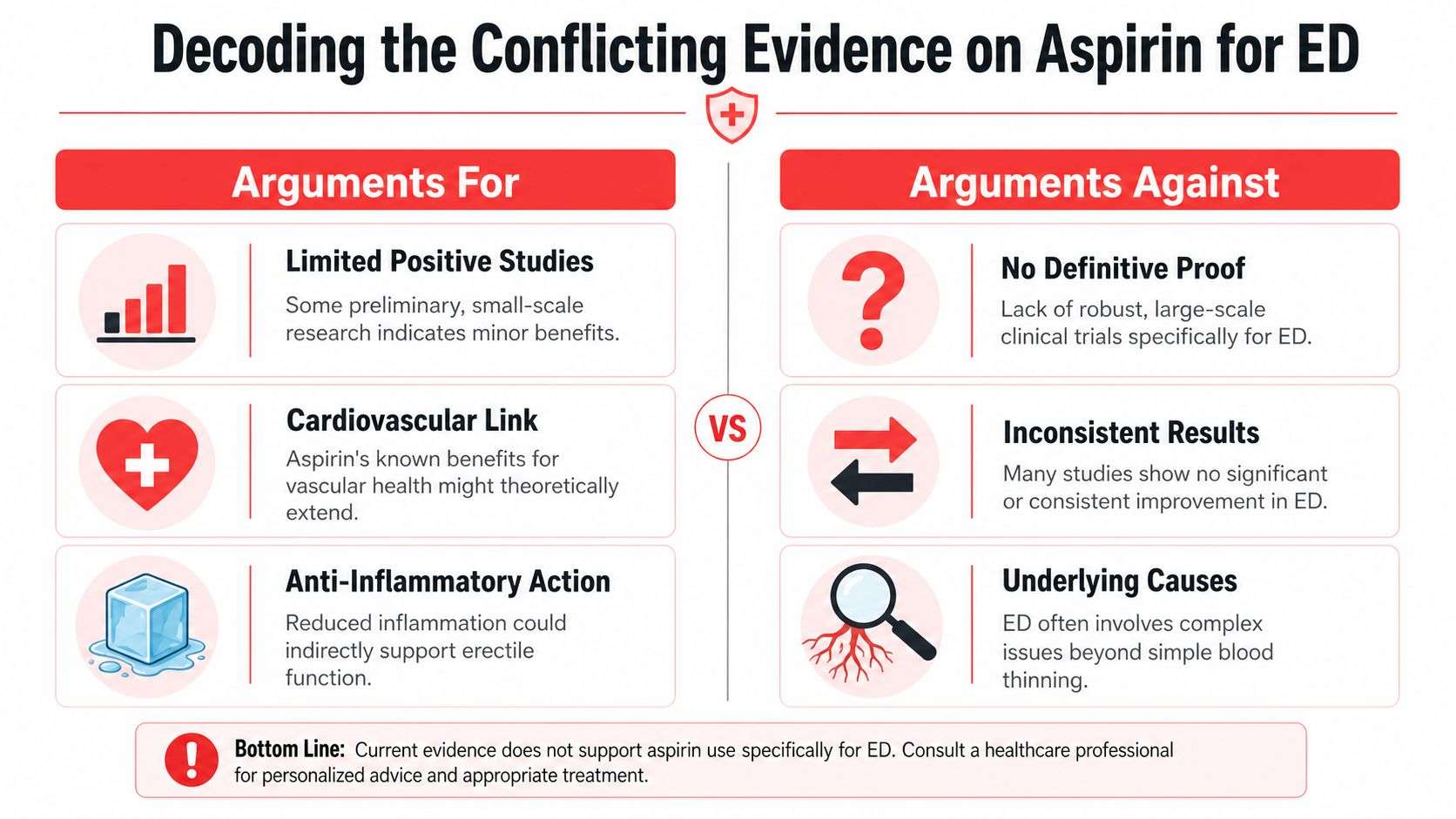
There is a real signal in the literature suggesting benefit in a narrow context. A meta-analysis of 214 men with vasculogenic ED found that aspirin taken for 6 weeks produced a mean improvement of 5.14 points on the IIEF scale, with 95% CI [3.89, 6.40] and I² = 0%, based on two randomized controlled trials, according to this PubMed-indexed meta-analysis on aspirin supplementation in vasculogenic erectile dysfunction.
That sounds promising. It suggests aspirin may have value as an adjunct in selected men whose erectile dysfunction is tied to vascular insufficiency, inflammation, or platelet-related issues.
But the enthusiasm has to stop there. The same analysis noted limited trial quality, high selection bias in one trial, and variable aspirin dosages. In other words, the result is interesting, not definitive.
What argues against aspirin use
A very different signal appears in genetic and population-level research. A two-sample Mendelian randomization study in European populations suggested a potential causal association between genetically inferred aspirin use and increased ED risk, with an inverse variance weighted odds ratio of 20.896 (95% CI = 2.077–210.2, P = 0.010), as reported in this Frontiers in Endocrinology review of aspirin and erectile dysfunction evidence.
That doesn't mean every man who takes aspirin will develop ED. It does mean the state of research is not remotely settled.
The same body of discussion also notes that larger population studies have suggested regular aspirin use could increase erectile dysfunction risk, and that no officially approved dosage exists for treating ED. A separate animal study in aging rats found no measurable benefit for erectile function, which adds more uncertainty rather than resolving it.
Why the science is split
The disagreement in the data makes sense if you look at the condition itself. ED is not one disease. It is a final common symptom produced by different problems.
Aspirin might plausibly help a subset of men with one specific vascular pattern. It might be neutral in others. It may even worsen function where prostaglandin reduction matters more than antiplatelet effects.
That's why broad advice fails. It also explains why many men do better when they stop chasing isolated remedies and get a proper workup, especially if they've already tried how erectile dysfunction treatment pills actually work and still don't have consistent results.
| Evidence direction | What it suggests | Main limitation |
|---|---|---|
| Positive trial signal | Aspirin may improve erectile scores in some men with vasculogenic ED | Very limited number of high-quality trials |
| Genetic and population concern | Aspirin use may be associated with increased ED risk in some contexts | Association and causality remain complex |
| Mechanistic data | Aspirin affects both platelet activity and erection-related prostaglandins | Biology supports both benefit and harm |
If one study suggests benefit and another suggests risk, the right response isn't blind optimism. It's better diagnosis.
Weighing Potential Benefits Against Serious Risks
Aspirin is often treated casually because it's familiar. That familiarity can be misleading.
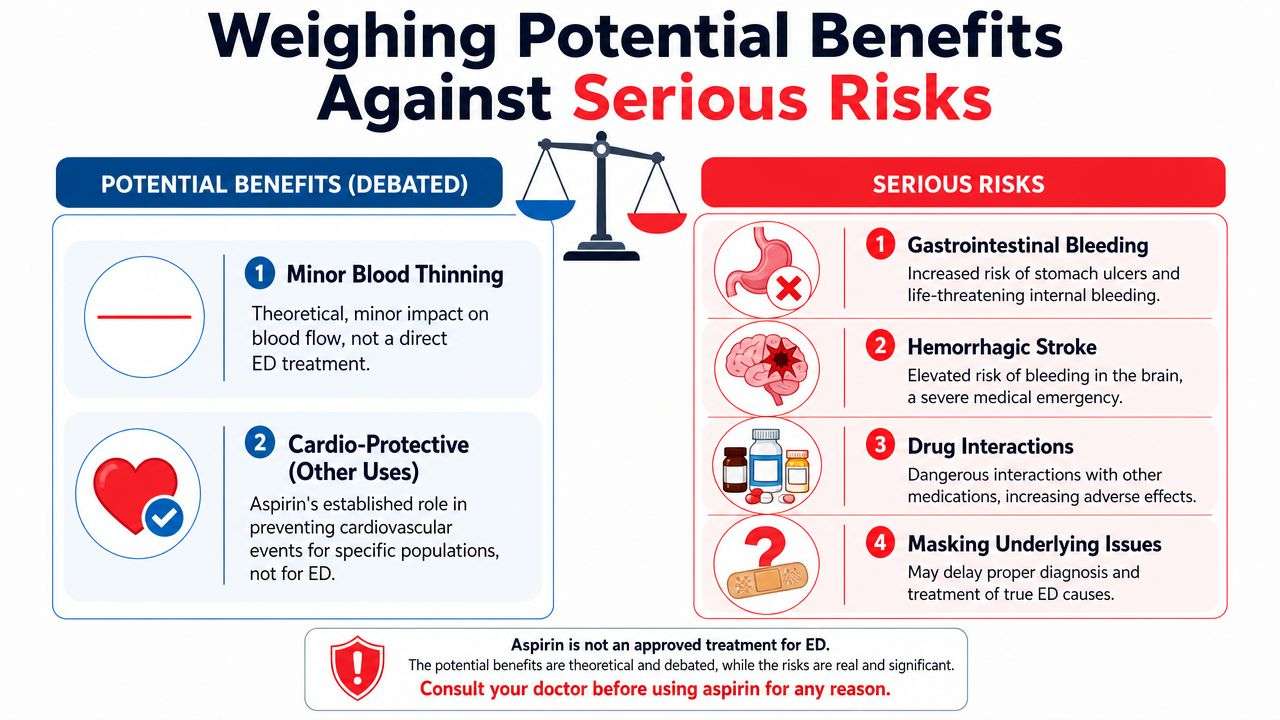
For ED, the proposed upside is debated. The medical risks of aspirin are not. If a man starts taking it mainly because he hopes it will improve erections, he is accepting real downside for an unproven sexual benefit.
The common low-dose aspirin scenario
This comes up all the time in clinic. A man is already taking baby aspirin for cardiovascular reasons, or he's thinking about starting because he assumes it might protect both heart health and sexual performance.
The problem is that the ED-specific guidance isn't there. A review discussing this exact question noted that many men with cardiovascular disease wonder whether daily low-dose aspirin helps or worsens ED, that evidence is mixed, that some studies show daily NSAID or aspirin use raises ED risk by 22%, and that no guidelines specify a safe daily dose threshold for ED patients, as summarized in this review focused on low-dose aspirin, cardiovascular disease, and erectile dysfunction uncertainty.
That's the core safety issue. Men want a clear answer on low-dose aspirin and ED, but medicine doesn't currently have one.
What the trade-off looks like in practice
If the benefit were strong and predictable, clinicians could weigh risk against reward. But with aspirin for ED, the reward remains uncertain.
A practical way to understand this:
- If you take aspirin for a heart-related reason prescribed by your clinician, that's a separate medical decision.
- If you're taking aspirin mainly to improve erections, you're stepping into an area with mixed evidence and no ED-specific dosing standard.
- If you haven't had an ED evaluation, aspirin may delay the diagnosis of a more important problem.
Known minor issues versus major concerns
In the positive aspirin trials, adverse events such as dyspepsia, abdominal burning, and constipation were reported, though they occurred at similar frequencies in treatment and placebo groups in the limited available studies. That's useful to know, but it shouldn't reassure anyone into casual self-treatment.
The larger concern is that aspirin is not a benign sexual wellness supplement. It alters clotting and can create serious consequences in the wrong patient, especially if that patient is older, has a bleeding risk, or combines aspirin with other medications that increase complications.
Taking aspirin for ED without medical guidance can turn a frustrating symptom into a preventable medication problem.
Why caution is the more rational choice
If a treatment offers uncertain erectile benefit, no established ED dosing strategy, and the possibility that regular use may worsen the problem in some men, caution isn't overreaction. It's good medicine.
For most patients, the smarter move is to stop asking whether aspirin might be a shortcut and start asking what the ED is trying to reveal.
When to Consult a Clinician About Erectile Dysfunction
The biggest mistake I see is treating ED like a stand-alone bedroom problem. It often is not.
An erection depends on blood flow, nerve function, hormones, tissue health, medication effects, sleep, stress, and metabolic health all working well enough at the same time. Once erections become less reliable, the question is no longer whether to try another home fix. The question is what changed, and whether that change points to a problem that deserves medical attention.
Signs the issue needs medical review
Schedule an evaluation if the problem persists for more than a few weeks, appears suddenly, keeps getting worse, or starts to affect confidence and intimacy in a consistent way. Do the same if ED shows up with fatigue, lower libido, urinary symptoms, penile curvature, pelvic pain, diabetes, high blood pressure, or chest pain with exertion.
Medication timing matters too. If erections changed after starting or adjusting a blood pressure drug, antidepressant, hormone therapy, or another prescription, that pattern can be clinically useful. Patients often blame stress first. Sometimes stress is part of the story. Just as often, it is covering up a vascular, hormonal, neurologic, or medication-related issue.
A proper review usually looks at several categories:
- Hormonal function: Low testosterone and other endocrine problems can affect desire, energy, and erection quality.
- Blood flow: Arterial disease and endothelial dysfunction can limit penile inflow.
- Nerve signaling: Neuropathy, spinal issues, or pelvic nerve injury can interfere with the erectile response.
- Penile tissue health: Structural change, scarring, and loss of tissue responsiveness can reduce rigidity and durability.
Why guessing delays useful treatment
Aspirin is a good example of why self-treatment goes sideways. The evidence is mixed, the right patient is unclear, and the wrong patient can end up with side effects or a missed diagnosis. Trying aspirin on your own does not clarify whether the underlying issue is low testosterone, impaired circulation, medication side effects, early cardiovascular disease, or declining penile tissue function.
That uncertainty is exactly why a clinician-led evaluation has more value than another trial-and-error experiment.
A temporary erection change is a symptom. Treating it blindly can postpone the diagnosis that actually matters.
What a real evaluation can uncover
A useful ED visit is more than a prescription request. It may include a focused sexual and medical history, medication review, physical exam, lab testing, and, when appropriate, a closer look at penile blood flow or tissue quality.
That level of evaluation changes the treatment plan. A man with hormone deficiency needs a different approach from a man with diabetes-related vascular disease. A man with medication-induced ED needs a different plan from someone with Peyronie's disease, pelvic floor dysfunction, or reduced penile blood flow.
For some men, the next step is standard medical management. For others, it makes sense to look at options that target vascular and tissue-level function more directly, including shockwave therapy for ED and what the studies show. The right choice depends on cause, severity, overall health, and treatment goals.
That is the advantage of getting evaluated early. You stop guessing and start treating the problem you have.
Moving Beyond Pills A Modern Approach to Reversing ED
Pills and improvised medication use focus on short-term performance. They don't necessarily improve the health of the tissue that has to produce and maintain the erection.
That's why more men are interested in approaches that go beyond temporary support. Instead of asking how to squeeze a response out of underperforming tissue, a modern strategy asks whether the tissue, blood vessels, and biologic environment can be improved in the first place.

Why single-mechanism solutions often fall short
Aspirin is a perfect example of a narrow intervention. Even if it helps one piece of the puzzle, it doesn't rebuild tissue, correct hormonal imbalance, improve penile responsiveness across multiple pathways, or reverse deeper vascular decline.
That limitation isn't unique to aspirin. It applies to many ED strategies that target only one mechanism.
A more complete model often looks at several layers at once:
- Penile blood flow
- Tissue quality and regenerative capacity
- Hormonal status
- Inflammatory and metabolic contributors
- Treatment response over time
What regenerative treatment is trying to do
Regenerative protocols aim to improve function by supporting tissue repair and vascular performance rather than only creating a temporary effect for one encounter. In practice, that may involve combinations of acoustic wave therapy, laser-based tissue support, biologic injections, and broader optimization based on labs and exam findings.
For men who want a better understanding of one component of this approach, this review of shockwave therapy for ED success and what the studies show gives helpful context on why blood-flow-focused regenerative care has drawn attention.
This type of care doesn't replace diagnosis. It depends on diagnosis. The treatment plan only makes sense after the clinician understands why the erections have declined.
Where this approach differs from aspirin
The strongest argument against using aspirin as an ED strategy is not just that the evidence is mixed. It's that aspirin is disconnected from the complexity of the condition.
By contrast, multi-modal regenerative care is built around complexity. According to this overview of the REGENmax® protocol and its internal clinical results, these protocols work at the cellular level to rebuild tissue and restore vascular function, and internal clinical data has shown a 97.2% success rate in helping men regain erectile function.
That kind of approach makes more sense for men who are tired of temporary fixes, mixed signals, and trial-and-error with medications that were never designed to solve the whole problem.
The best ED treatment isn't the one that sounds convenient. It's the one that matches the cause.
If your erections have become less reliable, less firm, or less spontaneous, don't reduce the problem to an aspirin experiment. Get a workup. Find the drivers. Then choose a treatment plan that is designed around actual physiology, not wishful thinking.
If you want a thorough, medically guided evaluation of erectile dysfunction and want to explore whether regenerative treatment may be appropriate, schedule a consultation with Sexual Wellness Centers of America. Their clinic focuses on adult sexual health and non-surgical treatment options that address vascular function, tissue health, hormones, and performance from a root-cause perspective.