
If you're reading this with a coffee cup nearby and a quiet worry in the back of your mind, you're not alone. A lot of men search for answers after noticing weaker erections, less consistency, or a drop in confidence. Then they see mixed headlines. One article says coffee helps. Another says it doesn't matter. A third makes it sound like caffeine is either the problem or the fix.
That confusion is understandable. Erectile function is tied to blood flow, hormones, sleep, stress, medications, and underlying health conditions. Coffee sits in the middle of that conversation because it affects several of those systems at once. The result is a messy online debate that often leaves out the most important question: can coffee change erectile dysfunction in a meaningful way?
The short answer is nuanced. Moderate coffee intake may be associated with lower odds of erectile dysfunction in some observational research. But newer genetic evidence does not support coffee or caffeine as a causal prevention or treatment strategy. That distinction matters if you already have symptoms and want something that is effective.
Table of Contents
- Your Morning Coffee and Your Nightly Performance
- The Case for Coffee Benefits in ED Prevention
- Why Coffee Is Not a Cure for Erectile Dysfunction
- Potential Risks and Negative Effects of Caffeine
- Practical Takeaways What This Means for You
- When Coffee Isnt the Answer Moving Beyond Lifestyle Tweaks
Your Morning Coffee and Your Nightly Performance
A common scenario goes like this. A man feels fine for years with his usual morning routine, then erections start becoming less reliable. He doesn't know whether to blame stress, age, sleep, blood pressure, low testosterone, relationship strain, or the extra coffee he's been drinking to get through the day.
That question makes sense because coffee affects the body in ways that seem relevant to sexual performance. It can change alertness, heart rate, sleep quality, anxiety, and vascular tone. Those are real physiological effects, so it's reasonable to ask whether your daily habit is helping, hurting, or doing very little at all.
The online advice is where things usually go off track. Many articles oversimplify the topic into a catchy headline. They either frame coffee as a sexual health booster or treat caffeine as the hidden reason erections are failing. In practice, coffee erectile dysfunction discussions are rarely that simple.
What patients usually want to know
Most men aren't asking for an academic debate. They want direct answers to practical questions:
- Is my morning coffee making ED worse? Sometimes heavy intake can worsen sleep, jitters, and overall sexual function, but coffee isn't the main cause in most persistent cases.
- Can a few cups help blood flow? Possibly in a limited, indirect way for some men, but that's not the same as treatment.
- Should I stop caffeine completely? Not always. The better question is whether your current intake is creating side effects that undermine erections.
- Can I use coffee instead of ED treatment? No. That's where many articles drift away from reality.
Many men lose time chasing small lifestyle explanations for a problem that actually needs a medical workup.
What matters most is context. If you have stable erections, coffee may not be a problem at all. If you have occasional performance issues tied to fatigue or stress, caffeine might play a minor role. If you have ongoing ED, the coffee itself is often a distraction from the bigger issue.
The Case for Coffee Benefits in ED Prevention
There's a reason this topic keeps resurfacing. The theory behind coffee and erectile function isn't random. It comes from plausible biology and from earlier observational findings that suggested a possible benefit.
Why researchers thought coffee might help
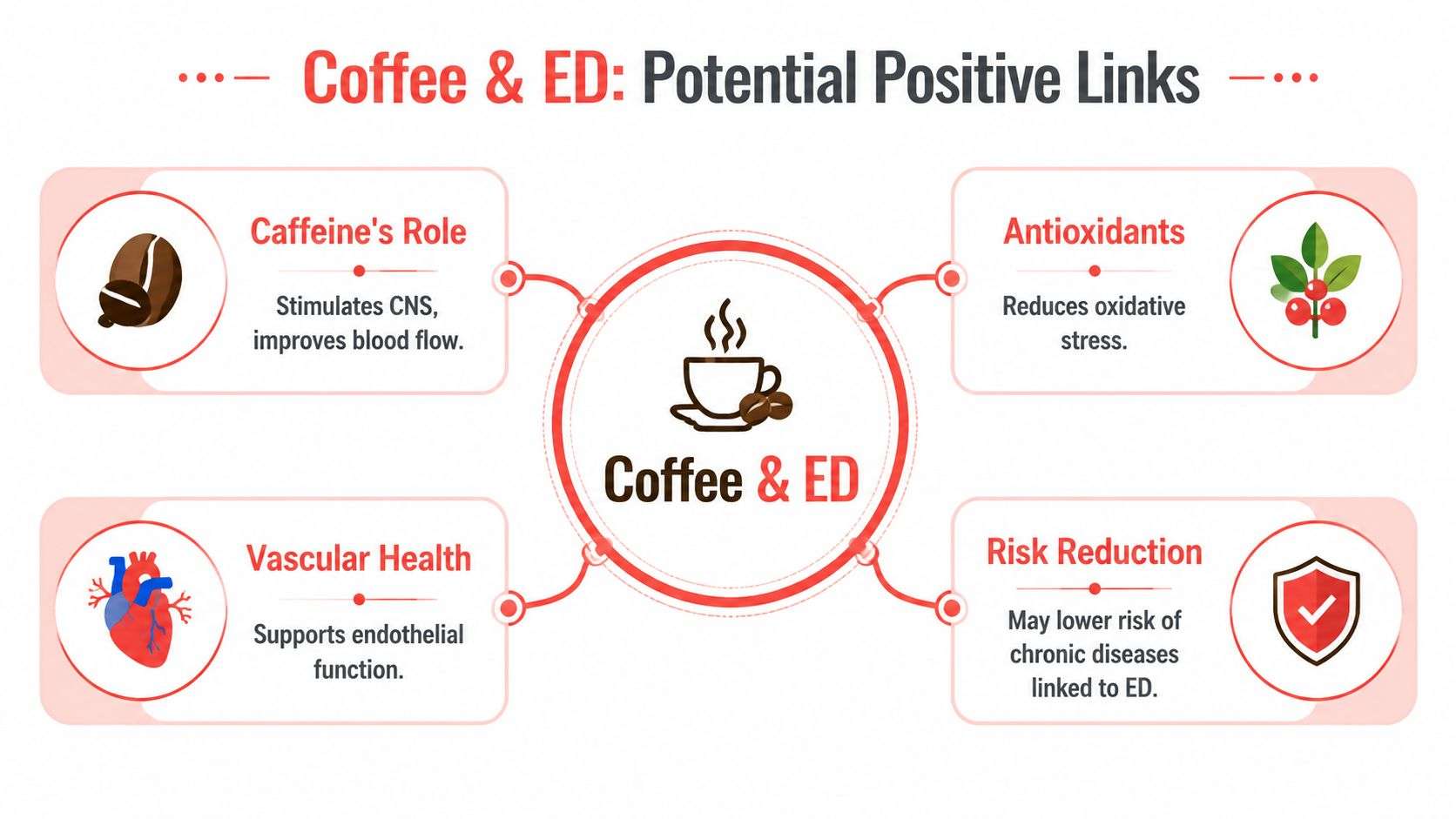
An erection depends on adequate blood flow and healthy vessel function. That's why researchers looked at caffeine and coffee through a vascular lens. If blood vessels are underperforming, erections often are too.
One way to think about it is a garden hose. If flow is restricted, the output weakens. If the system opens more effectively, flow improves. Coffee has been discussed in this context because caffeine stimulates the central nervous system and may influence vascular dynamics, while coffee itself also contains antioxidant compounds that researchers believe could support endothelial function.
That doesn't make coffee a therapy. It does explain why the idea gained traction.
For men interested in broader lifestyle support, there are also nonprescription approaches worth reviewing alongside diet, exercise, sleep, and weight management. This overview of natural remedies for erectile dysfunction is useful as long as it's read with the right expectation. Supportive habits can help overall health, but they don't replace diagnosis when symptoms persist.
What the observational data actually showed
The strongest argument in favor of coffee comes from a nationally representative study of U.S. men. In that analysis, intake equivalent to approximately 2 to 3 daily cups of coffee, or 170 to 375 mg/day, was associated with a reduced likelihood of reporting erectile dysfunction, according to the published study in NIH's PubMed Central.
The same study reported that men consuming 85 to 170 mg/day had an odds ratio of 0.58 for ED compared with non-consumers, and men consuming 171 to 303 mg/day had an odds ratio of 0.61. The inverse association was noted particularly among overweight or obese men, men with hypertension, and non-diabetic men, while no protective effect was observed in men with diabetes.
Clinical interpretation: If coffee has any benefit, it appears modest and context-dependent, not universal.
That last part often gets ignored. The findings weren't a blanket statement that coffee protects every man from ED. They suggested an association within a certain intake range and in certain groups. That's interesting. It's not the same thing as proof that drinking coffee will improve your erections.
Why Coffee Is Not a Cure for Erectile Dysfunction
The biggest mistake in this topic is turning an association into a treatment plan. That leap happens all the time online, and it's exactly where patients get misled.
Correlation is not causation
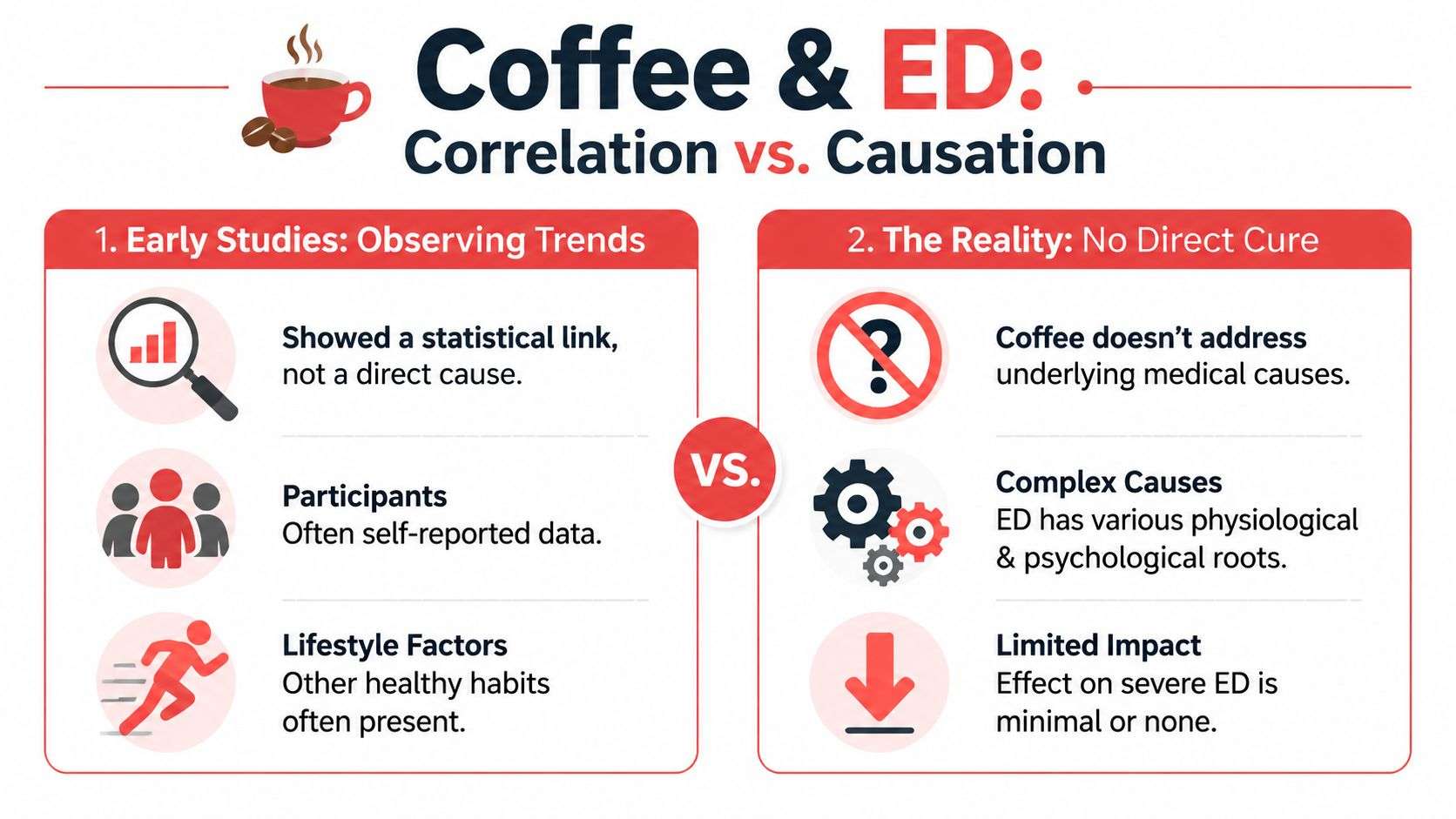
Observational studies can detect patterns. They can show that one behavior travels with one outcome. They cannot prove that the behavior caused the outcome.
That matters here because coffee drinkers may differ from non-coffee drinkers in many ways. They may have different routines, exercise habits, body composition, metabolic health, stress patterns, or medical histories. Even careful statistical adjustment can't eliminate every confounder.
A more recent approach tried to answer the causation question more directly. A 2024 Mendelian Randomization study found no causal association between coffee or caffeine consumption and erectile dysfunction risk. The paper reported an inverse odds ratio of 1.021 (95% CI: 0.843–1.238; p=0.829) for genetically predicted coffee consumption, and pooled analyses also showed no causal relationship, as described in this Frontiers in Endocrinology study.
The same source also noted a 2024 meta-analysis of four cohort studies including 51,665 adult males, which found no significant relationship between caffeine intake and ED risk, with a relative risk of 0.94 (95% CI: 0.86–1.03; p=0.999).
Why this matters if you already have ED
If you already have erectile dysfunction, coffee is not a realistic fix. It doesn't correct vascular disease. It doesn't reverse nerve injury. It doesn't restore testosterone deficiency. It doesn't resolve medication side effects, diabetic changes, pelvic floor dysfunction, or performance anxiety.
That's why “Can I just drink coffee for ED?” has to be answered clearly. No. Coffee is not an approved treatment for erectile dysfunction, and it's not a substitute for evidence-based care.
If you want to understand why medications can help some men while coffee cannot, this explanation of how erectile dysfunction treatment pills actually work is a practical place to start. Pills target a specific erection pathway. Coffee doesn't.
If your erections are failing consistently, caffeine is usually a side topic, not the main diagnosis.
Potential Risks and Negative Effects of Caffeine
The discussion gets more useful when you stop asking whether coffee is “good” or “bad” and start asking whether your current intake is creating conditions that work against sexual performance.
Where caffeine can backfire
For some men, the problem isn't a direct coffee-to-ED pathway. It's the chain reaction that follows too much stimulation. A man drinks more caffeine because he's tired. Then he sleeps worse. He becomes more anxious, more wired, and less physically settled. Sexual function often suffers in that environment.
Common real-world trouble spots include:
- Sleep disruption: Poor sleep lowers resilience, worsens mood, and often weakens libido and sexual confidence.
- Anxiety and jitteriness: Erections depend on a coordinated balance between the brain, nerves, and blood vessels. A revved-up, anxious state can interfere with that balance.
- Overreliance during stress: Men who use caffeine to push through burnout often overlook the deeper fatigue that's affecting performance both during the day and at night.
For readers who notice shakiness or overstimulation from coffee, this guide on how to manage coffee anxiety offers practical ways to reduce jitters without making the topic more complicated than it needs to be.
The hormone issue with heavy intake
One caution deserves more attention. According to the Sexual Medicine Society of North America's patient resource, excessive daily caffeine consumption above 400 mg is associated with reduced serum testosterone levels in men. That can lead to diminished libido and contribute to erectile dysfunction, especially in men who already have low testosterone.
The same source notes that this appears dose-dependent and may vary by caffeine source. It also mentions that coffee may have properties distinct from other caffeine forms, though that hasn't been confirmed in large-scale trials. Decaffeinated coffee has been linked to increased ED risk in specific studies, which suggests the relationship between coffee compounds and sexual function is more complex than a simple “caffeine helps” story.
Bottom line for heavy users: If you're consuming caffeine aggressively and your sleep, mood, or libido are slipping, cutting back is a reasonable step.
This is also where medication safety comes in. Men with cardiovascular issues, blood pressure concerns, palpitations, or stimulant sensitivity should be more careful about high intake. The same is true for men already using treatments that affect blood pressure or circulation.
Practical Takeaways What This Means for You
Most men don't need a philosophical answer to coffee erectile dysfunction. They need a clear decision framework they can use this week.
A simple way to think about coffee and erections
Use this standard:
- If you tolerate coffee well, moderate intake is probably not your main problem. It may even be associated with favorable outcomes in some observational data.
- If you're drinking a lot and feeling wired, tired, or restless, caffeine may be making things worse indirectly.
- If you have established ED, coffee is not a treatment. Don't expect it to rescue unreliable erections.
- If symptoms are persistent, evaluate the root cause instead of endlessly adjusting beverages.
A practical daily approach also helps:
- Keep intake moderate: More isn't better just because some earlier data suggested possible benefit at moderate levels.
- Watch timing: If caffeine pushes into later hours and affects sleep, your nighttime performance may pay the price.
- Notice your pattern: Better erections after coffee don't necessarily mean coffee fixed anything. Worse erections after several poor nights of sleep may say more about recovery than caffeine itself.
- Use symptoms as feedback: Jitters, racing thoughts, poorer sleep, reduced libido, and inconsistent erections are all signs to reassess.
If you want a lower-intensity option for alertness, some people prefer tea over coffee because it feels steadier for them. This guide on how to brew green tea for focus can be useful if you're trying to reduce stimulation without giving up a morning ritual.
Coffee and Erectile Function A Summary of Effects
| Potential Positive Effects (Moderate Intake) | Potential Negative Effects (Excessive Intake) |
|---|---|
| May support alertness and energy in men who are fatigued | Can worsen sleep quality, which often affects libido and erections |
| May be associated with better erectile outcomes in some observational settings | Can increase anxiety, tension, and performance pressure |
| Coffee contains compounds researchers have linked to vascular and antioxidant effects | Heavy intake may reduce testosterone in some men |
| Moderate use is often tolerated without obvious sexual side effects | Can aggravate underlying cardiovascular or stimulant-related symptoms |
The balanced takeaway is simple. Coffee can be part of a healthy routine, but it isn't a therapy for erectile dysfunction. If your sexual function is normal, there may be no reason to fear your morning cup. If your erections are declining, coffee deserves a quick review, not center stage.
When Coffee Isnt the Answer Moving Beyond Lifestyle Tweaks
When ED becomes persistent, the more important question isn't “Should I switch to decaf?” It's “What's driving this?”
Persistent ED usually points somewhere else
Ongoing erectile dysfunction commonly reflects an underlying medical issue that lifestyle tweaks alone won't solve. That may include vascular disease, hormone deficiency, medication effects, nerve-related problems, diabetes-related changes, pelvic issues, or a psychological component that's become self-reinforcing.
A lot of men spend months trying to optimize coffee, supplements, or internet advice while the actual diagnosis remains untouched. That delay matters because ED can be an early warning sign of broader health trouble.
For a closer look at common medical drivers, review these conditions that may cause erectile dysfunction. That list is often more clinically relevant than anything happening in your coffee mug.
The other point that deserves clarity is this: articles that promote coffee as an ED helper often leave out the fact that correlation doesn't imply causation and that coffee is not an approved treatment. For men with existing ED, the impact is minimal and it can't replace conventional medications or regenerative therapies that address underlying pathology, as discussed in TIME's coverage of coffee and erectile dysfunction.
When to stop experimenting and get evaluated
It's time to seek professional evaluation if any of these sound familiar:
- You're losing erection quality regularly: Not once in a while. Repeatedly.
- You still have desire but erections are unreliable: That pattern often points to a physical issue, not a coffee issue.
- You've already cleaned up sleep, stress, and lifestyle basics: If the problem remains, more self-experimentation usually has low payoff.
- You suspect a mental and physical overlap: When stress, anxiety, and body symptoms interact, broader support may help. Some men also benefit from resources that explore DeTalks' treatment resources when a psychosomatic component is in play.
Persistent ED deserves a real diagnosis and a treatment plan built around the physiology of erections, not hope pinned to a stimulant.
If coffee questions led you here, use them as a starting point, not the final answer. For men dealing with persistent erectile dysfunction, a professional evaluation can identify whether the issue is vascular, hormonal, neurologic, metabolic, or multifactorial. Sexual Wellness Centers of America provides clinic-based evaluation and non-surgical treatment options designed to address the underlying mechanisms of erectile function, including advanced regenerative protocols for men who want a more thorough path forward.