
A lot of men read about treatment late at night, after months of hoping the problem will pass on its own. They've tried to ignore it, blame stress, change the timing, or rely on willpower. By the time they search for an erectile dysfunction treatment doctor, they usually want two things at once. They want the truth, and they want hope.
That's a reasonable place to start.
Modern ED care is much broader than a pill and a shrug. A good doctor looks at blood flow, nerve function, hormone balance, medication effects, relationship stress, sleep, cardiometabolic health, and the pattern of the problem itself. Just as important, a good doctor helps you sort marketing promises from realistic outcomes. Some men do very well with simple treatment. Others need a layered plan. Some are strong candidates for regenerative therapy. Others are better served by injections, devices, or even implant referral.
The right next step isn't guessing. It's getting evaluated well.
Table of Contents
- Your Guide to Finding an ED Treatment Specialist
- Recognizing the Signs It Is Time to See a Doctor
- What to Expect at Your First ED Consultation
- A Full Survey of Modern ED Treatment Options
- Understanding Regenerative Therapies and Candidacy
- How to Choose the Right ED Doctor and Clinic for You
- Taking the Next Step Toward Renewed Confidence
Your Guide to Finding an ED Treatment Specialist
Most men don't need more vague reassurance. They need a doctor who can tell the difference between an occasional off night, a circulation problem, a hormone issue, medication side effects, performance anxiety, or a more advanced case that won't improve with a basic prescription alone.
That distinction matters because ED treatment has branches. One patient may need oral medication and a cardiovascular workup. Another may need a second-line treatment because pills don't work well enough. Another may be looking at regenerative options and needs an honest answer about candidacy rather than a sales pitch.
An experienced erectile dysfunction treatment doctor helps with three decisions at once:
- What's causing the problem: Blood flow, nerve input, hormones, stress, chronic disease, sleep, or several factors together.
- What treatment tier fits best: Pills, devices, injections, regenerative care, or surgical referral.
- What outcome is realistic: Better function, more reliable rigidity, easier maintenance, or a longer-term solution.
Some men arrive thinking they need “the newest treatment.” Others are sure they need testosterone. Many want to know whether the issue is fixable. In practice, the best consult often starts by slowing the process down and getting specific.
Practical rule: If a clinic offers a one-size-fits-all answer before asking detailed questions, keep looking.
A strong specialist doesn't treat ED as an isolated bedroom issue. ED can overlap with diabetes, vascular disease, low desire, poor sleep, anxiety, or medication effects. That's why the search for the right doctor is not just about convenience. It's about finding someone who can build a treatment path that matches your biology and your goals.
You don't need to know the solution before you book the visit. You just need a clinician who takes the problem seriously and explains your options clearly.
Recognizing the Signs It Is Time to See a Doctor
Many men wait too long because they use the wrong threshold. They assume they should only seek help if they can't get any erection at all. That's not how ED usually presents.
Often, the first signs are subtler. Erections become less firm. They don't last as long. You can get started but lose momentum. You notice a pattern instead of a one-time fluke. You stop initiating sex because you're worried about failure. That's already enough reason to schedule an appointment.
Changes that deserve attention
Watch for patterns like these:
- Reduced firmness: You're able to get an erection, but it isn't rigid enough for dependable intercourse.
- Loss of staying power: The erection fades before you want it to.
- Unpredictability: Some days are fine, others aren't, with no clear explanation.
- Lower desire plus erection trouble: This can point toward a hormone issue, stress load, or broader health problem.
- Avoidance behavior: You begin avoiding intimacy, not because you don't care, but because you don't trust the outcome.
A doctor should also know if the problem appeared suddenly or gradually. Sudden onset may point toward psychological or medication-related triggers. Gradual decline more often raises questions about vascular, metabolic, or hormonal causes.
Why this is about more than sex
ED can be an early signal that the body isn't handling blood flow, nerve signaling, or endocrine balance well. Men sometimes frame the visit as a private quality-of-life issue, but the workup often overlaps with broader health concerns.
That's especially important if you also have symptoms or history such as:
- Diabetes or blood sugar issues
- High blood pressure or vascular disease
- Fatigue, low mood, or low libido
- Medication changes
- Pelvic surgery history or neurologic symptoms
- Snoring, poor sleep, or daytime exhaustion
ED is sometimes the symptom that finally gets a man into a doctor's office. That visit can uncover much more than a sexual complaint.
Another reason not to wait is emotional spillover. Men often minimize the stress, but repeated sexual disappointment can create anticipatory anxiety, relationship tension, and a self-reinforcing cycle where fear worsens performance. That doesn't mean the problem is “all in your head.” It means the physical and psychological pieces often feed each other.
If you're wondering whether the issue is serious enough to bring up, that usually means it is.
What to Expect at Your First ED Consultation
You arrive expecting an awkward conversation and leave with a clearer map of what is likely causing the problem, which tests matter, and whether you are a candidate for pills, devices, injections, or a regenerative approach. That is what a well-run first ED visit should do.
The appointment should feel private, organized, and medically useful. It should not feel like a sales pitch for the newest treatment on the menu.
The first visit is mostly history, because the pattern matters
The first part of the consultation is usually a detailed discussion. I want to know when the problem began, whether erections are hard to get or hard to keep, whether the issue is consistent or intermittent, what your sex drive is like, and whether you still have morning, spontaneous, or situational erections.
Your doctor should also ask about diabetes, blood pressure, heart disease, prior pelvic surgery, trauma, medications, alcohol, sleep quality, stress, and relationship strain. Those details help sort out likely blood flow problems from hormone issues, medication effects, nerve involvement, or mixed causes. They also help predict which treatments are realistic.
This is also the point where a good specialist starts setting expectations. A man with mild vascular decline, preserved morning erections, and no major nerve injury may have several reasonable paths. A man with severe diabetes, prostate surgery, or poor response to repeated pill trials may still improve, but the path is often different and more stepwise.
That distinction matters. Modern ED care includes promising regenerative options, but candidacy is never one-size-fits-all.
The exam and testing should answer treatment questions
The physical exam is usually brief and direct. It may include blood pressure, weight or waist pattern, a genital exam, and a focused check for signs of low testosterone, circulation problems, or neurologic issues. The goal is to find clues that change the plan.
Lab work should also be selective. Many men need hormone testing and basic metabolic screening. Some need a broader workup if fatigue, low libido, poor recovery, or other symptoms suggest a larger health issue. Good clinics explain why each test is being ordered and how it could affect treatment choices.
If pills are likely to be part of your plan, it helps to understand how erectile dysfunction treatment pills actually work before deciding they failed or assuming they are your only option.
In some cases, the first visit also identifies men who need more than a standard office workup. That may include vascular assessment, hormone follow-up, or a discussion about whether regenerative therapies are appropriate, premature, or unlikely to help enough on their own.
You should leave with a plan, not just a prescription
A strong first consultation usually ends in one of these paths:
| Clinical outcome | What it means for you |
|---|---|
| Simple first-line plan | Your history suggests a standard starting approach is reasonable, often with medication, lifestyle changes, or both. |
| More diagnostics needed | Your pattern suggests a vascular, endocrine, neurologic, or medication-related issue that needs clarification before treatment is chosen. |
| Escalation beyond pills | Your case may be better suited to devices, injections, regenerative treatment, or a surgical discussion because first-line options are less likely to be enough. |
The best consults lower anxiety because they replace guesswork with specifics. By the end of the visit, you should understand what your doctor suspects, what still needs to be confirmed, and which treatment lane fits your level of ED, your health history, and your goals.
A Full Survey of Modern ED Treatment Options
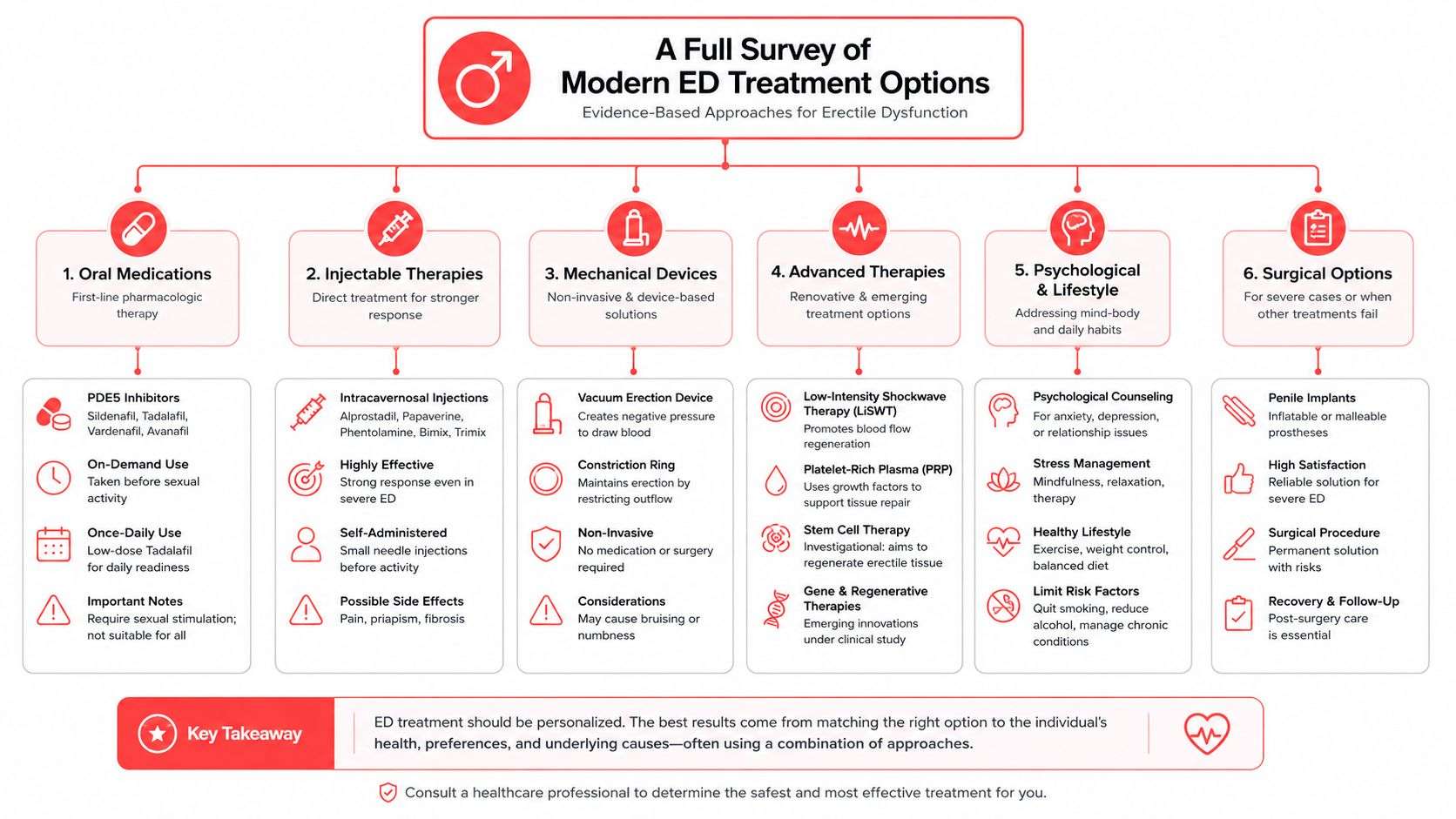
A common first question is simple: “What happens if the pill does not work?” The answer is that ED treatment is not one option repeated in different brands. It is a stepwise set of choices, and the right next step depends on severity, cause, comfort level, and how much reliability matters to you and your partner.
Oral medication and where it fits
PDE5 inhibitors are still the standard starting point for many men. Sildenafil, tadalafil, vardenafil, and avanafil improve penile blood flow through the nitric oxide pathway, and they are often a good first move when ED is mild to moderate and there are no major contraindications. They are less dependable in men with more advanced vascular disease, diabetes, post-prostate treatment changes, or severe baseline dysfunction, as discussed in this review on evolving ED treatment options.
That difference matters in clinic. A partial response to pills is still useful information. It often suggests that blood flow support helps, but not enough on its own.
If you want a plain-language overview before deciding whether medication was used correctly or given a fair trial, start with this guide on how erectile dysfunction treatment pills work.
Injections, devices, and surgery
When oral medication is inconsistent or ineffective, treatment usually shifts toward options that create a more dependable erection.
Intracavernosal injection therapy is often the most effective nonsurgical choice after pills. Medication is placed directly into the erectile tissue, which means it does not rely on the same degree of nerve signaling or vascular responsiveness as oral therapy. The benefit is reliability. The trade-off is that it takes teaching, dose adjustment, and comfort with self-injection. Some men do very well with it for years. Others decide the process feels too medical or too disruptive to intimacy.
Vacuum erection devices are another practical option, especially for men who want a non-drug approach or need something that works regardless of medication response. They can be effective, but the erection may feel less natural, the constriction band can bother some couples, and spontaneity is limited.
Penile implants sit at the far end of the treatment ladder and remain the most reliable option for men who want a durable solution after less invasive therapies have failed or become frustrating. Surgery is a serious step, but for the right patient, it offers predictability that pills, devices, and regenerative plans may not match.
Matching the treatment to the patient
Here, expectations need to be honest.
A man with occasional performance issues, preserved morning erections, and mild vascular risk factors may do well with medication, better timing, and a few health changes. A man with long-standing diabetes, poor pill response, and severe ED often needs a more direct option. Someone strongly motivated to avoid needles or surgery may still be a candidate for regenerative care, but only if the underlying pattern makes that approach reasonable.
A simple comparison helps:
| Treatment path | Main strength | Main limitation |
|---|---|---|
| Pills | Convenient and familiar | Less reliable in more advanced ED |
| Injections | High reliability without surgery | Invasive and technique-dependent |
| Vacuum devices | Non-drug, non-surgical | Mechanical and less spontaneous |
| Regenerative therapies | May help selected men with vascular-related ED | Outcome depends heavily on candidacy and baseline severity |
| Implants | Most dependable rigidity | Requires surgery and long-term device commitment |
Where regenerative care fits in the larger plan
Regenerative treatment belongs in the conversation, but not as a universal answer. The goal is tissue and blood-flow improvement over time, not immediate on-demand rigidity. That distinction is one of the biggest reasons men either choose the right path or end up disappointed.
Some clinics also discuss laser-based or injection-based regenerative protocols. Those may be reasonable to review, but they should be presented with the same standard I use for any ED treatment. Who is the right candidate, what problem is this meant to treat, how long do results tend to take, and what is the backup plan if the response is partial?
The best treatment plan is the one that matches your biology and your goals, not the one with the most appealing marketing.
Understanding Regenerative Therapies and Candidacy
A common scenario goes like this. A man reads that shockwave, laser, or injection-based regenerative treatment can “restore” erections, then assumes he should start there. In practice, the right first question is simpler. What is really causing the erection problem, and does that cause match what regenerative care is designed to improve?

Who tends to be the best candidate
The strongest candidates are usually men with mild to moderate vasculogenic ED. That means erections are weakening largely because penile blood flow has declined, not because of major nerve injury, severe scar tissue, or advanced structural change. In that setting, regenerative treatment has a reasonable biologic target.
Low-intensity shockwave therapy has the clearest clinical role in this category. Some protocols are also paired with medication, especially when a man still gets partial benefit from PDE5 inhibitors and wants to improve baseline function rather than rely only on on-demand support. If you want a practical summary of the evidence before agreeing to treatment, review shockwave therapy for ED success and what the studies show.
Laser-based protocols and injection-based regenerative options are sometimes discussed in the same conversation. I advise patients to judge them the same way I judge any ED treatment. What tissue problem is the treatment trying to improve? How long should results take? How often is repeat treatment needed? What is the backup plan if the response is partial?
Those questions matter because regenerative care aims for gradual improvement, not instant reliability.
Who should be cautious about cure claims
Men with severe venous leak, significant pelvic nerve damage, long-standing diabetes with advanced erectile decline, or major post-surgical changes often need more guarded expectations. Some can still try regenerative treatment. The issue is not whether treatment is allowed. The issue is whether the likely payoff justifies the cost, time, and delay before moving to a more dependable option.
That trade-off gets missed in marketing.
A man who still has some spontaneous or medication-assisted rigidity may be a reasonable candidate for a regenerative trial. A man with very limited baseline erectile function, poor response to multiple conservative treatments, and signs of structural decline often needs a different plan. In that group, regenerative treatment may be an adjunct, not the centerpiece.
PRP, laser therapy, and other injection-based protocols should be presented transparently. Evidence quality varies. Office protocols vary even more. If a clinic cannot explain why you are a candidate beyond broad claims about “healing,” slow down and ask harder questions.
If every patient is labeled a strong candidate for regenerative treatment, the evaluation is probably too shallow.
Setting realistic expectations before you commit
Good candidates still need realistic expectations. Results are usually gradual. Response can be partial. Some men notice better firmness or better medication response rather than a complete return to previous function. That still counts as progress, but only if you went in with the right goal.
Cost also matters. Regenerative care is often cash pay, and coverage can be limited. If insurance access is part of your decision, review these essential tips for finding in-network doctors before you book consultations.
The best use of regenerative treatment is selective. It fits men whose history, exam, and treatment goals line up with what these therapies can realistically do. Everyone else deserves a doctor who says so clearly, early, and without sales pressure.
How to Choose the Right ED Doctor and Clinic for You
A man calls after months of hesitation. He has seen ads for shockwave, read about injections, tried pills on his own, and still does not know who to trust. That is a common starting point. The right clinic brings order to that confusion and shows you which options fit your medical picture, budget, and goals.
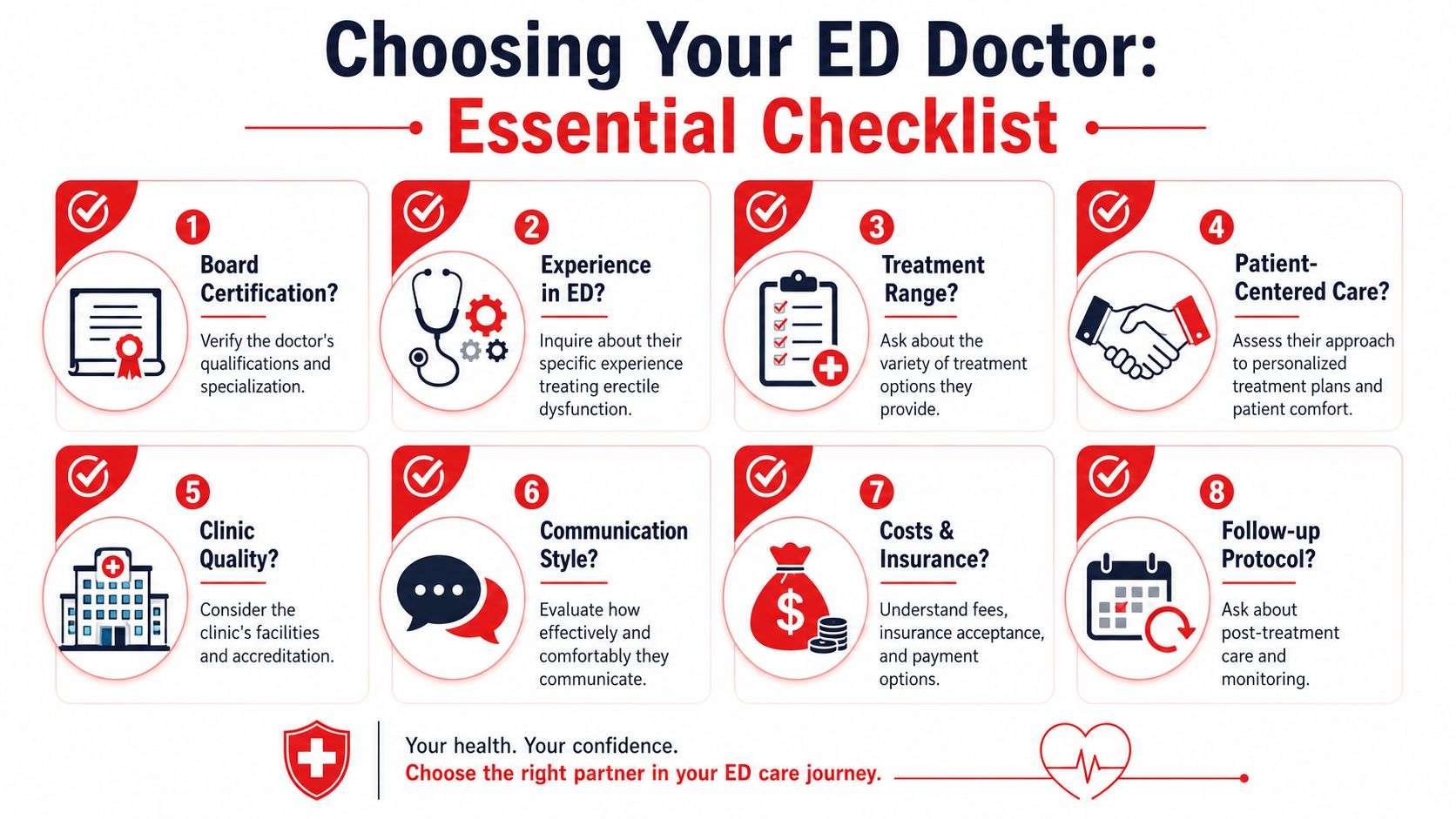
The right doctor offers clinical judgment. Good judgment shows up in the way a clinic evaluates you, explains trade-offs, and recommends treatment only after deciding what problem is being treated.

Questions worth asking before you book
Start with the office evaluation process. If the conversation quickly turns into a package price before anyone asks about your health history, erection quality, relationship context, medications, hormone status, or prior treatment response, that is useful information.
Ask a few direct questions:
- What does the first visit include? Look for a real workup, not a sales consult.
- Who decides the treatment plan? A physician-led decision matters, especially if injections, hormone issues, or surgical referral may be part of the discussion.
- Do you offer both traditional and newer therapies? Clinics with range can usually match care more carefully to the patient in front of them.
- How do you determine whether someone is a candidate for shockwave, laser, or injection-based regenerative care? A good answer should mention severity, likely cause, treatment history, and realistic goals.
- What happens if the first plan does not work well enough? ED care often requires adjustment, dose changes, or a move to a different category of treatment.
- How is follow-up handled? Progress tracking matters because partial improvement and full success are not the same thing.
Insurance and billing matter too. If coverage affects your decision, these essential tips for finding in-network doctors can help you sort out costs before you schedule.
What separates a strong clinic from a sales-driven one
Patients often focus on the treatment menu and miss the more important question. Does this clinic know how to sort candidates well?
That matters because the best clinic for one man may be the wrong clinic for another. A younger man with mild vascular ED and good baseline function may reasonably ask about regenerative options. A man with advanced diabetes, prior pelvic surgery, severe curvature, or poor response to several standard treatments needs a doctor who can discuss injections, devices, and implant referral without hesitation.
Look for plain answers about trade-offs. Regenerative treatments may appeal to men who want a non-surgical option and are willing to accept gradual, sometimes partial improvement. Traditional treatments often work faster and more predictably, but each comes with its own burden, such as timing, side effects, discomfort, or ongoing use. A good clinic explains those differences without pushing every patient toward the highest-ticket service.
Published patient education from major medical organizations and peer-reviewed urology literature also supports a practical point. Treatments such as shockwave may require a series of visits and, in some cases, repeat sessions over time. That affects convenience, total cost, and long-term fit.
A few practical filters help:
| What to evaluate | Why it matters |
|---|---|
| Diagnostic depth | Better evaluation leads to better candidacy decisions and fewer mismatched treatments. |
| Treatment range | More than one pathway reduces pressure to fit every man into the same protocol. |
| Cost clarity | You should know what is included, what may be repeated, and what insurance is unlikely to cover. |
| Follow-up process | Dose titration, technique coaching, and reassessment often determine whether treatment succeeds. |
| Referral judgment | Strong clinics know when to continue office-based care and when to refer for surgery or more specialized testing. |
Good ED care works best as an ongoing clinical relationship, not a one-time purchase.
If you are comparing providers regionally, this guide on how to find top ED specialists across Texas can help you assess experience, access, and clinic fit before you book.
Taking the Next Step Toward Renewed Confidence
A man finally books a visit after months, sometimes years, of hoping the problem will settle on its own. By the time he sits down, he usually wants one clear answer. Will this treatment actually work for me?
That is the right question.
The value of seeing an erectile dysfunction treatment doctor is not just access to treatment. It is getting a realistic plan based on the cause of the problem, your health history, your goals, and your tolerance for cost, downtime, needles, medication use, or surgery.
Some men are strong candidates for office-based care. Men with mild to moderate vascular ED, early decline in erection quality, or a partial response to pills may have reasonable options with medication adjustment, devices, or selected regenerative treatments. Other men need a different path. If erections have been absent for a long time, if there is major nerve injury, advanced diabetes-related damage, significant scarring, or a true venous leak pattern, treatments such as shockwave, laser-based therapy, or biologic injections may offer limited benefit. In those cases, setting expectations early protects patients from spending time and money on a plan that is unlikely to match the severity of the problem.
That kind of honesty helps.
It also changes the tone of the visit. Instead of chasing a promise, you can choose among real options. For some patients, that means improving function enough for reliable intercourse without surgery. For others, it means accepting that a penile implant evaluation may offer the most dependable result after less invasive treatments have failed or are unlikely to succeed.
The encouraging part is that there is rarely only one path. There may be a short-term option to restore function now, a longer-term strategy to improve contributing health factors, and a clear point where the plan should be reassessed if results are weak.
Book the consultation. Bring a current medication list. Be specific about what is happening, how long it has been going on, whether morning erections have changed, and what you have already tried. A good doctor will not shame you or rush you into the newest treatment on the menu. You should leave with a diagnosis, a candidacy discussion, and a plan you understand.
If you're ready to take that step, Sexual Wellness Centers of America offers evaluation and treatment planning for adults seeking non-surgical sexual wellness care. The best first move is a thorough consultation, clear discussion of candidacy, and a realistic plan built around your goals.