
Why Finding the Ventrogluteal Site Matters for Safe IM Injections
The ventrogluteal injection technique is the gold standard method for delivering intramuscular (IM) medications — and for good reason. It targets the gluteus medius and minimus muscles on the side of the hip, away from major nerves and blood vessels.
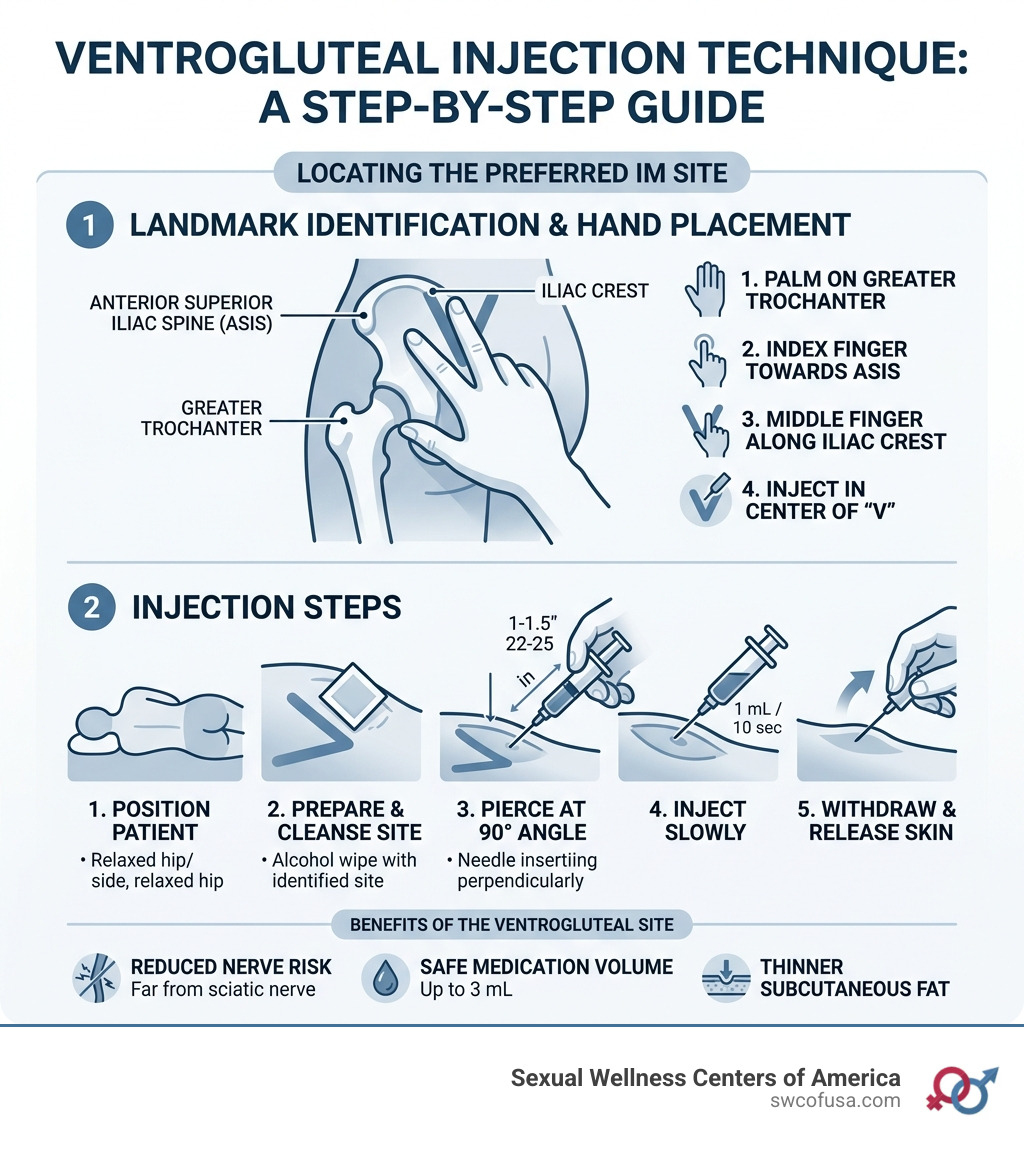
Here’s a quick overview of the technique:
- Position the patient on their side or back, with the injection-side hip relaxed
- Place your palm on the greater trochanter (the bony bump on the outer hip)
- Point your index finger toward the anterior superior iliac spine (the front hip bone)
- Spread your middle finger back along the iliac crest to form a “V” shape
- Inject in the center of that V, at a 90-degree angle, using a 1–1.5 inch, 22–25 gauge needle
- Inject slowly — about 1 mL every 10 seconds — then withdraw and release the skin
This site can safely hold up to 3 mL of medication in adults, making it ideal for hormone therapy and other volume-sensitive treatments.
The ventrogluteal site is preferred over the traditional dorsogluteal (upper buttock) site because it has thinner skin, less subcutaneous fat, and sits far from the sciatic nerve. Studies show that dorsogluteal injections only reach actual muscle tissue 32–52% of the time — dropping to just 8% in women. The ventrogluteal site solves that problem reliably.
I’m Jeff Nuziard, CEO of Sexual Wellness Centers of America, where our clinical team uses the ventrogluteal injection technique daily to deliver hormone therapies like HEshot® and SHEshot® with precision and safety. In this guide, I’ll walk you through everything you need to know to locate and use this site with confidence.
Why the Ventrogluteal Site is the Preferred IM Location
When we talk about intramuscular injections, we are looking for the “sweet spot” where medication can be absorbed quickly and safely. The ventrogluteal site, which involves the gluteus medius and gluteus minimus muscles, is that sweet spot.
Unlike other areas, this site lacks major nerves and large blood vessels. This significantly reduces the risk of accidental intravenous injection or nerve damage. One of the biggest fears in gluteal injections is hitting the sciatic nerve, which can lead to permanent injury or paralysis. Because the ventrogluteal site is located on the side of the hip, it is situated far away from the sciatic nerve’s path.
Furthermore, the subcutaneous tissue (the fat layer) over the ventrogluteal muscle is generally thinner than the layer over the traditional “butt shot” site (the dorsogluteal site). This means the needle is much more likely to actually reach the muscle rather than getting stuck in the fat layer. When medication is trapped in fat, it isn’t absorbed as efficiently, and it can cause more irritation.
According to Ventrogluteal Injection: Purpose, Preparation, and Safety, this site is considered the safest for adults and even children over seven months old. At Sexual Wellness Centers of America, we prioritize this site for our IM Injections because it accommodates larger volumes of fluid (up to 3 mL) and is perfect for oil-based or irritating medications, such as those used in peptide injection therapy or testosterone replacement.
Mastering the Ventrogluteal Injection Technique: A Step-by-Step Guide
Administering an injection doesn’t have to be a source of anxiety. By following a structured ventrogluteal injection technique, we ensure the medication goes exactly where it needs to go with minimal discomfort.
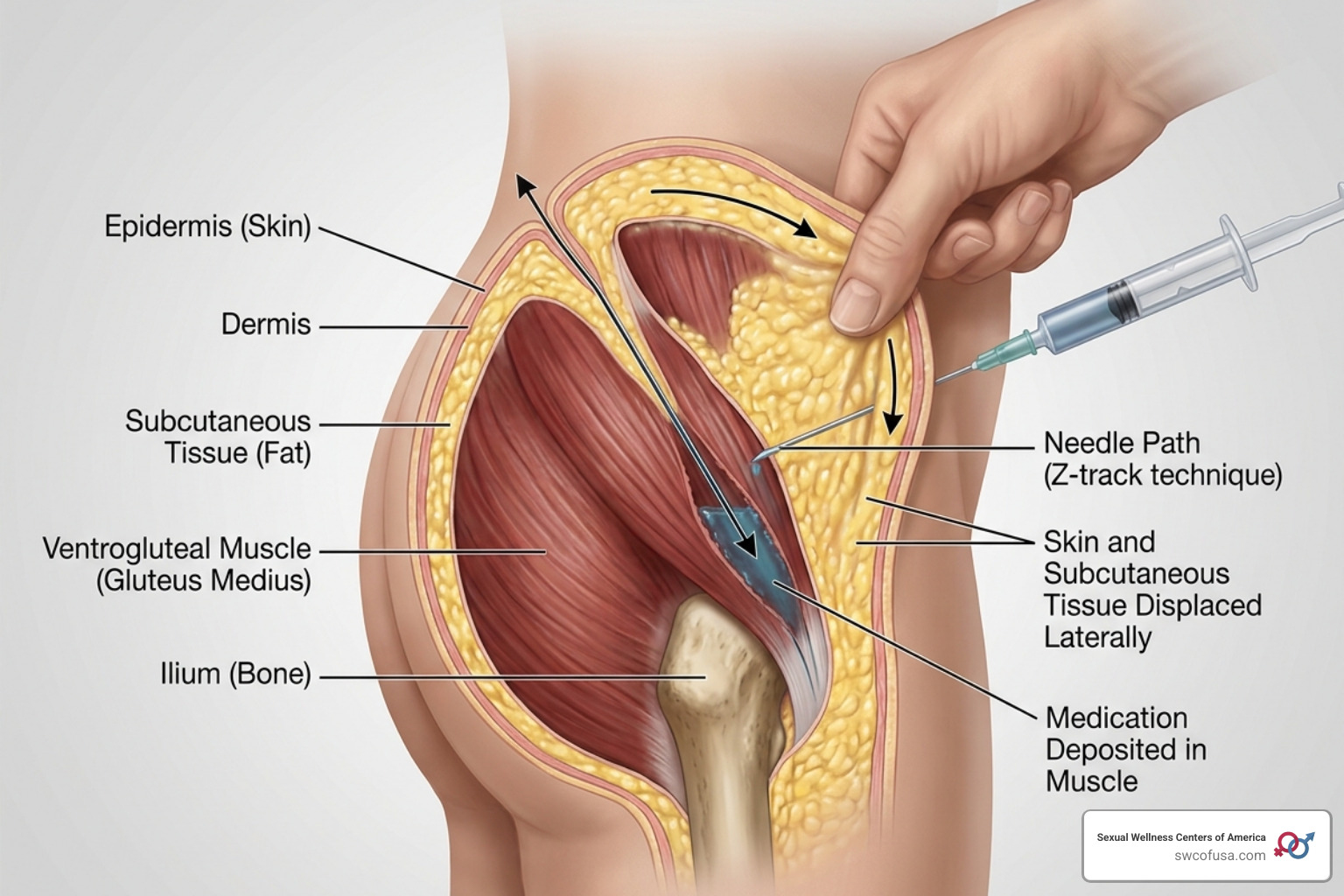
The Z-Track Method
We highly recommend the Z-track method for all ventrogluteal injections. This technique creates a “zigzag” path that seals the medication inside the muscle, preventing it from leaking back into the subcutaneous tissue. This is especially important for irritating drugs or dark-colored medications that could stain the skin.
- Displace the skin: Use your non-dominant hand to pull the skin and subcutaneous tissue approximately 1 inch (2.5 cm) to the side or downward.
- Insert the needle: While holding the skin taut, insert the needle at a 90-degree angle.
- Inject: Deliver the medication slowly. A good rule of thumb is 10 seconds per 1 mL.
- Withdraw and Release: Withdraw the needle quickly and then release the skin. The tissue layers will slide back over each other, sealing the injection track.
For a deeper dive into these standards, you can review 18.6 Administering Intramuscular Medications – Nurse Refresher.
Landmarking for the Ventrogluteal Injection Technique
The “lost” feeling usually happens during landmarking. To find the site accurately, we use two primary methods: the V-method and the G-method.
The V-Method (Hand Placement) This is the most common way to find the site.
- Find the Greater Trochanter: This is the bony “knob” at the top of the femur. You can feel it move if you rotate the patient’s leg. Place the heel of your hand (use your right hand for the patient’s left hip, and vice versa) directly over this bone.
- Point Your Index Finger: Aim your index finger toward the anterior superior iliac spine (the prominent bone at the front of the hip).
- Spread Your Middle Finger: Extend your middle finger toward the iliac crest (the top of the hip bone), forming a “V.”
- The Injection Site: The center of the triangle formed by your index finger, middle finger, and the iliac crest is your target.
The G-Method (Geometric) Interestingly, research suggests the G-method may be even more accurate. While the V-method has a success rate of about 57% for hitting the muscle, the G-method boasts a 75% success rate.
- To use the G-method, draw an imaginary triangle between the greater trochanter, the iliac crest, and the anterior superior iliac spine.
- Find the median line of this triangle to locate the injection point. This method is often preferred for patients with a higher BMI where bony landmarks might be harder to palpate.
Patient Positioning for Ventrogluteal Injection Technique
Positioning is key to muscle relaxation. If the muscle is tense, the injection will hurt more.
- Side-Lying (Lateral): This is the preferred position. Have the patient lie on their side with the upper leg flexed at the knee and hip. This position “opens up” the ventrogluteal area and relaxes the muscle.
- Supine (On the Back): If the patient cannot lie on their side, they can stay on their back with their knees slightly bent.
- Prone (On the Stomach): While possible, it is less common for this specific site.
Relaxing the muscle is essential. We often tell our clients at Sexual Wellness Centers of America to take a deep breath or wiggle their toes to help distract the nervous system. You can learn more about how we handle IM Injection Gluteal Muscle procedures for our wellness treatments in our clinical guides.
Equipment Selection and Volume Guidelines
Choosing the right tools is just as important as the technique itself. If the needle is too short, you’re giving a subcutaneous injection instead of an IM one. If it’s too long, you risk hitting the bone (though this is rare at the ventrogluteal site).
For an average adult, we typically use:
- Needle Gauge: 22–25 gauge.
- Needle Length: 1 to 1.5 inches.
- Maximum Volume: Up to 3 mL for a well-developed muscle.
However, these are not “one size fits all” rules. We must adjust based on the patient’s body composition.
Needle Length Recommendations by BMI and Gender
| Patient Profile | Recommended Needle Length |
|---|---|
| Thin Adults (BMI < 18.5) | 5/8 to 1 inch |
| Average Adults | 1 to 1.5 inches |
| Women > 200 lbs (90 kg) | 1.5 inches |
| Men > 260 lbs (118 kg) | 1.5 inches |
| Obese Patients (BMI > 30) | 1.5 to 2 inches (use clinical judgment) |
Using the right needle ensures the medication reaches the gluteus medius rather than sitting in the fat layer. For more details on site-specific equipment, check out our resource on the Gluteus Maximus IM Injection Site.
Safety Protocols and Complication Prevention
Safety doesn’t end once the needle is out. Proper ventrogluteal injection technique includes pre-injection checks and post-injection monitoring.
The Aspiration Debate
For years, nurses were taught to “aspirate” (pull back on the plunger) for 5–10 seconds to check for blood. The idea was to ensure the needle wasn’t in a blood vessel. However, the CDC and WHO now state that aspiration is not necessary for most IM injections, especially vaccines, because the recommended sites (like the ventrogluteal) don’t have large blood vessels.
That said, some clinicians still prefer to aspirate when injecting large volumes or oil-based medications. If you do aspirate and see blood, you must withdraw the needle, discard the syringe, and start over with a fresh dose and a new site.
Post-Injection Care and Complications
While the ventrogluteal site is the safest, complications can still occur if the technique is poor. These include:
- Pain and Bruising: Common and usually minor.
- Abscess or Infection: Prevented by using strict aseptic technique (cleaning the site with alcohol for 30 seconds).
- Nerve Injury: Extremely rare at this site, but possible if landmarks are missed.
- Hematoma: A collection of blood under the skin.
The Gait Assessment One unique way we assess for proper injection is by checking the patient’s gait. If a patient develops a limp or difficulty walking immediately after a gluteal injection, it could indicate sciatic nerve involvement. Because the ventrogluteal site is so far from that nerve, a limp is highly unlikely, which is why we prefer it!
For a scientific overview of these risks and how to manage them, you can consult the Intramuscular Injection guide on NCBI. If you’re comparing sites, you might also find our article on the IM Shot in Thigh useful for understanding alternative locations like the vastus lateralis.
Frequently Asked Questions
Should I aspirate before injecting?
As mentioned, current CDC guidelines suggest aspiration is unnecessary for most IM injections because the ventrogluteal site lacks major vascular structures. However, for certain medications like hormone replacement therapy or when required by specific facility protocols, a brief 5-second aspiration is still practiced by some. If blood appears, do not inject.
Is this site safe for children?
Yes! The ventrogluteal site is safe for children as young as 7 months old. It is often preferred because the muscle is well-developed even in infants who have started walking. For pediatric patients, the volume is usually limited to 1 mL, and we recommend using distraction techniques (toys, songs) to make the process easier.
Why is the dorsogluteal site avoided?
The dorsogluteal site (the upper outer quadrant of the buttock) was the standard for decades, but it is now considered high-risk. Research shows that only about 8% of injections in women actually reach the muscle in that area due to thicker fat pads. More importantly, it is dangerously close to the sciatic nerve. Accidental injury to this nerve can lead to permanent foot drop or paralysis.
Why do some nurses still use the “butt shot” site?
Despite the evidence, many healthcare providers stick to the dorsogluteal site because of “tradition” or a lack of confidence in landmarking the ventrogluteal site. A study showed that 74% of nurses never used the ventrogluteal site, often because they were afraid of hitting the hip bone. However, with proper training, the ventrogluteal site is objectively safer and more effective.
Conclusion
Mastering the ventrogluteal injection technique is one of the best things you can do for patient safety and comfort. By moving away from the risky dorsogluteal site and focusing on the thick, safe muscle of the hip, we ensure that medications like our HEshot®, SHEshot®, and vitamin protocols are delivered with maximum efficacy.
At Sexual Wellness Centers of America in Colleyville, TX, we don’t just provide treatments; we provide precision. Whether we are utilizing regenMAX® technology or conducting detailed hormone panels, our goal is a 97.2% efficacy rate in erectile dysfunction reversal and total sexual wellness. Proper injection technique is a vital part of that success.
If you are looking for expert care or want to Learn more about IM injections in Colleyville, TX, reach out to us today. We are here to help you navigate your wellness journey with confidence and the very best clinical standards.