
You've probably had this conversation in your head already. The hot flashes are stealing sleep, your libido feels unfamiliar, and someone you trust mentioned peptide therapy at just the right moment. The hard part is that you don't want another trendy fix, you want to know what belongs in a menopause plan and what's marketing dressed up as medicine.
The honest answer is that peptide therapy for menopause sits in a narrow, useful lane. It can be part of a targeted plan for selected symptoms, especially sexual health and some recovery concerns, but it is not a replacement for guideline-based menopause care, and major reviews say there's no established guideline-supported role for peptides as a primary treatment for menopause symptoms or hot flashes (peptide journal guidance on peptides for perimenopause and menopause). That distinction matters because the right order usually is foundation first, hormones where indicated, then select adjuncts if there's still a symptom left to solve.
Table of Contents
- Where Peptides Fit in a Modern Menopause Plan
- What Peptides Are and Why They Get Mentioned for Menopause
- Matching Specific Peptides to Specific Menopausal Symptoms
- Sexual Function and Libido After Menopause
- How Peptide Therapy Is Integrated With HRT and Regenerative Services
- Safety, Contraindications, and What a Real Evaluation Looks Like
- Common Misconceptions About Peptide Therapy for Menopause
- Who Is a Reasonable Candidate and What to Ask Any Clinic
Where Peptides Fit in a Modern Menopause Plan
A woman in her early 50s usually doesn't arrive asking for a peptide by name. She arrives tired, waking at 3 a.m., less interested in sex, and frustrated that her body feels like it changed departments overnight. She may have already tried lifestyle changes, maybe even hormone therapy, and she's asking whether a peptide can do what everything else hasn't.
That's the right question, because the answer depends on the symptom. If the main problem is hot flashes, night sweats, and vaginal estrogen loss, peptide therapy is not the central tool. If the main problem is residual libido concerns, slow recovery, or a narrow sexual symptom, a peptide may be discussed as an adjunct, not as a standalone fix.
Practical rule: the best menopause plan solves the biggest driver first, then adds smaller tools only if there's a clear reason to do so.
In a clinic setting, I look at three things before anyone starts talking about peptides. First, what symptom are we trying to change. Second, what evidence supports each option for that symptom. Third, how the treatment is sequenced so the patient isn't using a niche tool to compensate for an untreated hormone problem.
That sequence matters because peptide content online often blurs treatment categories. A woman searching for help with menopause can end up in a conversation about “optimization” when what she really needs is a structured workup, a discussion of hormone therapy, and then, if appropriate, a targeted add-on.
For readers who want to track what they're taking and when, a simple regimen log can help keep the plan clear, including dose timing, symptom changes, and follow-up notes, and track your peptide regimen with PepFlow if you need a dedicated place to organize that information.
If your main concern is libido, jump to the sexual health section. If you're trying to understand the place of peptides inside a broader menopause protocol, the sections on mechanism, integration, and safety will be the most useful.
What Peptides Are and Why They Get Mentioned for Menopause
Peptides are short chains of amino acids that act as signaling molecules. They're different from steroid hormones like estrogen and progesterone, which circulate broadly and change many systems at once. Think of hormones as the body's main thermostat, while peptides are the messengers adjusting specific rooms.
Why the idea sounds appealing
That specificity is the reason peptides keep coming up in midlife medicine. Some peptides can nudge growth hormone release, some may influence tissue repair, some modulate inflammation, and some act on narrow receptors tied to appetite, desire, or recovery. In theory, that makes them attractive during menopause, when sleep, tissue health, body composition, and sexual function can all feel off at the same time.
The way peptides are delivered also shapes how people encounter them. Some are FDA-approved for narrow uses, while others are compounded. They may be given by subcutaneous injection, and some products are marketed in oral, nasal, or topical forms. That wide delivery range is one reason sourcing, quality, and regulation vary so much from one clinic to another.
A peptide is not automatically a treatment plan. It's a signaling molecule, and the clinical question is whether the signal matches the problem.
Why regulation matters
The practical issue is that “peptide therapy” is not one uniform category. Some products have meaningful clinical support in a specific indication, while many of the compounds discussed online have a much thinner evidence base in menopause care. That's why a careful clinician separates the molecule from the marketing and asks what problem it's supposed to solve.
If you want a plain-language primer on how clinics define peptide treatment, the guide on clinical peptides is a useful vocabulary resource, and the internal overview at /what-is-a-peptide-therapy/ can help anchor the basics in a medical setting.
The important point is this. Peptides may be biologically interesting, but interest is not the same thing as proof. In menopause care, the proof question comes first.
Matching Specific Peptides to Specific Menopausal Symptoms
Patients usually don't ask for a peptide class. They ask whether something can help with desire, dryness, energy, sleep, body composition, or mood. That's the more useful way to think about them clinically, because the mechanism and the evidence are different for each symptom.
Libido and sexual desire
The peptide most often discussed here is bremelanotide, also known as Vyleesi. Its mechanism is melanocortin-4 receptor agonism, which makes it relevant to desire pathways rather than to estrogen replacement. The evidence is narrow and specific, and it does not mean the same thing as broad menopause treatment.
Vaginal health and tissue recovery
For vaginal symptoms, peptides are usually discussed as adjuncts rather than direct replacements for local estrogen or other established vaginal therapies. Compounds such as BPC-157 get mentioned because of tissue-repair theory, but the human menopause evidence is thin. That means any conversation here should stay honest about the gap between theory and proven clinical use.
Energy, recovery, and body composition
Growth hormone secretagogues such as ipamorelin, CJC-1295, and sermorelin are often marketed for recovery or body composition. Their appeal is easy to understand in midlife, where women notice slower bounce-back from exercise and changes in lean mass or sleep quality. Still, these are not menopause-specific treatments, and in many cases the evidence comes from non-menopausal settings rather than rigorous menopause trials.
Sleep and mood
Sleep and mood are often wrapped into the same complaint, but they aren't the same symptom. Some women are really describing fatigue from fragmented sleep, while others are describing low mood tied to hormone change, life stress, or both. Peptides are sometimes proposed for these concerns, but the evidence is not strong enough to position them as primary treatment.
Clinical takeaway: the more a symptom is driven by estrogen loss, vaginal atrophy, or mood and sleep disruption, the less likely a peptide is to be the main answer.
A simple symptom scan
- Libido: bremelanotide is the only peptide with a clearly defined FDA-approved sexual-health role, and its indication is narrow.
- Vaginal health: peptides are adjunctive at best, while local menopause care usually does more of the heavy lifting.
- Energy and recovery: growth hormone-related peptides are discussed often, but menopause-specific proof is limited.
- Sleep: the signal is indirect, so expectations should stay modest.
- Mood: peptide therapy isn't a substitute for evaluating sleep, hormones, stress, or mental health.
Sexual Function and Libido After Menopause
Low libido gets blamed on one thing more often than it should. After menopause, sexual function is usually a layered problem, not a single switch. Estrogen decline can contribute to genitourinary syndrome of menopause, which means dryness, irritation, and pain can suppress desire. Sleep disruption lowers baseline energy, and relationship or identity changes can matter just as much as hormones.
Why desire changes are rarely one-dimensional
That's why I'm cautious when a patient asks whether a peptide will “bring back” libido. The question sounds simple, but the physiology isn't. A woman can have low desire because sex hurts, because she's exhausted, because her mood is flat, because testosterone or DHEA may be low, or because the relationship context has changed. Most of the time, it's a combination.
The one peptide that belongs in this conversation is bremelanotide (Vyleesi). It is the only FDA-approved peptide for sexual dysfunction, and its specific indication is hypoactive sexual desire disorder. It works through melanocortin-4 receptor agonism, which means it acts on desire pathways rather than replacing estrogen or correcting vaginal atrophy.
What it does not do
That distinction matters. Bremelanotide does not treat the tissue changes of low estrogen, and it doesn't solve pain with penetration or the dryness that comes from menopause. If a woman's main issue is discomfort, she usually needs a vaginal-focused plan first, not a desire-only treatment.
Peptide therapy can be misunderstood in this regard. A peptide may help the desire side of the equation, while other therapies address the comfort side. In practice, that can mean local estrogen, DHEA, testosterone optimization where appropriate, counseling, and sometimes procedures directed at vaginal health. The right tool depends on what's limiting sex.
The earlier section on symptom matching is the easiest way to think about it. If the complaint is “I don't want sex because it hurts,” a peptide alone is the wrong starting point. If the complaint is “I'm interested in sex, but desire has gone flat despite fixing the obvious issues,” a narrow peptide discussion may make sense.
Sex after menopause deserves that kind of specificity. A good treatment plan starts by naming whether the barrier is desire, arousal, comfort, orgasm, or relationship context, because those are not interchangeable problems.
How Peptide Therapy Is Integrated With HRT and Regenerative Services
In real clinic work, peptide therapy usually lives at the end of a sequence, not the beginning. The first step is a proper lab and symptom workup, because a woman can't make a rational decision about an adjunct if the underlying hormone picture is still unclear. The next step is restoring the hormonal foundation, then seeing what's left.
That's the framework I'd use for any integrative menopause visit. A patient comes in with hot flashes, sleep disruption, vaginal changes, and libido loss. The clinician reviews hormones and symptoms, decides whether HRT is appropriate, and then layers in other options for the residual issues that hormones don't fully resolve.
For a clinic-level explanation of hormone replacement options and how they fit into women's care, the internal guide at /everything-you-need-to-know-about-hrt-for-women/ is the right place to start.
How sequencing usually works
| Layer | Purpose | Example Modalities |
|---|---|---|
| Foundation | Identify the main hormonal and medical drivers | Labs, symptom review, medication review |
| Hormone restoration | Rebuild the baseline that menopause disrupted | HRT pellets or other hormone modalities |
| Targeted adjuncts | Address residual concerns after hormones are optimized | Selected peptides, targeted supplementation |
| Structural vaginal care | Improve comfort and tissue-related symptoms | Vaginal rejuvenation therapies, regenerative injections |
| Follow-up | Adjust based on response and tolerance | Monitoring, maintenance visit, dose changes |
A clinic that uses the SHEshot® protocol for women may place it in the sexual wellness pathway when reduced orgasmic response, reduced sensitivity, or tissue concerns are part of the picture. Laser or acoustic therapies can also sit in the vaginal or sexual health arm of care when the goal is structural or local tissue support rather than systemic hormone replacement.
Operational principle: hormones first, targeted adjuncts second, structural therapies when tissue support is part of the problem.
Sexual Wellness Centers of America also positions peptide therapy alongside hormone optimization, vaginal rejuvenation, and regenerative services, which is one example of how a clinic can organize care without pretending any single therapy is enough on its own. The strength of that model is not the existence of more tools, it's the discipline of matching each tool to the symptom it can address.
Safety, Contraindications, and What a Real Evaluation Looks Like
Safety has to be front and center here, because the “natural” label makes people underestimate risk. Peptides are not automatically benign, and compounded products are not FDA-approved for menopause indications. Dosing isn't standardized across the whole market, and long-term safety data in menopausal populations are sparse.
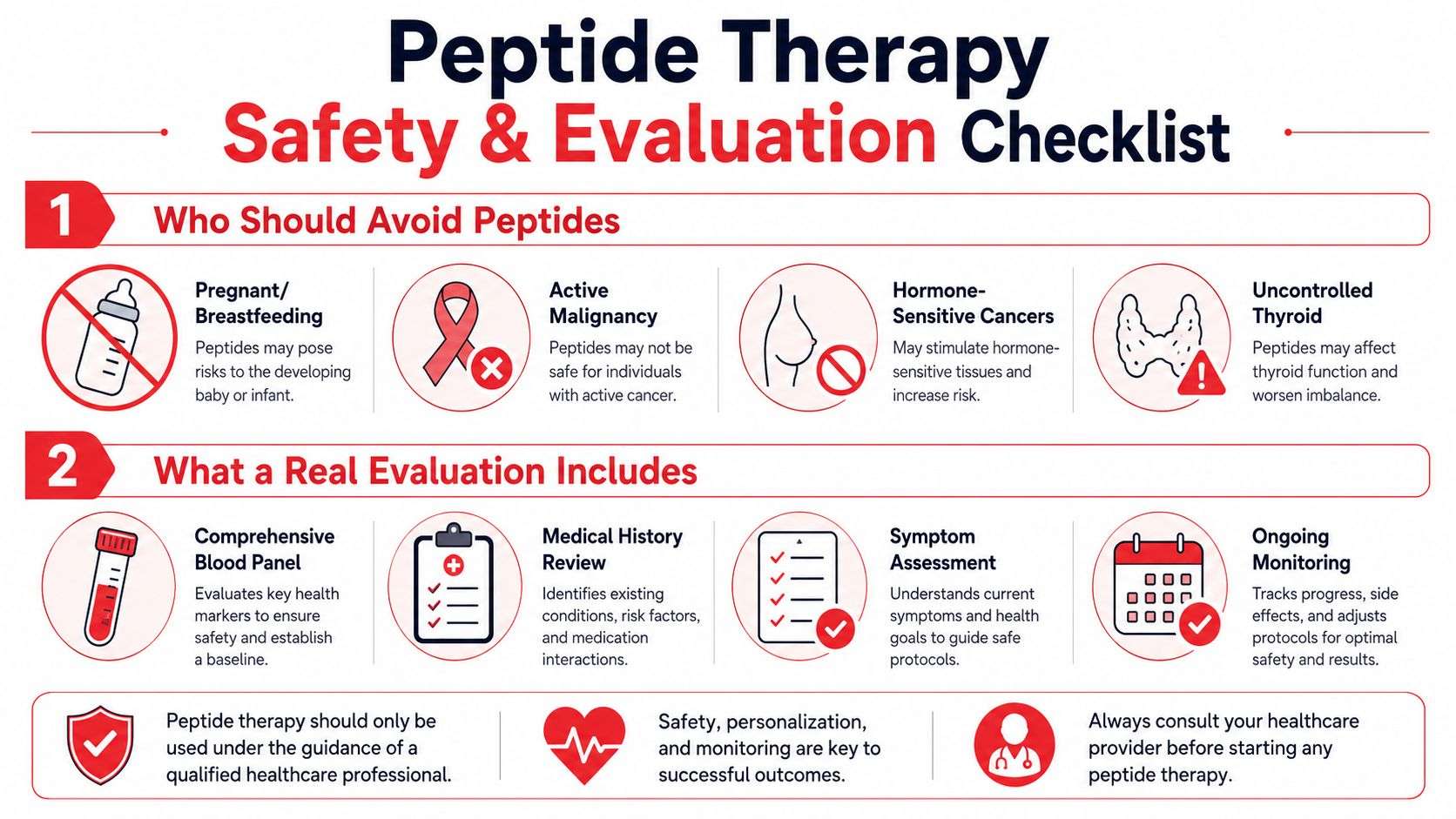
Who should avoid peptides
There are situations where I'd be cautious or avoid peptide use entirely. That includes pregnant or breastfeeding women, people with active malignancy, women with hormone-sensitive cancers, and patients with uncontrolled thyroid or pituitary disease. Medication interactions also matter, which is why a quick online order is not a real evaluation.
If you're also thinking about other add-ons, the same caution applies to any hormone-adjacent product. It's smart to review any supplements for hormone balance with a clinician who understands the full picture, not just the label claims.
What a real evaluation includes
A proper visit should start with thorough bloodwork, a full medical and symptom history, and a discussion of risks and benefits in plain language. It should also include written informed consent and a follow-up plan so the patient isn't left guessing whether the treatment is helping or causing side effects.
The internal starting point at /how-to-start-peptide-therapy/ is helpful for understanding how a clinic should sequence that process.
A real evaluation also asks a blunt question. Is the symptom severe enough, specific enough, and likely enough to respond that the benefit is worth the uncertainty. If the answer isn't clear, it's better to pause.
Red flags are easy to spot once you know what to look for. Be careful with clinics that prescribe without labs, sell peptides online without a visit, or promise that one peptide can replace HRT. Those are signs that the business model is moving faster than the medicine.
Common Misconceptions About Peptide Therapy for Menopause
Myth and reality get mixed together fast in this space, so a clean reset helps.
- Myth: peptides are a natural substitute for HRT. Reality: they're a different category entirely, and they don't replace the hormonal foundation for menopause symptoms.
- Myth: all peptides are equally well studied. Reality: they aren't, and the evidence behind one narrow sexual-health peptide is not the same as the evidence behind growth-hormone secretagogues or tissue-repair compounds.
- Myth: compounded peptides are the same as FDA-approved products. Reality: they're not regulated the same way, which changes how you think about sourcing, quality, and consistency.
- Myth: natural means risk-free. Reality: biology doesn't care about marketing language, and every active compound deserves a risk review.
- Myth: one protocol fits every woman. Reality: symptom clusters, medical history, and menopausal stage all change the decision.
Each of those myths leads to a bad clinical choice. The first one delays proper hormone treatment. The second one creates false confidence. The third one blurs the difference between a regulated product and a compounded one. The fourth one downplays contraindications. The fifth one produces cookie-cutter prescribing, which is exactly what menopause care should avoid.
A better question is not whether peptides are “good” or “bad.” It's whether a specific peptide fits a specific symptom in a woman with a specific history, after the foundational issues have been addressed.
Who Is a Reasonable Candidate and What to Ask Any Clinic
A reasonable candidate is usually a woman who already has a thoughtful menopause plan, has had a proper workup, and still has residual symptoms such as libido issues, sleep disruption, recovery concerns, or tissue-healing needs. She has no major contraindications, understands that evidence is limited for many peptides, and is working with a clinician who can monitor and adjust the plan over time.

Questions worth bringing to a consultation
- What peptide are you recommending, and what symptom is it meant to target?
- What evidence supports it for women in menopause, not just in theory?
- What labs or history findings made me a candidate?
- How will you monitor whether it's helping or causing problems?
- What happens if it doesn't work, and what's the next step?
A good answer to those questions should sound specific, not salesy. If the clinic can't explain why the peptide comes after hormone review, or if it can't name the symptom it's trying to change, that's a warning sign.
The women who tend to do best are the ones who treat peptide therapy as one well-placed tool in a broader menopause plan. That means respecting the evidence gap, using hormones when they're appropriate, and reserving peptides for the narrow situations where they belong.
If you want a careful, clinician-led conversation about menopause, sexual wellness, and whether peptide therapy has a place in your plan, reach out to Sexual Wellness Centers of America. Their team offers hormone optimization, peptide therapy, and regenerative services in a medical setting, so you can compare options with the right workup instead of guessing from internet advice.