
You've probably been here already. You try a pill, hope the timing works, and then spend more energy managing the moment than enjoying it. Or the medication helps somewhat, but the erection still isn't as dependable, spontaneous, or firm as it used to be.
That's usually the point where men stop asking for a quick fix and start asking a better question. Can the underlying function be improved, not just temporarily boosted?
That's where shock wave erectile dysfunction treatment enters the conversation. It matters because this approach isn't built around forcing a short-term response. It's built around trying to improve the tissue environment that erections depend on, especially blood flow. Used well, it can be a thoughtful regenerative strategy. Used poorly, it becomes another generic treatment sold with vague promises.
Table of Contents
- Beyond the Pill A New Approach to Erectile Dysfunction
- How Shock Wave Therapy Rebuilds Function from Within
- The Clinical Evidence for Shock Wave Therapy
- Determining If You Are a Good Candidate
- Your Shock Wave Therapy Treatment Walkthrough
- Comparing Shock Wave Therapy to Other ED Treatments
- Outcomes Timelines and Frequently Asked Questions
Beyond the Pill A New Approach to Erectile Dysfunction
The biggest limitation of standard ED treatment is simple. Most options are designed to help you perform around the problem, not repair what created it.
For some men, that's enough. If medication works predictably, causes no bothersome side effects, and fits their lifestyle, it may remain a reasonable choice. But many men want something different. They want erections that feel more natural, need less planning, and don't depend on the clock.
Why the treatment conversation has changed
Shock wave erectile dysfunction therapy changed the conversation because it introduced a regenerative goal. Instead of acting like a temporary blood-flow assist, it tries to stimulate biological repair in the penile tissue itself.
That matters most when ED has a vascular component. In plain language, the tissue isn't getting the blood flow quality it once did. The erection may start but fade. It may be less rigid. Or it may require more stimulation than before. Those patterns often point to function that's present, but weakened.
Practical rule: If a man can sometimes get an erection, but it's become unreliable, weaker, or difficult to maintain, I start thinking about whether the tissue can be rehabilitated rather than simply overridden.
This is also why the quality of the treatment plan matters. A regenerative therapy only makes sense when it's tied to diagnosis, tissue targeting, and protocol design. Generic treatment packages often ignore that.
What men are really looking for
Most patients aren't asking for a miracle. They're asking for one of three things:
- Consistency: They want to stop wondering whether things will work this time.
- Spontaneity: They want intimacy to feel natural again, not scheduled.
- Confidence: They want the mental noise around performance to quiet down.
A well-designed acoustic wave protocol aims at those goals by working on the physiology beneath them. The best programs also look beyond the penis itself. Hormones, metabolic health, medication effects, circulation, and inflammation all shape outcome.
That broader view is what separates a serious treatment program from a quick in-office sale. In advanced protocols such as REGENwave™, the idea isn't just to deliver sound waves. It's to apply the science in a way that matches the patient in front of you.
How Shock Wave Therapy Rebuilds Function from Within
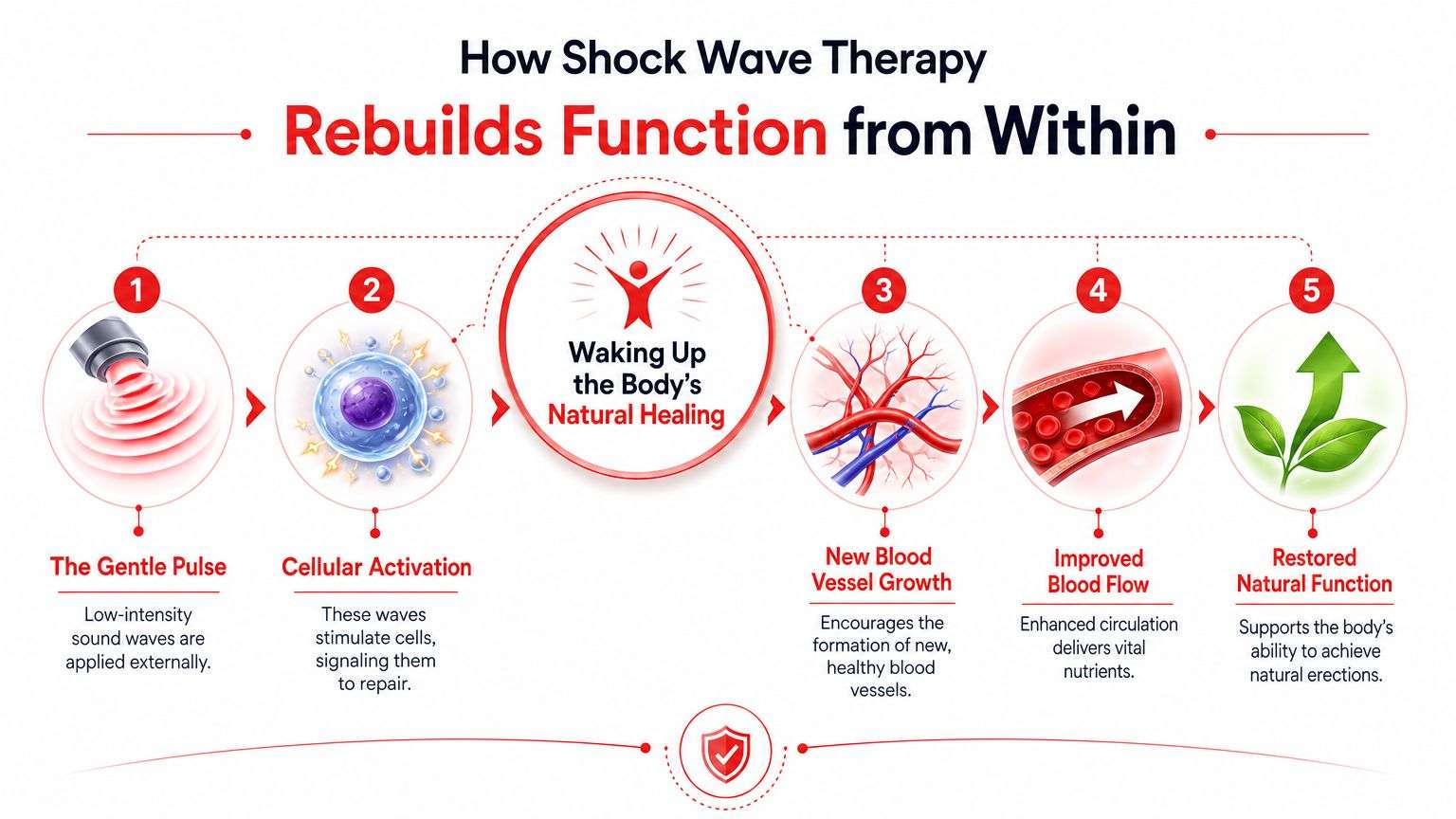
The easiest way to understand shock wave therapy is to think of it as a way of waking up dormant healing pathways. It doesn't add a drug to the bloodstream. It doesn't implant anything. It applies low-intensity acoustic energy from outside the body to stimulate a repair response within the tissue.
The biological story in plain English
Healthy erections depend on blood entering penile tissue efficiently and being held there effectively. When the small vessels and surrounding tissue lose quality, erections often lose firmness and reliability.
Shock wave therapy attempts to change that through controlled stimulation. The acoustic pulses create a very small mechanical stress in the tissue. That stress is not meant to injure you in the way people usually think about trauma. It's meant to signal the body that repair activity is needed.
The repair response can include cell signaling, release of growth-related factors, and support for the formation of healthier blood vessels. Clinicians often describe this as neovascularization, but patients don't need the jargon to understand the goal. The goal is better vascular support.
Cause and effect matters here
This process is easier to follow step by step:
- External acoustic pulses are delivered to targeted penile tissue.
- Cells detect the mechanical stimulus and shift into a repair-oriented response.
- The tissue environment becomes more active biologically, which can support vessel remodeling.
- Blood flow quality may improve, which is central to erection quality.
- Natural erectile function may become more dependable because the tissue is performing better, not just being chemically pushed.
The treatment is trying to improve the road system, not just wave more cars through a traffic jam.
That distinction is why men often describe this therapy differently from medication. The goal isn't an on-demand event. The goal is an improved baseline.
Why protocol details matter
Not all acoustic wave treatment is biologically equivalent. A detailed review of low-intensity shock wave therapy for ED noted that it's best supported for vasculogenic, mild-to-moderate ED, and that randomized trials and meta-analyses show an average IIEF-EF improvement of about 2 to 4 points versus sham. The same review also reported a rise from 13.5 to 20.9 in IIEF-EF at 4 weeks in one review, with gains maintained through 3 to 6 months, and found that published protocols used 1,500 to 5,000 shocks per session, with stronger outcomes when more than 3,000 shocks and lower energy flux densities around 0.09 mJ/mm^2 were used. Those details support a dose-response effect rather than a one-size-fits-all class effect, as described in this review of low-intensity shock wave therapy protocols and outcomes.
That's one reason advanced programs emphasize customization. In a proprietary protocol such as REGENwave™, the clinical value isn't just the machine. It's how the treatment is planned, dosed, and integrated into a larger restorative strategy.
The Clinical Evidence for Shock Wave Therapy
A lot of therapies in sexual medicine sound good in theory. Shock wave treatment became important because researchers didn't stop at theory. They measured whether erectile function improved.
The strongest practical takeaway is that low-intensity shock wave therapy has shown clinically measurable short-term benefit in randomized research, especially in the patient group most likely to respond well.
What the data shows
An American Family Physician evidence summary of eight trials that synthesized n=519 found that shockwave therapy produced a greater mean improvement in erectile-function scores than control, with a mean difference of 4.0 points; 95% CI, 2.1 to 5.8. In that same review, more patients achieved a minimal clinically important improvement of more than 4 points on the IIEF score, with an odds ratio of 8.5; 95% CI, 2.6 to 28.
That matters because erectile function scores can feel abstract to patients. What they really want to know is whether treatment changes lived experience. The same evidence summary included a trial in which 15 of 21 men (71%) receiving shockwave therapy achieved erections sufficient for intercourse, compared with 2 of 21 (9.5%) receiving sham treatment.
How to interpret that honestly
These results are encouraging, but they don't mean every man with ED will respond the same way. The evidence is strongest in men whose dysfunction is mild to moderate and vascular in nature. That's a narrower claim than many advertisements make, and it's the more accurate one.
A therapy can be promising and still require careful patient selection. That isn't a weakness in the science. That's how good medicine works.
Another important point is that research on shock wave erectile dysfunction treatment doesn't support the idea that every protocol is interchangeable. Device settings, total shocks, treatment schedule, and tissue targeting all influence outcomes. So does the larger medical context of the patient.
What patients should take from the evidence
If you're deciding whether to explore this treatment, the clinical literature supports three reasonable conclusions:
- It is not just hype: randomized trials and meta-analyses have shown measurable benefit.
- It is not universal: results depend heavily on the cause and severity of ED.
- It is not plug-and-play: protocol design matters.
Those three truths should guide every serious treatment discussion.
Determining If You Are a Good Candidate
The best way to think about candidacy is not, “Can I buy this treatment?” It's, “Does my pattern of ED match the mechanism this treatment can help?”
That question protects patients from wasted time, wasted money, and the frustration of trying a regenerative therapy when the underlying problem points somewhere else.
Who tends to benefit most
The clearest fit is the man with vasculogenic ED, meaning erectile dysfunction related to impaired blood flow. He often still has some erectile ability, but the quality has changed. Erections may be less rigid, slower to develop, or harder to maintain. Medication may help, but not fully.
This is also where symptom timing helps. A gradual decline often points in a different direction than a sudden overnight loss of function after surgery, major trauma, or severe neurological injury.
A proper workup should also explore broader contributors. Conditions discussed in this guide to contributory conditions that may cause erectile dysfunction often overlap, and ED rarely exists in isolation.
When shock wave therapy may not be the best fit
Some men are poor candidates for a stand-alone acoustic wave approach. Examples include men whose ED is driven primarily by severe nerve injury, major structural damage, or factors that are predominantly psychological without a significant vascular component.
That doesn't mean they can't be helped. It means the treatment plan should match the driver of the dysfunction. In those cases, a combined strategy may make more sense than relying on shock wave therapy alone.
Good candidacy screening isn't gatekeeping. It's outcome protection.
What a serious evaluation should include
A thoughtful consultation should answer several questions before treatment starts:
- What is the likely driver of the ED: vascular, hormonal, neurological, medication-related, metabolic, psychological, or mixed?
- How much baseline function remains: this often predicts whether tissue rehabilitation is realistic.
- Are there reversible contributors: low hormone levels, poor metabolic control, sleep issues, or medication side effects can blunt response.
- Would imaging or additional testing help: in some cases, vascular assessment provides valuable clarity.
The men who do best usually aren't the men who rushed into treatment fastest. They're the men whose diagnosis was specific enough to make the therapy make sense.
That's also why specialized protocols such as REGENwave™ are more compelling when they're part of a personalized medical evaluation, not sold as a generic package to everyone who walks in.
Your Shock Wave Therapy Treatment Walkthrough
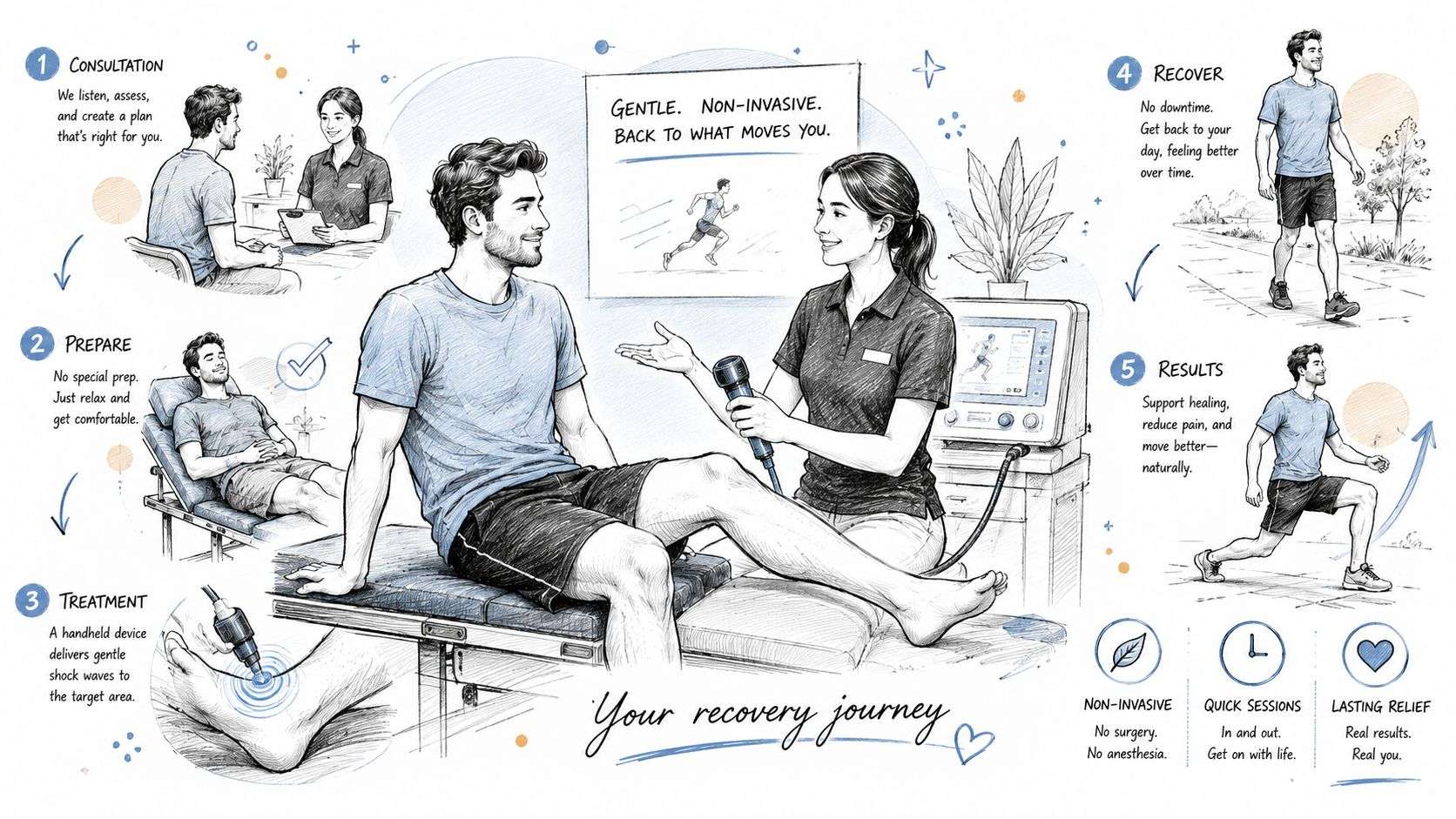
The procedure itself is usually much less intimidating than patients expect. Men hear the phrase “shock wave” and assume something aggressive is happening. In practice, the treatment is non-surgical, external, and typically straightforward.
What the first visit usually feels like
A good first appointment is focused and private. You review your history, talk through how the ED shows up in real life, and discuss whether the pattern sounds vascular enough for acoustic treatment to make sense. If the plan goes forward, the treatment area is mapped and the protocol is selected.
The actual session generally feels like a series of light taps or pulses. Most men describe it as unusual rather than painful. Because the energy is low intensity, the goal is stimulation, not brute force.
The course of treatment
A common treatment schedule described by Yale's 2023 urology review is about six sessions over roughly two weeks, and the same review noted that major centers still describe the therapy as investigational rather than established standard care. Yale also reported that studies suggest about 65% to 70% of patients may still have good erections six months after treatment, while about 40% to 50% may maintain benefit at two years. Utah Health, cited in that same review, noted that each session often costs about $400 to $500 out of pocket. Those practical details are summarized in this Yale urology review on acoustic wave treatment for ED.
That information is useful for expectation-setting because it combines logistics, durability, and cost in one place. Men deserve all three before they commit.
What happens after each session
Most patients get off the table and return to normal activity. There's no surgical recovery period and no downtime in the usual sense. What changes first varies. Some men notice improved responsiveness earlier. Others notice that rigidity or staying power improves more gradually over the treatment course and after it.
A typical patient experience often looks like this:
- Early phase: You're mostly judging comfort and ease. The process feels manageable.
- Middle phase: You may start noticing changes in tissue response, morning erections, or less effort needed.
- Later phase: Improvements tend to show up as better consistency rather than a dramatic overnight shift.
That gradual pattern makes sense for a regenerative therapy. Tissue remodeling doesn't behave like an instant switch.
Comparing Shock Wave Therapy to Other ED Treatments
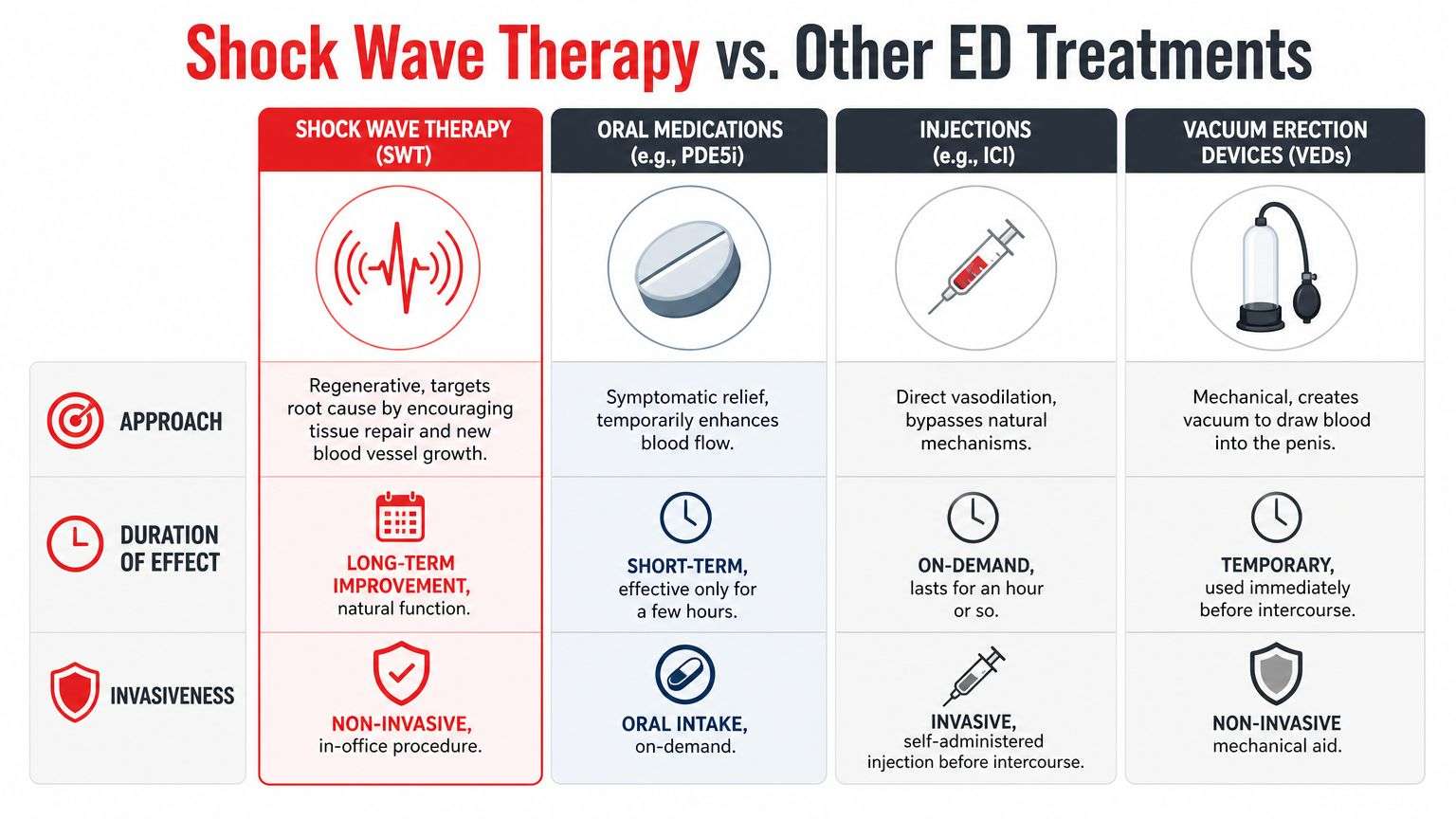
Men usually don't evaluate shock wave therapy in a vacuum. They're weighing it against the treatments they already know: pills, injections, and mechanical aids. The right comparison isn't “which option is best for everyone.” The right comparison is “what is each option designed to do?”
Mechanism matters more than marketing
Some treatments are symptom management. Others aim at tissue restoration. That's the key divide.
| Treatment type | Core purpose | How patients use it | What it asks from you |
|---|---|---|---|
| Shock wave therapy | Support tissue repair and blood flow quality | Completed as a treatment series | Patience and proper candidacy |
| Oral medication | Temporarily improve erectile response | Taken around anticipated sexual activity | Timing, planning, and adequate medication response |
| Injection therapy | Create a direct erectile effect | Used before intercourse | Comfort with self-injection and careful technique |
| Vacuum devices | Mechanically draw blood into the penis | Used immediately before intercourse | Preparation and tolerance of the device |
This is why men who are tired of planning often become interested in acoustic therapy. They want a better baseline, not a better workaround.
For a practical look at the symptomatic side of treatment, this article on how erectile dysfunction treatment pills actually work helps explain what pills can and can't do.
Not all shock wave protocols are the same
This point gets missed all the time. “Shock wave therapy” sounds like one treatment, but protocol details change the biological effect. The published literature has used 1,500 to 5,000 shocks per session, and outcomes were strongest when more than 3,000 shocks and lower energy flux densities around 0.09 mJ/mm^2 were used, as summarized earlier in the clinical literature.
That means a generic off-the-shelf package may not represent the strongest application of the science. Protocol design, tissue targeting, session structure, and integration with broader regenerative care all matter.
If dose and energy settings influence outcome, then provider judgment influences outcome too.
That's where proprietary systems such as REGENwave™ become relevant. The value of an advanced protocol isn't the branding by itself. The value is the attempt to move beyond one-size-fits-all treatment and build a more deliberate biological response.
Where each option fits best
Shock wave therapy may fit the man who still has recoverable function and wants to improve natural performance over time. Pills may fit the man who wants an on-demand option and responds well to them. Injections may fit the man who needs a direct mechanical result despite weaker natural pathways. Mechanical devices can be useful when a non-drug aid is preferred.
None of those options are morally better. They're different tools for different goals.
The mistake is assuming they all solve the same problem. They don't. Some create an erection for an evening. A regenerative protocol tries to improve the system that creates erections in the first place.
Outcomes Timelines and Frequently Asked Questions
Most men want the same practical answers. How long does it take, how long does it last, what does it cost, and is it worth the effort?
Common questions men ask
How many sessions are typical?
A commonly described schedule is about six sessions over roughly two weeks, based on Yale's 2023 review.
When do men notice changes?
That varies. Some notice early changes in responsiveness, while others improve more gradually as the treatment course finishes and tissue response develops. This overview on how soon you may notice results from erectile dysfunction treatment can help frame that timeline.
How durable are the results?
Yale reported that studies suggest about 65% to 70% of patients may still have good erections at six months, while about 40% to 50% may still have that benefit at two years.
Is it covered by insurance?
Often, no. Utah Health, as cited in Yale's review, noted that sessions often cost about $400 to $500 out of pocket.
Is it painful?
Most men describe the treatment as very tolerable, with a tapping or pulsing sensation rather than pain.
The most important expectation is this: shock wave erectile dysfunction treatment can be a strong option for the right patient, but it works best when the diagnosis is accurate, the protocol is thoughtful, and the goal is realistic.
If you want a medically guided evaluation of whether a regenerative approach makes sense for your ED, Sexual Wellness Centers of America offers advanced, non-surgical sexual health care for adults, including proprietary treatment protocols designed around the underlying drivers of function, not just short-term symptom control.