
In the United States, testosterone replacement therapy cost can range from about $500 to $12,000 or more per year, with monthly costs running from $40 to $1,000+ depending on the treatment type, insurance coverage, and the kind of clinic you use. That spread is so wide because the actual price usually isn't just the testosterone. It's the medication, labs, follow-up care, and whatever else gets bundled into the plan.
If you're researching TRT right now, you've probably seen numbers that don't seem to belong in the same universe. One website says treatment is affordable. A local clinic gives you a quote that feels far higher. Then someone tells you injections are cheap, while another person insists pellets are easier and "worth it."
All of those statements can be true, and still leave you confused.
The problem is that most pricing conversations focus on the headline number. Patients hear the monthly medication price and assume that's the main expense. In practice, the total cost of care over a year matters more. Safe TRT isn't a bottle on a shelf. It's diagnosis, prescribing, monitoring, dose adjustment, and a care model that may or may not be transparent.
Many individuals make costly errors in comparing treatment prices. They compare one clinic's medication-only price to another clinic's all-inclusive price. They compare a covered prescription to a cash-pay subscription. They compare a low-cost injectable protocol to a high-convenience pellet plan without accounting for procedure fees.
A good financial decision starts with the right question: not "What's the cheapest testosterone?" but "What will this cost me over a year, and what am I getting for that money?"
Table of Contents
- Why Is Testosterone Replacement Therapy Cost So Confusing
- The Key Drivers of Your Total TRT Cost
- TRT Cost by Modality A Side-by-Side Comparison
- The Hidden Costs and Bundled Program Traps
- Insurance, Financing, and Long-Term Budgeting
- How Clinic Memberships Can Simplify TRT Costs
- Frequently Asked Questions About TRT Costs
Why Is Testosterone Replacement Therapy Cost So Confusing
A common scenario goes like this. A patient sees an online ad for "TRT" at a low monthly price, then calls a local clinic and gets a much higher quote. He assumes one of them is overcharging.
Usually, he's comparing two different things.
One price may reflect only the medication. The other may include physician oversight, blood work, follow-ups, supplies, and pharmacy coordination. Some programs package everything together. Others advertise the lowest possible entry point and add charges later. That's why the same treatment category can feel impossible to price.
I've found that patients do best when they stop treating TRT like a retail purchase. It's medical care with recurring decisions attached to it. If the diagnosis is legitimate and the treatment is managed properly, the cost question becomes more nuanced than "How much is the vial?"
The right comparison isn't ad versus ad. It's total yearly care versus total yearly care.
This confusion gets worse when clinics use bundled language that sounds simple but isn't specific. "All-inclusive hormone optimization" may include items you want, items you don't need, and items you weren't expecting to pay for. Before agreeing to a program, it helps to review the same kind of tactics patients use to negotiate medical bills, especially asking for itemized pricing and separating core treatment from optional services.
There are also personal factors that affect cost before treatment even starts. Insurance status matters. So does the delivery method you choose. So does whether you want a broad primer on medical planning before starting hormones, such as this guide on what to consider before hormone replacement therapy.
When people feel blindsided by TRT pricing, it usually isn't because the numbers are hidden in fine print. It's because nobody translated the quote into plain language.
The Key Drivers of Your Total TRT Cost
A patient calls after seeing an ad for TRT at a low monthly price. By the end of the first year, the number that matters is rarely that ad price. The actual budget includes evaluation, labs, follow-up, medication, supplies, and sometimes fees that only show up after treatment starts.
That is the frame patients should use. Yearly cost of care matters more than the headline monthly medication number.
Medication is only one part of the bill
Patients usually ask about the vial, gel, or prescription first. That makes sense, but it is only one line item in a treatment plan that has to be diagnosed, prescribed, and monitored.
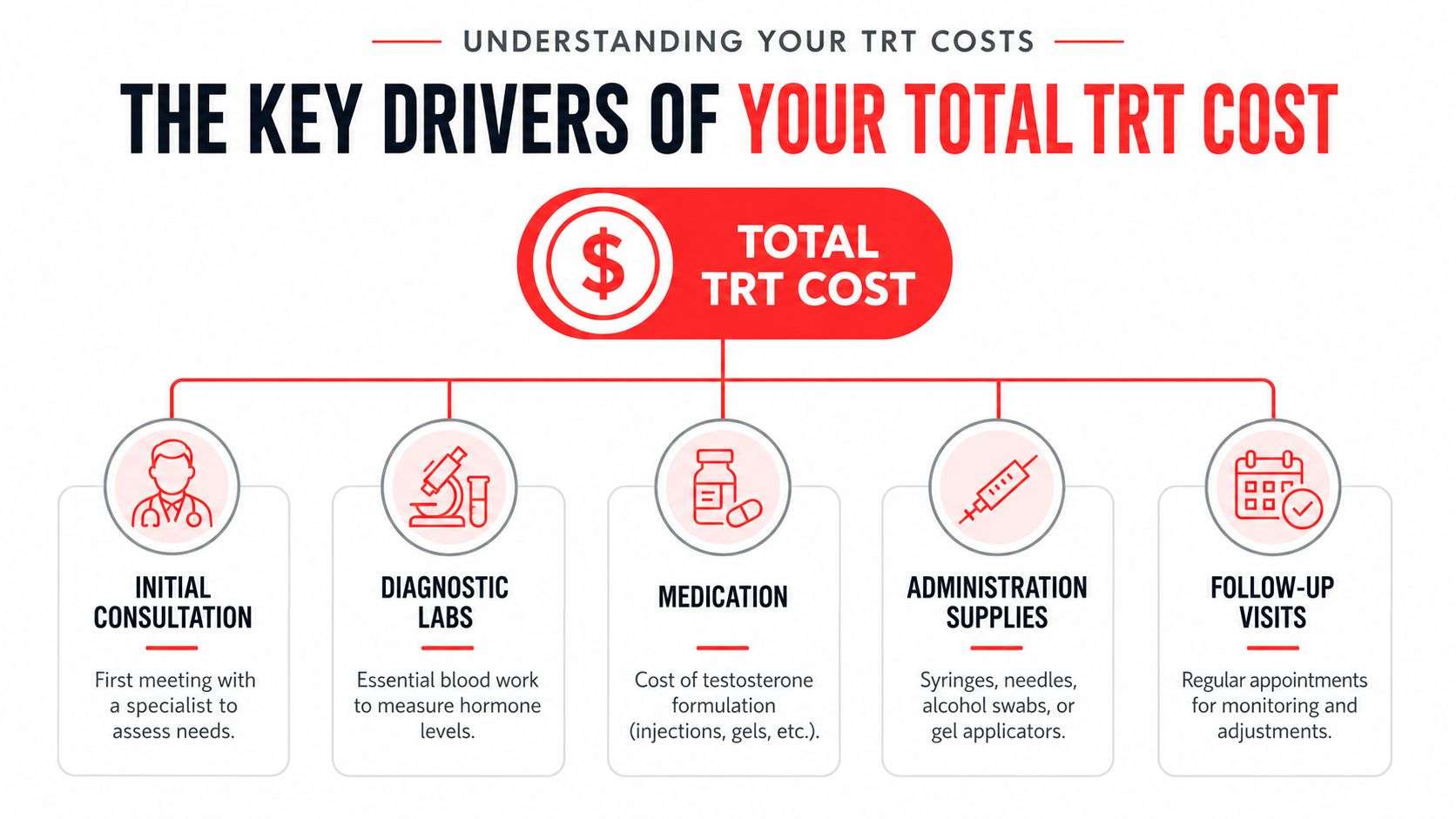
A typical TRT budget can include:
- Initial evaluation: the visit where a clinician reviews symptoms, medical history, risks, and whether TRT is appropriate
- Diagnostic lab work: baseline testing to confirm low testosterone and check markers that affect safety and dosing
- Medication: the testosterone itself, which may be generic or brand-name and may be billed through a pharmacy or directly through a clinic
- Supplies or administration: needles, syringes, sharps containers, applicators, or office administration fees, depending on the modality
- Follow-up care: repeat visits, lab review, symptom assessment, and dose changes over time
The practical problem is simple. A quote can look inexpensive because it leaves out two or three of those categories.
Monitoring changes the total more than many patients expect
Good TRT care has recurring monitoring costs. That is not padding. It is part of prescribing testosterone responsibly.
The American Urological Association's testosterone deficiency guideline makes clear that diagnosis and follow-up depend on lab confirmation and ongoing monitoring, not a one-time prescription decision, as outlined in the AUA guideline on testosterone deficiency. In practice, that means the yearly price rises when a clinic includes repeat labs and clinician review, but the patient also gets a safer and more adjustable plan.
This is one of the trade-offs I discuss often with patients. A lower advertised monthly rate may still produce a higher annual bill if every follow-up lab and medication adjustment is billed separately.
Practical rule: If the clinic cannot show you the full first-year cost, you do not yet know the real TRT price.
The care model affects how costs show up
The same treatment can be priced in very different ways. Some clinics charge separately for visits, labs, and prescriptions. Others fold several services into a monthly membership. Neither structure is automatically better. The important question is what the annual total looks like once everything is counted.
Cash-pay care can be easier to predict when the clinic gives clear package terms. Insurance-based care can lower some parts of treatment but still leave the patient paying for deductibles, specialist visits, or uncovered lab work. The least expensive-looking option at signup is not always the least expensive option over twelve months.
Drug pricing also changes based on how the prescription is processed. Pharmacy benefit managers can affect formulary status, copays, prior authorization, and which pharmacy price the patient sees. For a plain-language overview, read My Policy Quote's PBM explanation.
Ask for the yearly number, not just the monthly one
A clear TRT quote should answer these questions before treatment starts:
| Cost driver | What to ask |
|---|---|
| Evaluation | Is the first consultation billed separately or included? |
| Labs | Which baseline and follow-up tests are expected over the year? |
| Medication | Is the prescription generic or brand-name, and where is it filled? |
| Supplies or administration | Will I need injection supplies or pay for in-office treatment? |
| Follow-up care | How many reviews, dose changes, and lab interpretations are included? |
That approach gives patients a much more honest number. It also exposes bundled programs that look simple on the surface but become expensive once the missing pieces start appearing on separate invoices.
TRT Cost by Modality A Side-by-Side Comparison
A patient may hear "$99 a month for TRT" and assume one option is clearly cheaper than another. In practice, the delivery method changes far more than the pharmacy price. It changes how often you need follow-up, whether procedures are involved, how flexible dose adjustments are, and what your twelve-month spend is likely to look like.
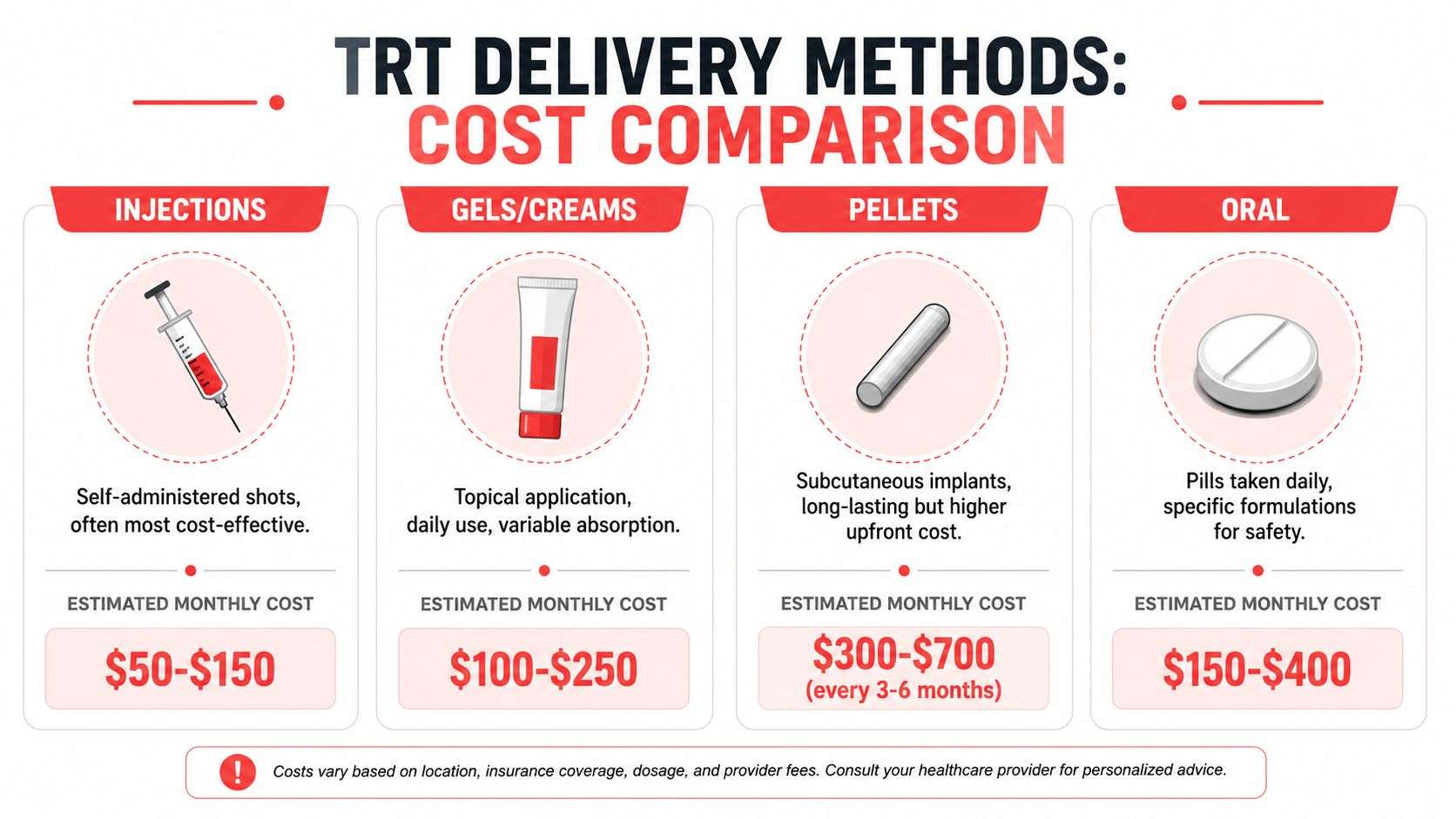
The medication itself is only one line item. Some forms stay inexpensive at the pharmacy but require supplies or more active self-management. Others feel simpler day to day, yet shift the cost into procedures, brand pricing, or repeat office visits. That is why a side-by-side comparison works best when it reflects the full care model, not just the prescription label.
Injections
Injections are usually the lowest medication-cost option, especially when prescribed as a generic and filled through a standard pharmacy. The FDA lists testosterone cypionate injection as an approved generic product, and that generic availability is one reason injections often become the baseline cash-pay option in routine practice, as shown in the FDA's approved drug database for testosterone cypionate injection.
That lower drug cost does not mean "cheap" in every setting. A patient still needs syringes, needles, a sharps container, periodic labs, and clinician follow-up. If the clinic requires in-office administration, the annual cost can climb quickly even when the vial itself is affordable.
Pros and cons are fairly consistent:
- Usually the lowest pharmacy spend: Generic injectable testosterone is commonly the price anchor.
- Good dose flexibility: Adjustments are easier than with pellets.
- More active participation: Self-injection technique, supply ordering, and scheduling matter.
- Possible added visit costs: This shows up when injections are done in clinic instead of at home.
For patients focused on long-term budget control, injections often offer the best value. For patients who dislike needles or want minimal hands-on involvement, the lower price may not feel worth the trade-off.
Gels and creams
Topicals appeal to patients who want to avoid injections and procedures. The routine is straightforward. Apply daily, wash hands, and stay consistent.
The financial trade-off is less friendly. The Cleveland Clinic notes that topical testosterone products can be more expensive than injectable generics and require daily use, which is one reason total yearly spending often runs higher for patients paying cash through retail pharmacies, according to its patient guide to testosterone replacement therapy.
There is also a practical cost beyond the receipt. Daily treatment creates more chances for missed doses, refill interruptions, skin irritation, or concern about transfer to a partner or child. Some patients start gels for convenience and later decide the daily routine is more burdensome than a weekly injection schedule.
Pellets
Pellets shift the pricing model from pharmacy-heavy to procedure-heavy. That distinction matters.
The American Urological Association describes pellet therapy as an implanted option that requires an in-office procedure and provides testosterone over time rather than through daily or weekly dosing, as explained in its patient education overview of testosterone therapy. For budgeting, that means patients are not just paying for testosterone. They are paying for the insertion, the clinician's time, and the limited flexibility that comes with a longer-acting treatment.
Some patients like pellets because there is less day-to-day maintenance between insertions. I also caution patients about the downside. If the dose needs to be adjusted, you do not have the same control you get with injections or topicals. A modality that feels convenient on paper can become expensive if it requires more procedural visits than expected over the course of a year.
Oral capsules
Oral testosterone is the easiest option to understand and often one of the hardest to justify financially for cash-pay patients. Taking a capsule is simple. The price usually is not.
The National Library of Medicine's MedlinePlus entry on testosterone undecanoate highlights that oral testosterone is a branded prescription product with specific safety considerations and monitoring requirements, outlined in its drug information for testosterone undecanoate. In real-world pricing, oral therapy tends to sit toward the premium end of TRT care because patients are paying for convenience, brand positioning, and ongoing refill costs.
For a small group of patients, that premium may be reasonable. For many others, the yearly number makes oral therapy a poor fit unless insurance coverage is unusually favorable.
Here is the practical comparison patients should use:
| Modality | Typical cost pattern over a year | Convenience | What often gets missed |
|---|---|---|---|
| Injections | Lower medication cost, but ongoing labs, supplies, and possible visit fees | Moderate | Supply costs and administration fees |
| Gels and creams | Higher recurring pharmacy spend | Daily routine | Refill cost over 12 months and adherence burden |
| Pellets | Larger upfront procedural payments | High between visits | Insertion fees and limited dose flexibility |
| Oral capsules | Higher ongoing medication cost | Very high | Premium pricing over time |
The right modality is not the one with the lowest advertised monthly number. It is the one whose full yearly cost, follow-up burden, and day-to-day routine still make sense after the first few months wear off.
The Hidden Costs and Bundled Program Traps
The biggest pricing mistake in TRT isn't choosing the wrong drug first. It's signing up for a package you don't fully understand.
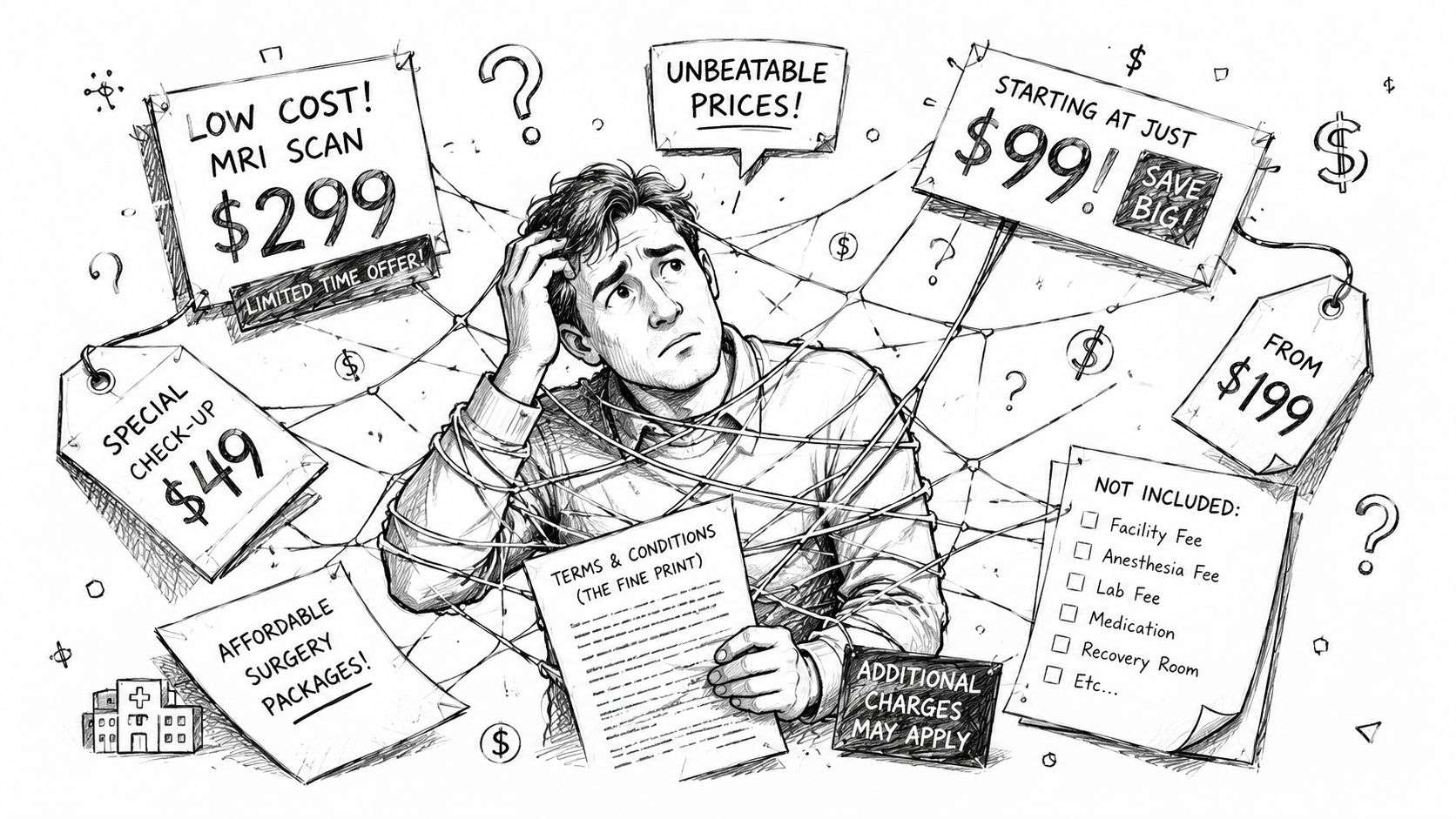
A key published warning is that the all-in cost of TRT can be hidden inside subscription models that run from $3,000 to $10,000 annually, even when the underlying medication is inexpensive. That same review notes that clinics may fold in supplements, ED drugs, growth hormone testing, and similar extras without giving patients a clear line-item breakdown. The source is this analysis of bundled TRT pricing and savings tips.
Why the cheapest ad often isn't the cheapest plan
A low monthly headline price can be real and still be misleading.
A clinic may advertise the medication cost while leaving out several categories:
- Lab charges: Testing may be billed separately at enrollment or during follow-up.
- Visit fees: A low subscription price may not include clinician reviews.
- Ancillary products: Supplements or add-on medications may appear inside the program by default.
- Administrative markups: Convenience pricing often hides in "optimization" packages rather than explicit medical fees.
This doesn't mean bundled care is bad. It means you should know whether the bundle contains necessary care, optional care, or sales-driven extras.
Questions to ask before you enroll
Patients protect themselves when they ask direct, narrow questions.
Use this checklist:
- What is the cost of the medication alone?
- What is included in the monthly or annual fee?
- Which labs are required, and which are optional?
- Are supplements or sexual health medications automatically included?
- If I stop the membership, what charges continue and what stops?
If a clinic can't explain your bill in plain language before treatment starts, expect confusion after treatment starts.
The most expensive TRT plan isn't always the one with the highest monthly fee. Often, it's the one that looked simple until the add-ons appeared.
Insurance, Financing, and Long-Term Budgeting
A common budget mistake happens before treatment even starts. A patient sees a low prescription copay, assumes TRT will stay inexpensive, and then gets separate bills for lab work, follow-up visits, or a formulation the plan does not cover.
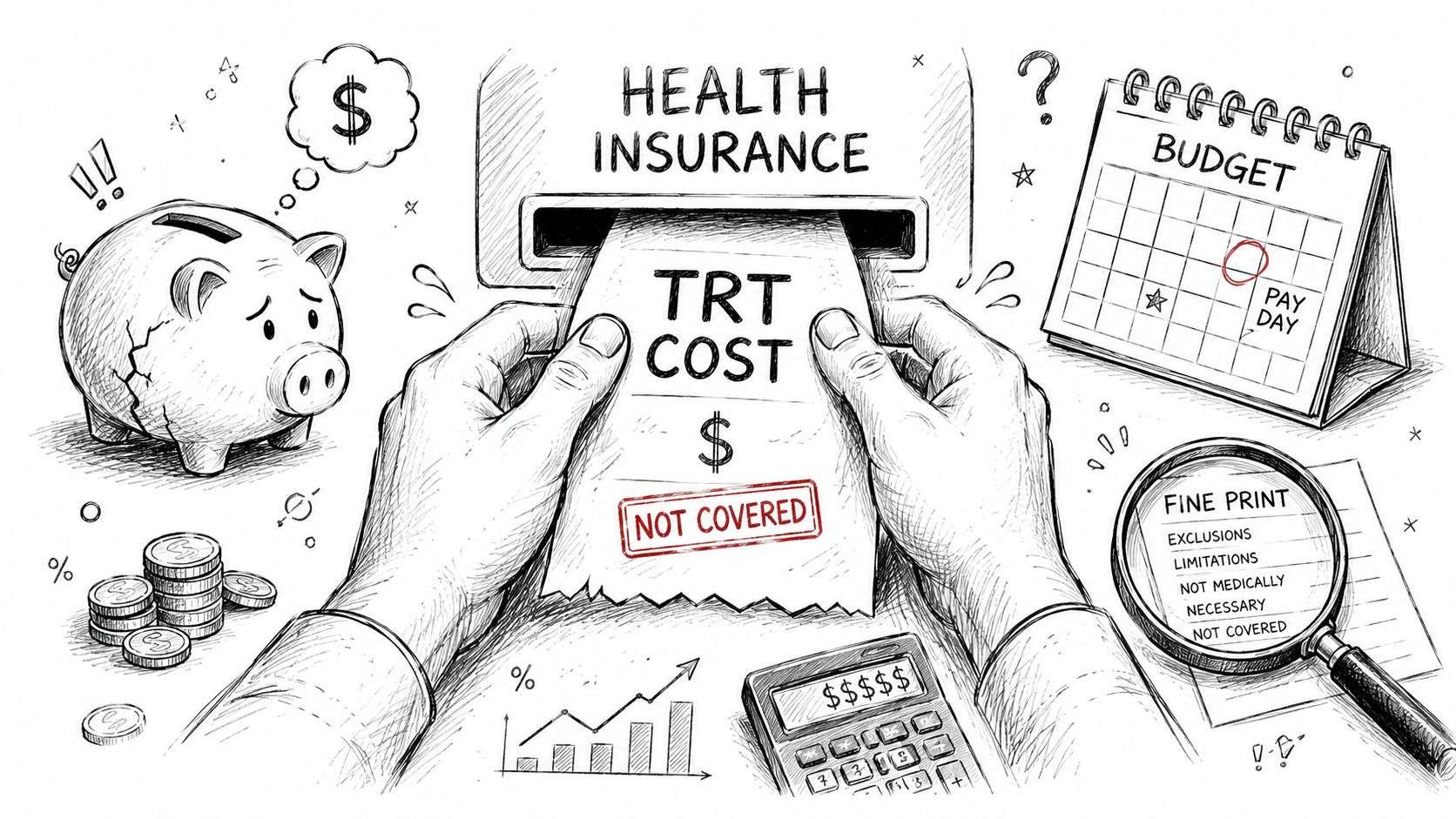
Insurance can reduce the pharmacy portion of TRT, but it rarely covers the full cost of care. Patients with strong prescription coverage may pay a modest copay for testosterone itself, while still paying out of pocket for monitoring, office visits, prior authorizations, or a delivery method their plan excludes. Cash-pay programs can look more expensive at first glance, yet sometimes include more of the care you need over a year.
What insurance may change
Insurance works best when three things line up. The diagnosis meets the plan's criteria, the prescribed modality sits on formulary, and the required monitoring is covered under your benefits.
Even then, I advise patients to price TRT as four separate categories on paper:
- Prescription cost
- Lab cost
- Follow-up visit cost
- Procedure or administration cost, if applicable
That simple breakdown prevents a lot of confusion. It also helps you compare an insured route against a cash-pay clinic without mixing medication price with total treatment cost.
If upfront charges make treatment hard to start, review the clinic's financing options for treatment costs before enrolling. Financing can help with timing, but it does not change the actual annual cost, so the numbers still need to make sense before you sign.
Why long-term math matters
The patients who budget best look at TRT over 12 months, not one refill cycle.
Procedure-based options can look reasonable when quoted as a single visit every few months. The problem is that the annual total may include repeated insertion fees, follow-up labs, and office appointments that are easy to overlook during the sales conversation. Injectable therapy often has the opposite pattern. The medication may be inexpensive, but a true comparison only becomes fair after you add monitoring and clinician follow-up.
A practical rule is to build a one-year estimate before starting care. Then ask for a three-year estimate if you are considering a higher-convenience option with recurring procedures.
That approach exposes the trade-off. You are not only choosing a monthly price. You are choosing a cost structure.
How Clinic Memberships Can Simplify TRT Costs
For the right patient, a membership model can remove a lot of financial friction.
The value isn't that memberships always make TRT cheaper. It's that they can make the cost more predictable. When consultations, medication management, follow-up care, and routine monitoring are grouped into one transparent structure, patients can budget with fewer surprises.
That matters more than people think. Uncertainty is expensive. It causes delayed treatment starts, skipped follow-ups, and frustration when charges arrive from different directions.
A good membership model should make three things obvious:
- What's included: The patient shouldn't have to guess whether labs or follow-ups are extra.
- What's optional: Add-ons should be separated from core treatment.
- What changes the fee: Different modalities or procedure-based options should be clearly explained.
If you're considering a structured care model, reviewing a clinic's membership program details can help you see whether the pricing is transparent or just packaged neatly.
The best membership plans don't hide cost. They organize it.
Frequently Asked Questions About TRT Costs
Is telehealth cheaper than in-person TRT care
Often, yes. Telehealth programs can have lower overhead and simpler pricing. In-person care may cost more, but some patients prefer direct exams, procedure access, and face-to-face follow-up. The better choice depends on your medical needs, comfort level, and whether the quote is transparent.
Can you use an HSA or FSA for TRT
In many cases, patients use HSA or FSA funds for eligible medical expenses tied to prescribed treatment. The important step is documentation. Keep receipts, itemized statements, and any required clinician paperwork. Ask the plan administrator how they classify medication, labs, and office visits.
Why might a primary care doctor hesitate to prescribe TRT
There are several reasons. Some primary care physicians prefer a specialist to handle hormone therapy because diagnosis and monitoring can be nuanced. Some are cautious about long-term follow-up demands. Others may be constrained by insurance documentation requirements or prefer to refer out when the treatment plan extends beyond routine primary care management.
If you're trying to sort out your real testosterone replacement therapy cost, not just the advertised number, Sexual Wellness Centers of America can help you review options, understand what belongs in a safe treatment plan, and evaluate whether a transparent clinic model fits your needs.