
You're probably here because erections that used to show up on their own now need more effort, more time, or don't last like they used to. That change is easy to blame on stress, fatigue, or aging, but when the pattern keeps repeating, the underlying issue is often blood flow. Vascular erectile dysfunction is the term for that problem, and once you understand how blood gets in, stays in, and then gets trapped, the whole condition starts to make sense.
If you've ever thought of erections as mostly “in the head,” it helps to reset that idea. Desire matters, nerves matter, hormones matter, but an erection is still a hydraulic event first. The simplest question is this, is blood getting into the penis fast enough, and is it staying there long enough? If not, the cause is often vascular.
Table of Contents
- What Vascular Erectile Dysfunction Actually Means
- How Blood Flow Creates and Destroys an Erection
- The Vascular Risk Factors That Drive ED
- Diagnosing Vascular ED What Each Test Tells You
- Conventional Treatments From Pills to Vascular Surgery
- Non-Surgical Regenerative Options Worth Knowing About
- Lifestyle Changes and Diabetes Management That Move the Needle
- Realistic Outcomes and When to See a Specialist
What Vascular Erectile Dysfunction Actually Means
A man in his late 40s or 50s notices a familiar pattern has changed. Erections are softer, they fade sooner, or they never quite reach the firmness he expects, and the first thought is often, “Is this just age?” That question makes sense, but age is usually not the whole story. In many men, the real bottleneck is vascular, meaning the blood supply can't deliver or hold enough pressure to create a dependable erection.
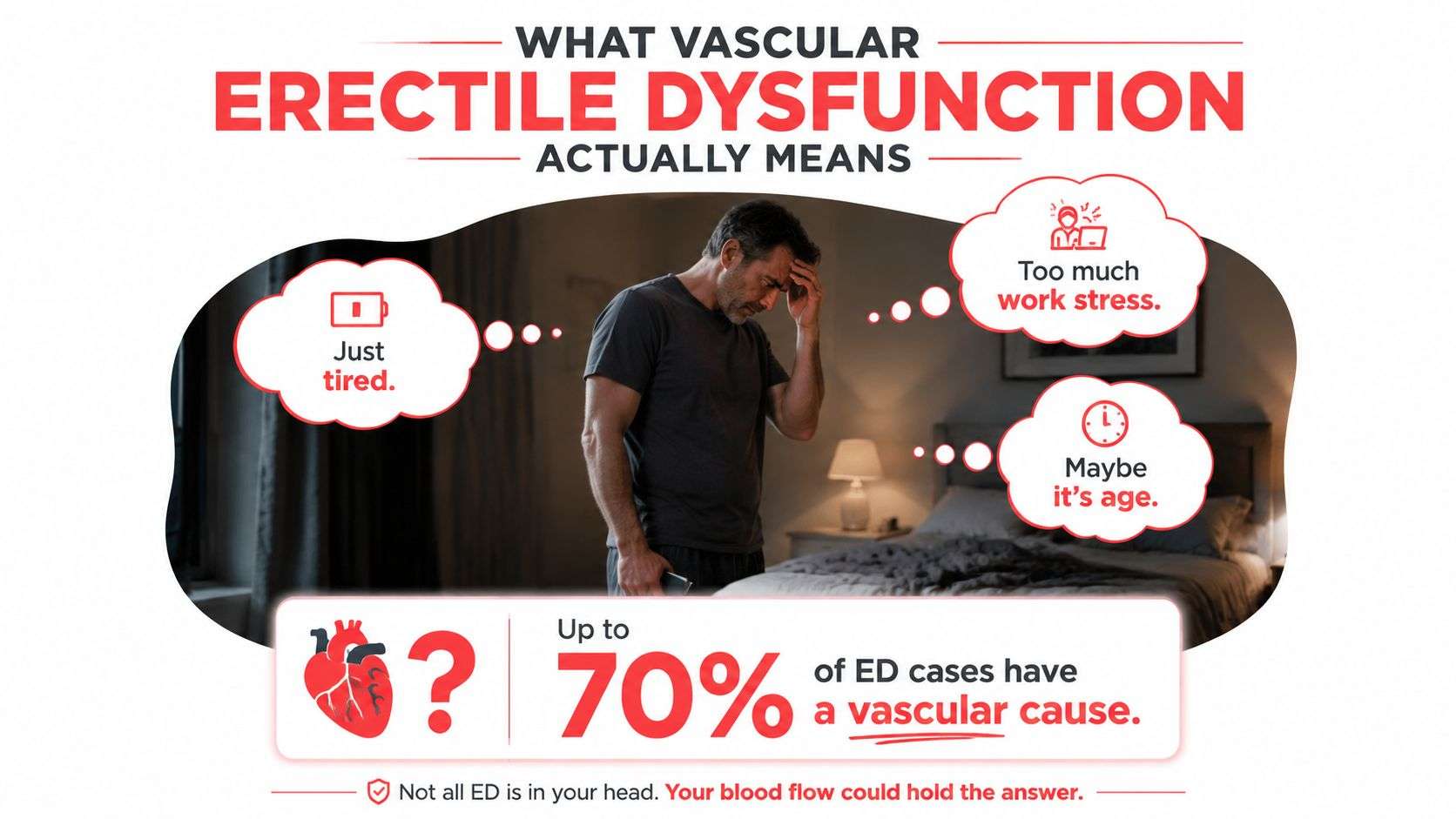
The Massachusetts Male Aging Study is still one of the clearest reminders that erectile dysfunction is common, not rare. That community survey, conducted between 1987 and 1989 in 1,709 men aged 40 to 70, found a 52% total prevalence of ED, with minimal ED in 17.2%, moderate ED in 25.2%, and complete ED in 9.6% (Johns Hopkins Medicine). Those numbers matter because they show how often erectile problems have a physical basis, even before modern screening for metabolic and cardiovascular risk became routine.
Practical rule: if erections are weaker in a steady, repeatable pattern, don't assume it's “just in your head.” Blood flow deserves a serious look.
The simple mental model
Think of the penis like a garden hose with a faucet and a pinch valve. The arteries are the faucet, they bring blood in. The veins are the exit route, and during a healthy erection they get compressed so blood stays trapped inside. If the faucet is weak, you don't fill the hose. If the pinch valve leaks, the hose fills and then drains too fast.
That's why vascular erectile dysfunction is often the first place clinicians look when a man over 40 starts to struggle. It doesn't exclude stress, hormones, or nerves. It just means the blood-flow component is usually the part that's failing first, and the rest of the workup needs to answer why.
For readers who want a practical deep-dive into related testing and wellness tools, global lab supply can be a useful starting point for understanding how lab-based thinking supports a broader medical evaluation. In this topic, the principle is the same, identify the bottleneck before choosing the fix.
How Blood Flow Creates and Destroys an Erection
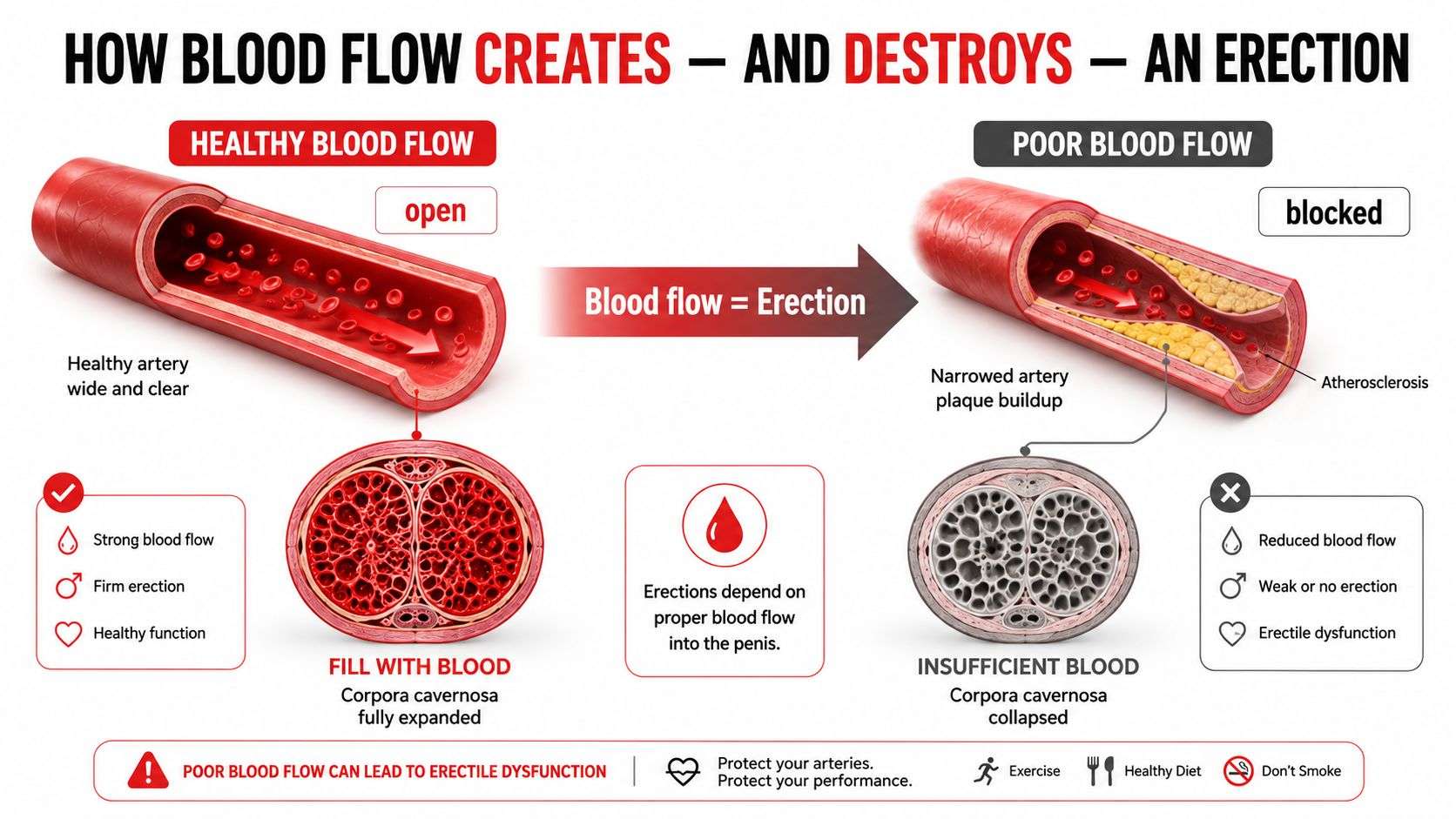
An erection is a pressure event. Blood rushes into the corpora cavernosa, those sponge-like chambers inside the penis, and as they fill, they compress the veins that would normally drain blood away. When inflow stays high and outflow stays low, rigidity holds. When either side fails, firmness drops.
Arterial insufficiency versus venous leak
The two major vascular failure modes are easy to separate once you use the hose analogy. Arterial insufficiency means not enough blood gets to the penis in the first place. Venous leak, also called failure of corporal veno-occlusion, means blood gets in but escapes too quickly to sustain rigidity.
If the hose never fills, the problem is upstream. If the hose fills and then goes soft fast, the problem is downstream.
That distinction matters because the treatment logic changes. A man with poor inflow needs a plan that improves arterial delivery or nitric-oxide signaling. A man with venous leak may need a different approach because the core issue is containment, not delivery. Treating both men the same way is one reason generic advice often disappoints.
The chemical switch behind the flow
At the tissue level, the system depends on the NO-cGMP-smooth muscle relaxation pathway. Nitric oxide helps relax cavernosal smooth muscle, which opens the vascular space and lets blood rush in. When endothelial cells are damaged by oxidative stress, inflammation, atherosclerosis, diabetes, smoking, or hypertension, nitric oxide bioavailability drops and the whole mechanism gets sluggish (PMC pathophysiology review).
That is why vascular erectile dysfunction is not just “poor circulation” in a vague sense. It is a failure of the normal relaxation and filling process. Older vascular injury can narrow arteries and lower perfusion pressure, while venous-occlusive defects can make the penis lose pressure too soon. In many men, both problems overlap.
A useful shorthand is this, blood flow creates the erection, and smooth muscle relaxation lets the blood flow happen. If either step is impaired, the erection is weaker, shorter, or absent. That's the core mechanism behind every other section in this article.
The Vascular Risk Factors That Drive ED
The same conditions that damage the heart and brain also damage penile arteries, often earlier and with fewer warning signs. That's one reason erectile problems can appear before a man thinks of himself as having “vascular disease.” The penile vessels are small, so they can show strain before larger arteries do.
Diabetes, atherosclerosis, hypertension, and smoking
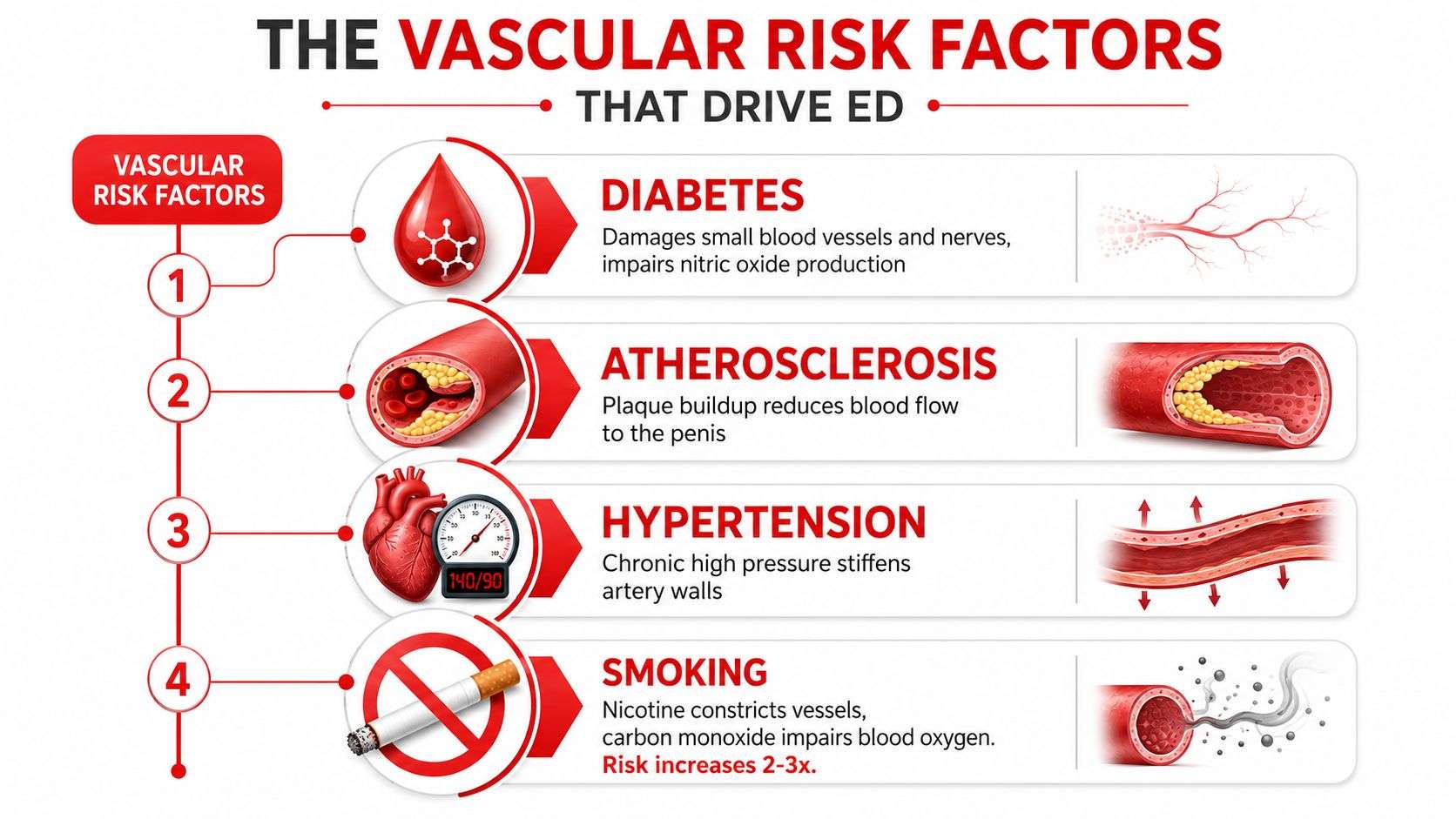
Diabetes is one of the strongest vascular threats because it injures small vessels and disrupts endothelial function. That means less nitric oxide, less smooth muscle relaxation, and more microvascular damage. It also often travels with nerve injury, so the sexual problem can be mixed rather than purely vascular. For a deeper look at that relationship, the internal guide on how diabetes affects erectile dysfunction is a useful companion piece.
Atherosclerosis is the same plaque process people hear about in heart disease, just happening in smaller vessels that feed the penis. Hypertension keeps the arterial wall under constant pressure, which stiffens and injures the lining over time. Smoking adds two hits at once, vessel constriction and accelerated vascular injury.
Clinical takeaway: the more vascular risk factors stack up, the more likely ED is to be structural rather than situational.
The important point is that these risks rarely travel alone. A man with diabetes may also have hypertension. A smoker may also have early atherosclerosis. That overlap is why vascular ED often signals a broader cardiovascular risk pattern, not just a sexual problem.
A quick self-check
If you're trying to guess whether vascular factors might be involved, start with these questions:
- Do you have diabetes or prediabetes? Blood-sugar injury is a major clue.
- Do you have high blood pressure or known plaque disease? That raises suspicion for arterial narrowing.
- Do you smoke or recently quit? Smoking history matters even if you stopped.
- Do erections fail more with time than with desire? That pattern often points away from purely psychologic causes.
The goal isn't self-diagnosis. It's to notice whether the pattern fits a blood-vessel problem strongly enough to justify a vascular-focused workup.
Diagnosing Vascular ED What Each Test Tells You
A good ED evaluation starts with the basics and gets more specific only when the story points that way. A rushed approach often misses the subtype, and that's how men end up trying treatments that were never likely to work.
Start with the history and the labs
A clinician should ask about onset, firmness, morning erections, medication use, libido, diabetes, blood pressure, smoking, and cardiovascular symptoms. That same visit usually includes lab work that looks beyond sex itself. Hormone testing often checks testosterone, prolactin, and thyroid function, while metabolic labs help show the vascular risk picture, especially blood sugar and lipids. If you want a broader explanation of hormone testing in this setting, the guide on hormone panel tests fits well here.
Those labs matter because they separate broad contributors from the more specialized vascular questions. Low testosterone can blunt desire and response. Abnormal glucose or lipid patterns can point toward the kind of vessel injury that later shows up in the penis.
The test that helps separate arterial and venous problems
The most useful non-invasive vascular screen is intracavernosal vasodilator testing combined with penile Doppler ultrasound. A vasodilator is injected into the penis, then ultrasound measures how well blood enters and exits the erectile tissue. That helps identify whether the issue is poor inflow, venous leak, or a mixed pattern. Recent review literature also notes that this distinction matters because advanced vascular procedures are most reasonable in men with focal arterial disease, not diffuse disease (Frontiers review).
The right test doesn't just confirm ED, it tells you what kind of ED you have.
That is the turning point. If the problem is diffuse atherosclerosis or widespread endothelial dysfunction, vessel repair is less likely to help. If the problem is a focal arterial lesion, the conversation changes. A specialist visit should answer one question clearly, is this an arterial inflow problem, a venous containment problem, or both?
Conventional Treatments From Pills to Vascular Surgery
Standard treatment still has a place, but each option has limits that people often gloss over. The best choice depends on what the diagnostic workup showed, not just how frustrating the symptoms feel.
Medications and devices
PDE5 inhibitors such as sildenafil, tadalafil, and vardenafil work by enhancing the NO-cGMP pathway. They don't create blood flow from nothing. They make the existing relaxation signal more effective, which is why they can help men with milder endothelial dysfunction but often fall short when the vascular damage is more severe. The more the tissue is damaged, the less room these pills have to work.
Vacuum erection devices take a different route. They use mechanical suction to draw blood into the penis and then a constriction ring helps trap that blood. That can be useful when the vascular system is weak, because the device partly bypasses the usual inflow problem. It's a workaround, though, not a repair.
Surgery only fits a narrow group
Vascular surgery is not a blanket solution. Penile artery revascularization and venous ligation are most plausible in carefully selected men, especially younger patients with focal arterial injury, often after pelvic trauma. They are far less compelling in older men with diffuse atherosclerosis or mixed vascular disease, because there isn't a single clean vessel problem to fix. The PubMed-indexed vascular surgery population data also underline how severe ED can be when vascular disease is already established, with ED present in 90% of those cases and moderate or severe ED in 70% (PubMed study).
Conventional treatment can absolutely help the right patient, but it often either supports the mechanism or masks the symptom. It doesn't always repair the underlying tissue problem, which is why some men keep looking for options that aim deeper.
Non-Surgical Regenerative Options Worth Knowing About
Regenerative care is getting attention because it tries to improve the tissue itself instead of only forcing an erection temporarily. That doesn't mean every claim is proven equally well, but it does mean the conversation is different from a simple pill discussion.
What these approaches are trying to do
Acoustic wave therapy uses low-intensity pulses aimed at stimulating a healing response and neovascularization, which is new vessel growth in treated tissue. Laser therapy is used with the goal of improving cellular and mitochondrial function in erectile tissue. Concentrated regenerative injections aim to deliver healing factors directly into the corpora to support repair and endothelial recovery.
The logic is straightforward, if the problem is damaged tissue and poor microcirculation, then a protocol that tries to restore tissue health may be more relevant than one that only boosts short-term blood trapping. That's the appeal. The challenge is patient selection, because diffuse vascular disease, severe endothelial injury, and non-vascular causes tend to respond less predictably.
The internal guide on shockwave therapy for ED success and what the studies show is a useful companion if you want a deeper look at one of these modalities.
Regenerative options at a glance
| Option | Mechanism | Typical Protocol | Best Fit For |
|---|---|---|---|
| Acoustic wave therapy | Stimulates tissue healing and vessel growth | Clinic-based sessions over a course of visits | Men with vasculogenic ED who want a non-surgical option |
| Laser therapy | Targets tissue health and cellular function | Repeated in-office treatments | Men looking for a supportive regenerative approach |
| Concentrated injections | Delivers regenerative factors into erectile tissue | In-office protocol tailored to the patient | Men with selected tissue-repair goals and appropriate evaluation |
The publication from Sexual Wellness Centers of America describes combined regenerative protocols and cites 97.2% efficacy in trials and 98% in a separate cited study on its site, while emphasizing individualized treatment planning. Those figures should be read in the context of protocol design and patient selection, not as a promise for every man. In practice, the most useful question is not “does regeneration sound advanced?” It's “does this patient have a vascular pattern that can respond to tissue-focused care?”
Lifestyle Changes and Diabetes Management That Move the Needle
No treatment works well on a neglected vascular baseline. If the arteries are inflamed, stiff, or chemically stressed, every other therapy has to fight uphill. That's why daily habits matter, not as moral advice, but as vascular support.
What actually helps
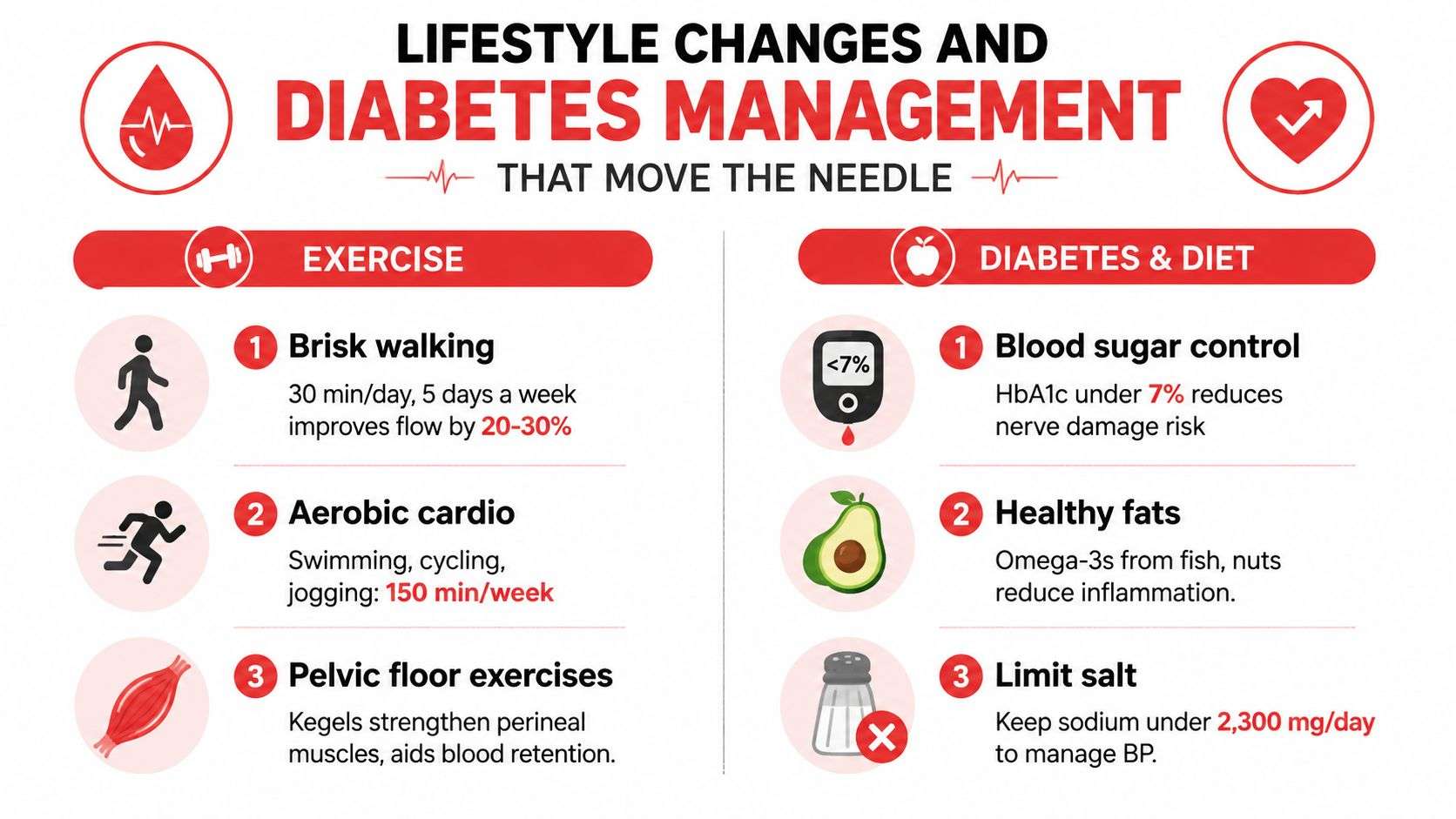
Regular aerobic exercise supports endothelial function and circulation. A heart-healthy eating pattern, especially one that reduces excessive sodium and prioritizes better fats, supports blood pressure control and vascular flexibility. Smoking cessation matters because it removes a constant source of vessel injury. For men with diabetes, tighter glycemic control is not just about long-term complications, it's part of the erectile plan.
If meal structure is the sticking point, a practical resource like a low sodium high protein meal plan can help translate the idea into daily food choices. The point isn't perfection. It's reducing the vascular load that keeps the penis from responding normally.
Bottom line: lifestyle changes don't replace treatment in established vascular ED, but they make every other treatment more likely to work.
Supplements get a lot of hype, but most over-the-counter “ED boosters” don't have strong evidence behind them. Lab-guided supplementation is a different conversation. If a deficiency is present, fixing it can matter, but random stacking usually doesn't solve a blood-flow disorder.
Realistic Outcomes and When to See a Specialist
Some men improve quickly with pills or a device. Others need a layered plan that includes vascular treatment, lifestyle change, and hormone optimization. The right expectation is steady progress, not a magic switch. If erectile problems are persistent, started suddenly, happen at a young age, or come with pain, curvature, or cardiovascular symptoms, it's time to see a specialist rather than wait it out.
When the pattern suggests vascular disease, a focused evaluation can separate arterial insufficiency, venous leak, and mixed causes, which makes treatment far more rational. Persistent ED despite lifestyle change is a strong reason to escalate. So is ED in men under 40, because that raises the odds of a specific underlying problem rather than simple age-related decline.
If you want a medical team that evaluates erectile dysfunction through a vascular and hormonal lens, Sexual Wellness Centers of America offers clinic-based assessment and regenerative care in one setting. Visit Sexual Wellness Centers of America to explore evaluation, treatment planning, and whether a vascular-focused approach fits your situation.