
Why Knowing Your IM Administration Sites Matters
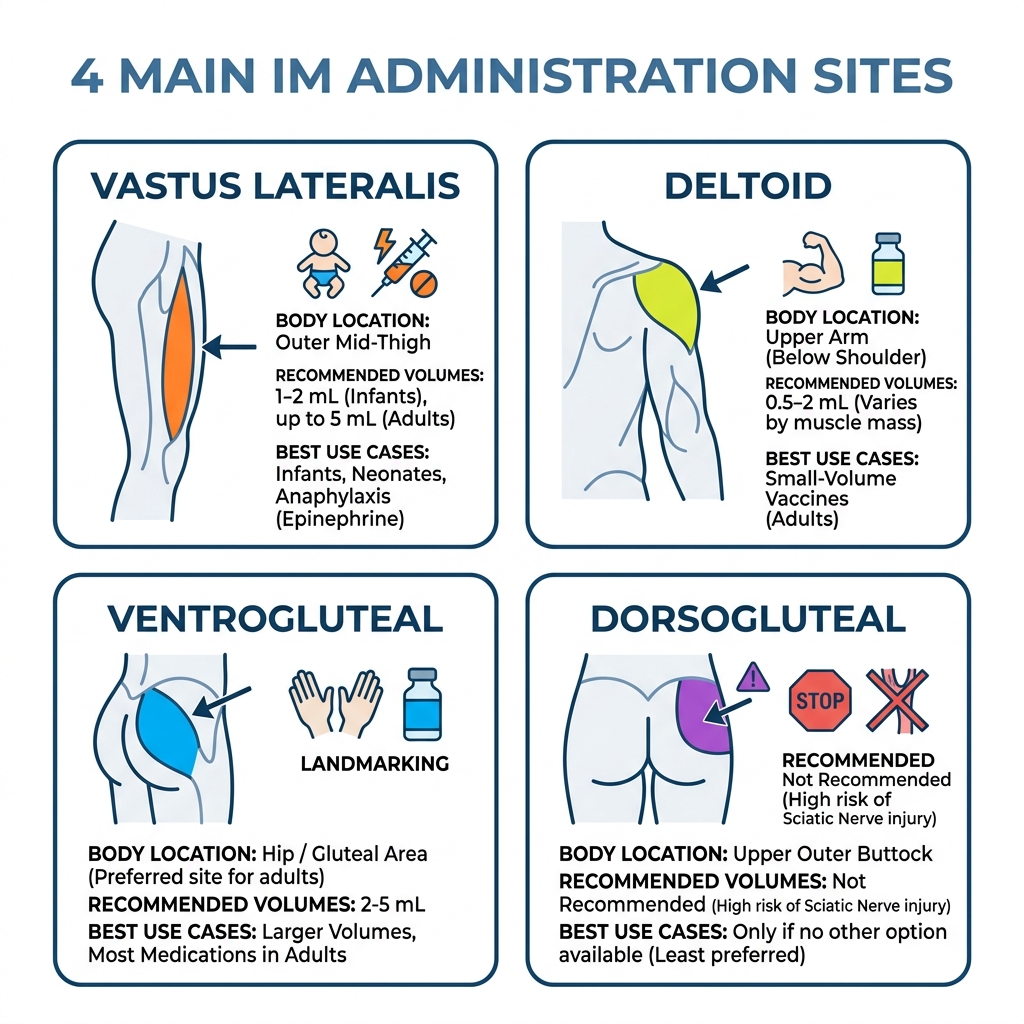
IM administration sites are the specific muscle locations used to deliver injections directly into muscle tissue. Here is a quick overview of the main sites:
| Site | Location | Best For |
|---|---|---|
| Vastus lateralis | Outer mid-thigh | Infants, neonates, anaphylaxis |
| Deltoid | Upper arm | Adults, small-volume vaccines |
| Ventrogluteal | Hip/gluteal area | Adults, larger volumes |
| Dorsogluteal | Upper buttock | Adults only, less preferred |
Choosing the wrong site — or using poor technique — can lead to nerve damage, poor medication absorption, or painful site reactions. As one clinical guideline puts it: poor technique and incorrect landmarking can lead to site reactions, sub-optimal medication absorption, and adverse events.
That is why site selection is one of the most important steps in giving a safe, effective IM injection.
This is especially relevant if you are managing hormone therapy, peptides, or other treatments that require regular IM dosing. Getting it right every time protects both your comfort and your results.
I’m Jeff Nuziard, CEO of Sexual Wellness Centers of America, and through years of guiding patients through hormone therapy and advanced wellness treatments, I’ve seen how proper knowledge of IM administration sites can make or break a treatment outcome. Let’s walk through everything you need to know to inject safely and confidently.
Im administration sites terms to remember:
Choosing the Right IM Administration Sites
Selecting the right spot for an injection isn’t just about finding a soft place to poke; it’s a clinical decision based on anatomy, age, and the type of medication being used. When we talk about im administration sites, we are looking for large, well-developed muscles that are far away from major nerves and blood vessels.
Muscle tissue has a greater blood supply than the fatty tissue just under the skin (subcutaneous layer). This allows the medication to be absorbed into your system more quickly and effectively. However, not all muscles are created equal. We must consider the muscle mass available—for example, you wouldn’t give a 4mL dose into the small deltoid muscle of a child.
Research, such as the Scientific research on anatomically safe sites, emphasizes that certain sites are inherently safer than others due to the underlying structures. At Sexual Wellness Centers of America, we prioritize safety and efficacy, ensuring that every patient understands how to navigate their own anatomy for the best results.
Vastus Lateralis: The Preferred IM Administration Sites for Infants
The vastus lateralis is the large muscle on the outer side of the thigh. For neonates and infants under 18 months, this is the “gold standard” site. Why? Because in very young children, the gluteal muscles (the buttocks) and the deltoid (the arm) aren’t yet developed enough to safely hold medication.
Even for adults, the IM Shot in Thigh is a fantastic option, especially for self-administration. It is easily accessible while sitting or lying down. It is also the preferred site for administering adrenaline (epinephrine) during anaphylaxis across all age groups because of its rapid absorption rate.
Ventrogluteal vs. Dorsogluteal IM Administration Sites
The “glute” area is a common choice for larger volumes of medication, but there is a big difference between the two main options.
- Ventrogluteal (The Hip): This is widely considered the safest site for adults and children over seven months. It is located on the side of the hip, away from major nerves and blood vessels. It has a thick muscle mass and a thin layer of fat, making it ideal for most injections.
- Dorsogluteal (The Buttock): While historically popular, many modern nursing guidelines, including those from RCH Melbourne, advise against using the Gluteus Maximus IM Injection Site as the first choice. The primary risk here is the sciatic nerve. If the needle strikes this nerve, it can cause permanent pain or mobility issues. If you must use this site, precise landmarking is non-negotiable.
The Deltoid Muscle for Small Volume Injections
The deltoid is the triangular muscle on the upper arm. It’s the site most of us are familiar with from yearly flu shots or COVID-19 vaccines. It is convenient because you don’t have to undress, but it has limitations. Because the muscle is relatively small, it can only handle small volumes of medication—typically 1 to 2 mL. It is generally recommended for adults and children aged 3 to 18 who have sufficient muscle mass.
Landmarking and Technique for Safe Delivery
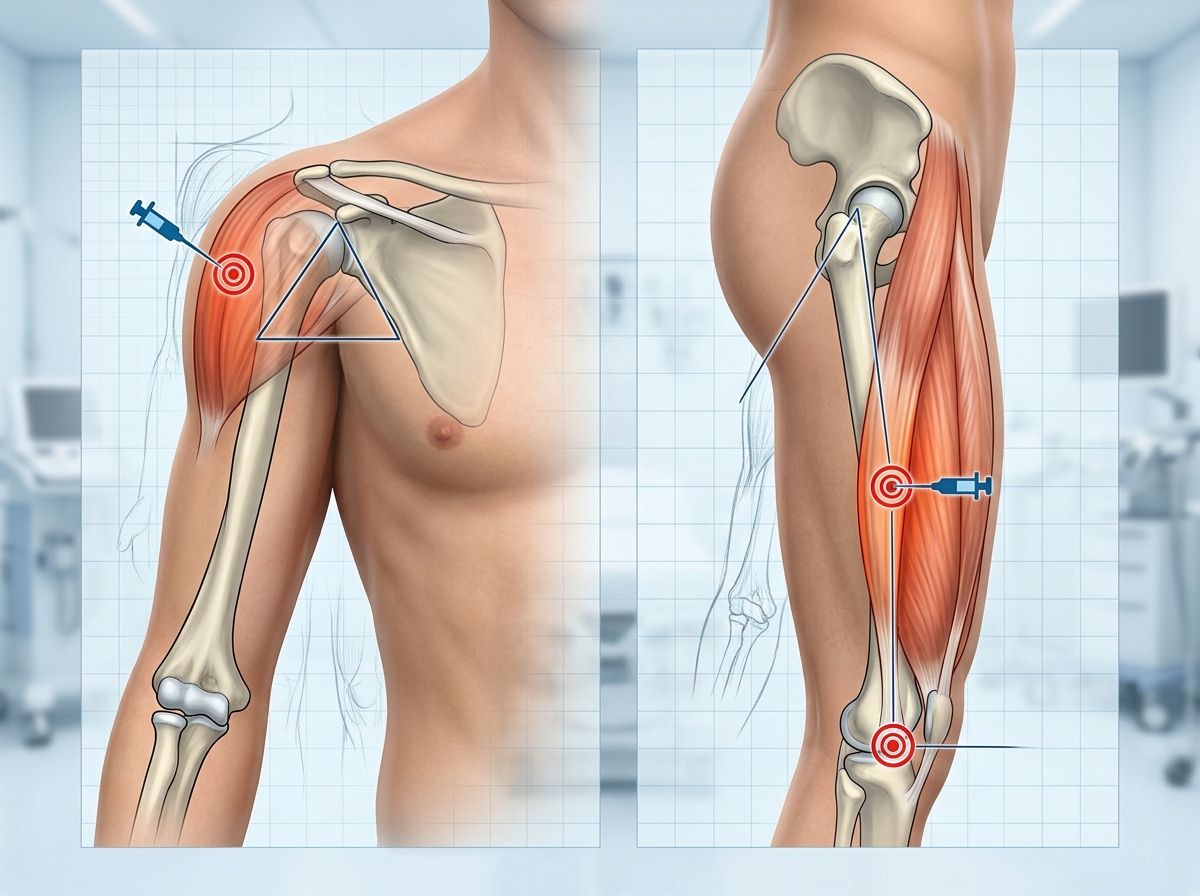
“Landmarking” is the process of using your bones and joints to find the exact “bullseye” for the needle. You should never just “guess” where the muscle is. Using proper anatomical landmarks ensures the needle reaches the deep muscle tissue without hitting a bone or a major vessel.
According to The Australian Immunisation Handbook, the needle should always enter the skin at a 90-degree angle. This ensures the medication goes deep into the muscle rather than getting stuck in the subcutaneous fat, which can cause irritation and poor absorption.
Identifying the Greater Trochanter and Iliac Crest
To find the ventrogluteal site, we use the “V-method.”
- Place the palm of your hand over the greater trochanter (the bony part that sticks out at the top of your thigh bone).
- Point your index finger toward the anterior superior iliac spine (the front “point” of your hip bone).
- Spread your middle finger back toward the iliac crest (the top of your hip bone) to form a “V.”
- The injection site is right in the middle of that “V.”
This method, often referred to as Clark’s point, is anatomically safe because there are no major nerves in that specific triangle.
Locating the Mid-Thigh for Vastus Lateralis
Finding the vastus lateralis is a bit simpler.
- Divide the area between the trochanter major (top of the thigh) and the lateral epicondyle (the side of the knee) into three equal sections.
- The injection should go into the middle third, on the outer (lateral) aspect of the leg.
It is important to stay on the side of the leg. Research shows that the IM Injection Gluteal Muscle area and the front of the thigh (rectus femoris) have a much higher concentration of blood vessels. In fact, major blood vessels were observed at the middle of the rectus femoris in up to 78.6% of females in some studies, while the middle of the vastus lateralis had 0% vessel interference.
Needle Selection and Volume Limits by Age
Using the wrong needle is like using the wrong tool for a home repair—it just won’t work correctly. If the needle is too short, the medication ends up in the fat. If it’s too long, it might hit the bone.
Appropriate Gauges for Pediatric vs. Adult Patients
The “gauge” refers to the thickness of the needle. A higher number means a thinner needle.
- 22-25 Gauge: These are standard for most IM injections.
- Length: For adults, a 1-inch (25mm) needle is usually sufficient for those under 90kg. For patients who are larger or have more subcutaneous thickness, a 1.5-inch (38mm) needle is preferred to ensure it reaches the muscle.
- Pediatrics: Neonates and infants typically require a 25mm needle (23g or 25g).
Maximum Medication Volumes per Site
You can’t pour a gallon of water into a pint glass, and you can’t force too much medication into a small muscle. Overfilling a site causes extreme pain and can lead to tissue necrosis.
| Age Group | Vastus Lateralis | Deltoid | Ventrogluteal |
|---|---|---|---|
| Neonate | 0.5 – 1 mL | Not Rec. | Not Rec. |
| Infant | 1 – 2 mL | Not Rec. | 1 mL (if mass exists) |
| Child (3-18) | 2 – 3 mL | 0.5 – 1 mL | 2 mL |
| Adult | 3 – 5 mL | 1 – 2 mL | 2 – 3 mL |
Minimizing Complications and Pain
We know that “getting a shot” isn’t exactly on anyone’s list of favorite activities. However, there are several techniques we use at Sexual Wellness Centers of America to make the process nearly painless.
One of the most effective methods is the Z-track technique. This involves pulling the skin and underlying tissue to one side before inserting the needle. After the injection, the skin is released. This creates a “zigzag” path that seals the medication inside the muscle and prevents it from leaking back into the subcutaneous tissue. This is especially helpful for oily medications like testosterone.
Rotation is also key. If you are on a weekly injection schedule, don’t use the same spot every time. This prevents the buildup of scar tissue, which can make future injections more painful and less effective. For more on how athletes manage this, check out IM Injections for Athletes Benefits and Recovery.
Why Aspiration is No Longer Recommended for Children
You might remember a healthcare provider pulling back on the syringe plunger before injecting to check for blood. This is called aspiration. Current guidelines from the CDC and RCH Melbourne now state that aspiration is not recommended for most IM injections, especially in children.
Studies show that aspiration does not increase safety but does increase the time the needle is in the skin, which increases pain and anxiety. Since the recommended im administration sites are chosen specifically because they lack large blood vessels, the risk of injecting into a vein is extremely low.
Preventing Nerve and Blood Vessel Damage
The biggest fear many people have is “hitting a nerve.” By staying within the landmarks we discussed, you avoid the sciatic nerve (in the glutes) and the femoral artery (in the thigh).
A cross-sectional study using ultrasound Doppler confirmed that the middle of the vastus lateralis is the safest thigh site, with no major vessels or nerves within 1 cm of the injection point in the vast majority of patients. In contrast, the rectus femoris (the front of the thigh) often has nerve branches within 1 cm of the surface.
Frequently Asked Questions about IM Injections
What is the safest site for a self-administered IM injection?
For most people, the vastus lateralis (outer thigh) is the safest and easiest site for self-administration. It allows you to use both hands to landmark and stabilize the syringe while you are in a comfortable seated position.
Which needle size should be used for an adult deltoid injection?
For a standard adult deltoid injection, a 22-25 gauge needle that is 1 to 1.5 inches long is standard. The 1-inch needle is usually sufficient for adults weighing less than 90kg (200 lbs), while the 1.5-inch needle is better for those with more tissue to ensure the medication reaches the muscle.
Why is the ventrogluteal site preferred over the dorsogluteal site?
The ventrogluteal site is preferred because it lacks major nerves and blood vessels, has a consistent muscle thickness, and is less likely to result in an accidental subcutaneous injection. The dorsogluteal site carries a significant risk of injuring the sciatic nerve, which can lead to foot drop or permanent nerve pain.
Conclusion
Mastering the use of im administration sites is a vital skill for anyone taking charge of their health through injectable therapies. Whether you are using the vastus lateralis for ease of access or the ventrogluteal site for larger volumes, proper landmarking and needle selection are your best defenses against complications.
At Sexual Wellness Centers of America in Colleyville, TX, we don’t just provide treatments; we provide the education you need to succeed. Our innovative protocols, including the HEshot®™, SHEshot®™, and REGENmax® technology, are backed by comprehensive hormone and vitamin panels to ensure a personalized approach to your wellness.
We are proud of our 97.2% efficacy rate in erectile dysfunction reversal and our commitment to using the latest science to help our patients feel their best. If you have questions about your treatment or need guidance on how to safely administer your medications, we are here to help.
Ready to take the next step in your wellness journey? Explore our Services IM Injections Colleyville TX and discover how personalized care can transform your life.