
The most common advice women hear about sexual problems is also one of the least helpful: “It's just stress,” “It's part of aging,” or “Try to relax and give it time.” Sometimes stress does matter. Hormones do change. Relationships do affect desire. But that doesn't mean pain, dryness, low arousal, or orgasm changes should be brushed off as inevitable.
That dismissal is especially frustrating because women already use clinics as a major point of contact with the healthcare system. In Guttmacher Institute reporting on sexual and reproductive health visits, 70% of U.S. women of reproductive age, about 44 million women, made at least one visit for sexual and reproductive health services in 2015 to 2019, and 77% of those receiving care went to a private provider. Women are showing up for care. The deeper problem is that many still leave without answers to the sexual concerns affecting comfort, confidence, and intimacy.
A modern women's sexual health clinic exists for that gap. It treats sexual wellness as part of health, not as a vanity issue or an awkward side note. If you've been told your symptoms are normal when they clearly aren't normal for you, there are better questions to ask and better ways to evaluate treatment.
Table of Contents
- Beyond the Annual Exam What Is a Womens Sexual Health Clinic
- Common Reasons to Visit a Sexual Health Specialist
- A Closer Look at Modern Sexual Health Therapies
- Your First Visit What to Expect from Consultation to Treatment
- How to Choose the Right Womens Sexual Health Clinic
- Your Partners in Wellness at Sexual Wellness Centers of America
- Frequently Asked Questions About Sexual Health Treatments
Beyond the Annual Exam What Is a Womens Sexual Health Clinic
A women's sexual health clinic goes beyond routine gynecology. A standard annual visit often focuses on screening, contraception, infection concerns, and general reproductive care. A sexual health clinic still understands those basics, but its center of gravity is different. It focuses on function, comfort, response, and quality of life.

The easiest comparison is this: a general exam tells you whether anything obvious is wrong. A specialist asks why sex hurts, why desire disappeared, why arousal changed, or why lubrication no longer matches what your mind wants. Those are not small questions. They affect relationships, sleep, mood, self-image, and often a woman's willingness to seek care at all.
A full-service clinic should be able to evaluate more than contraception and STI concerns. As summarized in clinical guidance on women's health services, a strong women's sexual health clinic should address sexual function, pelvic pain, menopause symptoms, and urinary complaints as part of an integrated diagnosis and treatment plan.
What makes it different
A specialized visit usually spends more time on patterns that don't fit neatly into one category:
- Pain that seems “gynecologic” but isn't simple: Burning, tearing, or deep aching can involve tissue changes, pelvic floor tension, irritation, or hormone-related dryness.
- Desire that faded for more than one reason: Low libido can reflect menopause, medications, fatigue, stress, relationship strain, discomfort with sex, or a mix of those.
- Arousal and orgasm changes: These can involve blood flow, nerve sensitivity, tissue health, fear of pain, or the way the body has adapted after months or years of disappointing sexual experiences.
- Urinary and vaginal symptoms together: Women often notice urgency, irritation, recurrent discomfort, and sexual pain at the same time.
Practical rule: If your concern affects intimacy, comfort, or sexual response and keeps recurring, it deserves a medical workup, not a shrug.
Testing can also be more targeted. Instead of stopping at “everything looks fine,” a specialist asks whether the right problem was examined in the first place.
If you want a better sense of how routine screening fits into the bigger picture, this sexual health screening guide is a useful overview. Screening matters. It just isn't the whole story when the underlying issue is pleasure, pain, dryness, or desire.
Common Reasons to Visit a Sexual Health Specialist
Many women don't seek out a women's sexual health clinic because they think their issue sounds too personal, too complicated, or somehow not medical enough. In practice, those are exactly the concerns that belong in this setting.
The gap is real. As reflected in this overview of women seeking care for sexual health concerns, many patients are looking for help with low desire, orgasm changes, and pain with sex, issues that standard OB/GYN pages often don't explain in depth. Patients want libido, comfort, and intimacy treated as medical concerns, not folded into vague “wellness” language.
Low desire that doesn't feel like you
A common story sounds like this: a woman still loves her partner, still wants closeness, but the internal spark is gone. She may assume that means the relationship is failing or that she has to accept a new normal.
Sometimes the body is protecting itself. If sex has become dry, uncomfortable, rushed, or emotionally loaded, desire often drops first. In other cases, hormonal shifts, sleep disruption, medication effects, or chronic stress flatten interest before a woman even realizes what changed.
Pain with sex that keeps getting minimized
Another patient may say, “Insertion burns,” or “I tense up before anything happens.” She may have been treated repeatedly for infection even though the problem keeps returning or never fully matched an infection pattern.
Pain with sex can reflect tissue dryness, vaginal or vulvar sensitivity, pelvic floor muscle guarding, menopause-related changes, or a layered combination. That's why a specialist looks for triggers, timing, location of pain, and whether symptoms also show up with exercise, sitting, tampon use, or urinary complaints.
Pain during sex is never something you have to earn the right to complain about.
Changes in arousal or orgasm
Some women describe this as a “disconnect.” They may feel mentally interested but physically flat. Others can become aroused but find orgasm weaker, delayed, or absent.
That doesn't automatically mean the problem is psychological, and it doesn't automatically mean a procedure is the answer either. Blood flow, tissue elasticity, lubrication, nerve sensitivity, medication effects, and anxiety about pain can all shape orgasmic response.
Dryness and irritation after midlife changes
A woman may first notice the problem outside the bedroom. She feels dry during the day, irritated after exercise, or uncomfortable after urinating. Then sex becomes difficult, and she starts avoiding it.
This pattern often needs more than lubricant. A women's sexual health clinic looks at whether symptoms point toward menopause-related tissue change, inflammation, pelvic floor tension, or another source of irritation.
When the real concern is intimacy, not a diagnosis label
Some patients don't walk in saying “I have dyspareunia” or “I have arousal dysfunction.” They say:
- “I miss feeling normal.”
- “I avoid sex because it's easier than dreading it.”
- “I want to want it again.”
- “I don't know whether this is hormones, stress, or something else.”
Those are valid medical openings. A good specialist translates them into a structured evaluation without making you feel dramatic or embarrassed.
A Closer Look at Modern Sexual Health Therapies
The newest treatment is not automatically the right treatment. In sexual medicine, the best plan is usually the one that matches the actual cause of the symptom, not the one with the most attention online.
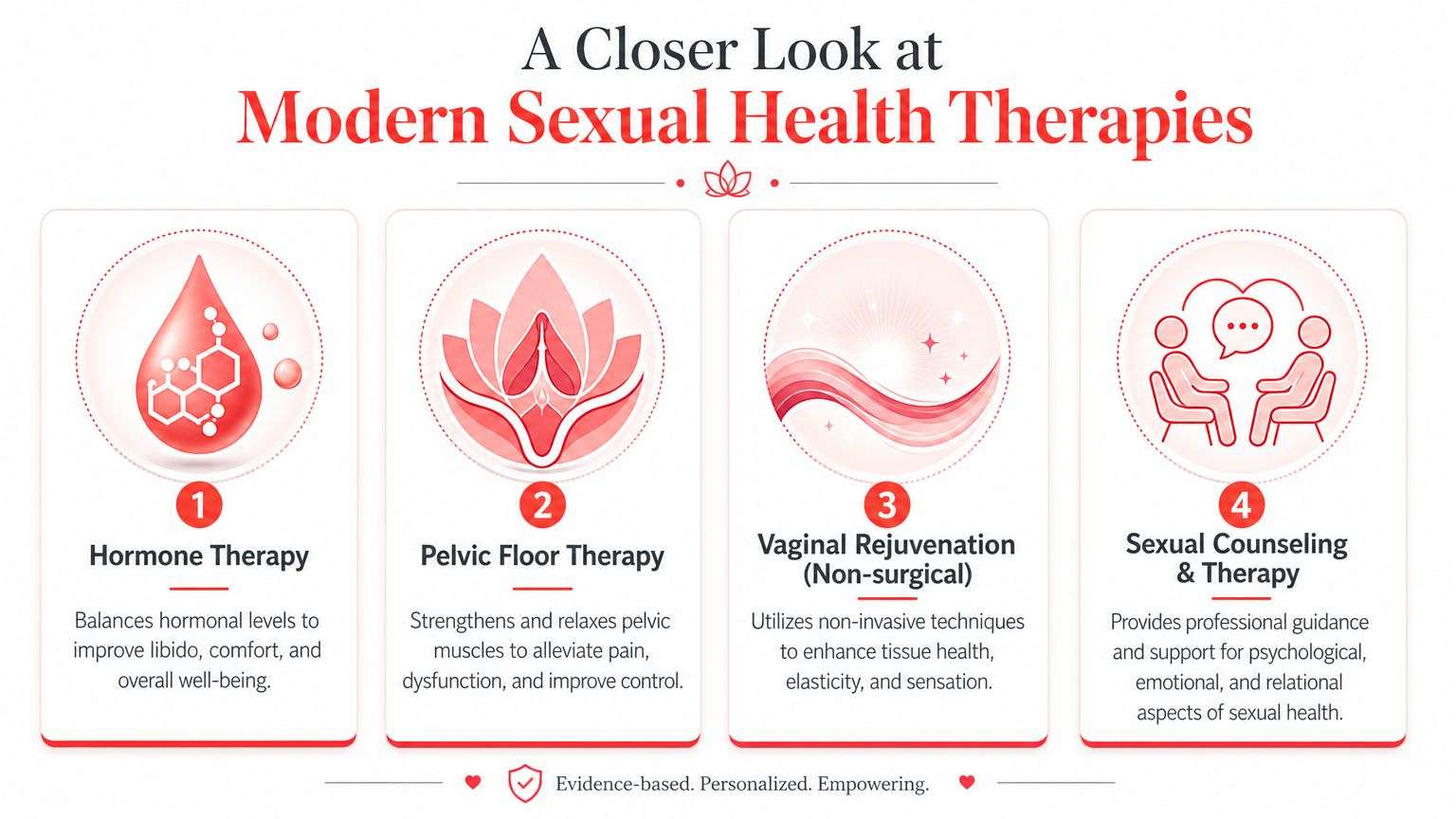
A strong women's sexual health clinic should separate established care from newer interventions with much more care than marketing usually does. As noted in guidance discussing evidence and patient expectations in women's sexual health, patients need clear explanations of what a treatment is meant to improve, how long results may take, what the limits are, and when a different diagnosis should be treated first.
Comparing Modern Sexual Health Therapies
| Therapy | Primary Target | Mechanism | Best For |
|---|---|---|---|
| Hormone therapy | Libido, dryness, tissue health, menopause-related symptoms | Adjusts hormonal environment to support comfort and sexual response | Women with symptoms that fit hormonal change |
| Pelvic floor therapy | Pain, muscle tension, penetration difficulty, pelvic dysfunction | Retrains overactive or weak pelvic muscles and improves coordination | Women with pain, guarding, or pressure symptoms |
| Non-surgical vaginal rejuvenation | Tissue quality, comfort, sensation concerns | Uses energy-based treatment to stimulate local tissue response | Women with selected symptoms after proper evaluation |
| Regenerative injection treatments | Arousal, orgasmic response, localized sensitivity concerns | Targets tissue response through injection-based protocols | Women considering specialized therapies after review of risks and evidence |
Hormone Therapy
Hormone treatment often does more for comfort and sexual function than patients expect. Local estrogen can improve dryness, burning, and tissue fragility when the problem is related to menopause or other estrogen loss. In the right setting, systemic hormone therapy may also improve sleep disruption, hot flashes, and other symptoms that affect sexual interest and response.
The trade-off is that hormones are not a universal answer. Low desire can also be shaped by medication effects, pelvic pain, relationship stress, depression, chronic illness, or poor sleep. Good care starts with pattern recognition, then matches treatment to that pattern.
Pelvic Floor Therapy
Pelvic floor therapy is one of the most useful treatments for women who have pain with penetration, muscle guarding, pressure, or a sense that their body is bracing against intimacy. I often find that patients have been told to do Kegels when overactivity, not weakness, is the problem.
Treatment may include internal and external muscle work, breathing strategies, scar or tissue mobility work, down-training, and home exercises chosen for the specific dysfunction. For women trying to understand what this care can look like in practice, this overview of Boston pelvic floor rehabilitation gives a practical example of how targeted therapy supports pelvic recovery and sexual function.
Non-Surgical Vaginal Rejuvenation
This area deserves careful counseling. Energy-based treatments may help selected patients with tissue quality, irritation, mild laxity concerns, or comfort, but they are not interchangeable with treatment for infection, skin disease, hormone loss, or pelvic floor dysfunction.
That is the real distinction many women never get.
A clinic offering non-surgical sexual health treatments should be able to explain who is a reasonable candidate, what symptoms are less likely to improve, how many sessions are usually recommended, and what evidence supports the plan. If a clinic cannot define those points clearly, the technology is being sold before the diagnosis is understood.
Advanced treatment works best when it is used selectively and for the right reason.
Regenerative Injection Treatments
Injection-based therapies are usually discussed for concerns such as diminished arousal, weaker orgasm, or reduced localized sensitivity. Some women are interested in them after childbirth, hormonal change, or a longer period of sexual difficulty that did not improve enough with first-line care.
These treatments require especially careful expectation-setting. Some patients feel a meaningful difference. Others notice little change. The responsible approach is to place them after a proper evaluation, not in place of one.
A trustworthy clinic says plainly whether a treatment is established, emerging, or still being studied, and it explains the trade-offs in the same conversation as the benefits. That level of honesty is what separates modern sexual health care from routine gynecology and from procedure-first sales.
Your First Visit What to Expect from Consultation to Treatment
Most women feel less anxious once they know what the visit looks like. A good women's sexual health clinic should feel private, organized, and unhurried. You shouldn't have to squeeze your concern into the last two minutes of a routine appointment.

The Consultation
The first conversation usually covers more than symptoms alone. Expect questions about when the problem started, whether it is constant or situational, what sex feels like now versus before, and whether the issue is desire, pain, lubrication, arousal, orgasm, or all of the above.
You may also be asked about:
- Medical history: Menopause status, surgeries, childbirth history, medications, and chronic conditions
- Symptom pattern: Burning, tearing, deep pain, dryness, urgency, irritation, or loss of sensation
- Lifestyle factors: Sleep, stress, exercise, and relationship context
- Treatment goals: Less pain, better lubrication, stronger orgasm, more desire, or a return to comfortable intimacy
The Exam and Testing Plan
Not every patient needs the same exam. Some need a focused pelvic exam. Others need infection testing, a tissue assessment, or lab work if hormone imbalance seems likely. The value of a specialist is that testing should answer a question, not just create a longer bill.
A clinic may recommend a staged plan. That can include addressing obvious contributors first, then reassessing whether more advanced treatment makes sense. If you're wondering how a walk-in or local clinic process can differ from a specialty intake, this guide on what to expect from a local sexual health clinic visit offers a useful orientation.
If a clinic recommends a procedure before clearly naming the problem it is treating, slow down.
Treatment and Follow-Up
Treatment sessions vary. Hormone care may involve prescription management and repeat review. Pelvic floor therapy usually unfolds over multiple visits with home strategies in between. Device-based or injection-based procedures are generally performed in clinic, with instructions about discomfort, activity, and follow-up.
The most important part often comes after the first intervention. A thoughtful clinic checks whether pain improved, whether desire changed once sex became more comfortable, and whether the original diagnosis still fits. Sexual health care works best when it adjusts to your response instead of locking you into a one-size-fits-all package.
How to Choose the Right Womens Sexual Health Clinic
A polished website and a long menu of treatments do not tell you whether a clinic can solve your problem. The true measure is simpler. Can the team identify likely causes, explain uncertainty openly, and match treatment to your goals instead of steering every patient toward the same procedure?
That matters even more in sexual medicine, where many women reach specialty care after months or years of being told their symptoms are normal, stress-related, or just part of aging. As noted earlier, dedicated programs are still limited, and private clinics often step in to fill that gap. That can be helpful. It also means you need to ask better questions, especially when a clinic offers newer therapies that may help some patients more than others.
Look for Clinical Reasoning, Not Just a Treatment Menu
Start with how the clinic thinks.
A strong clinic should be able to explain why pain, dryness, low desire, orgasm changes, bladder symptoms, or recurrent irritation may overlap but still require different treatment paths. In practice, that often means the visit goes beyond a routine gynecology script. The clinician should connect your history, exam findings, hormonal context, pelvic floor function, and relationship or medication factors into a working diagnosis.
Be careful with clinics that reduce every concern to one answer. A patient with menopausal dryness may need local hormone therapy. A patient with pain during penetration may need pelvic floor treatment first. A patient bothered by reduced sensation may be asking about regenerative or device-based options, but only after irritation, scar tissue, hormonal causes, or nerve-related issues have been considered.
Ask How They Talk About Evidence
Good clinics do not hide uncertainty. They explain where evidence is stronger, where treatment is used to improve symptoms even if long-term data are still developing, and what trade-offs matter for cost, recovery, maintenance, and expected benefit.
Ask direct questions:
- “What diagnosis are you treating?”
- “What else could be causing this symptom?”
- “What are the likely benefits for someone like me?”
- “What are the downsides, limits, and maintenance needs?”
- “When would you recommend a different option or no procedure at all?”
Those answers tell you a lot. If the response is vague, heavily sales-focused, or avoids discussion of who may not benefit, keep looking.
Evaluate Follow-Up Before You Commit
Sexual health treatment is rarely one-and-done. Symptoms can improve in one area and persist in another. Pain may ease before desire returns. Dryness may improve while orgasm still feels different. A thoughtful clinic plans for that reality.
Look for a practice that offers:
- A clear reassessment plan. You should know when progress will be reviewed and what outcomes the clinic is tracking.
- Willingness to adjust course. Treatment should change if your response is partial, disappointing, or points to a different diagnosis.
- Coordination across treatment types. Some women do best with a combination of hormone care, pelvic floor therapy, counseling support, or in-office procedures rather than a single intervention.
One more practical point. Ask who you can contact after treatment if something feels off, if symptoms do not improve, or if you are unsure whether the result is normal healing or a problem. Clinics that take follow-through seriously usually answer that clearly and without defensiveness.
A trustworthy women's sexual health clinic makes room for nuance. It does not promise that every advanced therapy will restore function or pleasure for every patient. It should help you understand what is most likely to improve, what may take time, and what plan makes sense for your body and your priorities.
Your Partners in Wellness at Sexual Wellness Centers of America
For women in the Colleyville and greater DFW area who want care aligned with the principles above, Sexual Wellness Centers of America offers clinic-based sexual health services that include hormone support, vaginal rejuvenation therapies, and the proprietary SHEshot® protocol. The practical value is the combination of in-office treatment options with an evaluation process that can address more than one contributor to symptoms at the same time.
That matters when your concern doesn't fit a single box. A woman may need help with dryness, orgasm changes, and hormone-related symptoms together. Another may want to discuss whether non-surgical options are reasonable before considering more invasive care. The clinic setting gives space for that discussion, along with questions about maintenance and follow-up.
If you've been putting this off because you're tired of feeling dismissed, a confidential consultation is often the clearest next step. You don't need to arrive with the right terminology. You only need to describe what has changed and what you want to feel better.
Frequently Asked Questions About Sexual Health Treatments
Are these treatments painful
It depends on the treatment and on your baseline symptoms. Pelvic floor therapy can feel tender at times, especially if muscles are already guarded. Device-based and injection-based treatments vary. A careful clinic should explain what the procedure feels like, what numbing or comfort measures are used, and what soreness is normal afterward. If pain is already one of your symptoms, that should shape the treatment plan.
How quickly will I see results
Some women notice change quickly, especially when the main problem is untreated dryness, irritation, or muscle tension. Other concerns improve more gradually. Hormone-related treatment, pelvic floor therapy, and multi-part plans usually require patience and reassessment. A reliable clinician won't promise instant transformation.
Are these services covered by insurance
Coverage often depends on the service. Visits, exams, and some medically necessary evaluation may be handled differently from regenerative or wellness-oriented procedures. Many advanced sexual function treatments are paid out of pocket. Ask for a written breakdown before you start, including follow-up costs.
How do I talk to my partner about this
Start with the medical truth, not an apology. Try: “Something has changed in my body, and I want help with it.” If sex has been painful or disappointing, explain that avoiding it wasn't rejection. It was self-protection. The best conversations are specific, calm, and focused on teamwork rather than blame.
You are not asking for too much by wanting sex to feel comfortable, connected, and possible again.
If you're ready to talk with a clinic that treats sexual function as real healthcare, Sexual Wellness Centers of America offers confidential consultations for women seeking answers about desire, discomfort, orgasm changes, hormone concerns, and non-surgical treatment options.