
You're in bed, things are going well, and then the momentum breaks. You reach for a condom, open the wrapper, start to roll it on, and your erection fades just enough to make the rest of the encounter feel tense. For a lot of men, that moment doesn't feel like a small inconvenience. It feels personal, embarrassing, and confusing.
Clinically, though, it's a familiar problem. The best condoms for erectile dysfunction aren't just the thinnest options on the shelf. The right choice supports sensory feedback, warmth, fit, and confidence so the erection has fewer interruptions to fight through. If you already deal with reduced rigidity, inconsistent firmness, or a drop in arousal during application, condom choice matters more than most generic guides admit.
Table of Contents
- The Frustrating Moment a Condom Halts an Erection
- Why Condoms Can Interfere with Erections
- Key Condom Features That Support Erections
- Practical Tips for Using Condoms with ED
- Enhancing Erections with Condom-Compatible Aids
- When Condoms Arent Enough The Path to Lasting Solutions
- Frequently Asked Questions About Condoms and ED
The Frustrating Moment a Condom Halts an Erection
A common story in practice goes like this: a man can get mostly erect during kissing, touch, or oral stimulation, but loses firmness during the pause required to put on a condom. He often assumes it means his ED is getting worse, or that he's “in his head.” Sometimes anxiety is part of it. But often the condom itself is part of the mechanism.
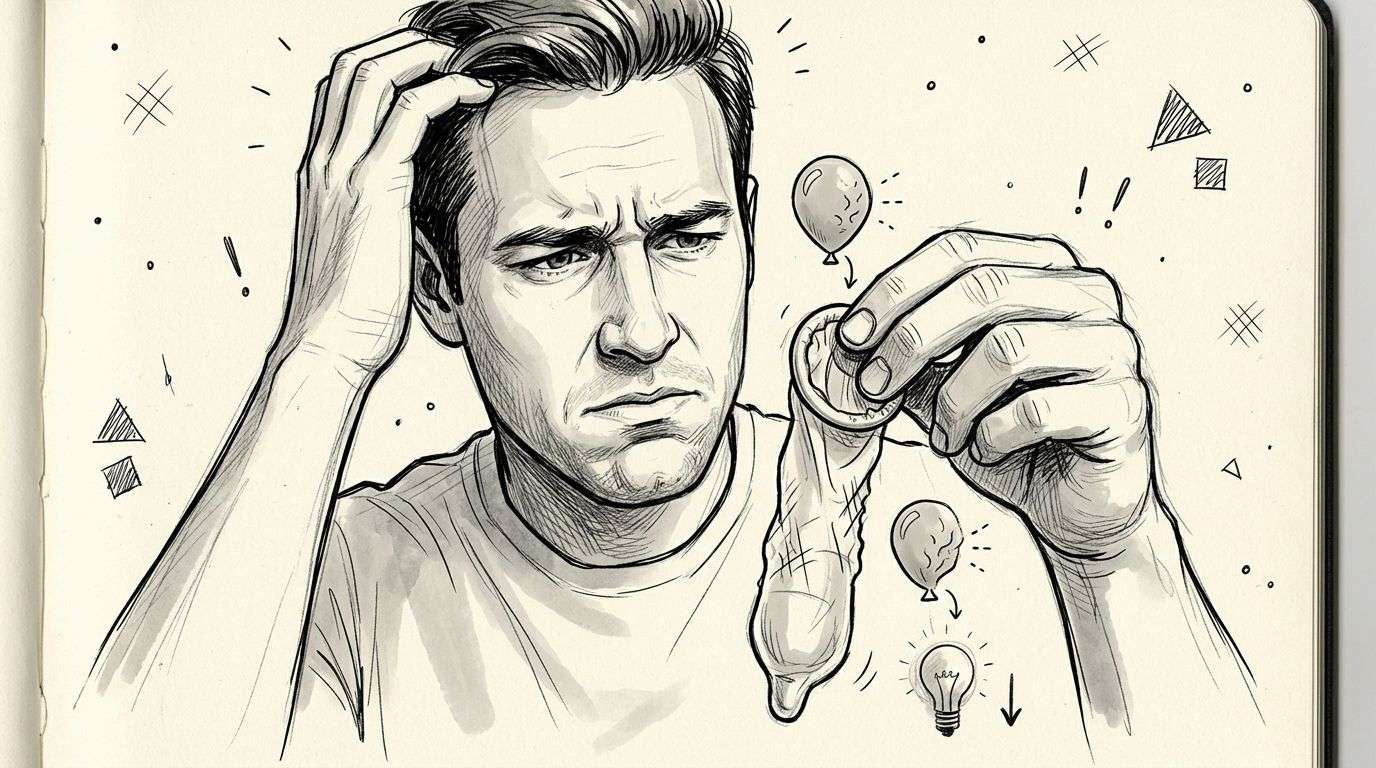
There's a medical term for this: contraceptive-related erection problems, or CAEP. Research indicates that approximately 20% of men experience CAEP, meaning the physical barrier of a condom interferes with natural blood flow and nerve response enough to contribute to erection loss during sex, according to this NIH review of condom-associated erection problems.
That matters because it changes the conversation. This isn't a confidence issue or a failure of willpower. In many men, it's a real interaction between a vulnerable erection and a barrier that reduces sensation at exactly the wrong moment.
What this usually feels like
Men rarely describe this as total erection loss out of nowhere. More often, they report one of these patterns:
- Good start, poor transition when they're aroused before the condom but soften during application
- Adequate firmness, then fading once penetration begins and sensation feels muted
- Repeated hesitation because prior condom-related losses create anticipatory worry
Clinical reality: If the erection depends on continuous sensory input to stay stable, anything that blunts touch, warmth, or rhythm can interrupt it.
Why this article matters
Many articles lump erectile dysfunction together with premature ejaculation and recommend products designed to delay climax. That's often the wrong approach. A man who already struggles to stay hard usually doesn't need less sensation. He needs a setup that preserves more of it.
The best condoms for erectile dysfunction are the ones that reduce friction in every sense of the word. Physically, neurologically, and psychologically.
Why Condoms Can Interfere with Erections
An erection isn't just a blood flow event. It's a feedback loop. Nerves detect touch, pressure, warmth, and movement. The brain interprets those signals as arousal. Blood flow and muscular responses help maintain rigidity. If that loop weakens, the erection can weaken with it.
The condom can disrupt that loop in several ways at once.
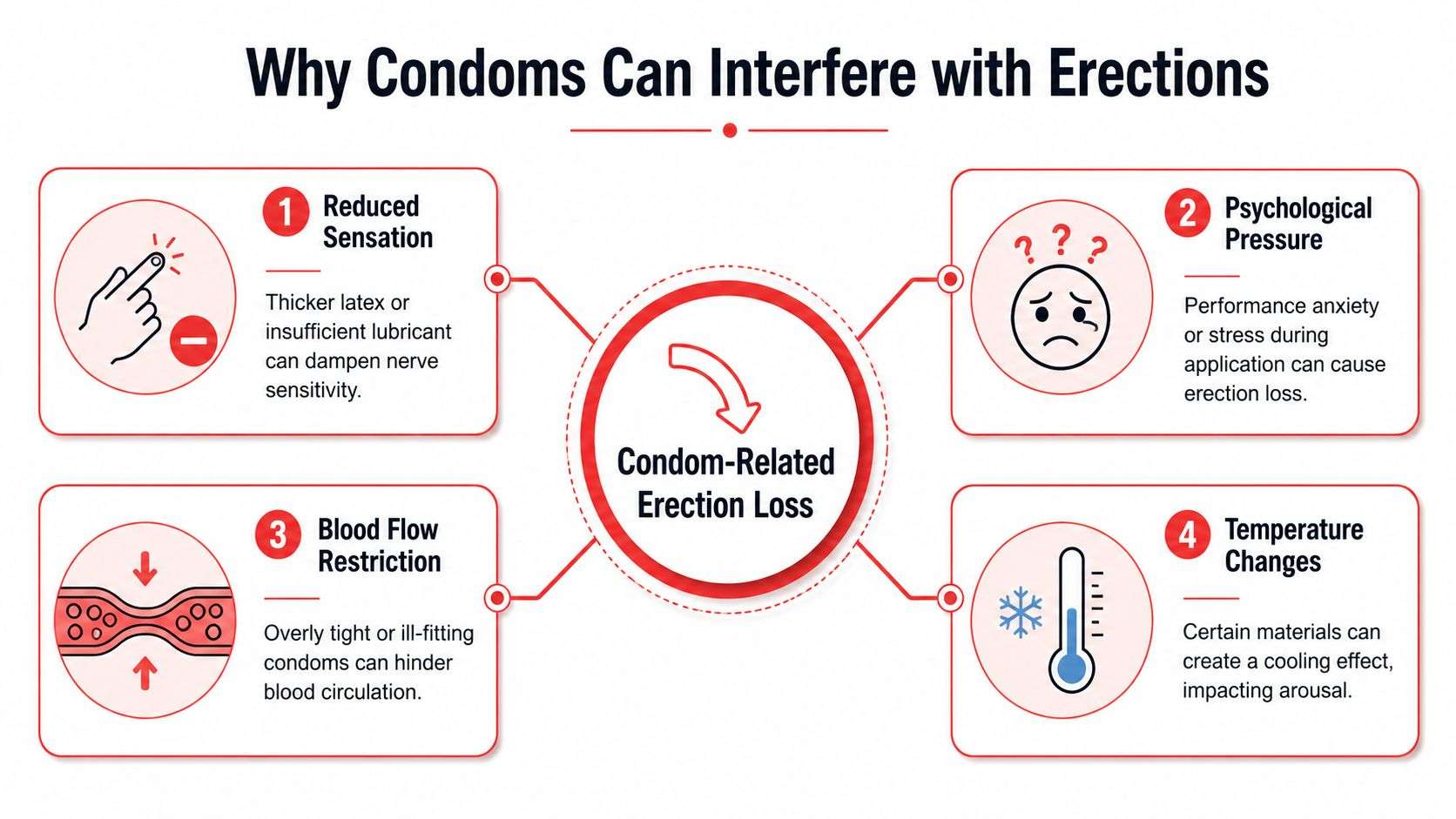
Reduced sensory input
The first issue is straightforward. A thicker barrier can dull tactile stimulation and reduce heat transfer. For a man with a strong erection, that may be only mildly noticeable. For a man whose erection is already vulnerable, that drop in sensation can be enough to break arousal continuity.
Think of it as lowering the volume on the signal your body is trying to follow. If the signal is already faint, even a small reduction matters.
Poor fit changes how the penis responds
A condom that's too loose can shift during sex, creating distracting movement and inconsistent pressure. One that's too tight can feel restrictive and uncomfortable. Neither supports a steady erection.
This is one reason discomfort during erections deserves attention more broadly. Men who notice pressure, pain, or odd tightness during arousal may also benefit from reviewing other causes of erection-related discomfort, including those described in this guide on common causes of discomfort during erections.
The pause itself can become the trigger
The condom application moment often introduces a stop-start pattern. Arousal pauses. Attention shifts to the wrapper, orientation, placement, and whether the erection will hold. If you've lost an erection during that moment before, your brain may start monitoring for it the next time.
That monitoring is rarely helpful.
Men often assume they need more confidence. Often they need fewer interruptions and better sensory conditions.
Temperature can matter too
Some materials create more of an insulating effect than others. For men with ED, preserved warmth can make sex feel more natural and less mechanical. This sounds subtle, but erections often respond to subtle changes.
A practical way to think about it is this:
| Condom factor | What it can do | Why it matters in ED |
|---|---|---|
| Thickness | Lowers touch intensity | Less nerve stimulation to support rigidity |
| Loose fit | Increases shifting | Distracts and breaks rhythm |
| Tight fit | Feels constricting | Can add discomfort and self-monitoring |
| Lower heat transfer | Makes sex feel cooler | Reduces natural sensation |
When a man understands these mechanics, the experience usually feels less mysterious. That matters. Clarity lowers shame, and lower shame makes it easier to choose solutions that fit the problem.
Key Condom Features That Support Erections
The best condoms for erectile dysfunction support erections by preserving sensation rather than muting it. That means shopping with a clinical filter, not a marketing one. Material, thickness, fit, and lubrication each affect how much sensory information gets through.
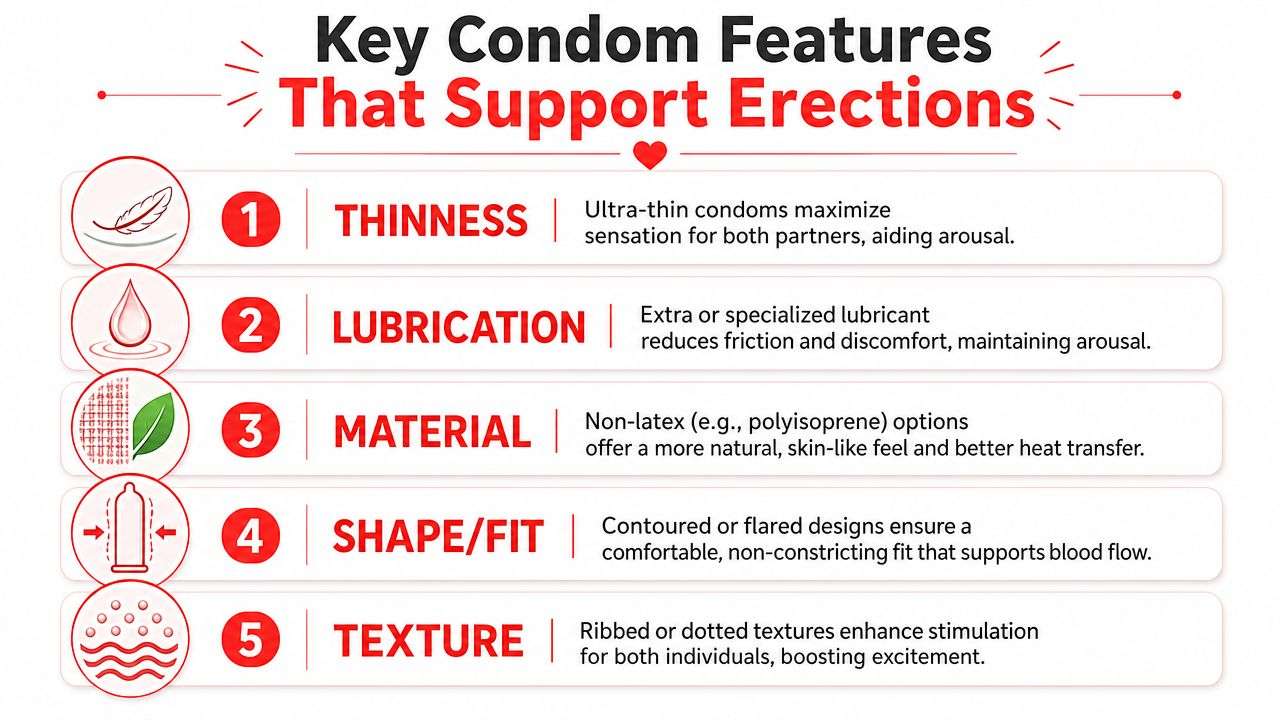
A useful benchmark comes from the literature: a 2024 study in the Journal of Sexual Medicine found that 68% of men with mild-to-moderate ED reported improved erection rigidity when using ultra-thin, non-latex polyisoprene condoms compared with standard latex, attributed to better thermal and tactile sensation, as noted by the Journal of Sexual Medicine.
Material matters more than most men realize
If a man tells me condoms make sex feel numb or distant, material is one of the first things I think about.
Polyisoprene often works well for men with ED because it tends to feel more flexible and less insulating than standard latex. The practical benefit is not just comfort. It's a more natural sensory experience. That can help a neurologically fragile erection stay engaged.
Men with latex sensitivity have another reason to consider non-latex options. Even mild irritation can create distraction, and distraction is the enemy of erection stability.
Thickness changes sensory load
Ultra-thin options are usually the right starting point for men with ED. The point isn't novelty. The point is preserving enough touch and warmth that the erection doesn't lose support after application.
A simple comparison helps:
| Feature | More likely to support erections | More likely to work against erections |
|---|---|---|
| Wall thickness | Ultra-thin | Thick or “extra safe” styles |
| Sensation profile | Sensory-preserving | Desensitizing |
| Use case | ED support | Delay-focused use |
Practical rule: If your main problem is staying hard, avoid products built to make you feel less.
Fit should feel secure, not restrictive
Fit is where many men guess instead of test. That usually leads to one of two mistakes: buying too large because they think “larger” sounds safer for comfort, or buying too tight because they assume tighter means more secure.
Neither assumption is reliable.
For men with a girth of 4.7 inches or less, snug fit is the recommended target, while a girth matching the internal diameter range of a toilet paper roll generally aligns with regular fit. The value of that rough at-home check is practical. It helps reduce micro-slippage without choosing a condom that feels strangling.
A good fit should do three things:
- Stay put during movement without bunching or rolling
- Avoid pinching at the base or creating a sharp band-like sensation
- Preserve confidence so you're not checking the condom every few seconds
Lubrication should increase sensation, not mute it
Men with ED often underestimate how much friction can interfere with arousal. Dryness increases drag, makes the condom feel more obvious, and turns sex into a mechanical experience. Extra condom-safe lubrication can make a major difference because smoother movement feels more continuous and less distracting.
What to favor and what to avoid:
- Choose lubricated condoms if you want a better baseline feel right out of the wrapper
- Add extra condom-safe lubricant if intercourse tends to feel draggy or disconnected
- Skip numbing formulas because desensitizing ingredients work against the goal of preserving input
Texture can help some couples, but it's secondary. If the condom is too thick, too dry, or the wrong fit, texture won't rescue the experience. Start with the fundamentals first.
Practical Tips for Using Condoms with ED
Buying a better condom helps, but technique matters too. A man can choose the right material and still lose his erection if application becomes rushed, awkward, or overly monitored. The goal is to make condom use feel like part of sex, not a break from sex.
Clinical benchmarks show that men with ED have a 40% higher rate of erection loss when using thick, non-lubricated condoms, while switching to ultra-thin, lubricated polyisoprene models restores erection stability by 25 to 30%, according to sexual medicine guidance from ISSM.
Build a repeatable routine
A stable routine lowers mental load. That matters because many men lose firmness during uncertainty, not just during contact changes.
Try this:
- Open the wrapper before arousal peaks so you're not fumbling at the critical moment.
- Keep stimulation going during application, whether that means touch, kissing, or partner involvement.
- Apply a small amount of condom-safe lubricant so the condom feels less dry and less noticeable.
- Roll it on deliberately, not frantically because rushing makes men monitor themselves even more.
A condom works better for ED when the body barely notices the transition.
Avoid common mistakes that sabotage sensation
Some habits make condom-related erection loss much more likely.
- Don't use climax-control condoms if your issue is erection maintenance. They're designed to reduce sensation.
- Don't wait until firmness is already fading before application. Put the condom on while the erection still has margin.
- Don't assume one failed attempt means the product is wrong forever. Sometimes the issue is timing, lubrication, or anxiety carried over from prior experiences.
One practical at-home sizing trick is the toilet paper roll check. It's not perfect, but it gives some men a useful starting point for choosing between regular and snug fits. If the penis is clearly smaller than the roll's inner diameter, a snugger fit may reduce movement and distraction.
If application itself feels like the biggest obstacle, practice alone once or twice. That removes the social pressure from the learning curve. Men often do better once the motion becomes automatic.
Enhancing Erections with Condom-Compatible Aids
Some men do everything right with condom choice and still need extra support. That doesn't mean they've failed. It means the erection needs more help than a better barrier alone can provide.
Erection rings can help maintain what you already achieve
An erection ring works by helping trap blood once an erection is present. In the right situation, that can make firmness easier to maintain through condom application and intercourse. The key is using it conservatively and safely.
Look for a body-safe, flexible ring rather than a hard device that's difficult to remove. It should feel supportive, not painful. If there's numbness, discoloration, or discomfort, remove it.
A few safety basics matter:
- Use it only for limited periods
- Avoid anything that feels sharply constrictive
- Never ignore pain or significant swelling
Vacuum support can reduce the pressure of the moment
A vacuum erection device can help some men get erect before condom application. That can be especially useful when the problem is losing momentum during transitions. It turns “can I get hard right now?” into “how do I keep this going once I am?”
For men exploring broader sexual wellness tools, this overview of top-rated intimacy enhancers gives a practical look at supportive options that may complement, but not replace, proper ED care.
Supportive aids can improve performance in the moment. They don't tell you why the erection is fragile in the first place.
That distinction matters. If you need multiple workarounds every time, the problem usually deserves a medical evaluation.
When Condoms Arent Enough The Path to Lasting Solutions
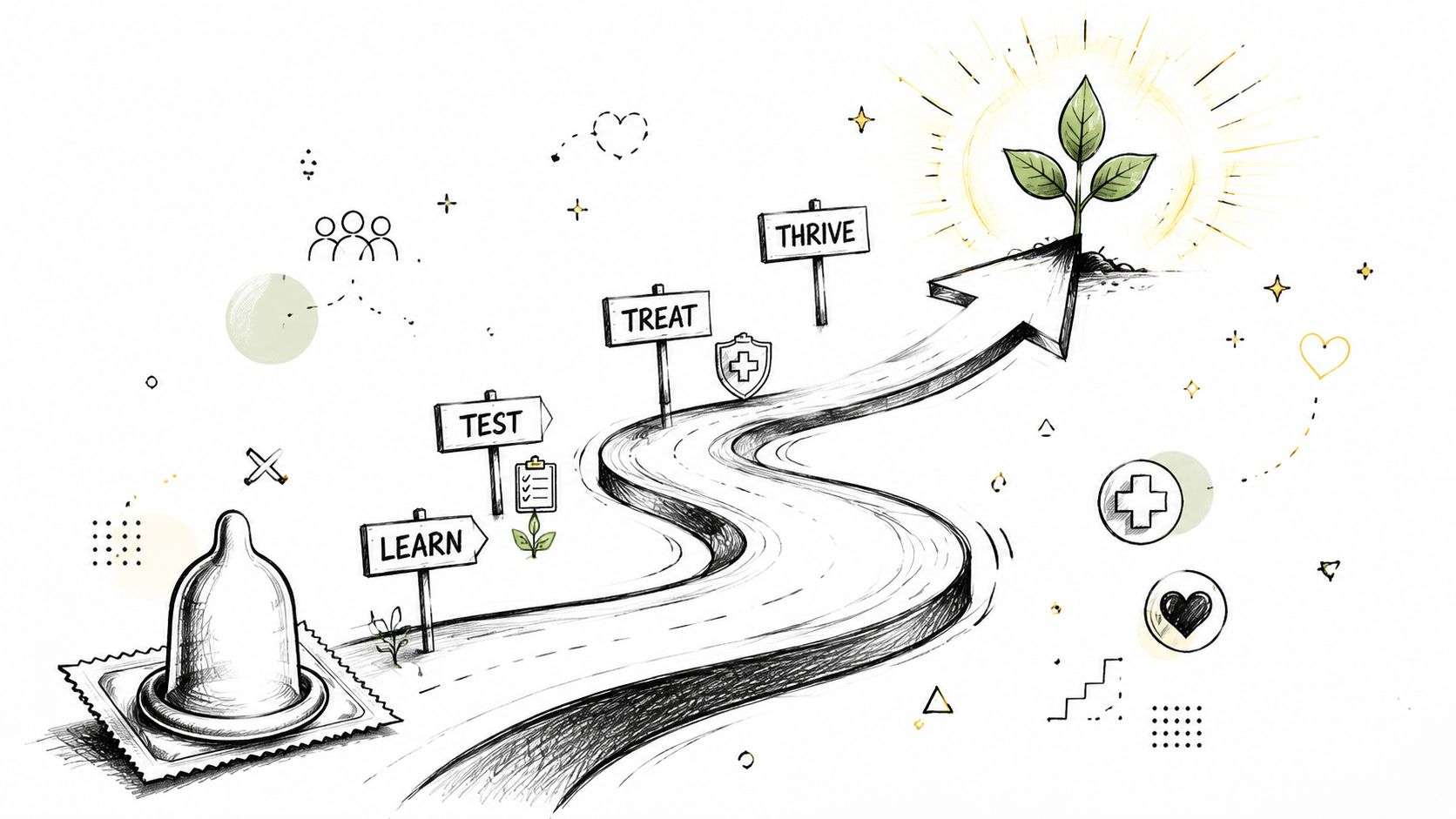
The right condom can absolutely improve sex for a man with ED. But symptom management and treatment aren't the same thing. If your erection only holds under carefully controlled conditions, there may be an underlying vascular, neurologic, hormonal, medication-related, or structural issue that deserves proper workup.
One reason material choice matters so much is that polyisoprene has superior elasticity and lower thermal resistance than latex, enabling 98% heat transfer efficiency and reducing the insulation effect linked to 35% of ED-related erection failures in clinical surveys, as discussed in this NCBI article on condom materials and sexual function. That's useful management. It still doesn't correct the reason your erection became vulnerable in the first place.
Managing symptoms is not the same as treating ED
A man may need a special condom because his erection now depends on maximizing every bit of sensory input. That can happen when blood flow is weaker, nerve signaling is dulled, or anxiety has become layered onto a physical problem. It can also happen when a medication changes arousal or sensation. If you're reviewing how certain drugs affect nerve-related symptoms more broadly, this explainer on amitriptyline for nerve pain and migraines is a useful example of how medications can influence nerve pathways and body responses, even outside sexual medicine.
For some men, oral medication helps enough. For others, it only partially compensates. If you want a clearer understanding of that medical pathway, this article on how erectile dysfunction treatment pills actually work gives a patient-friendly overview.
When to move from self-management to medical care
Consider a professional evaluation if any of these sound familiar:
- You lose erections with or without condoms
- You need increasingly specific conditions just to stay firm
- Rigidity has declined over time, even when desire is still present
- There's curvature, pain, or visible change in erections
- You're avoiding sex because the troubleshooting is becoming exhausting
At that point, better condoms are still worth using. They just shouldn't be your whole plan. Lasting improvement usually comes from identifying the cause and treating it directly.
Frequently Asked Questions About Condoms and ED
Do medicated condoms exist for ED treatment
There's a lot of curiosity about drug-infused or “erection-enhancing” condoms. The short answer is that they're not an established, accessible solution in the United States. A 2023 review in Sexual Medicine Reviews found that while nitroglycerin topical agents can improve penile blood flow, there is no FDA-approved medicated condom for ED treatment in the US, and global trials remain inconclusive regarding sustained clinical benefit, according to Sexual Medicine Reviews.
So if you see chatter online about medicated condoms, treat it cautiously. Interest exists. Proven, approved mainstream access does not.
Are delay condoms a good idea if I have ED
Usually not. Delay condoms are built to reduce sensation so ejaculation takes longer. That can help some men with premature ejaculation, but it often works against a man whose problem is erection maintenance.
If staying hard is the issue, your priority is preserving sensation, not muting it.
Is it safe to use two condoms for extra security
No. Using two condoms at once increases friction between the layers, which can make failure more likely rather than less. It also makes sex feel less natural, which is the opposite of what most men with ED need.
One properly fitted condom used correctly is the safer approach.
Can the right condom make safer sex easier to stick with
Yes. Men are much more likely to use condoms consistently when the experience feels comfortable, predictable, and close to natural. That's important because frustration with condoms can push some men toward avoidance, rushed sex, or abandoning protection altogether.
The practical takeaway is simple:
- Choose for sensation first if ED is the main issue
- Match the fit carefully instead of guessing
- Use lubrication generously
- Seek treatment if condom optimization still leaves you struggling
The best condoms for erectile dysfunction can make sex easier and safer. They just work best when they're part of a larger plan to restore dependable erections.
If condoms are helping only a little, or if you're tired of managing around the problem, Sexual Wellness Centers of America offers confidential evaluation and treatment for erectile dysfunction with a focus on non-surgical, clinic-based care. A thorough assessment can help you move beyond trial and error and toward a plan built for lasting sexual function.