
Environmental mold exposure is not an established clinical cause of hair loss in humans, and the only confirmed fungal cause is tinea capitis, a scalp infection that's biologically different from household mold. If you're seeing more shedding, the right question usually isn't “Is mold the cause?” first, it's “What pattern of hair loss am I dealing with?”
Hair loss is one of those symptoms that can pull people down a rabbit hole fast. Mold exposure is common enough that it comes up often, but the evidence has to be handled carefully so you don't miss a real diagnosis while chasing an unproven one. The practical goal is simple, separate environmental exposure, scalp infection, and the more common medical causes that clinicians check first.
Table of Contents
- The Short Answer From Current Medical Evidence
- How Mold Might Indirectly Contribute to Hair Shedding
- Environmental Mold Exposure vs. Scalp Fungal Infection
- Getting the Right Diagnosis for Unexplained Hair Loss
- Treatment and Management Based on the Underlying Cause
- Why Hair Health Connects to Overall Systemic Wellness
- When to Seek Professional Medical Care for Hair Loss
The Short Answer From Current Medical Evidence
Environmental mold exposure is not an established direct cause of hair loss, while tinea capitis remains the confirmed fungal cause of alopecia in humans (NIH/PMC review, clinical guide). That distinction matters because it keeps patients from confusing a building problem with a scalp disease, and it keeps clinicians focused on the causes that are most likely.
There's a long history of people linking mold with a wide range of symptoms. A 2005 NIH/PMC report noted that mold in residential, public, and commercial buildings was already being discussed as a possible source of problems ranging from bleeding lungs to hair loss, which shows the question has been around for decades (NIH/PMC review). But historical discussion isn't the same as proof. The more cautious modern reading is that indoor mold exposure may matter for overall health, yet it hasn't been shown to directly cause hair loss in humans.
That's why the first diagnostic mistake to avoid is assuming every shedding pattern is “mold hair loss.” In clinical practice, the more common causes still come first, including genetics, hormones, stress, diet, medications, and autoimmune disease (NIH/PMC review). If a patient has patchy loss, scaling, broken hairs, or scalp sores, the question shifts toward a scalp fungal disorder rather than household mold.
Practical rule: if the scalp looks inflamed or infected, think about a scalp diagnosis first. If the hair is shedding diffusely without scalp lesions, the broader medical workup usually matters more.
The rest of the evidence-based approach is about sorting out what mold can plausibly do indirectly, what it can't be blamed for directly, and when the answer is a different diagnosis entirely.
Why the distinction matters
The phrase “can mold cause hair loss” gets searched because people want a single explanation for a frustrating symptom. The problem is that a single explanation is often wrong. A building may be damp, a scalp may be infected, or the body may be responding to stress from something else entirely.
When the diagnosis is unclear, the most useful next step is not panic. It's pattern recognition, scalp exam, and a basic medical evaluation that can separate a true fungal scalp disorder from diffuse shedding that needs a different workup.
How Mold Might Indirectly Contribute to Hair Shedding
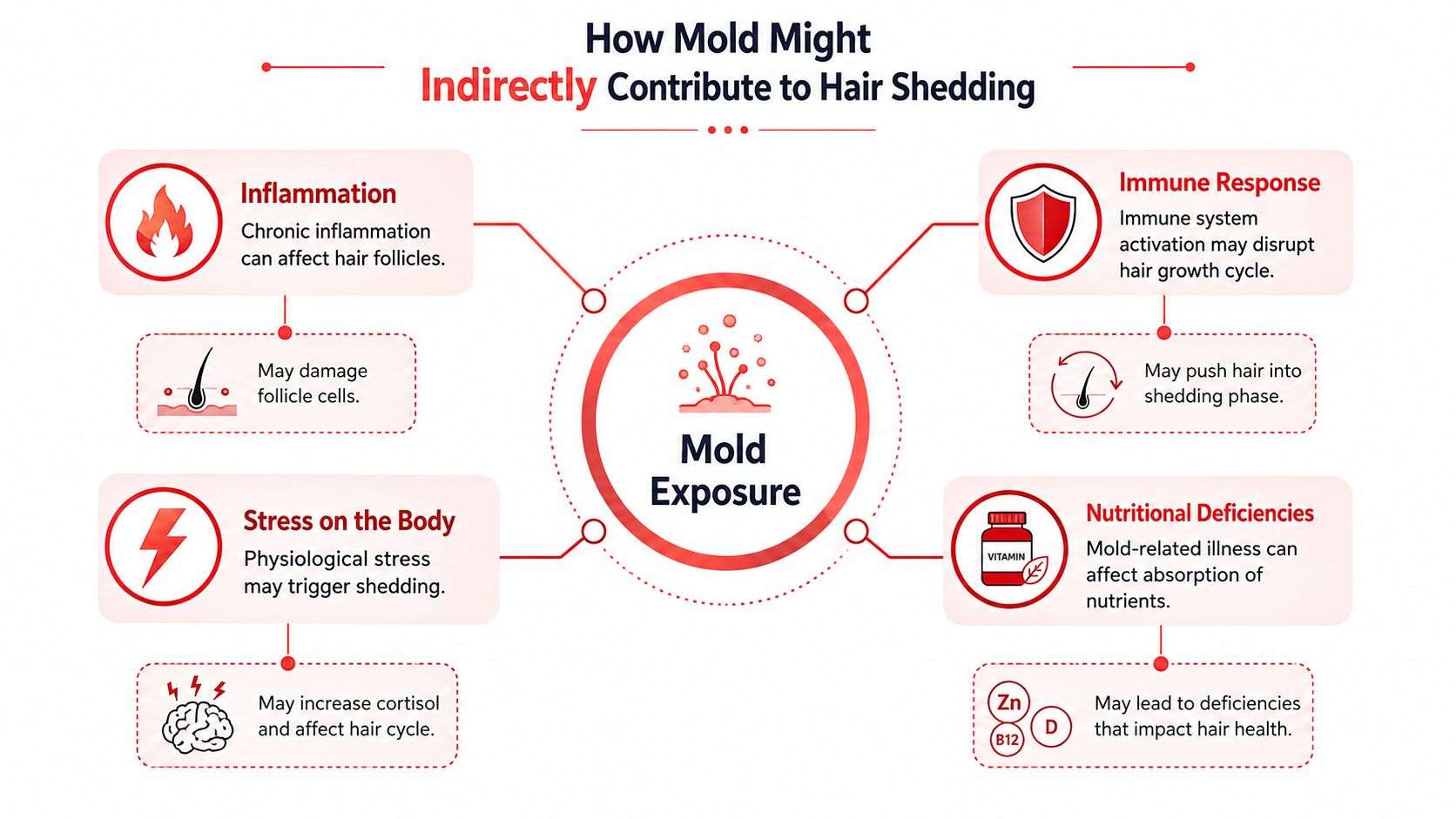
Indoor mold isn't established as a direct cause of hair loss, but it can still matter as a possible indirect stressor. That's the most honest way to frame the evidence. The idea is not that mold attacks the hair follicle like a scalp infection does, but that chronic exposure may add to the kind of body stress that sometimes pushes hair into a shedding phase.
Possible pathways people talk about
One proposed pathway is inflammation. If someone lives or works in a damp environment and develops ongoing irritation, immune activation, or poor sleep because of it, the body can stay in a stressed state. Hair follicles respond to systemic stress, so inflammation may contribute to shedding in a broad, indirect way. That said, this is still a mechanism-based explanation, not proof of direct causation.
Another theory involves immune response to mold spores or mycotoxins. Some consumer health sources describe immune activation as a route to hair shedding, but human clinical evidence linking indoor mold exposure to telogen effluvium or alopecia areata remains weak and speculative. That means the biology sounds plausible, yet the proof in actual patients is limited.
A third possibility is nutritional depletion. When people feel unwell, sleep poorly, lose appetite, or live under chronic stress, they may not eat or absorb nutrients as well as usual. Hair is sensitive to those shifts. The hair-loss issue then becomes part of a larger health picture, not a simple mold-to-hair pathway.
The last concept is environmental stress. If mold exposure is part of a bigger burden that includes fatigue, poor sleep, or chronic illness, shedding can fit the pattern of telogen effluvium, which is the body's nonspecific response to stress.
What works and what doesn't
What doesn't work is treating an indirect concern like a confirmed diagnosis. If a person is shedding hair, cleaning a room without understanding the medical cause may miss thyroid disease, iron deficiency, autoimmune hair loss, or a medication effect. What works is treating mold as one possible environmental stressor while still doing the medical workup that hair loss deserves.
If mold is part of the story, it's usually a contributor, not the whole diagnosis.
That's the key trade-off. The evidence allows caution and common sense, but not certainty. If a source presents mold as the sole reason for shedding, it's overselling what the literature supports.
Environmental Mold Exposure vs. Scalp Fungal Infection
A lot of confusion comes from blending two very different problems into one phrase. Indoor mold exposure is an environmental issue. Tinea capitis is a scalp infection. They can both sit under the umbrella of “fungal concerns,” but they're not the same disease, they don't behave the same way, and they don't get treated the same way.
| Feature | Environmental Mold Exposure | Scalp Fungal Infection (Tinea Capitis) |
|---|---|---|
| Main problem | Damp building exposure | Infection of the scalp and hair shafts |
| Typical pattern | More often diffuse shedding or nonspecific symptoms | Patchy loss, broken hairs, scaling, sores |
| Scalp appearance | Often no true scalp infection pattern | Often visible inflammation or scaling |
| Testing approach | Environmental assessment and moisture review | Medical scalp exam, sometimes lab confirmation |
| Treatment focus | Remediation and moisture control | Prescription antifungal treatment |
| Can it grow on human hair? | No scientific evidence that household mold grows on human hair | Yes, scalp fungi can invade hair and cause loss |
This distinction is especially useful if you're comparing symptoms with other scalp concerns. A general reference on hidden mold warning signs can help with the home environment side, but it won't diagnose a scalp infection. If you're trying to figure out whether dandruff-like flaking is a fungal scalp problem, it also helps to understand the difference between irritation and infection, which is why a practical guide like what actually makes dandruff contagious can be useful in the broader differential.
The symptom pattern tells the story
Environmental mold exposure may leave a person feeling unwell, but it doesn't have a classic scalp infection pattern. Tinea capitis often shows up with scaling, broken hairs, sores, or patchy loss, and those are the details that push the evaluation toward treatment rather than home cleanup.
That's also why the common internet claim that “mold grows on your hair” is misleading. Authoritative medical explanations note there's no scientific evidence that household mold colonizes human hair, while scalp fungi can directly infect the hair shaft and follicle (Healthline review).
Table helps, but exam matters more
A table is useful for sorting the categories, but a real clinician still has to look at the scalp. If the loss is patchy, inflamed, or accompanied by scalp symptoms, the infection pathway rises on the list. If the loss is diffuse and the scalp looks normal, the diagnostic lane changes completely.
In short, environmental mold management and scalp fungal treatment are different jobs. Mixing them up delays the right care.
Getting the Right Diagnosis for Unexplained Hair Loss
Clinicians usually start with the common causes because they're much more likely to explain hair shedding than mold alone. Genetics, hormonal shifts, stress, nutritional deficiency, thyroid disorders, medications, and autoimmune disease sit near the top of the list for a reason (NIH/PMC review). If hair loss doesn't fit one of those patterns, then the environmental history becomes one part of a broader conversation, not the entire answer.
What a good evaluation usually includes
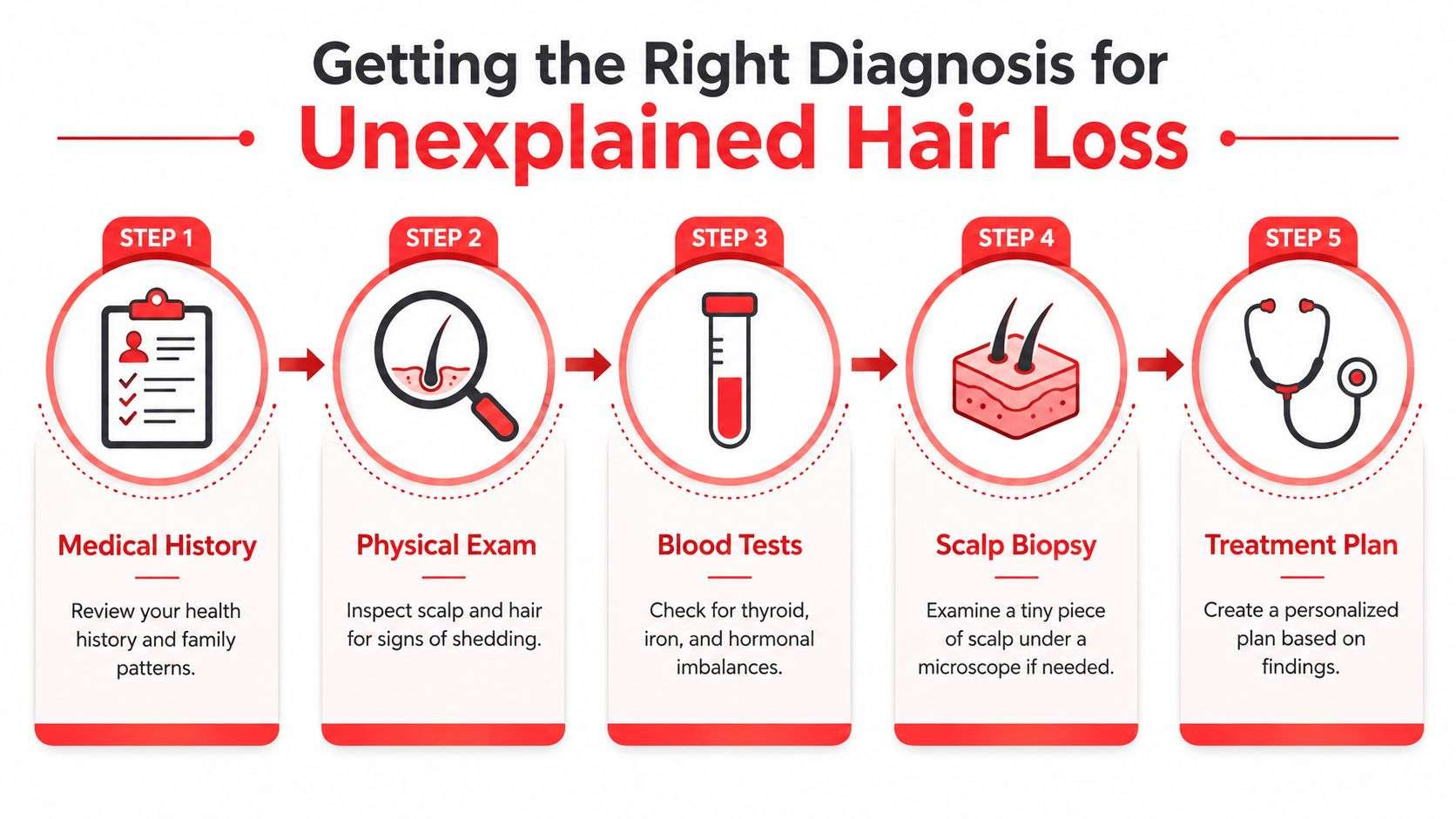
The first step is a medical history. That includes when the shedding started, whether it's diffuse or patchy, what medications changed recently, and whether there's family history of thinning. A careful scalp exam follows, because the pattern of loss often narrows the diagnosis before any tests are ordered.
Blood work may be used when the story suggests a systemic issue. In many hair-loss workups, clinicians think about iron, thyroid, hormone, and other nutritional or endocrine factors. If the body is sending other signals, such as fatigue, cycle changes, or unexplained weight changes, those clues matter. A broader hormone panel testing guide can help patients understand why clinicians look past the hair itself and evaluate the whole system.
What to ask for at the visit
If you're worried about mold, bring specifics. Describe any leaks, dampness, musty rooms, or visible moisture problems, and mention whether symptoms change when you're away from home. If scalp symptoms are present, ask whether the clinician sees signs of a fungal infection, because that changes treatment immediately.
It also helps to ask what findings would point away from mold and toward a more common diagnosis. Sometimes the answer is reassuringly ordinary, like stress-related shedding or a hormone shift. Sometimes it points to a scalp infection that needs prescription therapy.
A patient who has already had environmental or allergy testing may ask what those results mean in the context of hair loss. A useful resource on what allergy test results mean can help people understand that a positive result doesn't automatically prove the cause of shedding.
When evaluation shouldn't wait
Diffuse shedding that keeps going, patchy loss, scalp scaling, sores, or hair loss paired with other unexplained symptoms deserves a real exam. That's especially true if the pattern is new or if the person is also dealing with fatigue, cycle changes, or other signs that the body is under strain.
The point is not to over-medicalize every shed hair. The point is to avoid missing a treatable diagnosis just because mold was the first thing that came to mind.
Treatment and Management Based on the Underlying Cause
The right treatment depends on the diagnosis, not on the keyword that got someone searching. If the scalp problem is a fungal infection, the remedy is medical. If the issue is environmental exposure, the answer is remediation. If the hair loss is driven by hormones, nutrition, or stress, then the treatment has to match that cause.
Match the treatment to the cause
For tinea capitis, prescription antifungal medication is the standard path. Over-the-counter shampoos or “detox” products don't replace proper treatment when a true scalp infection is present. The infection has to be cleared at the source.
For environmental mold exposure, the priority is reducing exposure. That can mean finding moisture sources, addressing ventilation, and getting professional help if the problem is hidden or widespread. The hair itself isn't the first target. The body has to stop being exposed before shedding can settle.
For common non-fungal causes, treatment often looks very different. Genetic hair loss may be managed with medical or regenerative therapies. Nutritional deficiencies need correction. Telogen effluvium needs the trigger addressed, then time for recovery. Hormonal imbalance should be worked up and treated rather than guessed at.
One option for patients interested in a clinic-based regenerative approach is REGENhair™, which fits into a broader hair restoration strategy when the cause and treatment plan have been identified. That kind of option makes sense only after the diagnosis is clear, not as a substitute for it.
Practical rule: treat the diagnosis you have, not the one that sounds most alarming.
What helps and what wastes time
What helps is a cause-based plan, regular follow-up, and patience with hair cycles. What wastes time is buying random shampoos, using antiseptics on the scalp without a diagnosis, or assuming that every shedding pattern needs the same fix. The body doesn't respond well to guesswork.
If mold is part of the picture, then a structured plan usually starts with the environment, moves to medical evaluation, and then adds targeted hair support only when the root cause is known. That sequence is far more effective than trying to treat the symptom in isolation.
Why Hair Health Connects to Overall Systemic Wellness
Hair loss is rarely just a hair issue. It often reflects what's happening with hormones, inflammation, nutrition, stress, and metabolic health, which is why a root-cause approach matters. When the body is under strain, the scalp often shows it early.
The larger pattern matters
That same systems-based thinking is common in sexual wellness and hormone care, and it applies to hair just as much. A patient with unexplained thinning may need the same kind of careful review used for other wellness concerns, a look at sleep, lab values, medications, stress load, and possible inflammatory triggers.
A useful resource on mold remediation insights from Restore Heroes can help people think about the environmental side without losing sight of the medical side. The point isn't to label mold as the answer. The point is to remove preventable exposures while still evaluating the body.
Hair health improves most reliably when the underlying drivers are addressed together. That can mean correcting labs, stabilizing hormones, improving nutrition, and reducing environmental triggers at the same time. A bandage on the hair doesn't help much if the rest of the system is still signaling distress.
When patients understand that connection, they tend to ask better questions and make better decisions. They stop treating shedding like a mystery and start treating it like a symptom with a cause.
When to Seek Professional Medical Care for Hair Loss
Get evaluated if the loss is patchy, sudden, or clearly different from your usual shedding. You should also be seen if shedding lasts beyond a few weeks without an obvious trigger, if the scalp is scaly, sore, or broken out, or if hair loss comes with other unexplained symptoms like fatigue, weight change, or menstrual irregularity.
What to bring to the appointment
Bring a timeline. Note when shedding started, whether you've had any recent illness or major stress, what medications changed, and whether the issue seems linked to a room, a building, or a scalp symptom. Photos can help, especially if the loss is patchy or fluctuates.
Ask the clinician what pattern they see and what causes they're ruling out first. That conversation can clarify whether you need scalp treatment, a systemic workup, or environmental follow-up.
If you're choosing a provider, look for someone who evaluates hair loss as part of whole-person care rather than defaulting to a single explanation. The right clinician should be comfortable checking for fungal infection, hormonal imbalance, nutritional issues, and other common causes before deciding whether mold exposure is relevant.
Don't wait for the problem to become obvious before getting help. The earlier the diagnosis, the easier it usually is to treat the real cause.
Sexual Wellness Centers of America offers clinic-based care for hormone optimization, regenerative wellness, and REGENhair™ hair restoration, which fits well when unexplained shedding needs a structured medical evaluation. If you want a provider that looks at hair loss as part of whole-body health, visit Sexual Wellness Centers of America to learn more and schedule a consultation.