
Yes, working out legs can raise testosterone for a short window, but that bump usually fades within 15 to 30 minutes and often returns to baseline within 30 minutes after heavy resistance exercise. That's the part often overlooked when individuals ask whether leg day “boosts testosterone”: the spike is real, but it usually isn't the same thing as a lasting rise in your baseline hormone level.
A lot of fitness advice treats squats like a hormone hack. That oversimplifies what the body does. A hard lower-body session creates a temporary endocrine response, especially when it uses big compound lifts and a lot of total work. That can matter for training. It does not mean one brutal leg workout turns into a long-term fix for low testosterone, fatigue, low libido, or age-related hormone decline.
If you want the honest answer to does working out legs increase testosterone, it's a yes with an important qualifier. It can create a brief post-workout surge. It usually does not replace the bigger drivers of hormone health like sleep, body composition, stress load, recovery, and medical evaluation when symptoms point to a real problem.
Table of Contents
- The Short Answer to a Pressing Question
- Acute Spike vs Chronic Boost Explaining the Difference
- Why Leg Workouts Pack a Hormonal Punch
- Your T-Boosting Leg Day Workout Protocol
- Beyond the Spike The Path to Lasting Hormone Health
- Frequently Asked Questions About Exercise and Testosterone
The Short Answer to a Pressing Question
Leg workouts can increase testosterone temporarily. They are among the workouts most likely to do it because they recruit a lot of muscle at once, create high systemic demand, and usually involve hard multi-joint effort rather than small isolation work.
That said, the most useful answer is not just “yes.” It's yes, briefly. A 2021 NIH review on exercise and testosterone response reported that testosterone can rise immediately after heavy resistance exercise, then return to baseline or even dip below baseline within 30 minutes. The same review noted that elevations commonly last about 15 to 30 minutes after lower-body training.
What most people get wrong
Many people hear “leg day boosts testosterone” and assume it means more testosterone all week, better libido by default, or a natural workaround for clinically low levels. That leap isn't supported by the evidence.
A temporary rise after training is more like revving an engine when you hit the gas. The sound changes. The output changes for a moment. But when you stop pressing the pedal, the engine settles back down. That's very different from swapping in a bigger engine.
Practical rule: Treat leg day as a strong training tool, not as hormone therapy.
What this means in real life
If your goal is performance, muscle gain, or training hard with the biggest movements in the gym, leg day absolutely matters. If your goal is to correct persistent symptoms of low testosterone, leg workouts belong in the plan, but they shouldn't be the entire plan.
That distinction matters because it keeps you from chasing the wrong solution. A hard squat session may create a short-lived anabolic environment. It usually won't override poor sleep, chronic stress, excess body fat, under-fueling, or a genuine medical hormone issue.
Acute Spike vs Chronic Boost Explaining the Difference
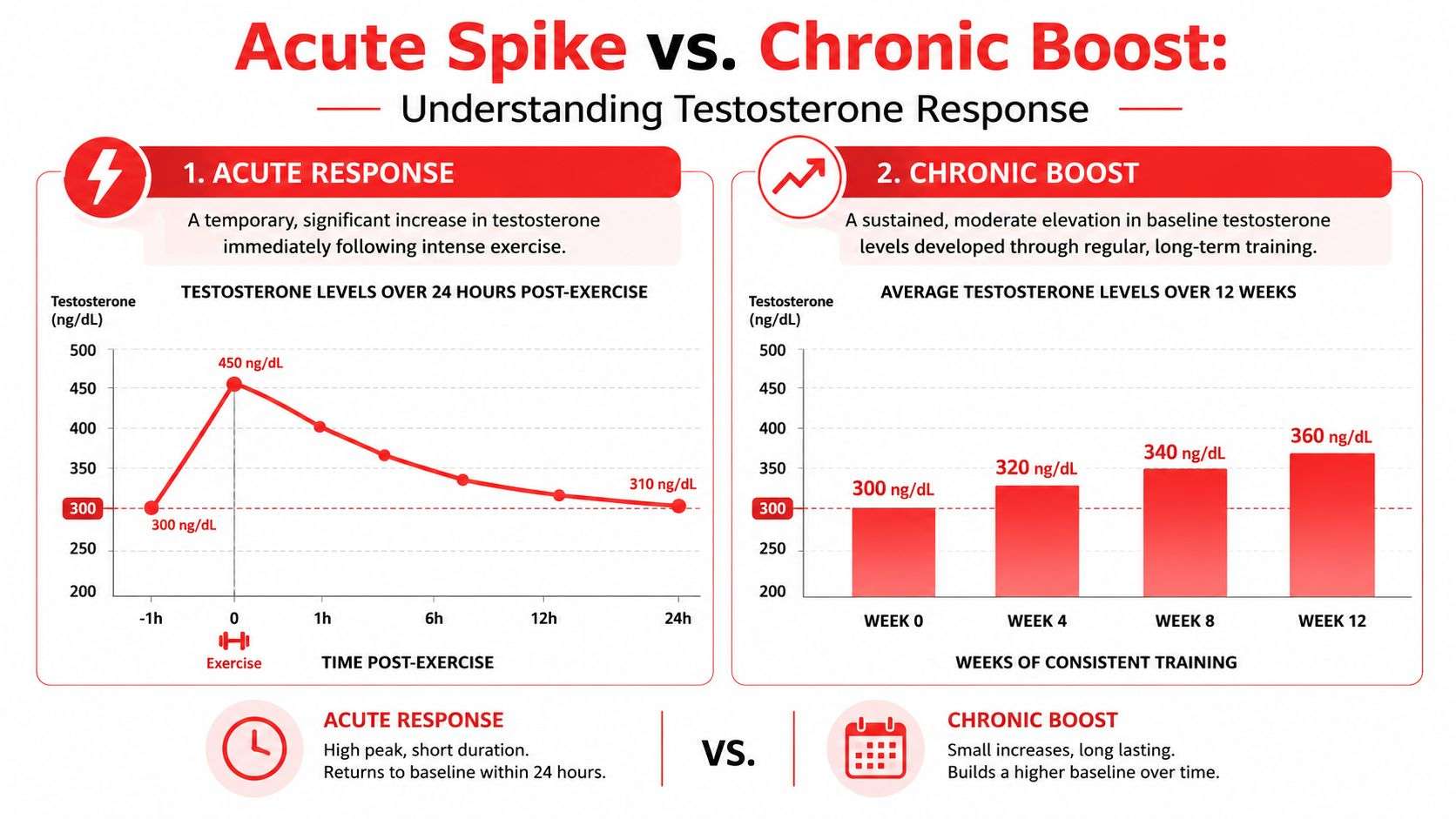
What acute actually means
Acute means short-term. In this context, it's the hormonal blip that happens right after a demanding session. Your body sees heavy training as stress, responds, and then tries to restore equilibrium.
Clinical and review data summarized in this discussion of exercise and resting testosterone note that exercise can temporarily increase serum testosterone, but regular training alone often doesn't meaningfully change resting testosterone unless it also improves body composition, sleep, stress, and overall energy balance. That last part is the key. The body doesn't like drifting away from baseline for long.
Think of it this way:
| Response type | What it feels like | What it means |
|---|---|---|
| Acute spike | Brief surge after hard training | A temporary response to stress and recovery demand |
| Chronic boost | Higher resting level day to day | A deeper shift in overall physiology and health status |
Why baseline matters more
Your baseline testosterone is what matters when you're talking about ongoing symptoms, sexual health, energy, and long-term endocrine status. That's the number your body returns to when you're not in the middle of a workout response.
Understanding this helps dispel much gym folklore. A post-workout bump can be interesting and real without being clinically meaningful. It's the difference between opening a faucet for a minute and changing the water pressure in the whole house.
The body usually treats a workout spike as a temporary event, not as a new hormonal normal.
If someone is asking because they're exhausted, losing libido, struggling with recovery, or worried about low T, the right question isn't “Can I trigger a spike?” It's “What is keeping my baseline where it is?”
That's why relying on post-workout hormone changes as a treatment strategy doesn't hold up well. Good training helps. It often helps a lot. But if sleep is poor, stress is high, calorie intake is mismatched, or body composition is working against you, the temporary spike won't fix the larger problem.
Why Leg Workouts Pack a Hormonal Punch
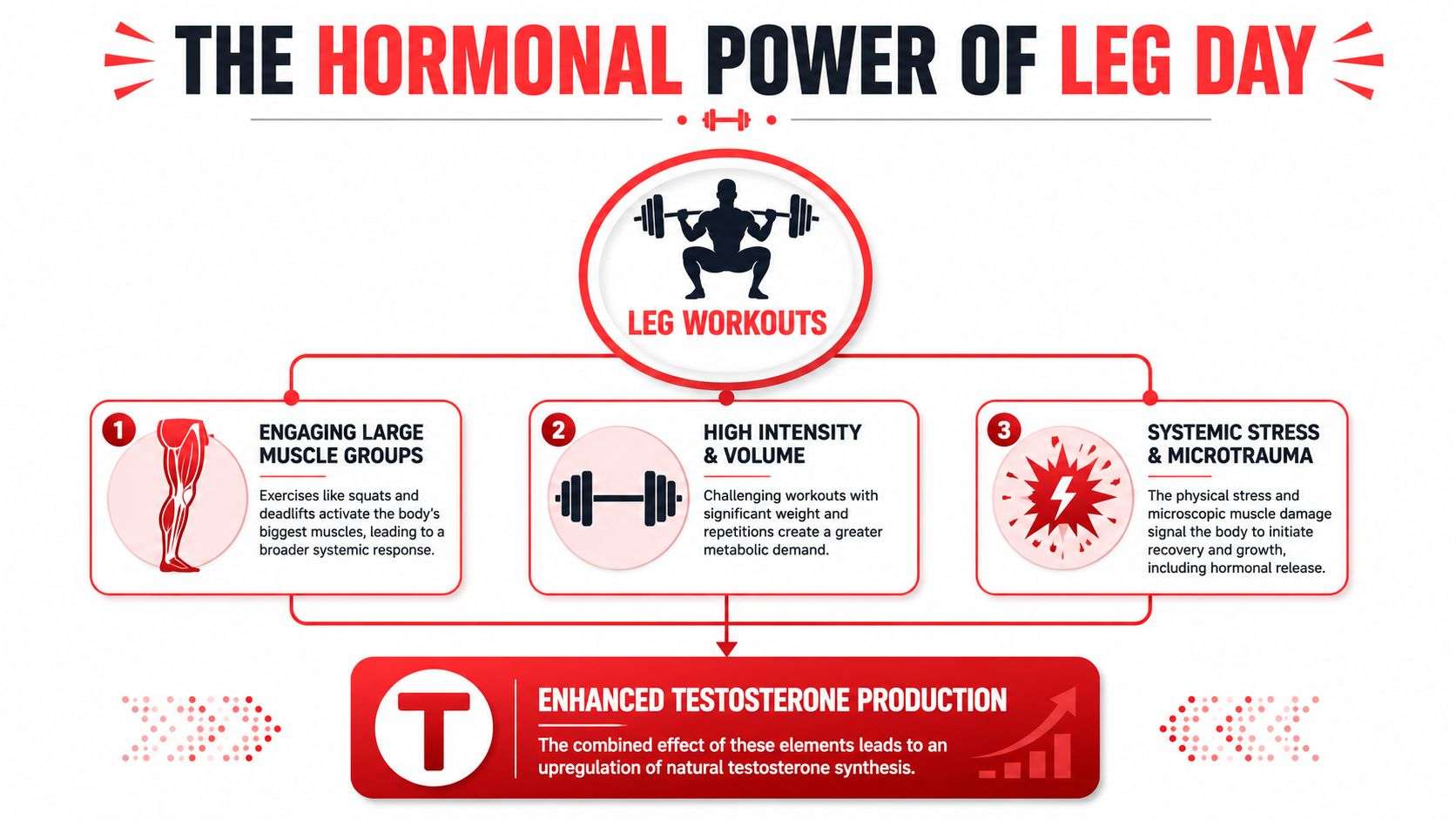
Big muscles create a bigger signal
Leg day gets this reputation for a reason. Exercises like squats, deadlifts, and leg presses recruit the largest muscle groups in the body. When you train more tissue at once, you create more total demand. The body responds to that global demand differently than it responds to a few sets of curls.
The pattern in the research is straightforward. Lower-body resistance sessions are more likely to produce a noticeable short-term testosterone response when they involve large muscle mass, moderate-to-high intensity, higher exercise volume, and short rest intervals. That's why the “leg day raises testosterone” idea didn't come out of nowhere. It came from observing what happens when people train the lower body hard enough to stress the whole system rather than a single small region.
For athletes focused on recovery support and connective tissue demands from hard lower-body training, it's worth understanding how tissue health fits into programming. This resource on collagen, performance, and muscle support is a useful companion read.
How to make the response more likely
The details matter more than the body part label. “Leg day” can mean a brutally effective session, or it can mean a few half-hearted machine sets while scrolling a phone. The hormonal response is much more likely with training that looks like this:
- Multi-joint lower-body lifts: Squats, hinge patterns, split squats, and leg presses create more systemic demand than isolated extensions or curls alone.
- Challenging loading: The work has to feel meaningfully hard. Light effort doesn't send much of a signal.
- Enough total volume: One heavy top set usually isn't the same as several demanding work sets across a session.
- Shorter rest periods: Rest that's controlled rather than overly long keeps the session metabolically demanding.
Bigger muscles under harder work create a bigger whole-body response. That's the real reason leg training stands out.
The trade-off is obvious. The workouts that are most likely to create this response are also the workouts that demand the most recovery. Push too hard too often, and the quality of your sleep, appetite, and next sessions can suffer. That can work against the broader hormone picture you're trying to improve.
Your T-Boosting Leg Day Workout Protocol
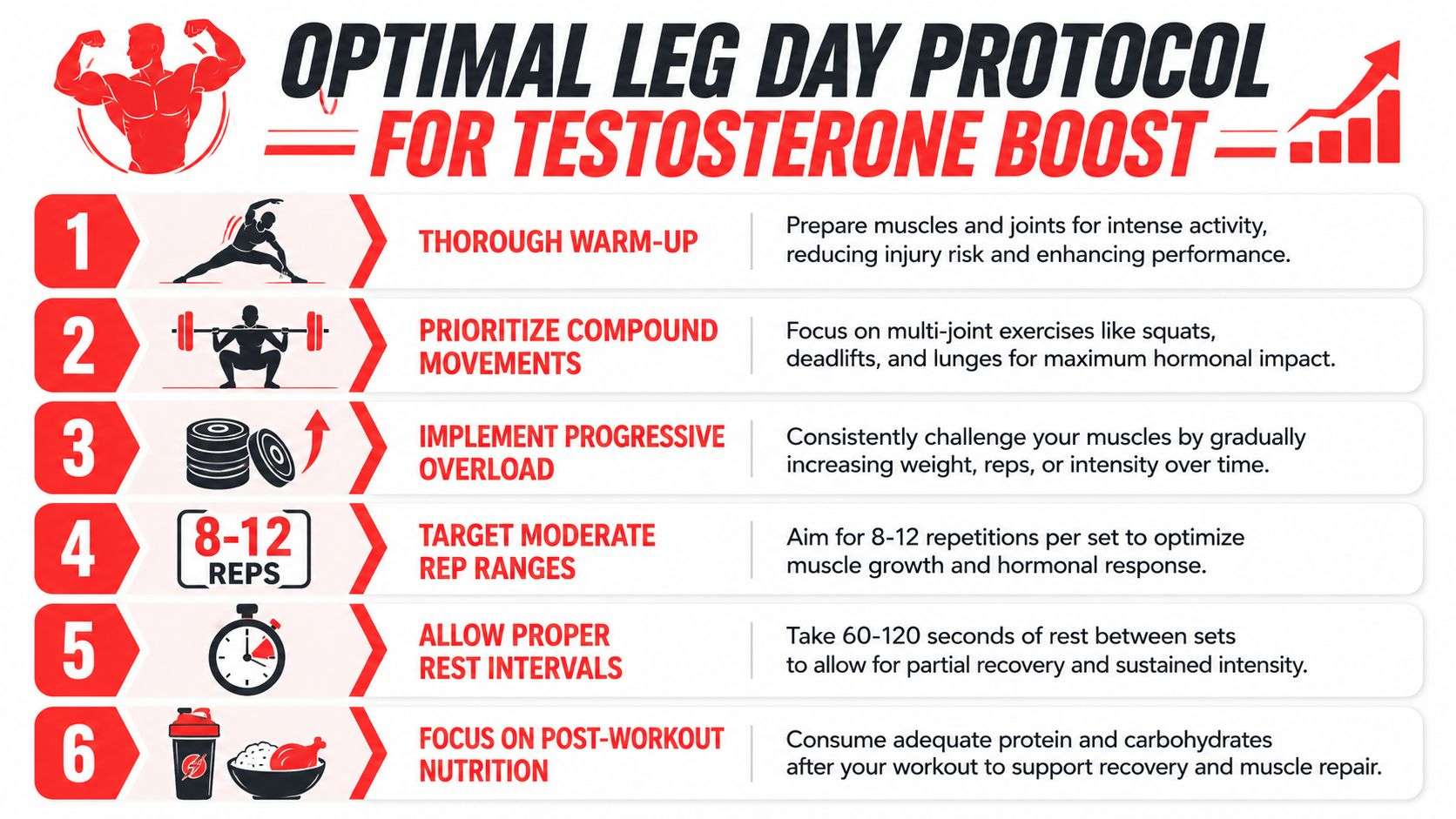
A practical template
If your goal is to build a leg session that's most likely to create a strong acute hormonal response, keep it simple. Use big lifts, enough work, and rest periods that don't let the session go soft.
A practical structure looks like this:
Warm up thoroughly
Use dynamic mobility, lighter ramp-up sets, and enough rehearsal to make your first work set crisp rather than shaky.Start with a major squat pattern
Try barbell squats, front squats, or a leg press if joint limitations make free-weight squats a poor fit. Perform 3 to 5 sets of 8 to 12 reps.Add a hip hinge
Romanian deadlifts or a similar pattern balance the session and load the posterior chain. Use 3 to 5 sets of 8 to 12 reps.Include a unilateral movement
Split squats, lunges, or step-ups extend the total work and expose side-to-side weakness. Aim for 3 to 5 sets in a moderate rep range.Keep rest controlled
Rest about 60 to 120 seconds between working sets so the session stays demanding.
For readers who want ideas on how to combine conditioning with lower-body work without turning the session into random fatigue, this MONFIT cardio leg day guide gives practical examples.
What makes this useful and what does not
This type of session works because it matches the conditions most often linked with a stronger response: large muscle recruitment, moderate-to-high effort, meaningful volume, and relatively short rest.
What doesn't work as well:
- Too little work: A token leg workout won't do much.
- Too much rest: Long breaks cool off the demand that makes the session effective.
- Only machine isolation: Useful for hypertrophy, but not usually the strongest systemic stimulus.
- Grinding every session: If soreness and fatigue wreck your recovery, the bigger goal gets lost.
If you're also exploring recovery support and muscle-focused adjuncts, this overview of peptide supplements for muscle growth adds context to the broader conversation.
Beyond the Spike The Path to Lasting Hormone Health

The bigger levers
The post-workout rise gets attention because it's easy to talk about. Lasting hormone health is less flashy. It depends on the boring fundamentals people often try to skip.
A review discussed in this article on lifting and testosterone expectations notes that the idea acute anabolic hormone spikes directly drive long-term strength adaptation or testosterone increases “cannot be supported” by all data. It also notes that these spikes are often transient, commonly lasting 15 to 60 minutes. That's why chasing the spike itself is the wrong target.
What usually matters more over time:
- Sleep quality: Testosterone biology doesn't like chronic sleep restriction.
- Energy balance: Under-eating or extreme dieting can work against hormone health.
- Body composition: Improvements here often do more than a temporary gym bump.
- Stress load: A body under constant stress rarely reads that as a signal to thrive.
A broader practical guide for hormone health can help people think beyond one workout variable and focus on sustainable habits.
When symptoms need more than training
If someone has low libido, erectile changes, reduced morning erections, fatigue, low motivation, or declining performance despite training consistently, leg day isn't a diagnostic test and it isn't a substitute for medical care.
Train hard for strength and health. Evaluate symptoms separately if they persist.
That's especially true when the question behind “does working out legs increase testosterone” is really about whether exercise alone can solve a deeper issue. Sometimes better training habits help. Sometimes they expose that the problem wasn't poor programming at all.
When symptoms point toward a persistent hormone issue, a proper clinical workup makes more sense than trying to out-squat biology. For readers considering that next step, this overview of how hormone therapy can help men with low testosterone gives a helpful starting point.
Frequently Asked Questions About Exercise and Testosterone
Do upper-body workouts help too
Yes. Resistance training in general can create a short-term testosterone response. Leg workouts tend to get the spotlight because they usually involve more total muscle mass and more systemic stress, but hard upper-body compound sessions still matter for strength, muscle, and overall training quality.
Does cardio raise testosterone the same way
Not usually in the same way people mean when they talk about the post-lifting spike. Short, intense intervals may fit better with a performance-focused plan than long, draining endurance work for someone who is already under-recovered. The main point is that cardio should support recovery, work capacity, and body composition rather than burying you in extra fatigue.
Is leg day enough if you think you have low T
No. That's the most important takeaway in this article. A hard leg workout may create a brief hormonal rise, but that is not the same as correcting low baseline testosterone. If symptoms are persistent, the next step is evaluation, not just adding more squats.
Should you chase soreness to get a better hormone effect
No. Soreness is a side effect, not the goal. Productive leg training should be challenging, progressive, and recoverable. If every session leaves you flat for days, the plan is probably too aggressive.
What kind of leg exercises are most useful
Prioritize compound movements. Squats, leg presses, deadlift variations, lunges, and split squats give you the best combination of muscle recruitment and training return. Isolation lifts can still help, but they usually work best as accessories rather than the backbone of the session.
If you're dealing with persistent low libido, erectile changes, fatigue, or other symptoms that training alone hasn't fixed, Sexual Wellness Centers of America offers clinical evaluation and treatment options focused on hormone health, sexual wellness, and regenerative care for adults.