
The global hair thickening fibers market reached $1.2 billion in 2024 and is projected to reach $2.45 billion by 2033 at an 8.1% CAGR, according to Research Intelo's hair thickening fibers market analysis. That number matters because it shifts hair fibers out of the “minor cosmetic trick” category and into a mainstream response to visible thinning.
Most guides stop at application tips. That misses the harder question: what are you buying when you choose fibers instead of a clinical strategy? You're not just choosing a product. You're choosing a timeline, a maintenance burden, a concealment method, and a relationship to the underlying biology of hair loss.
The hidden trade-off is simple. Hair thickening fibers can change how hair looks today. Clinical treatments aim to change what hair can become over time. Those goals overlap emotionally, but they're not the same intervention.
| Criteria | Hair Thickening Fibers | Clinical Hair Restoration |
|---|---|---|
| Primary purpose | Immediate cosmetic coverage | Long-term biologic or regenerative improvement |
| Speed of visible result | Same-day appearance change | Slower, treatment-dependent |
| Effect on hair loss biology | None | May target underlying causes, depending on approach |
| Maintenance style | Frequent reapplication and washout | Scheduled treatments and follow-up |
| Best fit | Mild to moderate visible thinning with existing hair present | People seeking more than concealment |
Table of Contents
- Why hair thickening fibers matter today
- Understanding hair thickening fibers
- Application process and maintenance
- Benefits and limitations of hair thickening fibers
- Safety considerations and scalp health when using fibers
- Cost and longevity of hair thickening fibers
- Comparing hair thickening fibers with clinical hair restoration
- Choosing between fibers and clinical treatment with next steps
Why hair thickening fibers matter today
Hair thickening fibers matter because they sit at the intersection of vanity, convenience, and avoidance. People want a fuller look quickly, but many also want to delay surgery, avoid drug side effects, or postpone a more serious evaluation of why their hair is thinning in the first place.
The market data shows this isn't a fringe habit. Hair thickening fibers were valued at $1.2 billion in 2024 and are projected to reach $2.45 billion by 2033 at an 8.1% CAGR, driven by demand for non-surgical cosmetic options, according to this market forecast. That growth tells you two things. First, consumers strongly value immediate visual improvement. Second, many people prefer reversible cosmetic solutions before they commit to medical pathways.
What their popularity reveals
Fibers solve a very specific problem. They reduce scalp show-through without requiring downtime, prescriptions, or a procedure. For someone with visible thinning under bright light, on video calls, or at the crown, that's emotionally powerful.
But popularity can blur categories. A cosmetic product often gets treated like a treatment plan. That's where people make expensive mistakes, not because fibers are ineffective, but because they're effective at the wrong job.
Clinical view: The more convincing the camouflage, the easier it is for a user to postpone decisions about the cause and trajectory of hair loss.
The real strategic choice
The important question isn't “Do fibers work?” In the right person, they clearly improve appearance. The better question is whether your goal is coverage, stabilization, or regeneration.
If your goal is coverage, fibers can be a rational first tool. If your goal is changing the long-term condition of your hair, cosmetic success can become a distraction. That's the trade-off most buyers don't recognize until months of daily maintenance have passed.
Understanding hair thickening fibers
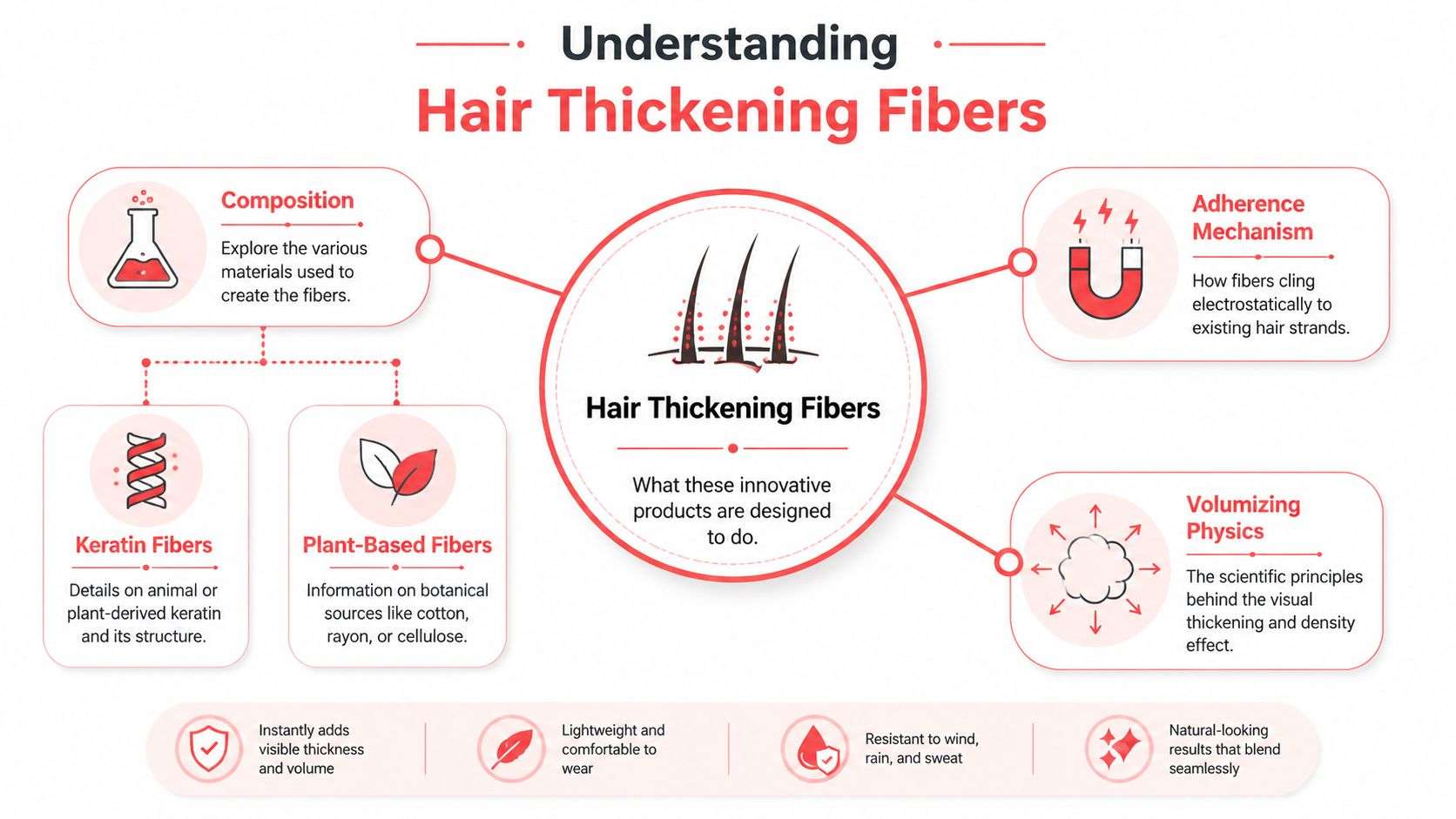
Hair thickening fibers are tiny cosmetic particles made from keratin or plant-based material that attach to existing hair through static forces. They don't create new follicles, and they don't wake up dormant ones. They make the hair you still have look denser.
What the fibers are made of
The material matters because the product has to visually blend with natural hair while staying light enough to disperse evenly. Keratin is the most intuitive base because it's the same protein associated with natural human hair. Plant-based alternatives aim to produce a similar visual effect for people who prefer non-animal-derived ingredients or different texture profiles.
Their function is mechanical, not metabolic. According to this technical reference on reconstructive hair fibers, fibers use static forces to bind to existing hair, increase strand diameter by 2 to 5 µm, and boost cross-sectional area by about 10%. That's why they can make thinning regions appear fuller immediately without altering DHT activity or the hair growth cycle.
Why the effect looks convincing
The visual effect comes from contrast reduction. Thinning hair becomes more obvious when scalp color shows through between fine or miniaturized strands. Fibers make each strand look thicker, which reduces that contrast and makes sparse zones look denser from normal viewing distance.
This is also why fibers work best when some hair remains in the target area. They need strands to cling to. On smooth, fully bald skin, there's very little substrate for the cosmetic illusion.
Hair thickening fibers don't reverse thinning. They improve the geometry of what the eye sees.
That distinction sounds small, but it changes expectations. A user who understands the underlying physics usually applies fibers more realistically. They use them as a finish layer, not as a substitute for diagnosis or long-term planning.
Application process and maintenance
Good fiber results depend less on the product than on the routine. The same bottle can look natural on one person and obvious on another because application errors are usually visible. Too much product, damp hair, brushing after placement, or poor removal habits all weaken the result.
How to apply them for a natural result
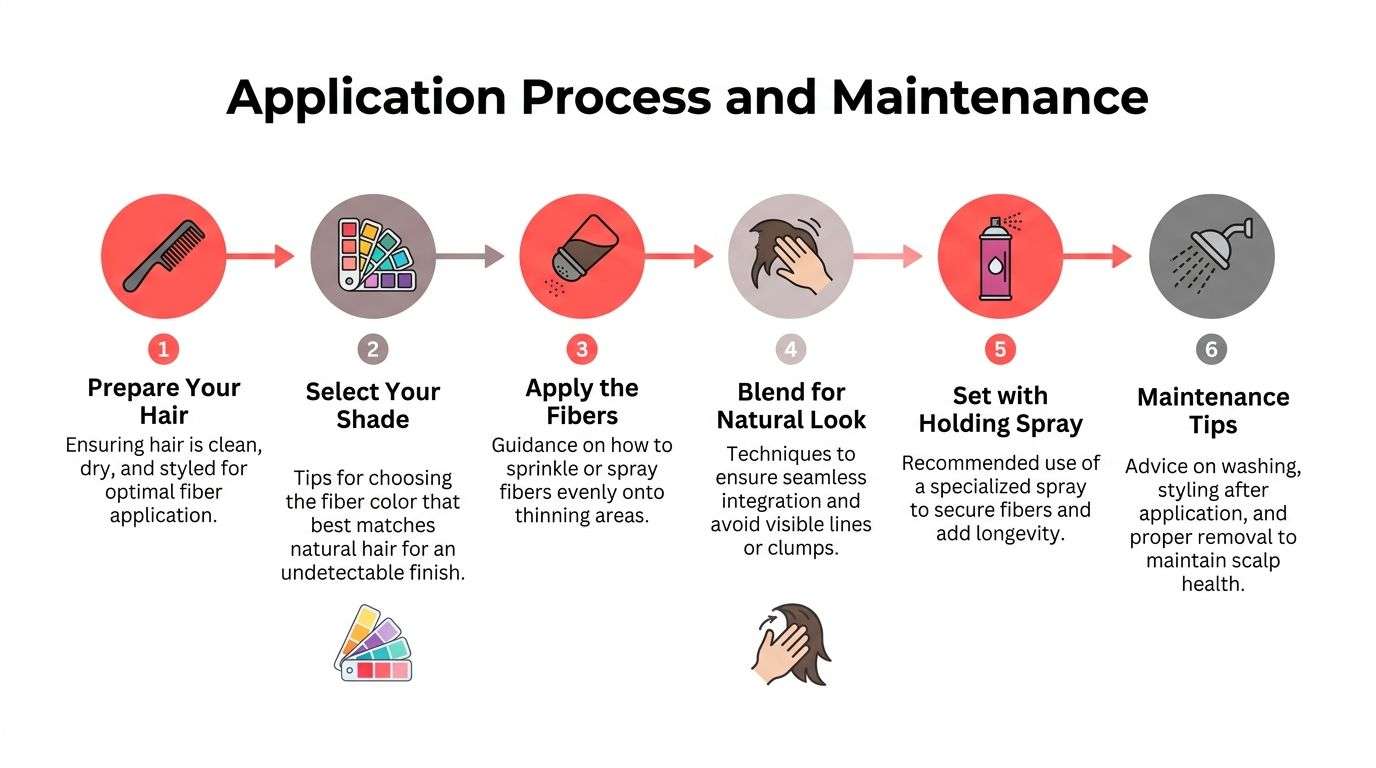
Use this sequence if you want the cosmetic effect to read as density rather than product buildup:
Start with dry hair. Static adhesion works better on dry strands. Damp hair tends to create clumping and uneven distribution.
Style first. Part the hair, shape the front, and settle the direction before adding fibers. Once fibers are attached, combing and brushing can dislodge them.
Apply lightly to thinning zones. Build coverage gradually. Sparse placement usually looks more believable than trying to erase every trace of scalp in one pass.
Pat, don't rake. Gentle patting helps the particles settle into the existing hair pattern without creating lines of excess product.
Set with holding spray. Daily wear improves when the cosmetic layer is fixed in place after application.
A useful detail often overlooked in consumer guides is performance after placement. Guidance summarized in SureThik's discussion of wear time and use patterns notes that fibers can remain stable all day during light activity when applied to dry hair and set with holding spray, while brushing or combing after application can dislodge them.
How to keep them looking clean through the day
Daily maintenance is mostly about friction control and realistic touch-ups.
- Keep your hands off the area. Repeated touching transfers oils and shifts the fiber layer.
- Avoid post-application brushing. If you need to restyle, expect some loss of coverage.
- Refresh only where needed. Small midday corrections usually look better than a full second application.
- Prioritize removal at night. Residue management matters as much as daytime hold.
Practical rule: Treat fibers like cosmetic architecture. Build on a prepared base, disturb them as little as possible, then remove them thoroughly.
The maintenance burden is the hidden price of “instant” improvement. It's not difficult, but it is repetitive, and that repetition shapes whether fibers feel convenient after the novelty wears off.
Benefits and limitations of hair thickening fibers
Hair thickening fibers are best understood as a high-performing camouflage tool. They're often judged too harshly by people who want them to regrow hair, and too generously by people who mistake visual coverage for disease control.
Where fibers perform well
Fibers are most useful when the user still has enough hair for the particles to anchor to. In that context, they offer three practical advantages:
- Immediate visual density: The biggest benefit is speed. A person can go from visible scalp show-through to a fuller-looking style in minutes.
- Low disruption: There's no procedure, no recovery period, and no need to reorganize work or social commitments.
- Reversibility: If the result looks too heavy or unnatural, the product can be washed out and adjusted.
They also pair well with people who need situational improvement. Think photographs, client-facing meetings, dating, or any setting where lighting exaggerates scalp visibility.
Where they disappoint users
The most important limitation is biological. A critical misconception is that fibers offer medical value. This analysis of whether hair fibers truly make thinning hair look fuller makes the distinction clear: they function as an optical illusion, with no effect on follicle biology or DHT-driven thinning.
That creates several downstream problems:
- They can mask progression. A person may look improved while the underlying thinning continues.
- They depend on remaining hair. As density drops, the same routine often delivers less believable coverage.
- They create a maintenance contract. The appearance gain lasts only as long as the user keeps reapplying.
For readers exploring broader appearance-focused support alongside camouflage, this guide on boosting hair density with serums is useful as a complementary, non-fiber perspective.
The practical conclusion is blunt. Fibers are excellent at changing what people see. They're ineffective at changing what the follicles are doing. If you confuse those two outcomes, you'll either overvalue the product or delay better options.
Safety considerations and scalp health when using fibers
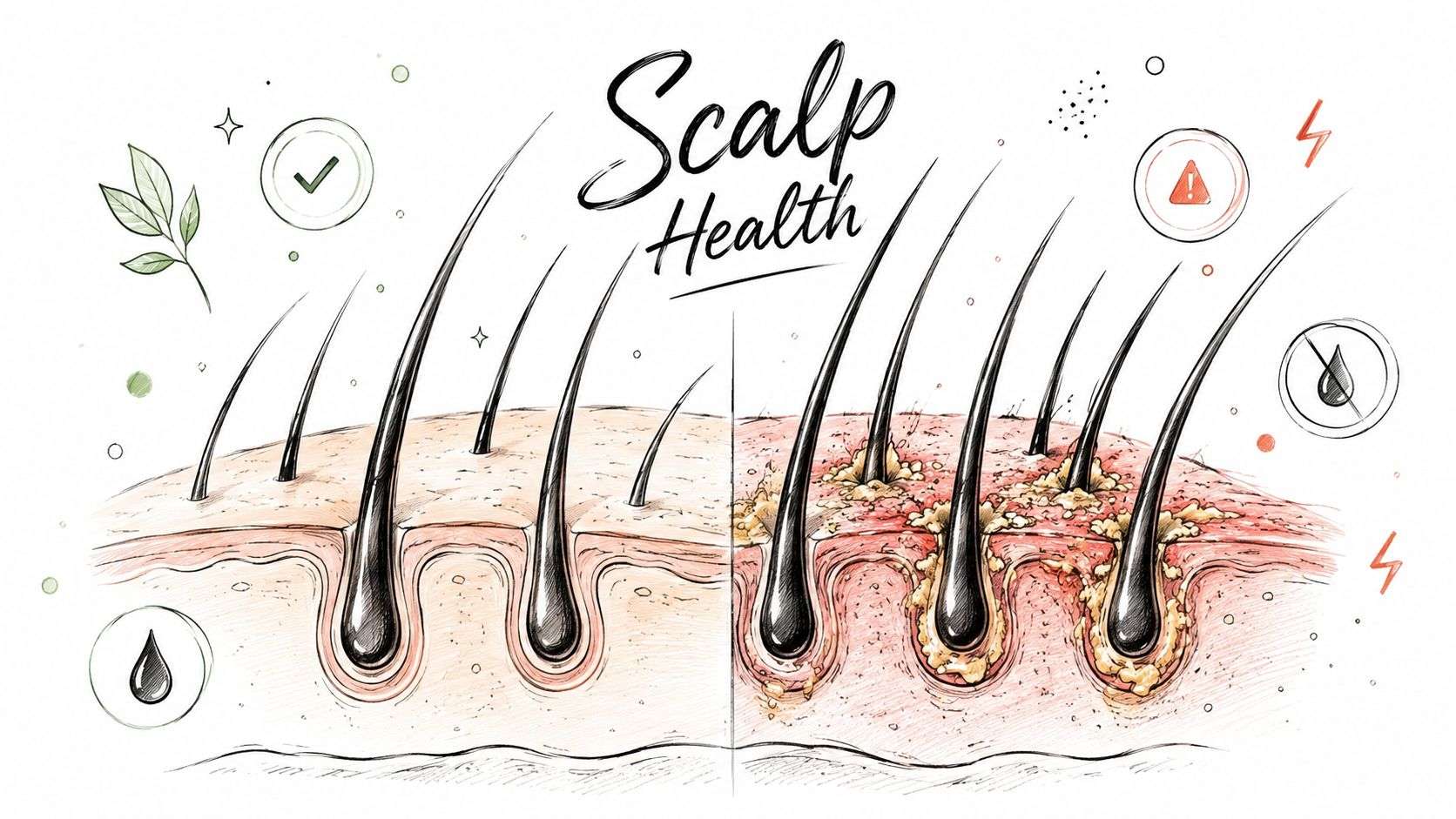
Most users assume that if a product is washable and sold for daily cosmetic use, long-term safety is straightforward. That assumption is too simple. The main concern isn't dramatic toxicity. It's cumulative residue, incomplete washout, and what repeated daily layering does to a scalp that's already sensitive, inflamed, or heavily styled.
The scalp issue most brand pages skip
One under-discussed concern is incomplete removal. Emerging user reports summarized here suggest that statically charged keratin fibers may clog follicles if not washed out thoroughly, with some advice recommending shampooing aggressively twice. That doesn't prove a universal long-term hazard, but it does challenge the casual idea that daily use is entirely consequence-free.
This matters most for people who already have scalp sensitivity, heavy product routines, or a habit of layering hold spray over fibers day after day. In those users, the issue may be less about the fibers alone and more about the combined residue burden.
If a cosmetic product stays attached well enough to survive your day, removal deserves the same level of attention as application.
Practical ways to reduce irritation risk
A few habits lower the chance of turning a cosmetic aid into a scalp-management problem:
- Wash deliberately: Don't rely on a quick rinse. Focus on complete removal from thinning zones and the surrounding scalp.
- Watch for symptom patterns: Itching, tenderness, or a “dirty scalp” feeling after wash day suggests the routine needs adjustment.
- Reduce stacking: Multiple styling products plus fibers can create more residue than many users realize.
- Use gentler care when sensitivity is present: If your scalp is already reactive, these soothing options for irritated scalps can help frame what to look for in a cleansing routine.
For readers interested in scalp-focused regenerative support rather than surface camouflage alone, this article on why GHK-Cu is the secret sauce for your scalp adds useful context.
What's missing from the public conversation isn't proof that fibers are dangerous. It's a mature discussion of cumulative use. Until that evidence base gets stronger, the safest position is disciplined removal, symptom monitoring, and a lower threshold for pausing use if the scalp becomes persistently irritated.
Cost and longevity of hair thickening fibers
The price tag on a bottle tells you very little. The meaningful metric is how long that bottle lasts under your actual pattern of thinning, your coverage expectations, and how often you apply. Cosmetic convenience often feels inexpensive in single-purchase form and more demanding when converted into a repeated grooming subscription.
What bottle lifespan really means
There is at least one useful benchmark. According to this wear-duration guide for hair fibers, a 15 g bottle lasts about 30 to 40 days for moderate hair loss, while a 30 g bottle lasts about 60 to 80 days, depending on frequency of application and the area covered.
Those ranges tell you several practical things without requiring a specific brand price. A person applying to a small crown area may get far better longevity than someone trying to conceal a wider frontal region. Someone using fibers only on workdays will stretch supply further than someone wearing them every day. A perfectionist trying to eliminate any visible scalp will also use product faster than someone comfortable with partial camouflage.
The maintenance cost that matters
The overall cost isn't just the bottle. It includes the behavior attached to it:
- Daily application time
- Holding products
- More deliberate wash routines
- Replacement frequency
- The possibility that coverage needs rise as thinning progresses
That last point changes the economics. Fibers can become less efficient over time if the area needing concealment expands or the remaining hairs become too sparse to support believable adhesion.
The cost analysis becomes more nuanced than “cheap versus expensive.” Fibers usually lower the barrier to entry, but they also commit the user to ongoing cosmetic upkeep. Clinical care generally asks for a higher commitment to evaluation and treatment, yet aims at a different endpoint. One is recurring concealment. The other is an attempt to change the baseline.
Comparing hair thickening fibers with clinical hair restoration
Comparing fibers with clinical treatment isn't a battle between right and wrong. It's a choice between appearance management and biologic intervention. Many people need both at different times.
The mistake is assuming that because fibers are easier to start, they're therefore the better first answer for everyone. In reality, the right choice depends on what bothers you most: visible thinning today, progression over time, or the burden of constant maintenance.
Hair Thickening Fibers vs Clinical Treatments Comparison
| Criteria | Hair Thickening Fibers | REGENhair™ | Other Clinical Treatments |
|---|---|---|---|
| Core goal | Conceal thinning by making existing hair look denser | Regenerative hair restoration approach | Varies by treatment type |
| Onset of visible effect | Immediate, cosmetic | Not immediate, treatment-based | Usually gradual rather than same-day |
| Dependence on existing hair | High | Lower emphasis on concealment alone | Depends on modality |
| Effect on underlying biology | None | Intended to address hair restoration rather than camouflage | May target underlying mechanisms, depending on approach |
| Routine burden | Frequent reapplication and removal | Clinic visits and follow-up | Ongoing medical or procedural follow-up |
| Best use case | Mild to moderate thinning with daily styling tolerance | People seeking more durable improvement | Users needing a broader medical treatment plan |
Who should choose concealment and who should choose treatment
Choose fibers when the main problem is visual and immediate. That includes early thinning, event-based use, or periods when you want a non-procedural option while considering longer-term care. They're especially practical for people who still have enough miniaturized or thinning hair to hold the fibers naturally.
Choose clinical treatment when the main problem is progression. If you're watching density worsen month by month, or if the area is expanding beyond what cosmetics can plausibly disguise, fibers become a defensive tactic rather than a solution.
A useful mental model is this:
- Fibers are a finish.
- Clinical restoration is a strategy.
That's why many informed users eventually combine them. They use a biologic or regenerative plan to address long-term goals and fibers to improve appearance during the waiting period. The combination is often more rational than relying on either approach alone.
For readers reviewing the broader range of advanced hair restoration treatments, it helps to compare options by endpoint rather than marketing language. Ask whether the method is designed to conceal, stabilize, or restore.
One more subtle trade-off deserves attention. Fibers reward consistency with appearance, but they punish disruption. Travel, sweating, rushed mornings, late nights, and scalp irritation all make the routine more fragile. Clinical care has its own inconvenience, but its burden is episodic. Fiber use is often lighter per day and heavier in aggregate because it never ends unless you stop needing the concealment.
Choosing between fibers and clinical treatment with next steps
A good decision starts with honesty about your goal. If you want your hair to look fuller for the next meeting, next date, or next few months, fibers may be enough. If you want to change the trajectory of thinning, camouflage alone won't satisfy you for long.
A practical decision framework
Fibers make the most sense when:
- You still have enough hair for adhesion
- Your thinning is mild enough to disguise naturally
- You're comfortable with a repeat grooming routine
- Your priority is immediate appearance rather than biologic change
Clinical treatment deserves stronger consideration when:
- Coverage is getting harder to maintain
- You're frustrated by daily upkeep
- The emotional burden comes from progression, not just visibility
- You want a plan built around restoration rather than concealment
If you're still in the exploratory phase, lifestyle measures can play a supportive role. These ideas on how to thicken hair naturally with these tips are worth reviewing as part of a broader self-care approach, even though they aren't substitutes for diagnosis or treatment.
For readers specifically considering a regenerative route, this overview of REGENhair™ hair restoration in Colleyville shows what a clinic-based next step can look like.
The strongest practical plan is often staged. Use fibers if you need fast cosmetic control. At the same time, get clear on whether you're also trying to protect, stabilize, or restore your hair over the longer term. The earlier you separate those goals, the less likely you are to mistake a convincing cover-up for a treatment outcome.
Sexual Wellness Centers of America provides regenerative wellness care for adults in Colleyville, Texas, including hair restoration support for people who want to move beyond cosmetic concealment and explore longer-term options. If you're weighing temporary coverage against a clinical plan, schedule a consultation with Sexual Wellness Centers of America to discuss whether a regenerative approach fits your goals.