
The GHK-Cu Peptide Your Scalp Has Been Missing Since Your 20s
The GHK-Cu peptide is a naturally occurring copper-binding tripeptide — made of three amino acids (glycine, histidine, and lysine) — that your body already produces, but makes less and less of as you age.
Here’s what you need to know at a glance:
- What it is: A small peptide complex that binds copper(II) and acts as a powerful biological signal for tissue repair and regeneration
- Where it comes from: Naturally found in human plasma, saliva, and urine
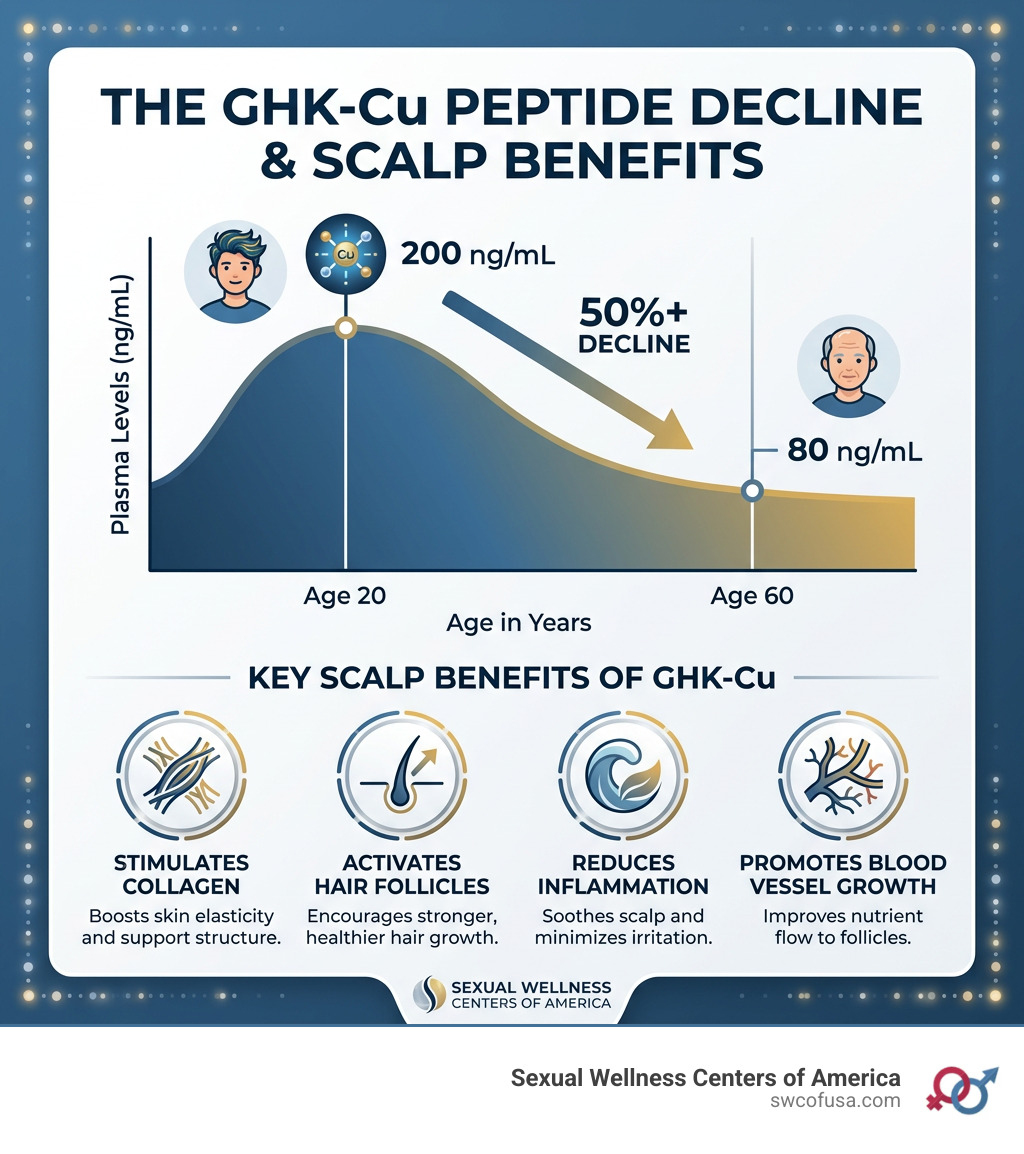
- Why it matters for your scalp: It stimulates collagen, activates hair follicles, reduces inflammation, and promotes blood vessel growth
- How it declines: Plasma levels drop from roughly 200 ng/mL at age 20 to just 80 ng/mL by age 60 — a decline of over 50%
- How you use it: Available as topical serums, creams, or injectable peptide therapy
- Is it safe? Yes, with decades of use and no serious adverse events reported in the research literature
That drop in GHK-Cu levels isn’t just a number. It coincides almost perfectly with the age when most people start noticing thinning hair, slower healing, and skin that just doesn’t bounce back the way it used to.
The peptide was first identified in 1973 by biochemist Dr. Loren Pickart, who noticed that young blood plasma caused aging liver cells to behave like young ones again. The molecule responsible? GHK. When paired with copper, it becomes something even more powerful for your body’s repair systems — including the scalp.
I’m Jeff Nuziard, CEO of Sexual Wellness Centers of America, and through my work helping men and women reclaim their vitality with science-backed treatments, the GHK-Cu peptide has become one of the most exciting tools in our regenerative wellness toolkit — particularly for hair and scalp health.
Easy ghk-cu peptide glossary:
What is GHK-Cu Peptide and How Does It Work?

At its core, ghk-cu peptide is a messenger. In biology, we call it a “matrikine”—a peptide derived from the breakdown of the extracellular matrix (like collagen) that signals the body to start repairing itself. When you get a cut or an injury, your body naturally releases GHK to coordinate the healing process.
But GHK doesn’t work alone. Its “superpower” is its incredible affinity for copper. It essentially acts as a high-tech delivery vehicle, grabbing copper ions and transporting them exactly where they are needed most. This is crucial because copper is a vital cofactor for many enzymes involved in antioxidant defense and tissue building.
The Biological Mechanism of GHK-Cu Peptide
The magic happens when ghk-cu peptide interacts with our cells, particularly fibroblasts. Fibroblasts are the “construction workers” of our skin and scalp; they are responsible for building the structural framework of our tissues.
Research shows that GHK-Cu:
- Increases Fibroblast Proliferation: It tells your body to make more of these repair cells.
- Boosts Collagen and Elastin: It stimulates the production of the proteins that keep your scalp firm and your hair follicles anchored.
- Activates Antioxidant Enzymes: It ramps up levels of Superoxide Dismutase (SOD), which protects your scalp from oxidative stress and environmental damage.
- Increases Stem Cell “Stemness”: It helps maintain the youthful markers of skin stem cells, ensuring they can continue to regenerate tissue over time.
According to Scientific research on GHK regenerative actions, this peptide is one of the few substances capable of broadly resetting gene expression to a healthier, more youthful state.
| Age | Average GHK-Cu Plasma Level (ng/mL) | Relative Decline |
|---|---|---|
| 20 | ~200 | Baseline |
| 60 | ~80 | -60% |
This decline explains why our ability to repair tissue—and grow thick, healthy hair—wanes as we get older. By supplementing with peptide supplements, we are essentially giving our body the signal it used to send naturally when we were younger.
Resetting the Human Genome to Health
One of the most mind-blowing aspects of ghk-cu peptide is its effect on our DNA. It doesn’t just “fix” things on the surface; it actually modulates the expression of 31.2% of human genes. Specifically, it stimulates about 59% of these genes and suppresses 41%.
This includes the activation of the ubiquitin-proteasome system (UPS). Think of the UPS as your body’s cellular recycling center. As we age, “junk” proteins build up in our cells, leading to dysfunction. GHK-Cu helps clear out this cellular debris, restoring health at a foundational level. For more details on how these work, you can explore what are peptide supplements?
Primary Benefits for Hair Growth and Scalp Vitality
If you’re looking for the “secret sauce” for hair, this is it. In hair restoration, we often focus on blocking DHT (the hormone responsible for male pattern baldness). While that’s important, ghk-cu peptide takes a different, more holistic approach by improving the “soil” in which the hair grows.
Follicle Enlargement and Anchoring
One of the primary reasons hair thins is that the follicles themselves shrink—a process called miniaturization. Research has shown that copper peptides can actually increase follicle size. Larger follicles produce thicker, stronger hair shafts. Furthermore, by boosting collagen and elastin in the scalp, GHK-Cu helps anchor the hair more securely, reducing premature shedding.
Angiogenesis: Feeding the Roots
Hair follicles are incredibly hungry for nutrients and oxygen. They require a robust blood supply to function. GHK-Cu is a potent promoter of angiogenesis, which is the formation of new blood vessels. By increasing vascularization around the hair papilla, the peptide ensures that your hair roots are getting the “fuel” they need to stay in the growth (anagen) phase longer. This is a cornerstone of peptides for hair growth.
Reducing Scalp Inflammation
Chronic micro-inflammation is a silent killer of hair follicles. Whether it’s from environmental stress, harsh products, or aging, an inflamed scalp is not a productive one. Scientific research on hair papilla cells indicates that GHK-Cu suppresses pro-inflammatory cytokines, creating a calm, healthy environment for hair to thrive.
Topical GHK-Cu Peptide for Scalp Health
In the cosmetic world, you’ll often see this listed as “Copper Tripeptide-1.” It is widely used in high-end scalp serums and post-hair transplant recovery protocols. Because GHK-Cu is so effective at wound healing, it is often applied after hair transplants to speed up the healing of grafts and reduce the risk of infection.
We often recommend peptide therapy for hair growth because it works synergistically with other treatments. For example, some studies suggest that copper peptides can be as effective as 5% minoxidil in stimulating hair growth, but with a much lower risk of irritation.
Systemic Benefits of Injectable GHK-Cu Peptide
While topical application is great for the scalp, injectable ghk-cu peptide offers systemic “anti-aging” benefits that go far beyond just hair. When administered via subcutaneous injection, the peptide enters the bloodstream and can affect tissues throughout the entire body.
- Wound Healing: GHK-Cu is legendary for its ability to speed up the healing of diabetic ulcers and ischemic wounds.
- Cognitive Health: It has neuroprotective properties and may help protect against cognitive decline by reducing oxidative stress in the brain.
- Lung Protection: Research shows it may protect against lung fibrosis and inflammation, particularly in conditions like COPD.
- Anxiety and Pain: Interestingly, animal studies have shown that GHK can reduce aggression and anxiety while providing mild analgesic (pain-relieving) effects.
These peptide therapy benefits make it a favorite for those pursuing a comprehensive longevity strategy. You can read more about Scientific research on GHK and tissue remodeling to see just how versatile this molecule is.
Topical vs. Injectable: Choosing Your Administration Method
Choosing how to use ghk-cu peptide depends on your specific goals. Are you strictly looking to improve hair density, or are you looking for a total-body “reset”?
Topical Absorption
Topical GHK-Cu is excellent for localized issues. It can penetrate the stratum corneum (the outer layer of skin), especially when formulated in liposomes or nano-lipid carriers. This makes it perfect for targeting the scalp or reducing wrinkles on the face. According to Scientific research on topical delivery pathways, modern formulations have significantly improved how much of the peptide actually reaches the deeper layers of the dermis.
Injectable Efficacy
For those who want the most potent effect, peptide injection therapy is the gold standard. By bypassing the skin barrier entirely, you ensure 100% bioavailability. This is the preferred method for systemic tissue remodeling, DNA repair, and anti-inflammatory benefits.
Recommended Dosages and Cycling Protocols
If you are using injectable ghk-cu peptide, it typically comes as a lyophilized (freeze-dried) powder that must be reconstituted with bacteriostatic water.
- Dosage Range: Common research dosages range from 0.5mg to 2.5mg per day.
- Administration: It is typically injected subcutaneously into fatty tissue (like the stomach or thigh) using a tiny insulin syringe.
- Cycling: We generally recommend a “cycle” approach—for example, 30 days of daily use followed by a 30-day break. This prevents the body from becoming desensitized to the signal and mimics the natural “pulse” of repair signals in the body.
While you are on a cycle, you might also consider the collagen peptide supplement benefits to provide the raw materials your body needs to build new tissue once the GHK-Cu sends the signal.
Safety, Side Effects, and the “Copper Uglies”
One of the best things about ghk-cu peptide is its safety profile. Because it is a substance your body already makes, it is generally very well tolerated. However, there are a few things to keep in mind.
Common Side Effects
Most people experience no side effects. Some may notice slight redness or irritation at the injection site or where the topical serum was applied. This is usually temporary and resolves quickly.
The “Copper Uglies”
If you spend any time in skincare forums, you might hear about the “copper uglies.” This refers to a rare phenomenon where the skin temporarily looks worse (loss of firmness or increased wrinkles) after starting copper peptides.
Why does this happen? GHK-Cu stimulates both the synthesis and the breakdown of the skin’s matrix. It activates enzymes called Matrix Metalloproteinases (MMPs) that clear out old, damaged collagen so new collagen can be built. If MMP activation happens too fast or if the concentration is too high, it can lead to a temporary “sagging” look.
To avoid this:
- Start with a low concentration.
- Don’t over-apply topical serums.
- Ensure you are using high-quality, pharmaceutical-grade products.
Contraindications and Risks
While Scientific research on copper toxicity shows that GHK-Cu is safe at therapeutic doses, there are specific groups who should avoid it:
- Wilson’s Disease: A rare genetic disorder where copper accumulates in the body.
- Cancer Patients: Because GHK-Cu promotes angiogenesis (new blood vessels), it should be avoided by those with active cancer unless specifically directed by a physician, as tumors also use angiogenesis to grow.
- Pregnant/Nursing Women: As with most peptide therapies, there isn’t enough data to confirm safety during pregnancy.
For general skin health without the specific copper focus, you can also look into other peptides for skin.
Frequently Asked Questions about GHK-Cu Peptide
How long does it take to see results from GHK-Cu?
Patience is key! While GHK-Cu starts working at a cellular level immediately, visible changes in hair density or skin texture usually take time. For skin, you might see a “glow” within 2-4 weeks, but for hair, you need to allow for at least one full growth cycle—typically 3 to 6 months—to see significant improvement.
Can GHK-Cu be used alongside other hair treatments?
Absolutely. In fact, we find it works best as part of a multi-modal approach. It pairs beautifully with our REGENmax® technology and can enhance the results of topical minoxidil or finasteride by improving the health of the scalp.
What are the “copper uglies” and how can I avoid them?
As mentioned, these are caused by excessive collagen breakdown. To avoid them, don’t rush the process. Start with lower dosages, cycle your use, and always support your body with proper nutrition and hydration. If you notice your skin looking “thinner,” simply stop use for a few weeks, and the skin usually bounces back better than before as the new collagen settles in.
Conclusion
At Sexual Wellness Centers of America in Colleyville, TX, we believe that true wellness comes from the inside out. Whether we are using our 97.2% effective protocols for erectile dysfunction or helping you restore your crowning glory, our goal is to use the most advanced science available to help you feel like yourself again.
The ghk-cu peptide is a remarkable example of how we can harness the body’s own signaling molecules to reverse the clock. When combined with our personalized plans and proprietary technologies like REGENmax®, HEshot®™, and SHEshot®™, you aren’t just masking the signs of aging—you are actively resetting your biology to a healthier state.
If you’re ready to see what pharmaceutical-grade peptides can do for your scalp and overall vitality, we invite you to explore Peptide Therapy Colleyville TX and schedule a consultation with our team. Let’s get your “secret sauce” working for you.