
Why do so many people ask for a few better moves when the actual problem is that they don't fully understand what female pleasure depends on?
If you want to learn how please a woman, the answer isn't a script, a trick, or a performance routine. It's the ability to read the whole picture. Her sense of safety. Her comfort in her body. Her anatomy. Her arousal pattern. Her health. Her ability to say yes, no, slower, softer, more, or stop without worrying about how you'll react.
That matters because many barriers to sexual satisfaction begin early, not only later in life. A nationally representative US survey found that 30.9% of women aged 18 to 24 reported being sexually inactive in the past year, a significantly higher rate than their male peers, according to this US survey on sexual activity frequency. That doesn't mean every woman in that group is unhappy or wants more sex. It does mean sexual connection is shaped by more than desire alone.
If you want broader context on intimacy, access, and sexual support resources, this guide on sexual well-being in Italy offers a useful starting point for adults looking at the topic through a health and relationship lens.
Table of Contents
- Beyond Technique The True Meaning of Female Pleasure
- The Foundation of Pleasure Communication and Consent
- Understanding Her Body Anatomy and Arousal
- Mastering the Art of Foreplay and Stimulation
- Navigating Medical and Life Stage Factors
- Putting It All Together for a Lasting Connection
Beyond Technique The True Meaning of Female Pleasure
A woman doesn't usually feel pleased because someone memorized the right sequence. She feels pleased when her body and mind are both included. That means the experience respects her boundaries, responds to her feedback, and stays flexible enough to meet her where she is on a given day.
A lot of common advice gets this wrong. It treats pleasure like a mechanical result. Touch the right place, use the right tempo, wait for a predictable outcome. Real intimacy doesn't work that way. A woman may enjoy the same type of touch one day and dislike it the next because stress, hormone shifts, discomfort, relationship tension, fatigue, or self-consciousness can all alter arousal.
Pleasing a woman isn't about proving skill. It's about creating the conditions where pleasure can happen.
That's why respect is not separate from eroticism. For many women, feeling emotionally safe makes physical pleasure more available. Being listened to lowers tension. Not having to perform lowers pressure. Knowing she can pause things without conflict helps her body stay open rather than guarded.
Three realities tend to matter more than people expect:
- Context matters: A thoughtful environment often does more than a flashy technique.
- Individual variation matters: What pleased one partner may irritate another.
- Responsiveness matters: The best lovers adjust quickly instead of insisting on a routine.
There's also a difference between chasing orgasm and supporting pleasure. Orgasm can be part of satisfying sex, but it's not the only marker of a good experience. Some women want intensity. Some want warmth and slowness. Some need more time to become mentally present than physically responsive. Some need physical discomfort addressed before pleasure becomes possible.
Clinical perspective: When pleasure feels difficult, the missing piece is often not effort. It's understanding.
That shift changes the whole question. Instead of asking, “What move should I do?” ask, “What helps her feel safe, turned on, comfortable, and free to guide me?” That question leads to better touch, better communication, and less pressure on both partners.
The Foundation of Pleasure Communication and Consent

If communication feels awkward, most couples try to skip it and hope chemistry will carry them. That usually leads to confusion. Good sexual communication doesn't kill desire. It reduces guesswork and makes desire easier to trust.
Research confirms that psychological factors are primary drivers of female pleasure. A woman's sexual assertiveness and body-esteem are more predictive of her ability to experience pleasure than physical technique alone, as discussed in this research on psychosocial predictors of female pleasure. In practice, that means a woman who feels judged, rushed, or unable to speak up may have a harder time enjoying even technically skilled touch.
Build safety before touch
Safety starts before anyone gets undressed. The way you speak at dinner, the way you respond to a boundary, the way you handle disappointment, all of that affects sexual openness later.
A supportive partner does a few simple things consistently:
- Invites honesty: “You can tell me if something doesn't feel good.”
- Normalizes feedback: “I'd rather know what you like than assume.”
- Makes stopping easy: “We can slow down or stop at any point.”
These phrases work because they lower risk. They tell her she won't be punished emotionally for having preferences.
Consent also needs to stay ongoing. A yes to kissing isn't a yes to everything else. A yes five minutes ago may become a no after discomfort, distraction, or pain. Pay attention to tone, muscle tension, stillness, and whether enthusiasm is growing or fading.
Practical rule: If you're not sure whether she likes something, pause and ask in a calm voice.
Use questions that invite honesty
Closed questions can box people in. “Do you like this?” often gets a polite yes, even when the answer is mixed. Open-ended questions are better because they give her room to describe sensation.
Try language like this:
- Before intimacy: “What helps you relax and get in the mood?”
- During intimacy: “Do you want more pressure, less pressure, or a different spot?”
- After intimacy: “What part felt best for you?”
These questions are specific enough to be useful without turning the moment into an interview.
It also helps to affirm her body instead of evaluating it. Many women carry tension around appearance, smell, sound, or whether they're taking too long. If she senses you're grading her response, arousal often drops. If she senses acceptance, her body usually has a better chance to stay engaged.
A few habits usually don't work:
- Interrogating in the middle: Too many questions can pull her out of sensation.
- Taking redirection personally: If she asks for a change, that's guidance, not criticism.
- Pushing for verbal performance: Not every woman wants to narrate what she feels in explicit detail.
Consent and communication are not separate from pleasure. They are part of pleasure. A woman who feels respected can focus on what her body is feeling instead of what she needs to manage.
Understanding Her Body Anatomy and Arousal
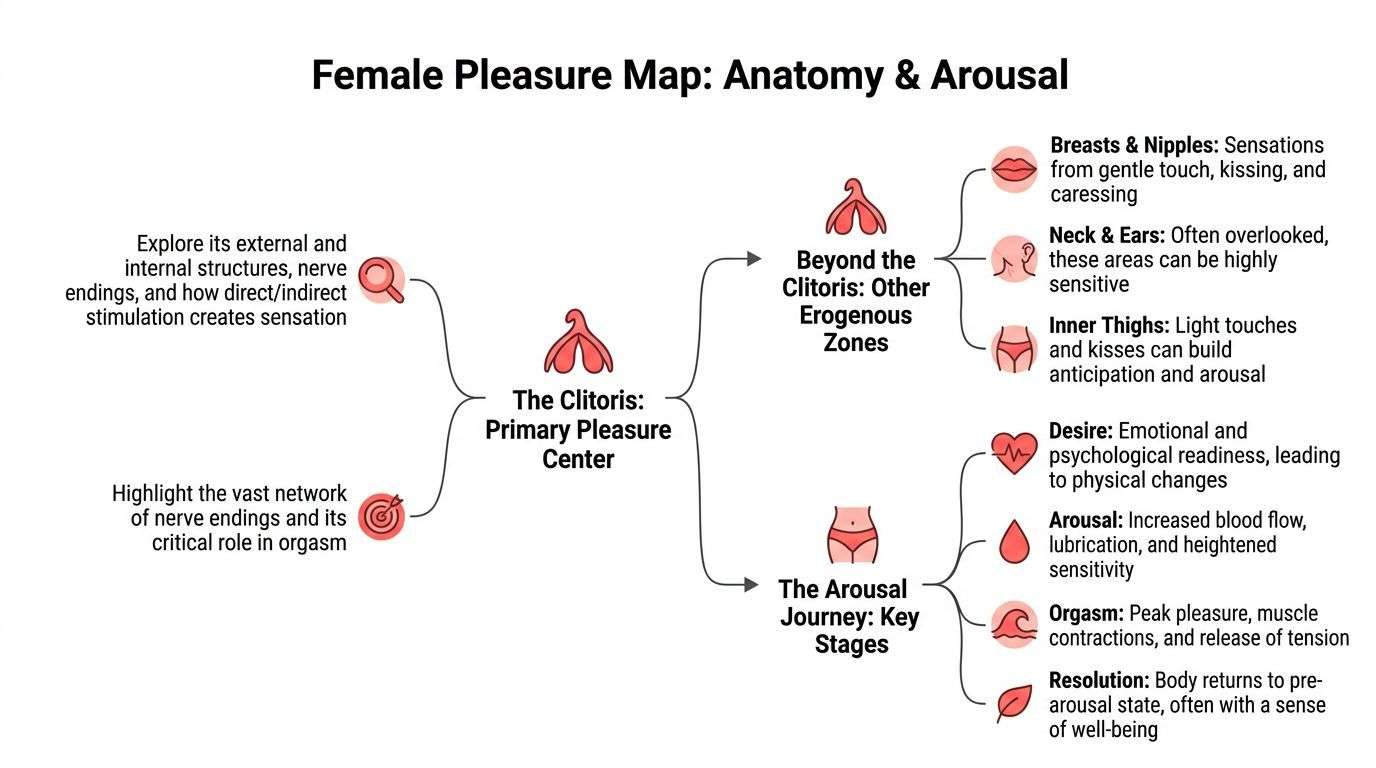
Many people were taught female anatomy in a way that's too limited to be useful in bed. They think of one tiny external point and ignore the wider structure, the surrounding tissue, and the fact that arousal often builds through indirect stimulation rather than immediate intensity.
One especially common mistake is the direct attack on the clitoral glans. Research on this topic notes that satisfying pleasure is more consistently achieved by stimulating the general mons area and the sides of the clitoral shaft, rather than going straight at the most exposed point, as explained in this clinical discussion of clitoral technique precision. In plain terms, what feels efficient to a partner can feel sharp, overwhelming, or irritating to the woman receiving it.
Why anatomy changes technique
The clitoris is not just the visible external tip. It's part of a larger erectile structure with substantial nerve supply. That's why broader, gentler contact often works better at first. Think less poking and more cushioning. Less pressure on the most sensitive spot, more exploration around it.
Useful principles include:
- Start around the area: The mons, outer vulva, and sides often help her warm into sensation.
- Increase pressure gradually: What feels too light at first may feel perfect later, or the reverse.
- Keep rhythm steady once something works: Constant switching can break the build.
Non-genital touch matters too. The neck, breasts, inner thighs, back, scalp, and hips can all contribute to arousal because pleasure isn't isolated to one structure. For many women, anticipation and pacing change the quality of sensation as much as location does.
Broad touch often feels safer and more arousing early on. Precision tends to work better after the body is already engaged.
The Four Stages of Female Arousal
Female arousal usually responds to a mix of mental, relational, and physical input. It may not move in a straight line. She can become mentally interested before she feels physical readiness, or physically responsive before she feels fully emotionally present.
| Stage | What's Happening Physiologically and Emotionally |
|---|---|
| Desire | Interest begins. This may come from emotional closeness, erotic thought, affectionate touch, or a sense of safety and readiness. |
| Arousal | Blood flow increases, lubrication may increase, and sensitivity rises. Attention often narrows toward pleasurable sensation. |
| Orgasm | If it occurs, pleasure peaks with rhythmic muscular release and intense sensory focus. Not every satisfying experience includes orgasm. |
| Resolution | The body settles. Some women want closeness and stillness. Others remain sensitive and may or may not want continued stimulation. |
Two practical lessons follow from this. First, don't assume instant genital readiness means she's fully comfortable. Second, don't assume slower arousal means lack of attraction. Her body may need more time, more context, or a different kind of touch.
Mastering the Art of Foreplay and Stimulation
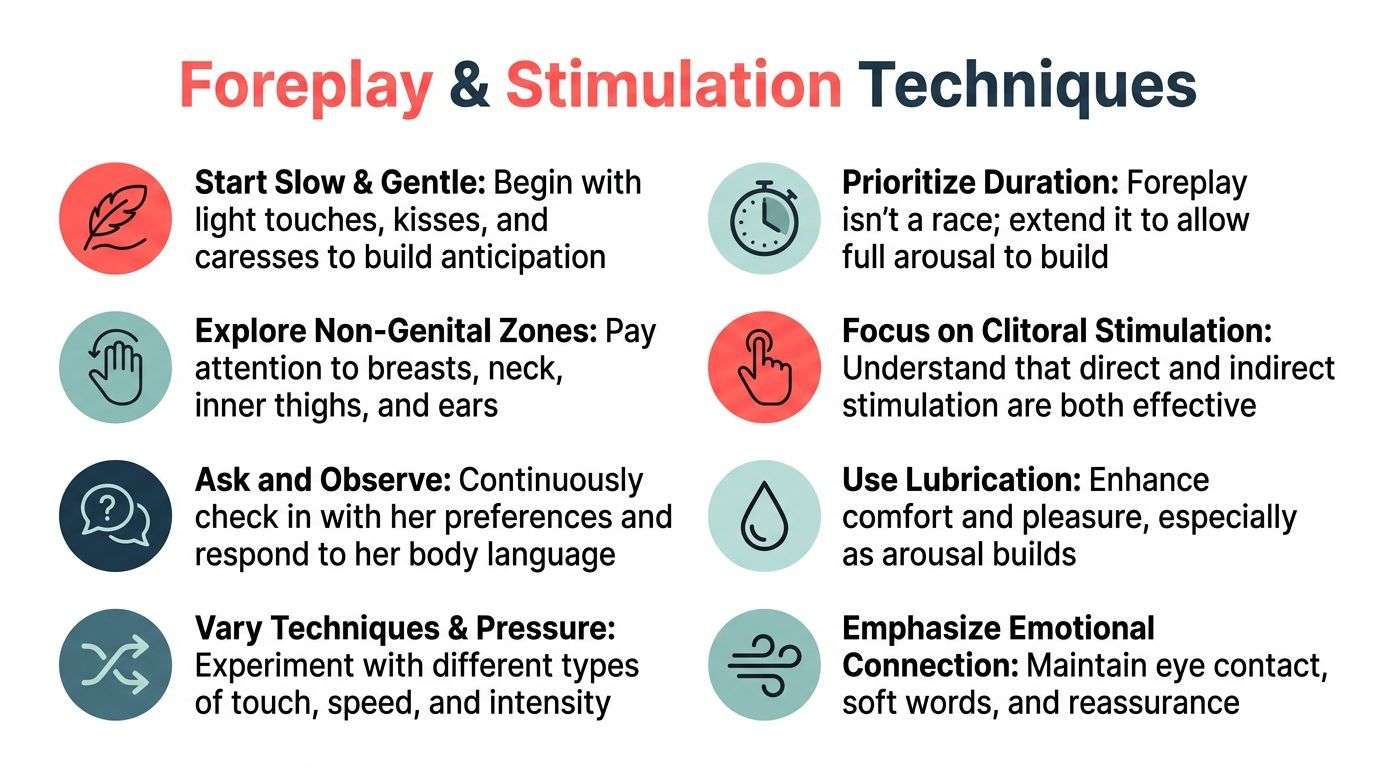
Foreplay is a misleading word because it makes the most important part of arousal sound optional. For many women, whole-body touch, emotional connection, and gradual stimulation are not warm-up activities. They are the main path to pleasure.
That matters in light of the orgasm gap. A global survey found that 64% of men report regularly achieving orgasm during sex, compared with 48% of women, according to this global sexual wellbeing survey. If you're trying to understand how please a woman in real life, this gap is a reminder that partner-focused stimulation often needs more patience and better technique than people assume.
What works better than rushing
Arousal tends to build more reliably when touch begins away from the genitals and becomes more focused only after her body is signaling interest. That might mean kissing longer, touching her waist and thighs slowly, or using your hand to explore with broad contact before narrowing in.
A responsive sequence often looks like this:
- Begin with atmosphere: Slow speech, relaxed pacing, and affectionate contact reduce mental noise.
- Use layered touch: Move from back, hips, neck, and thighs toward more sensitive areas gradually.
- Let one good thing continue: If she leans in, breathes deeper, or asks for the same motion, keep going.
Lubrication can also make a major difference in comfort. Even when desire is present, the body doesn't always respond on cue. Using lubrication is not a sign that anything is wrong. It's often just good sexual care.
If you want more ideas for expanding intimacy beyond a narrow script, this article on creative ways to enhance intimacy can help couples think more broadly about connection.
How to respond instead of perform
The most effective lovers pay attention instead of showing off. They notice whether her thighs open or tighten, whether she presses closer or pulls away, whether her breathing gets fuller, whether she seems present or distracted.
A few technique adjustments usually help:
- Use flatter contact first: A broad finger pad, palm, or tongue often feels better than sharp, pinpoint contact.
- Choose consistency over novelty: If she's getting close, don't suddenly change rhythm because you think you should.
- Match intensity to feedback: More pressure is not always better. Better is better.
- Stay emotionally connected: Eye contact, reassurance, and warmth can keep her from slipping into self-consciousness.
If she says “right there,” believe her. Don't improve it. Repeat it.
What usually fails is impatience. Fast escalation, rough direct contact, constant repositioning, or treating orgasm like a deadline can make pleasure collapse. Good stimulation is less about variety than about timing, steadiness, and listening.
Navigating Medical and Life Stage Factors
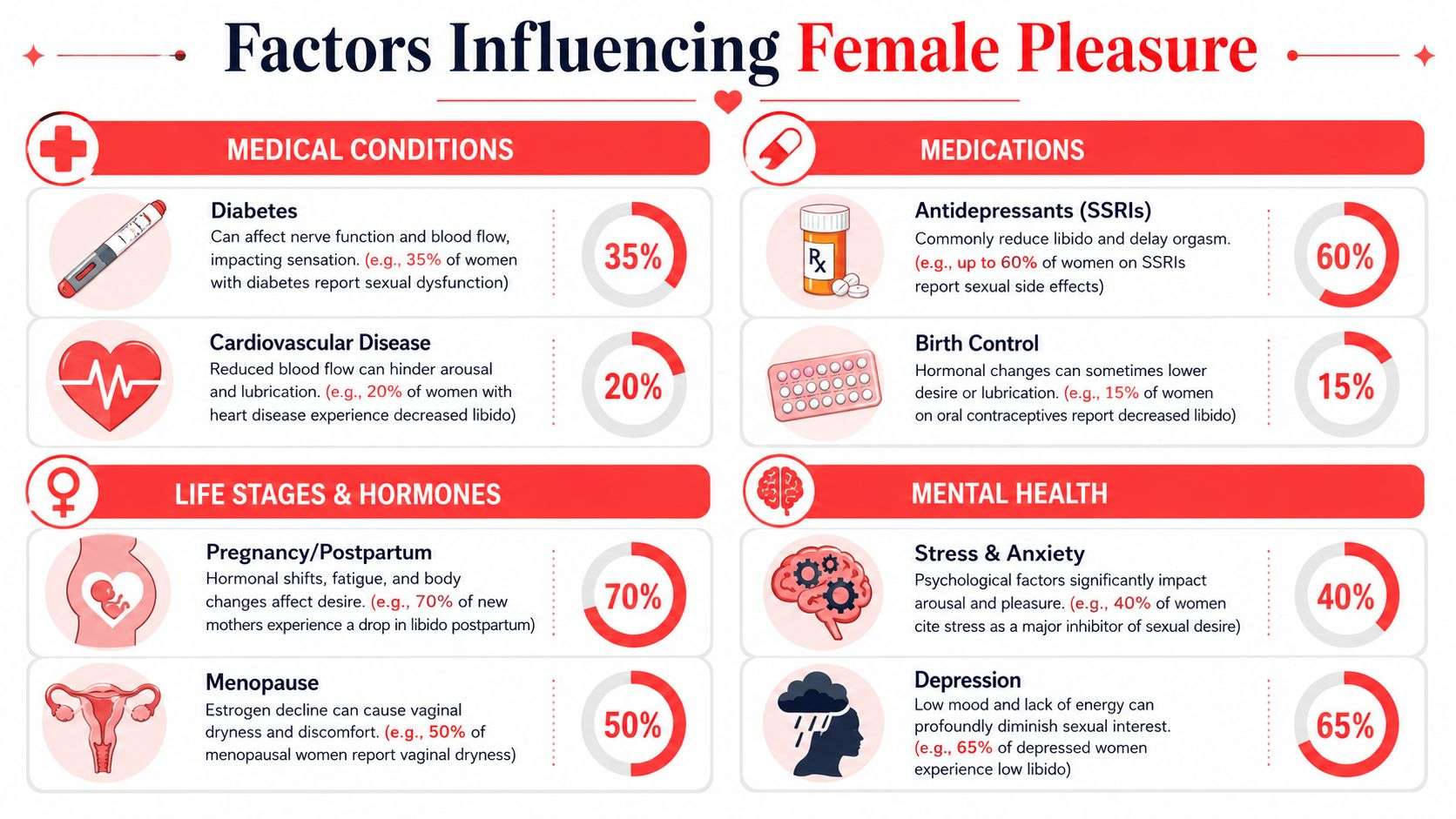
Sometimes a woman isn't hard to please. She's dealing with pain, dryness, hormone shifts, medication effects, pelvic floor tension, fatigue, or a history that makes closeness complicated. If you ignore those realities, even caring partners can misread the situation and conclude that chemistry is the issue when health is the issue.
Approximately 40% to 50% of women experience at least one form of sexual dysfunction in their lifetime, most commonly involving desire and arousal, and for postmenopausal women, transdermal testosterone can improve low desire while remaining within physiological limits, according to this review of female sexual dysfunction interventions and treatment options. That should normalize the conversation. Sexual difficulty is common, and in many cases it's treatable.
When the issue is not effort
Hormonal changes can affect desire, lubrication, tissue sensitivity, and comfort. Perimenopause and menopause are especially important periods, but they aren't the only ones. Postpartum recovery, chronic health conditions, medication changes, and pelvic pain can all alter what feels possible.
What a partner should understand:
- Dryness can make good intentions painful: More arousal time and lubrication may help, but persistent discomfort deserves medical evaluation.
- Low desire may be multifactorial: Stress, relationship strain, hormones, sleep, and medication effects can overlap.
- Pain is not something to push through: If sex hurts repeatedly, stop guessing and get it assessed.
For women dealing with lubrication changes, practical education can make the topic easier to discuss. This resource on ways to improve vaginal lubrication explains common contributors and supportive options in straightforward language.
Supportive partners notice patterns
A compassionate partner watches for recurring signs. Avoidance. Wincing. Dryness despite interest. Anxiety before intimacy. A sudden drop in comfort after a medication change. None of these should be framed as failure.
In some relationships, trauma is part of the picture. That doesn't mean intimacy can't be fulfilling. It does mean pressure and misunderstanding can make things worse. If trauma responses are affecting closeness, access to trauma-informed therapy services may help create the safety and pacing needed for healing.
Pain, numbness, or persistent lack of pleasure are not moral problems. They are clinical and relational signals worth taking seriously.
What works is a team mindset. “How do we solve this together?” is far more useful than “Why aren't you responding?”
Putting It All Together for a Lasting Connection
A woman is most likely to feel pleasure when several things line up at once. She feels safe enough to be honest. Her body is approached with knowledge instead of assumption. Touch builds gradually rather than rushing to the most sensitive area. Discomfort is taken seriously. Her changing needs are treated as normal.
That's the fundamental answer to how please a woman. Not a fixed sequence, but a reliable way of relating. Ask. Notice. Adjust. Stay kind. Don't confuse silence with enjoyment. Don't assume desire should look the same every time. Don't turn her body into a test you have to pass.
A lasting sexual connection usually includes a few shared habits:
- Talk outside the bedroom: It's easier to discuss preferences when nobody is in the middle of the moment.
- Treat feedback as useful information: Small changes often make the biggest difference.
- Stay open to support: Sometimes the next step is medical care, sometimes therapy, sometimes slowing down and rebuilding trust.
Emotional intimacy also matters more than many couples expect. If you want a deeper look at the bond between closeness and sexual satisfaction, this article on what it means to enhance intimacy and connection is a helpful companion read.
A good partner doesn't just try harder. A good partner gets more informed, more observant, and more trustworthy. That's what makes pleasure more possible over time.
If sexual discomfort, low desire, orgasm difficulty, or arousal changes are affecting your relationship or quality of life, Sexual Wellness Centers of America offers clinical evaluation and adult sexual wellness care in a medical setting. The right support can help you move from guessing to getting answers.