
The most popular advice about penile venous leakage is often the least useful: if an ultrasound says “venous leak,” many patients are told that a vein is leaking and that treatment should focus on blocking it. That explanation sounds clear, but it can push men toward invasive decisions before anyone has confirmed whether the diagnosis is accurate.
Penile venous leakage, also called veno-occlusive dysfunction or venogenic erectile dysfunction, is a problem with retaining blood during an erection. Yet the diagnosis is frequently overcalled on an initial penile duplex ultrasound. A careful evaluation should establish whether the difficulty comes from arterial inflow, venous outflow, corporal smooth-muscle function, medication effects, hormonal factors, or a combination of causes.
The practical lesson is straightforward. Don't treat a label until the testing supports the mechanism. A repeat, properly stimulated Doppler study or more definitive vascular testing may change the diagnosis and therefore change the treatment plan.
Table of Contents
- Why Penile Venous Leakage Is Often Misdiagnosed
- How Normal Erections Trap Blood Inside the Penis
- Recognizing the Symptoms of Veno-Occlusive Dysfunction
- Diagnostic Tests and What the Numbers Indicate
- Conventional Treatments and Their Limitations
- Regenerative Therapies Targeting the Root Cause
- What to Expect from Treatment and When to See a Specialist
Why Penile Venous Leakage Is Often Misdiagnosed
A scan that says “venous leak” does not automatically prove that a vein is failing. Penile venous leakage, also called veno-occlusive dysfunction or venogenic erectile dysfunction, describes difficulty retaining blood during an erection. Blood may enter the penis adequately, yet pressure falls because the erectile tissue does not compress its drainage channels effectively enough.
Penile Doppler results depend on more than a single velocity reading. Medication dose, erection quality, timing, anxiety, temperature, and the completeness of the arterial response can all affect the measurement. A borderline result obtained before a full pharmacologic erection may resemble venous leakage even when the underlying hemodynamics are normal.
What repeat testing has shown
A 2011 series of 292 patients found that 47% of men initially labeled as having venous leak had completely normal hemodynamics on repeat testing, while only 43% had the diagnosis confirmed (the PubMed study on repeat penile vascular testing). The same study reported that repeat duplex testing reassigned 19% to normal hemodynamics and 7% to isolated arterial insufficiency. Dynamic infusion cavernosometry and cavernosography confirmed venous leak in 58% of cases.
These findings do not make penile venous leakage imaginary. They show that an initial interpretation can be wrong, especially when the protocol is not standardized or the erection is incomplete. A false-positive diagnosis may steer a patient toward vein procedures when the actual contributor is arterial insufficiency, mixed vascular disease, medication effects, or another reversible factor.
Practical rule: Before considering an invasive treatment, ask whether the study produced a fully developed pharmacologic erection, whether arterial inflow was adequate, and whether confirmation is recommended.
The distinction matters for younger men who may feel alarmed by language suggesting permanent structural damage. Information about erectile dysfunction in younger men should address diagnostic uncertainty rather than treating an early abnormal scan as proof of a lifelong venous defect.
A sound evaluation also reviews erection quality in different situations, pelvic or penile injury, curvature, vascular risk factors, medications, hormones, and psychological stress. Symptoms can suggest a mechanism, but they cannot replace properly performed vascular assessment. When the suspected mechanism remains uncertain, regenerative protocols may offer a less invasive treatment discussion than immediate surgery, although candidacy and expected benefit require individual assessment.
How Normal Erections Trap Blood Inside the Penis
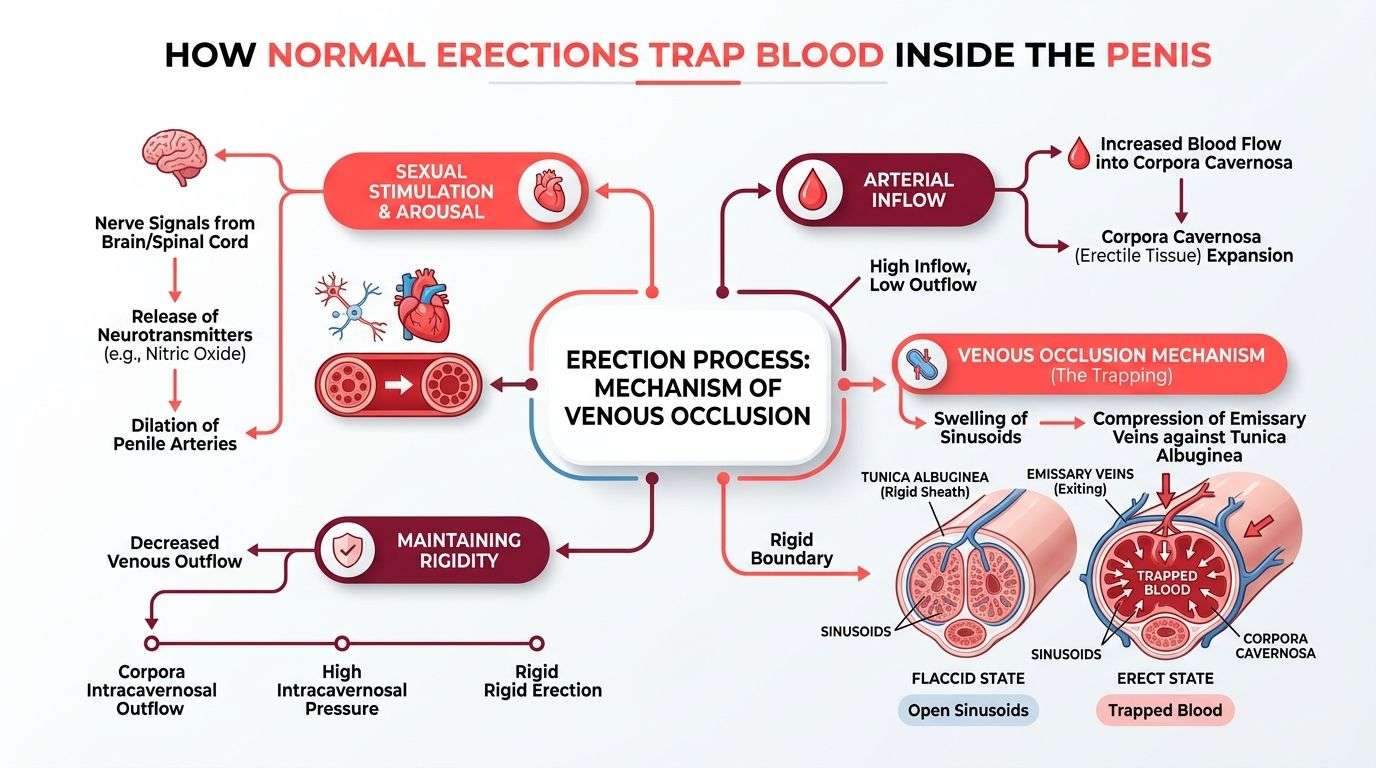
An erection requires more than blood entering the penis. It requires the erectile chambers to fill, expand, and restrict drainage at the same time.
The corpora cavernosa are spongy chambers containing smooth muscle and vascular spaces. During sexual stimulation, nerve signals and biochemical processes relax that smooth muscle. The penile arteries widen, blood flows into the chambers, and the tissue expands.
As the chambers enlarge, they press outward against the tunica albuginea, a firm surrounding layer. That expansion compresses the small veins running through the erectile tissue and near its outer boundary. The veins act less like open pipes and more like drainage channels that become squeezed shut as the chambers fill.
The balloon and valve analogy
Think of the corpora cavernosa as two elastic water balloons. The arteries are the filling hoses, while the veins are the outlets. A firm erection needs both a strong filling signal and an effective valve-like closure at the outlets.
If the filling hose is weak, the balloon never reaches enough pressure. That resembles arterial insufficiency. If the filling hose works but the outlet never closes, water continues to escape, and the balloon remains soft or loses firmness quickly. That is the basic mechanical idea behind veno-occlusive dysfunction.
The system also depends on healthy smooth muscle, connective tissue, nerves, and blood vessels. A problem in any of these areas can affect erection quality, which is why penile venous leakage shouldn't be treated as an isolated plumbing issue without a broader health review. Men concerned about vascular contributors may also benefit from guidance on how to support heart function naturally, since erectile and cardiovascular health share important physiological foundations.
Medication can improve arterial relaxation and inflow, but it can't automatically correct every outflow or tissue-retention problem. Understanding how erectile dysfunction treatment pills actually work helps explain why a medication may provide partial benefit without fully solving a confirmed veno-occlusive disorder.
Recognizing the Symptoms of Veno-Occlusive Dysfunction
The symptom pattern that raises suspicion is usually “getting hard is easier than staying hard.” A man may achieve a useful erection with stimulation, then lose firmness during intercourse, after changing position, or when stimulation briefly decreases.
That pattern differs from arterial insufficiency, where the erection may be slow to develop or never become sufficiently firm. It also differs from predominantly situational erectile dysfunction, where erection quality varies sharply according to stress, relationship context, performance pressure, or setting. These distinctions are useful clues, not diagnostic conclusions.
Patterns that deserve evaluation
Patients often describe one or more of the following:
- Rapid loss of firmness: The erection begins adequately but fades before sexual activity can continue.
- Position-related changes: Rigidity may seem better while lying down and less reliable when standing or moving.
- Dependence on constant stimulation: Firmness drops quickly if stimulation pauses.
- Incomplete medication response: A medication that improves inflow may not fully compensate for impaired blood retention.
- Mixed symptoms: Some men have both difficulty developing an erection and difficulty maintaining it, suggesting more than one vascular mechanism.
None of these experiences proves penile venous leakage. Anxiety can affect erection maintenance, and arterial disease can produce a similar feeling when inflow becomes marginal. Pelvic floor dysfunction, hormonal abnormalities, medication effects, diabetes, Peyronie's disease, and neurological conditions may also contribute.
The most useful appointment begins with a detailed timeline. Tell the clinician whether the problem is new or longstanding, whether morning erections change, whether there has been trauma or penile curvature, and whether prescribed medications help. Bring prior Doppler reports and ask what the provider believes is happening with inflow and outflow separately.
A specialist should be particularly cautious when a diagnosis rests on one borderline reading. The next step may be repeat Doppler testing with adequate pharmacologic stimulation, or additional vascular imaging if the findings remain uncertain.
Diagnostic Tests and What the Numbers Indicate
The main noninvasive test is a penile duplex Doppler ultrasound performed after an intracavernosal vasodilator injection. It measures arterial inflow through peak systolic velocity, or PSV, and assesses blood retention through end-diastolic velocity, or EDV. The resistive index, or RI, helps clinicians interpret those measurements together.
A practical pattern suggesting veno-occlusive dysfunction is persistent EDV above 5 cm/s despite adequate arterial inflow. An RI below approximately 0.75 to 0.80 can support that interpretation. The word persistent matters. An early reading may look abnormal before the smooth muscle has fully relaxed and the erection has reached its expected response (clinical Doppler guidance on veno-occlusive dysfunction).
A practical reading guide
| Measurement | Normal Range | Suggests Venous Leak |
|---|---|---|
| Peak systolic velocity, PSV | 30 cm/s or higher generally supports adequate arterial inflow | Below 30 cm/s suggests arterial insufficiency |
| End-diastolic velocity, EDV | Low or absent persistent diastolic flow, with reversal generally reassuring | Greater than 5 cm/s when arterial inflow is adequate |
| Resistive index, RI | Above 0.90 aligns with normal results in the cited radiology literature | Below 0.75 supports venous leakage; 0.75 to 0.90 is intermediate |
The threshold of PSV below 30 cm/s for arterial insufficiency and EDV at or above 5 cm/s for veno-occlusive dysfunction also appears in a recent review of penile Doppler practice (2024 review of penile Doppler thresholds and confirmatory testing). That review describes a cavernosography-based dataset in which the EDV cutoff had 92% sensitivity and 71% specificity, with cavernosography-based prevalence around 90% in that selected dataset. These findings should not be treated as a diagnosis from one borderline scan.
Why borderline results need context
At a later post-injection assessment, an RI below 0.75 was associated with venous leak in 95% of patients, while an RI above 0.9 aligned with normal results in 90% in earlier radiology guidance. Values in the intermediate 0.75 to 0.9 range are less decisive. Cavernosography may be considered when the clinical question remains important and Doppler findings do not resolve it.
Dynamic infusion cavernosometry and cavernosography can provide more direct information about pressure and venous drainage, but they are invasive and now used selectively. Current guideline language also questions whether penile venous leakage should always be treated as a standalone diagnosis. Classic invasive tests are used infrequently, and the findings may overlap with wider corporal smooth-muscle or vasculogenic dysfunction (European Association of Urology guideline on sexual and reproductive health).
Before interpreting vascular results, assess hormones, metabolic health, medications, and cardiovascular risk. Hormone panel testing information can help patients understand why laboratory evaluation may belong in the same workup, without assuming that a hormone finding explains an abnormal Doppler result. A careful clinician interprets the erection response, timing of measurements, medication effect, and the wider medical history together.
Conventional Treatments and Their Limitations
Treatment should follow the suspected mechanism, and that distinction matters. Oral medication, devices, injections, surgery, and implants solve different problems. None should be presented as proof that a patient has a “leaky vein,” particularly when the diagnosis rests on one uncertain test.
PDE5 inhibitors strengthen the arterial response to sexual stimulation. They can help men with mixed vascular disease or partial veno-occlusive impairment, but they do not directly stop rapid venous outflow. A poor response does not establish venous leakage, and a partial response does not exclude it. Medication timing, dose, stimulation, hormone status, and other health conditions also affect the result.
A vacuum erection device draws blood into the penis. A constriction ring placed at the base can retain that blood mechanically, making the device useful for planned sexual activity. The trade-offs are practical: some men dislike the sensation, setup, or time limit associated with the ring.
Intracavernosal injections can create a strong erection by directly relaxing corporal smooth muscle. They bypass some signaling problems that reduce the effect of oral medication, but patients need instruction and must understand risks such as pain, prolonged erection, and tissue complications. Injections create rigidity for an encounter. They do not repair the tissue or retention mechanism.
Where invasive options fit
Vein ligation and endovascular procedures attempt to reduce abnormal drainage. Their appeal is direct, yet penile venous anatomy is complex, recurrence can occur, and an incorrect diagnosis exposes a patient to procedural risk without treating the underlying cause.
Long-term results have also been uneven. A 2003 review described success across interventions for “venous leak impotence” as only about 50% (review of long-term treatment challenges). A 2019 systematic review and meta-analysis reported an overall clinical success rate of 59.8% for endovascular treatment of veno-occlusive dysfunction. That result indicates improvement over older surgical-era outcomes, while also showing that many patients do not achieve a complete, durable benefit.
A penile implant provides a dependable mechanical option for carefully selected men who remain dissatisfied after less invasive treatment. It requires surgery, carries device-related risks, and permanently changes how erections are produced. Patients should consider it only after the diagnosis has been reviewed and alternatives, expected benefits, and limitations have been discussed.
Regenerative Therapies Targeting the Root Cause
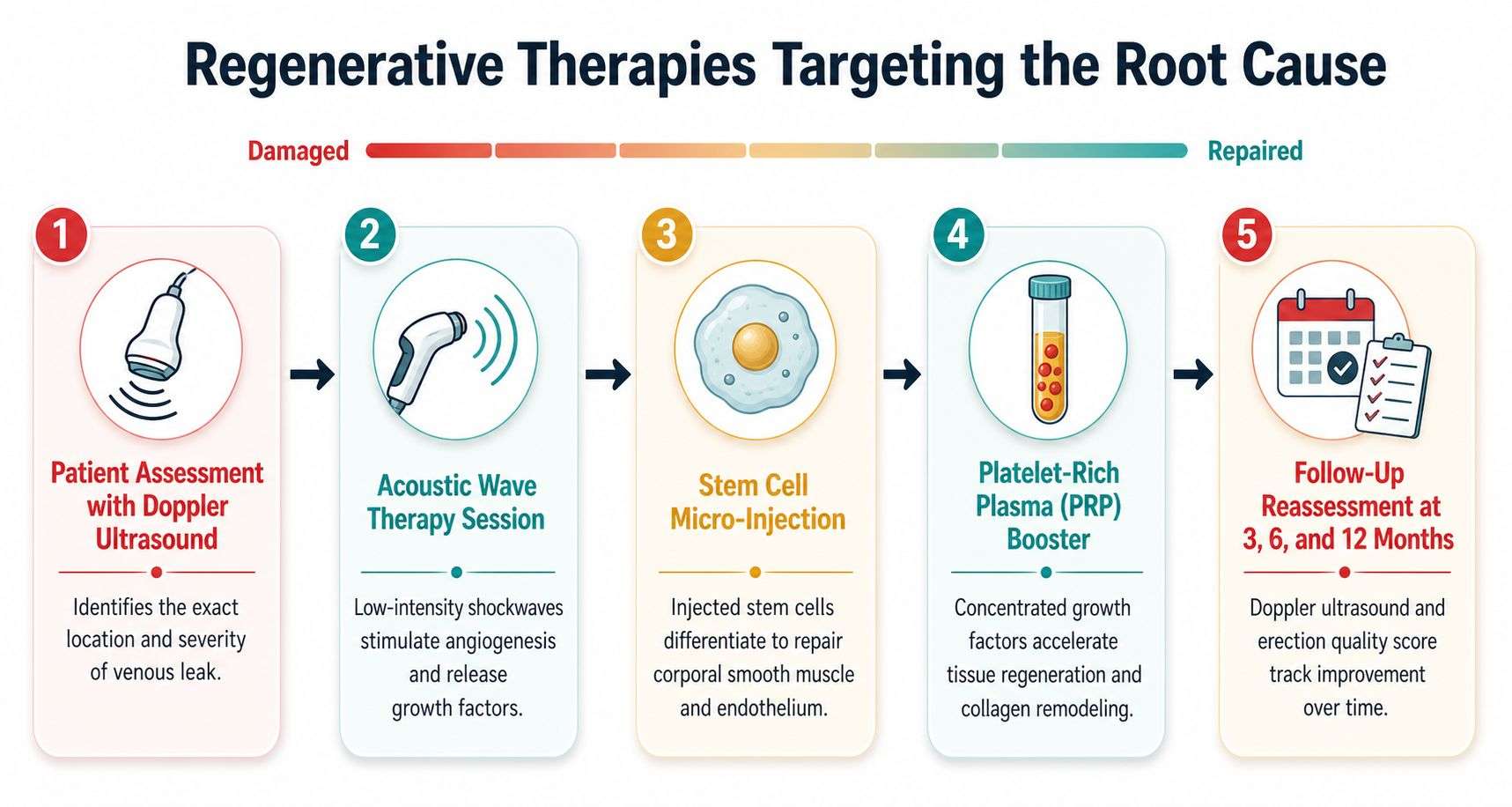
Regenerative care takes a different premise. Instead of treating every erection problem as a drainage vessel to block, it evaluates whether corporal smooth muscle, endothelial function, connective tissue, and local vascular signaling may be impaired together.
A clinic may combine acoustic wave therapy, laser-based treatment, and concentrated tissue-regenerative injections in an individualized protocol. The proposed aim is to encourage healthier tissue signaling and vascular function, not solely to force blood into the penis for one encounter.
How the modalities are used
Acoustic wave therapy, including protocols such as REGENwave™, uses mechanical energy directed at erectile tissue. Treatment planning should clarify the device, energy settings, treatment areas, number of visits, and the evidence supporting the specific protocol.
Laser therapy, such as REGENlase™, is presented as a tissue-focused modality intended to support local regenerative signaling. Patients should ask how the clinician evaluates response and whether treatment is being used for suspected veno-occlusive dysfunction, arterial disease, or general erectile tissue support.
Concentrated injections, including HEshot®, are designed to deliver biologically active material directly to targeted tissue. The source, preparation method, sterility controls, consent process, and risks should be explained before treatment. “Regenerative” isn't a substitute for a diagnosis.
A combined program such as REGENmax® may coordinate these modalities with baseline assessment and follow-up. The rationale is that one modality may address mechanical signaling, another may support tissue response, and injections may provide a localized regenerative stimulus. Whether that combination is appropriate depends on the patient's confirmed physiology, medical history, and expectations.

These treatments shouldn't be described as guaranteed repairs for every confirmed leak. The evidence base for penile veno-occlusive dysfunction remains nuanced, and outcomes depend heavily on patient selection and the exact protocol. A responsible clinic should discuss uncertainty, alternatives, follow-up measurements, and the possibility that surgery or another treatment category may ultimately be more appropriate.
Patients sometimes ask whether supplements can replace evaluation. A general vein-health product, such as Healthaid Vein at Vitamin Planet, isn't a diagnostic test or a proven repair for penile veno-occlusive dysfunction. Supplements may be discussed for general health when clinically appropriate, but they shouldn't delay vascular testing or create false confidence about a structural diagnosis.
What to Expect from Treatment and When to See a Specialist
Start with confirmation, not a procedure. Ask the clinician to review the Doppler protocol, explain the PSV, EDV, and RI readings, and state whether the erection was fully developed when measurements were taken.
A useful appointment checklist includes:
- Clarify the mechanism: Is the issue arterial inflow, venous outflow, corporal tissue function, or a combination?
- Review the alternatives: What can medication, a vacuum device, injections, regenerative treatment, or surgery realistically accomplish?
- Ask about evidence: What outcomes have been measured for the exact protocol, and how are results tracked?
- Plan follow-up: Will erection quality and vascular measurements be reassessed over time?
- Discuss escalation: At what point would a surgical consultation become reasonable?
Regenerative protocols are generally considered in a non-surgical treatment pathway when the diagnosis is uncertain or when tissue dysfunction may be contributing. A man with severe, confirmed dysfunction, major trauma, significant penile deformity, or repeated failure of conservative care may need consultation with a specialist who performs vascular or implant procedures.
Treatment response shouldn't be judged solely by a single sexual encounter. Clinicians may monitor erection firmness, duration, medication response, adverse effects, and patient-reported function across follow-up visits. If symptoms are persistent, worsening, associated with pain or curvature, or accompanied by cardiovascular risk factors, seek specialist care rather than relying on online self-diagnosis.
Sexual Wellness Centers of America evaluates erectile dysfunction with penile Doppler and intracavernosal testing, then discusses individualized options that may include non-surgical regenerative protocols such as REGENwave™, REGENlase™, and HEshot®. Visit Sexual Wellness Centers of America to request an evaluation and discuss whether your symptoms and test results fit a regenerative treatment plan.