
If you're reading this, there's a good chance you've already tried to solve erectile dysfunction as a blood flow problem. Maybe a pill helped once, then not the next time. Maybe you could get an erection alone but not with a partner. Maybe the worst part isn't the erection itself. It's the anticipation, the self-monitoring, the dread that starts long before sex does.
That pattern is common, and it doesn't mean the problem is imaginary. It means erectile function is tied to both the body and the mind. A man can have enough physical capacity for an erection and still lose it when anxiety, stress, shame, or relationship tension takes over. In practice, that gap is where many men get stuck. They keep looking for a stronger physical solution when the missing piece is often psychological care integrated with medical treatment, not separated from it.
Table of Contents
- Beyond the Pill The Mind's Role in Erectile Function
- Understanding the Psychological Roots of ED
- What Effective Psychological ED Treatment Looks Like
- Finding the Right Path Your First Steps
- Combining Mind and Body for Maximum Results
- Your Questions on Psychological ED Treatment Answered
- Does needing psychological help mean my ED isn't real
- Will my partner have to be involved in therapy
- How long does treatment take to show results
- What if I need both medical care and therapy
- Is therapy just talking about childhood or emotions
- How do I manage the practical side of getting care
- What should I do if I'm embarrassed to bring this up
Beyond the Pill The Mind's Role in Erectile Function
A man takes medication for ED, plans for a good night, and still feels his body shut down the moment sex becomes real. He starts wondering whether the medication failed, whether he's getting worse, or whether something is wrong with his masculinity. Usually, the deeper issue is simpler and more treatable than that. His body is being pulled in two directions at once.
An erection isn't just a hydraulic event. It's a coordinated response involving attention, arousal, safety, blood flow, nerve signaling, and emotional state. When a man feels pressure to perform, his thoughts can work directly against the relaxed state his body needs. That mind-body connection is one reason sexual health is more than just physical.
Why pills sometimes aren't enough
Medication can support blood flow. It can't automatically quiet fear, erase a bad sexual memory, repair resentment in a relationship, or stop the habit of monitoring every sensation. Men often tell me some version of the same story: "I know what to do physically, but once I start thinking about whether it'll work, everything changes."
That sentence captures the problem well. The physical mechanism may be partly supported, but the mental environment is hostile to arousal.
Practical rule: If erections are more reliable during sleep, masturbation, or low-pressure situations than during partnered sex, psychological factors deserve real attention.
The better frame
The most useful approach isn't "physical ED" versus "psychological ED." That split is too rigid for real life. Many men have both. Mild vascular change, lower confidence, a stressful season, and one failed experience can combine into a repeating cycle.
A better frame looks like this:
| What men often assume | What usually helps more |
|---|---|
| "I need a stronger physical fix" | Address physical contributors and the anxiety around sexual performance |
| "If it's psychological, it's not real" | Psychological triggers create real body-level erection disruption |
| "Therapy is only for severe cases" | Structured sexual counseling can be a practical part of early treatment |
When men understand that, they usually feel relief. They stop treating themselves like a machine that's malfunctioning and start seeing the full picture. That's where meaningful progress begins.
Understanding the Psychological Roots of ED
Psychological ED isn't "all in your head" in the dismissive sense. It's in your nervous system, your attention, your expectations, and your learned responses. Those are real biological processes.
The easiest way to understand it is to think of the brain as having a threat system and a pleasure system. Erection depends on enough safety, focus, and arousal for the pleasure system to stay in charge. When the threat system takes over, the body shifts toward vigilance instead of erotic response.
Performance anxiety is more physical than people think
A man doesn't have to feel panicked for anxiety to affect erections. Sometimes it shows up as subtle scanning. Am I hard enough? Am I staying hard? What if it happens again? Is my partner noticing?
Once that internal surveillance starts, attention shifts away from sensation and toward evaluation. The body reads evaluation as pressure. Pressure activates the threat response. That makes erection less likely, which creates more monitoring, and the cycle tightens.
This is one reason contributory conditions that may cause erectile dysfunction have to be assessed broadly. A man may have a physical contributor, but anxiety often determines how disruptive the problem becomes.
Spectatoring, stress, and mood
Sex researchers have long used the term spectatoring to describe what happens when a person stops experiencing sex and starts observing himself during sex. It's one of the most common patterns in psychological ED treatment. Men who spectator aren't failing because they don't care. They're trying too hard to manage the moment.
Other common drivers include:
- General life stress: Work conflict, financial strain, caregiving demands, and sleep disruption all reduce mental bandwidth for arousal.
- Depression: Desire often drops first. Confidence, motivation, and bodily responsiveness can follow.
- Relationship tension: Anger, distance, mistrust, or fear of disappointing a partner can suppress erotic engagement even when attraction remains.
- Shame after prior difficulties: One bad experience can become the standard a man expects to repeat.
Psychological ED often feels sudden in the bedroom, but the setup usually begins much earlier in the day through stress, avoidance, and negative anticipation.
Why this becomes a cycle
Most men don't seek help after the first off night. They try to push through. That's understandable, but brute force rarely works. The more urgently a man tries to "make" an erection happen, the less room the body has to respond naturally.
A useful way to think about it is this:
- An erection problem happens once.
- The memory of it creates fear.
- Fear increases self-monitoring.
- Self-monitoring interrupts arousal.
- The next experience confirms the fear.
That loop can continue even when the original trigger has faded. By the time men ask for help, they're often fighting the anticipation of failure as much as the erection issue itself.
What this does not mean
It doesn't mean physical assessment should be skipped. It doesn't mean every man needs long-term therapy. It doesn't mean the answer is to "just relax." Men hate hearing that because it sounds simplistic, and they're right to hate it.
Effective psychological ED treatment is structured. It identifies the pattern, lowers pressure, changes unhelpful thinking, and rebuilds erotic confidence with specific exercises. That's a clinical process, not vague reassurance.
What Effective Psychological ED Treatment Looks Like
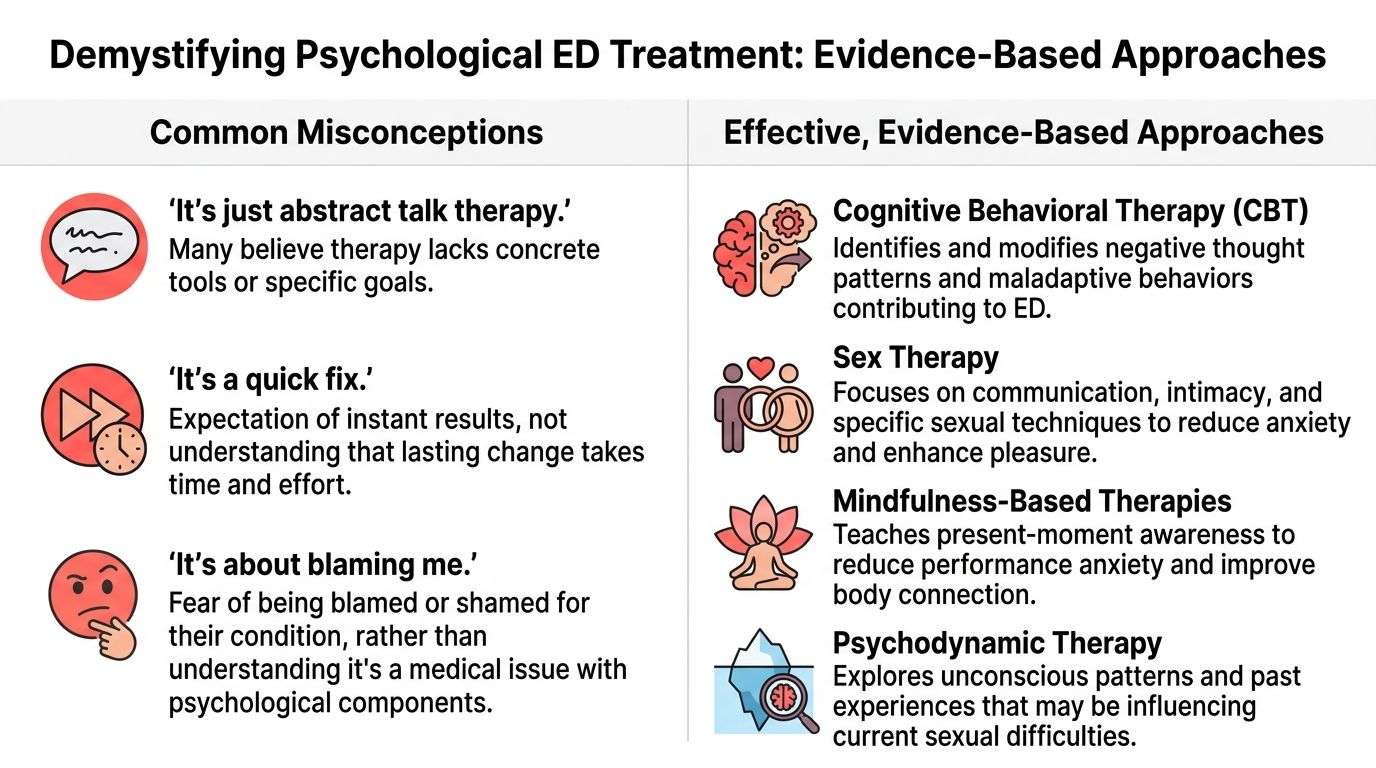
Men are often wary of therapy because they picture endless talking with no concrete plan. Good treatment for ED doesn't look like that. It should be focused, behavioral, and tied to specific goals.
One of the strongest models is cognitive behavioral sex therapy, or CBST. Evidence summarized in this clinical review of cognitive behavioral sex therapy for psychogenic ED shows that patients completing 8–12 structured sessions report reduced performance anxiety, less spectatoring, and higher scores on the International Index of Erectile Function. The same review notes Grade B evidence for improving both erectile function and relationship satisfaction.
What CBST actually does
CBST targets the thoughts and behaviors that keep ED going. It doesn't ask men to deny reality. It teaches them to notice the exact mental habits that create pressure and replace them with more accurate, more useful responses.
A typical course may include:
- Psychoeducation: Learning how stress, attention, and arousal interact.
- Cognitive restructuring: Challenging beliefs like "If I lose my erection once, the night is ruined."
- Graded exposure: Returning to sexual situations in steps rather than jumping straight into high-pressure intercourse.
- Behavioral assignments: Practicing specific exercises between sessions.
- Partner communication work: Reducing secrecy, guessing, and misinterpretation.
The point isn't to think positive thoughts. The point is to stop feeding the threat system.
Sensate focus and pressure reduction
Another highly practical tool is sensate focus. This is a structured series of touch exercises that temporarily removes the demand to perform. Couples shift attention away from erection and penetration and back toward sensation, curiosity, and connection.
That sounds simple, but it's powerful because it changes the rules of the sexual encounter. Instead of entering sex with a pass-fail test, the man enters with a different task. Notice touch. Stay present. Observe tension. Communicate. This lowers the "must perform now" pressure that keeps many men stuck.
The fastest way to intensify performance anxiety is to make erection the only acceptable outcome of intimacy.
What a credible treatment plan includes
Not every man needs the same mix, but effective psychological ED treatment usually has a few clear features.
| Credible treatment | Weak treatment |
|---|---|
| Specific goals tied to sexual function | Only general conversation about stress |
| Structured exercises between sessions | No behavioral plan |
| Assessment of medical and relationship factors | Treating ED as purely emotional |
| Monitoring progress over time | Repeating the same advice without adjustment |
What tends not to work
Some approaches sound helpful but fail in practice.
- White-knuckling through sex: Trying harder usually adds more pressure.
- Constant reassurance seeking: Asking repeatedly, "Was that okay?" keeps attention on evaluation.
- Avoidance: Short-term relief often turns into more fear next time.
- Relying on medication alone when anxiety is driving the pattern: Blood flow support can help, but it may not break the learned fear response by itself.
For men with psychogenic ED, structured therapy often works best when it feels practical, time-limited, and directly connected to sexual experiences. That doesn't make the process easy. It makes it usable.
Finding the Right Path Your First Steps
Most men delay care because they don't know where to start. They worry they'll be bounced between providers, judged, or told something vague. The process should be much more straightforward than that.
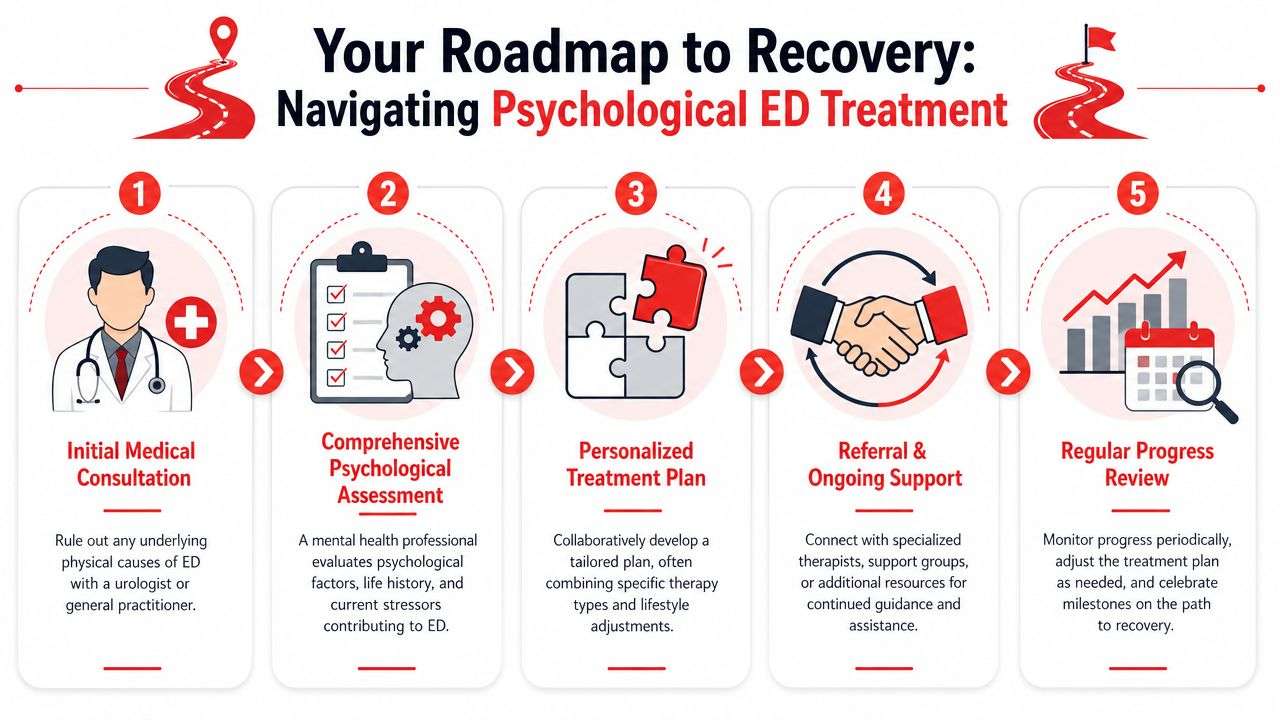
Start with a medical evaluation. That's not because the problem is probably physical. It's because ED deserves a proper screen for contributing factors such as vascular issues, hormone changes, diabetes, medication effects, sleep problems, or pelvic pain. Once that picture is clearer, you can decide whether psychological care should be added early rather than waiting until frustration builds.
A practical first sequence
If you're trying to act instead of overthink, use this order:
- Get assessed medically first. Rule in or rule out physical contributors.
- Describe the pattern clearly. Say whether erections differ by situation, partner context, time of day, or level of pressure.
- Ask for integrated care. If anxiety, shame, or relationship strain is involved, request referral to a therapist who understands sexual dysfunction.
- Treat avoidance as part of the problem. Delaying intimacy, overpreparing, or using alcohol to get through sex all matter clinically.
- Review progress after a defined period. Good care adapts instead of drifting.
A meta-analysis reported that standalone psychological treatments such as CBT and group psychotherapy can produce small-to-moderate improvements, with Hedges' g around 0.53, and some modalities showed statistically significant gains in erectile function compared with no treatment, as summarized in this meta-analysis reference on psychological ED interventions.
How to choose the right therapist
Not every therapist is trained to treat sexual dysfunction well. A qualified referral should be comfortable discussing erections directly, assigning structured exercises, and coordinating with medical care when needed.
Look for these signs:
- Specific sexual health experience: They don't treat ED as generic anxiety alone.
- Behavioral skill: They use exercises, not just insight.
- Comfort with partner work: They can involve a partner when helpful, without making that mandatory.
- Collaboration with medical providers: They understand when medication, hormones, or other interventions belong in the plan.
A good first visit should leave you with a clearer map, not just more language for the problem.
What to expect emotionally
Many men feel exposed talking about ED. That's normal. Most also feel relief once the conversation becomes concrete. When the problem is named accurately, shame usually loses force.
The first step isn't choosing between mind and body. It's refusing to leave either one out.
Combining Mind and Body for Maximum Results
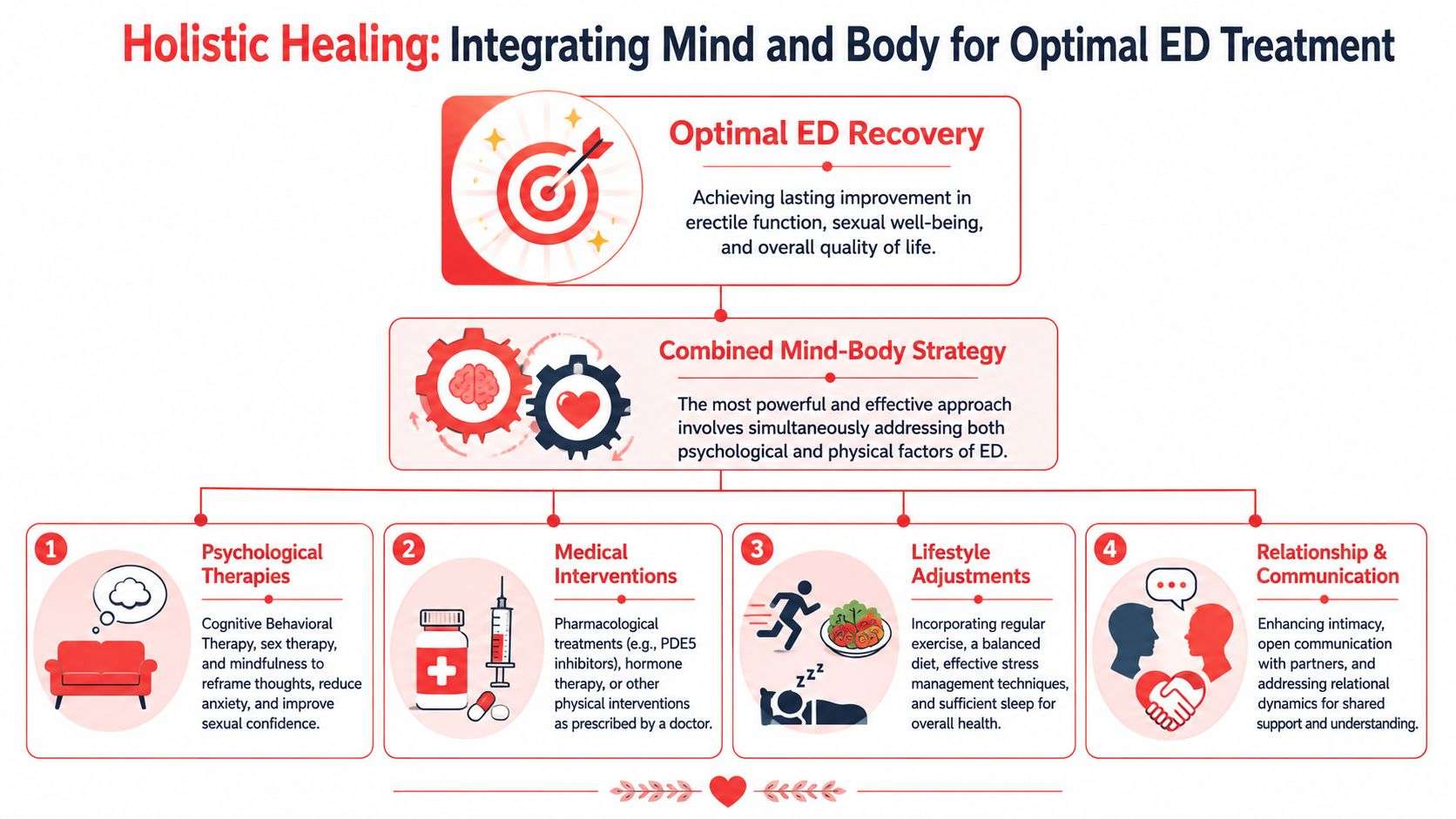
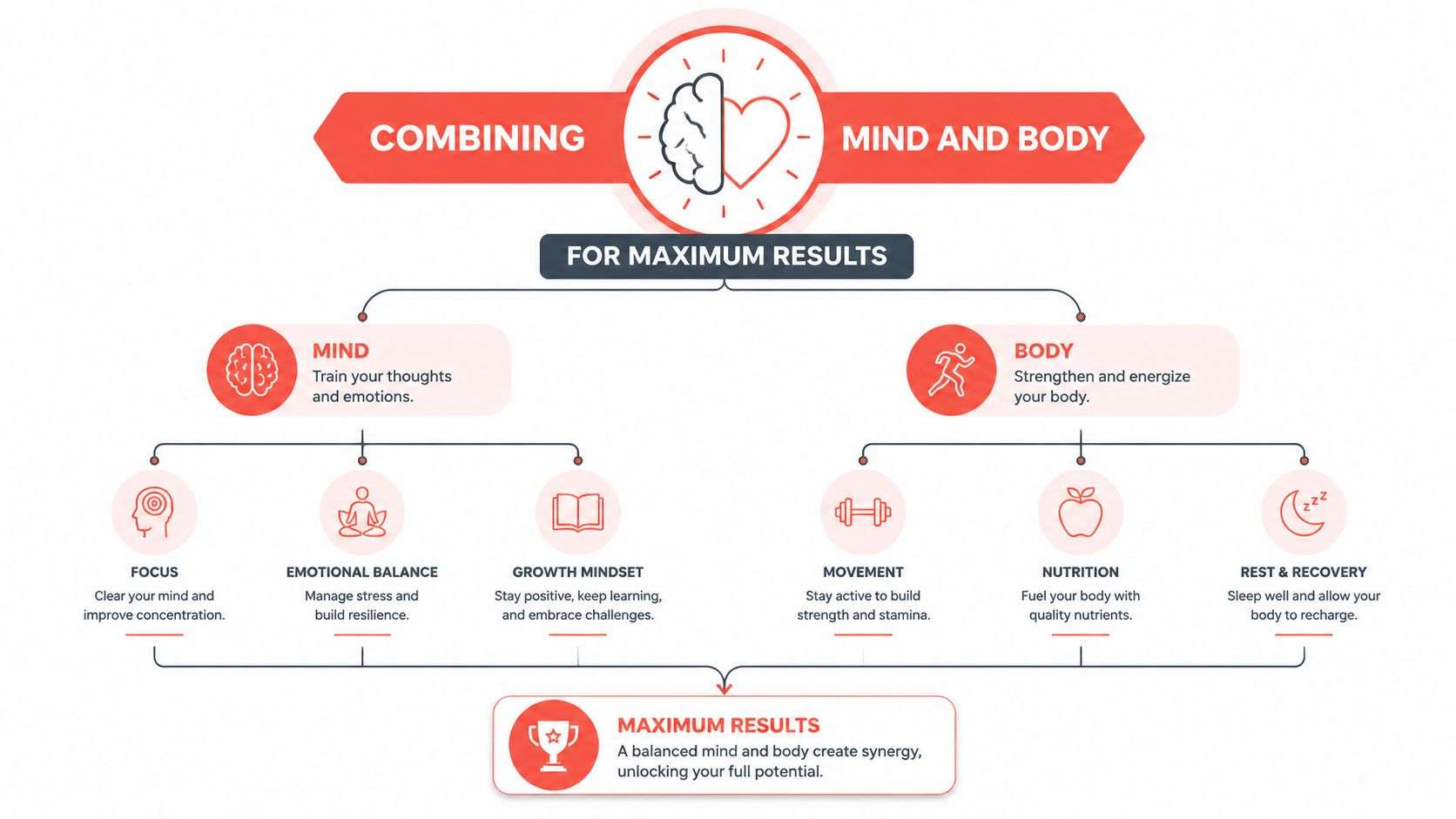
The most effective care for many men doesn't ask them to pick a side. It combines physical treatment with psychological skill-building so each part supports the other.
Erectile function involves more than just the ability to move blood into tissue. It entails the capacity to access arousal under real conditions, with a real partner, in a real life that includes stress, history, expectations, and emotion. If one layer improves and the other stays stuck, results can remain inconsistent.
Why integration works better
A man might respond physically to medication or another medical protocol but still brace for failure every time intimacy begins. In that situation, the body has more capacity than the mind allows him to use. Psychological care helps him access the physical gains he already has.
The same is true in reverse. A man may reduce anxiety, communicate better, and feel less pressure, but if he also has meaningful vascular or hormonal contributors, therapy alone may not carry the whole load. Integrated care closes that gap.
One way to think about this is through a biopsychosocial model in practice. The model is useful because it doesn't flatten ED into a single cause. It looks at biology, psychology, and relationship or social context at the same time.
What the evidence supports
The clearest data point for integration comes from combined treatment. A meta-analysis of eight trials found that adding psychotherapy to PDE5 inhibitor medication produced statistically greater improvements in erectile function than medication alone, with Hedges' g = 0.45. That finding supports the practical reality many clinicians see: men often do better when structured psychological care is added to medical treatment rather than reserved for "later."
How this plays out in real care
In practice, integration usually improves three things that medication alone can't guarantee:
- Consistency: Men stop losing progress to anticipatory anxiety.
- Confidence: Success feels repeatable rather than fragile.
- Connection: Partners become less likely to interpret ED as rejection, lack of attraction, or emotional withdrawal.
A combined approach may include medical treatment for blood flow or hormone support, alongside therapy that reduces fear, addresses spectatoring, and rebuilds intimacy. For men pursuing regenerative care, this same principle applies. If a protocol improves tissue response but the patient still enters sex with dread and hypervigilance, the full value of treatment may never show up in lived experience.
Better erections matter. Being able to trust your body again matters just as much.
The trade-off patients should understand
Integrated treatment asks more of the patient. It requires appointments, honesty, and behavior change. Some men want a single intervention that fixes everything without touching emotions or relationship patterns. That's understandable, but it often leaves progress incomplete.
The trade-off is simple. A narrower approach may feel easier at first. A combined approach usually gives a man a better chance of durable improvement because it treats the conditions under which erections succeed, not only the mechanism itself.
Your Questions on Psychological ED Treatment Answered
Does needing psychological help mean my ED isn't real
No. It means your brain, emotions, and nervous system are involved in a real sexual function problem. That is common in medicine, not a sign that you're weak or making it up. Psychological ED treatment addresses genuine mechanisms such as anxiety, self-monitoring, avoidance, and relationship stress.
Will my partner have to be involved in therapy
Not always. Many men begin individually and make strong progress that way. Partner involvement can help when miscommunication, resentment, pressure, or loss of intimacy are active parts of the pattern. It should be invited when useful, not imposed automatically.
How long does treatment take to show results
It depends on the driver. Some men improve quickly once pressure is reduced and they stop reinforcing the fear cycle. Others need more time because the issue involves depression, long-standing shame, relationship injury, or mixed physical and psychological contributors. What matters most is that treatment is structured and reviewed, not left vague.
What if I need both medical care and therapy
That combination is often the right move. Men do best when providers stop treating psychological and physical care like competing explanations. They are often complementary tools.
Is therapy just talking about childhood or emotions
Not if it's done well for ED. Effective treatment is usually practical. It may include thought work, behavioral exercises, touch-based assignments, and communication training. Insight can matter, but action matters too.
How do I manage the practical side of getting care
One overlooked source of stress is figuring out access, coverage, and coordination. If you're trying to understand the operational side of therapy-related services more broadly, this overview of mental health revenue cycle management gives useful context on how administrative systems around behavioral care are often organized. Patients don't need to master billing, but it helps to know that confusion in the system is common and not a personal failure.
What should I do if I'm embarrassed to bring this up
Use one direct sentence. "I'm having trouble getting or keeping an erection, and I think anxiety may be part of it." That's enough to start. You don't need a polished explanation. A clinician who treats sexual health regularly will know how to take it from there.
If you're ready for a more complete evaluation and want care that takes both the physical and psychological sides of ED seriously, Sexual Wellness Centers of America offers adult sexual health services focused on integrated, non-surgical treatment planning. Reaching out is often the hardest step. Once you do, the path usually becomes much clearer.