
You may be here because your body doesn't feel like your body anymore. Your energy is down. Your sleep is off. Your metabolism feels harder to manage than it used to. Intimacy may have changed. You may even have been told that your labs are “close enough” while your day-to-day life says otherwise.
That gap is where a regenerative wellness center often enters the conversation.
Instead of asking only, “What symptom can we suppress today?”, regenerative care asks a deeper question. What systems are underperforming, and how can we support repair, function, and resilience over time? For many patients, that feels less like chasing isolated problems and more like rebuilding the foundation of a house that has slowly shifted.
This broader shift is not happening on the fringe. The wellness economy is projected to reach nearly $7 trillion by 2025 after growing at an average annual rate of 9.9%, and it accounted for 5.1% of global economic output in 2020, according to this peer-reviewed review of the global wellness economy. That doesn't prove every program is high quality, but it does show that regenerative wellness centers are part of a large and expanding healthcare-adjacent sphere.
Many people first hear about treatments such as peptides, hormone optimization, or advanced sexual wellness therapies without understanding how they fit together. If you want a plain-language primer on that piece, how peptides are transforming health is a useful starting point.
Table of Contents
- Introduction Beyond Symptoms Towards Renewal
- What Are Core Regenerative Therapies
- Flagship Programs and What They Do
- Conditions Treated and Expected Outcomes
- Your Journey at a Regenerative Wellness Center
- Safety Evidence and Choosing the Right Provider
- FAQs for Local and Traveling Patients
Introduction Beyond Symptoms Towards Renewal
A regenerative wellness center usually makes the most sense when you're tired of fragmented care. One office treats sleep. Another addresses weight. A third handles hormones. A fourth looks at sexual function. You leave with separate recommendations, but no one is connecting the dots.
Regenerative wellness tries to connect them.
The basic idea is simple. Your body works as an interconnected network. Blood flow affects healing. Hormones affect energy, mood, libido, and body composition. Metabolic health affects inflammation, tissue function, and recovery. If several of those systems are strained at the same time, fixing one symptom in isolation often gives partial relief at best.
Renewal starts with function
A good center doesn't present regeneration as magic or as a shortcut around medical reality. It frames care around restoring function where possible, supporting tissue health, and improving how you feel in daily life.
That may include goals such as:
- Better energy: not a brief stimulant effect, but steadier day-to-day stamina
- Improved sexual health: stronger function, comfort, sensation, or confidence
- Metabolic support: helping the body respond better to treatment and lifestyle change
- Healthier aging: preserving strength, vitality, and independence rather than reacting late
Practical rule: If a clinic talks only about feeling younger but not about measurable function, ask more questions.
What confuses many patients is the word “regenerative.” They assume it always means stem cells or a dramatic medical intervention. In practice, regenerative wellness can be much broader. It may include physician-guided hormone optimization, peptide-based protocols, acoustic therapies, laser-based tissue support, targeted injections, metabolic treatment plans, and objective monitoring over time.
The mindset shift that matters
Often, the difference is philosophical. Conventional symptom care asks, “What drug matches this complaint?” Regenerative care asks, “What underlying pattern is driving this complaint?”
That shift matters most when symptoms overlap. A man with erectile dysfunction may also have poor sleep, low testosterone, insulin resistance, and vascular issues. A woman with vaginal dryness and low libido may also be dealing with menopause-related hormone change, stress, poor sleep, and tissue changes. Treating only the most visible symptom can miss the larger picture.
What Are Core Regenerative Therapies
The technology can sound intimidating at first. It doesn't need to. Most therapies used in a regenerative wellness center are easier to understand when you stop thinking in brand names and start thinking in mechanisms.
The field itself is growing quickly. The global regenerative medicine market is projected to rise from $48.17 billion in 2025 to $360.84 billion by 2034, reflecting a 25.56% CAGR, according to Fortune Business Insights' regenerative medicine market projection. For patients, that growth mainly means one thing. More clinics will offer these therapies, so understanding what they do becomes more important.
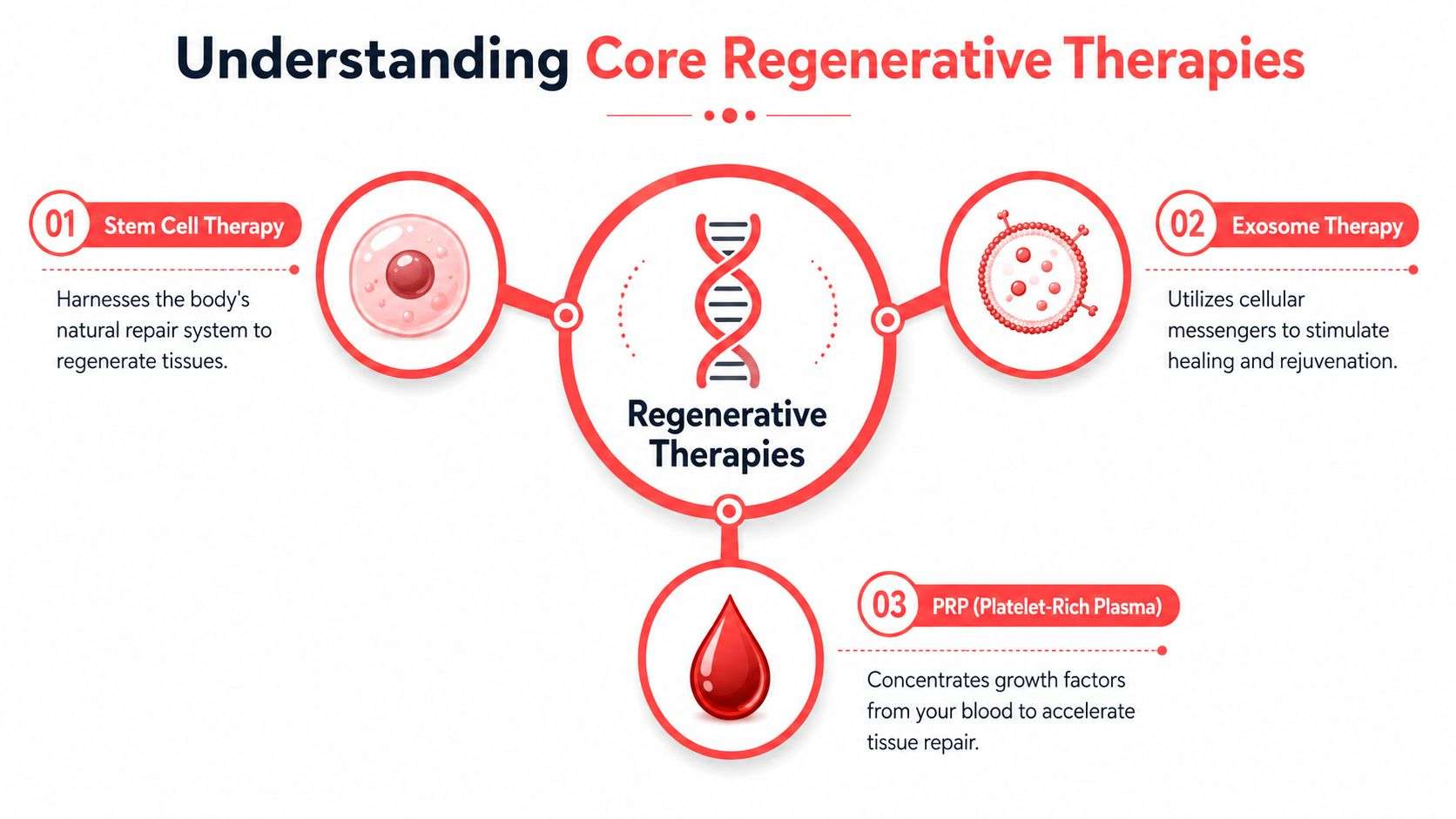
How these therapies work in plain English
Acoustic wave therapy uses mechanical energy. It functions by sending repeated pulses into an area that needs a wake-up signal. In sexual wellness, that often means encouraging blood vessel response and improving circulation in tissue that hasn't been functioning well.
A simple analogy is a pipe that has narrowed over time. You don't fix the plumbing by painting the outside. You improve the system by addressing flow. Acoustic approaches are often discussed in that context.
Laser therapy is usually explained badly. Patients hear “laser” and think cutting or burning. In regenerative settings, the goal is generally not destruction. It's support. You can think of it as helping cells work more efficiently, a bit like improving how well a rechargeable battery holds and uses energy.
Regenerative injections are more targeted. These protocols aim to place concentrated healing signals into a specific area. A helpful analogy is calling a repair crew to the exact room with the leak instead of asking them to inspect the whole building.
For readers who want extra background on signaling molecules involved in this area, PepFlow's peptide insights can help make the terminology easier to follow. A related overview of clinical use is also available in this guide to peptide therapy.
Why combinations often matter more than one therapy alone
One treatment can help. A coordinated protocol often makes more sense.
That's because many problems in regenerative wellness are not single-mechanism problems. Erectile dysfunction, for example, can involve circulation, tissue quality, nerve signaling, hormones, and metabolic health. Vaginal discomfort can involve hormonal shifts, tissue thinning, local blood flow, and pelvic floor factors. If the cause is layered, the treatment often needs to be layered too.
Here's a simple way to understand it:
| Therapy type | Main role | What patients usually notice |
|---|---|---|
| Acoustic therapy | Supports circulation and tissue stimulation | Improved responsiveness over time |
| Laser therapy | Supports cellular activity and tissue health | Better healing environment |
| Regenerative injection protocols | Targets specific tissues directly | More focused local support |
| Hormone and peptide strategies | Addresses system-wide signaling | Changes in energy, libido, recovery, or body composition |
The most credible regenerative care usually sounds less dramatic than the marketing. It's structured, mechanism-based, and tied to a specific problem.
Flagship Programs and What They Do
A patient may arrive with one clear complaint, such as weaker erections, vaginal dryness, reduced sensation, or discomfort during intimacy. After the first evaluation, the plan often looks less like a single procedure and more like a treatment map. That shift matters, because the body rarely works through one pathway alone.
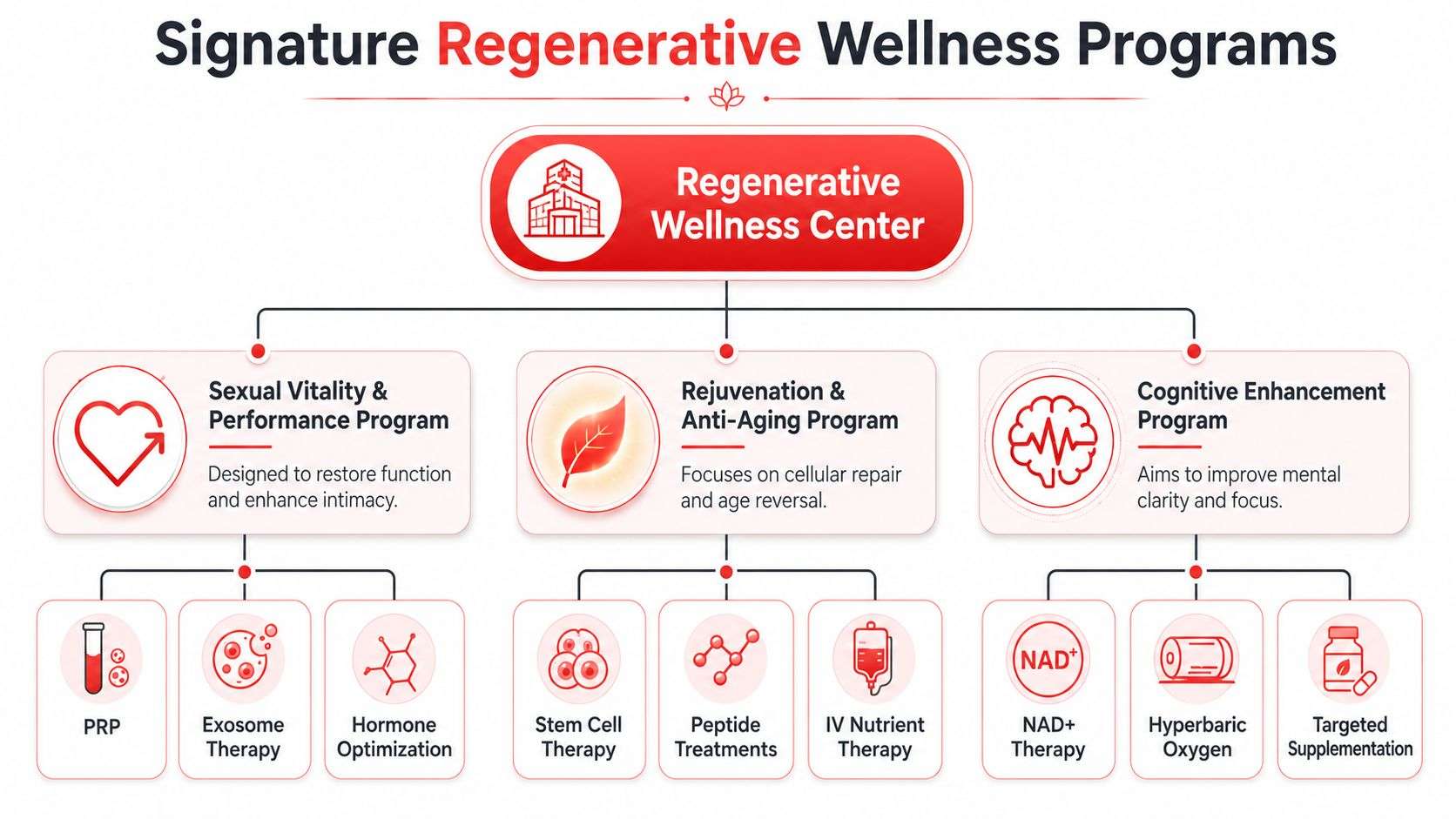
A program is more than a procedure
A flagship program groups therapies in a planned sequence, with each step serving a different job. One part may support circulation. Another may improve the local tissue environment. Another may place regenerative treatment directly where support is needed. The goal is to improve function in a way that fits the patient's biology, symptoms, and timeline.
A simple analogy helps here. Treating sexual wellness or tissue-related symptoms with one isolated therapy can be like trying to restore a garden by watering only one corner. If the soil is dry, the roots are stressed, and sunlight is limited, one fix will only go so far. Programs work better because they address several limiting factors at the same time.
A men's protocol illustrates the idea well. A physician might combine acoustic therapy for blood flow support, laser-based treatment for tissue health, and an injection-based regenerative option for focused local treatment. Lab review, hormone status, vascular risk, and metabolic health help determine whether that patient is ready for treatment now or needs broader medical optimization first.
That same logic shapes branded care paths such as REGENmax®. Patients who want a closer look at the treatment sequence can review this overview of REGENmax injection therapy.
What REGENmax, HEshot, and SHEshot are designed to address
REGENmax® refers to a coordinated treatment strategy rather than a one-time event. The purpose is to combine tools that support tissue function from different angles, so the patient is not relying on a temporary workaround alone.
For men, HEshot® is used within a broader sexual wellness plan aimed at concerns such as erectile quality, sensitivity, and confidence with spontaneous intimacy. Patients are often surprised to learn that the injection is usually one component of care, not the whole plan. The surrounding pieces, such as circulation support, follow-up timing, and medical screening, often shape the outcome as much as the injection itself.
For women, SHEshot® is used in regenerative sexual wellness settings where concerns may include dryness, reduced sensation, or diminished sexual response. Here again, the question is not only, “What treatment is offered?” A better question is, “What is contributing to the symptom?” Hormonal changes, tissue health, pelvic comfort, and blood flow can all affect the final result.
Sexual Wellness Centers of America offers REGENmax®, HEshot®, and SHEshot® as part of non-surgical regenerative sexual wellness care for adults.
The difference in program design is easier to see in this comparison:
- Single procedure approach: one therapy aimed at one symptom
- Program approach: evaluation, sequencing, follow-up, and adjustment
- Patient-centered outcome approach: better function, more comfort, improved confidence, and clearer expectations
Patients often ask for the strongest treatment. A more useful starting point is the right combination for the problem in front of them.
Conditions Treated and Expected Outcomes
Those looking for a regenerative wellness center usually aren't looking for science. They're looking for relief. They want to know whether life can feel normal again, or at least better than it feels now.

What patients are usually hoping will change
For erectile dysfunction, the desired outcome is rarely just an erection at any cost. Most patients want more natural responsiveness, less dependence on planning, and a return of confidence. They want intimacy to feel less clinical.
For Peyronie's disease, the concern may be curvature, discomfort, difficulty with intercourse, or anxiety about worsening function. A regenerative plan may aim to improve comfort and support sexual function, while setting realistic expectations about what non-surgical care can and cannot change.
For vaginal dryness, laxity, or reduced sensation, women often describe a mix of physical discomfort and emotional loss. The hoped-for outcome isn't cosmetic. It's comfort during intimacy, improved sensation, and feeling more like themselves again.
What improvement can look like in real life
Hormone-related complaints often show up as low libido, poor recovery, brain fog, or energy that drops by midafternoon. Improvement may feel less dramatic than people expect at first. It can look like waking up clearer, exercising with less struggle, wanting intimacy again, or feeling more emotionally steady.
Diabetes-related sexual dysfunction is especially important to discuss. In these cases, circulation, nerve function, inflammation, and hormone patterns may all play a role. That means a regenerative approach often works best when it's integrated into broader medical care rather than treated as a standalone fix.
Common goals by condition often look like this:
- ED: more reliable function, stronger rigidity, less performance anxiety
- Peyronie's-related symptoms: better comfort and improved sexual usability
- Female sexual wellness concerns: less dryness, improved sensation, better intimacy
- Hormone imbalance: stronger libido, steadier mood, improved daily vitality
- Metabolic and diabetes-linked issues: better response to treatment when underlying risks are addressed too
The key is expectation management. Regenerative care often aims for restoration of function, not a guarantee of perfection. The right patient usually sees that as a strength, not a weakness, because it keeps the plan medically grounded.
Your Journey at a Regenerative Wellness Center
The most reassuring part of good regenerative care is that it shouldn't feel vague. You should know what happens first, what gets measured, why a treatment was chosen, and how progress will be judged.
Step one is data not guesswork
A top-tier regenerative wellness center usually begins with a detailed conversation. Not just “What hurts?” but “What has changed, when did it change, and what else changed with it?”
Then comes the baseline.
A key differentiator is a data-dense, monitor-and-adjust model that starts with extensive hormone and metabolic panels so physicians can build a baseline and objectively track response over time, as described in this overview of baseline-driven regenerative wellness care.
That matters because treatment without a baseline is like starting a road trip without a map. If energy improves, was it hormones, sleep correction, weight loss support, or better blood sugar control? If sexual function stalls, is circulation the issue, or is the underlying barrier low testosterone, untreated sleep apnea, or medication burden? Baseline testing helps answer those questions.
A thorough early visit often includes:
History and goals
Your clinician looks at symptoms, timeline, medical conditions, medications, and what success would mean to you.Lab and body data
Hormones, metabolic markers, and other relevant measures help identify patterns that symptoms alone can't reveal.Risk review
Good clinics distinguish themselves during this stage. They look for reasons to slow down, not just reasons to sell.
Treatment follow-up and long term support
Once the center understands your baseline, treatment becomes more personalized. One patient may need hormone optimization first. Another may move into a procedural protocol. Another may need weight or sleep issues addressed before anything elective makes sense.
The middle phase often includes scheduled sessions, symptom tracking, and response checks. In some centers, physicians also adjust supportive therapies such as peptide strategies, nutrition support, or medication plans as new information comes in.
Follow-up is where many patients either succeed or drift. Sustainable results usually come from repeated reassessment.
- Monitor symptoms: changes in libido, energy, sleep, confidence, comfort, and function
- Repeat key labs when appropriate: this shows whether the internal picture matches how you feel
- Adjust the plan: dosing, timing, maintenance intervals, and priorities may shift
- Use maintenance intentionally: not as endless upselling, but as a way to preserve gains that took work to build
Good regenerative care is collaborative. The clinic brings diagnostics and treatment skill. You bring feedback, consistency, and honesty about what is and isn't changing.
Safety Evidence and Choosing the Right Provider
Many patients often require the clearest guidance. Regenerative wellness can sound hopeful, but hope alone isn't enough. You need a clinic that respects evidence, screens carefully, and tells you when now is not the right time for a procedure.
Why careful screening matters
Central to this field is risk stratification. The biggest need is often not more optimization, but identifying and correcting modifiable risks such as uncontrolled diabetes or sleep apnea before elective procedures, as noted in this discussion of risk stratification in regenerative wellness.
That idea is more important than it sounds.
If someone has untreated sleep apnea, unstable cardiovascular issues, or poorly controlled metabolic disease, pushing directly into elective regenerative procedures may lead to disappointing results or unnecessary risk. In those cases, the best medicine is often sequencing care properly. Stabilize first. Regenerate second.
This applies beyond procedures. Even supportive services should be integrated thoughtfully. For example, patients considering hydration or nutrient support should understand how thorough oversight works, which is why this patient guide to IV infusion therapy management can be useful background reading.
A practical checklist for choosing a center
Not every regenerative wellness center operates with the same level of rigor. When you evaluate a provider, look for signs of medical discipline rather than flashy promises.
Use this checklist:
- Physician-led evaluation: Someone qualified should review your history, current medications, risks, and goals before treatment starts.
- Customized planning: Be cautious if everyone seems to receive the same package.
- Objective tracking: The clinic should measure outcomes, not rely only on enthusiastic testimonials.
- Transparent limitations: A responsible team will tell you when a therapy may help, when it may not, and what needs to be corrected first.
- Whole-patient thinking: Sexual symptoms, hormone complaints, sleep, weight, and metabolic health often overlap. The clinic should act like it knows that.
If a center treats screening as an obstacle, that's a warning sign. Careful screening is part of the treatment.
FAQs for Local and Traveling Patients
Practical questions often decide whether someone books a consultation. That makes sense. Even when the science sounds promising, people want to know how treatment fits into real life.
Common practical questions
Will I know my full treatment plan on day one?
Usually not. A good plan often becomes clearer after your consultation, exam, and lab review. That's a good sign, not a delay. It means the clinic is building around your biology instead of forcing you into a preset script.
How do out-of-town visits usually work?
Many centers that see traveling patients try to coordinate appointments efficiently. That may mean bundling diagnostics, consultation, and procedures in a way that reduces repeat travel. Ask early what must happen in person and what can be handled remotely.
Do these treatments hurt?
Comfort varies by therapy and by patient. Many regenerative procedures used in wellness settings are non-surgical or minimally invasive, so people often return to normal activity quickly. Still, “little downtime” doesn't mean “no sensation.” Ask what the visit feels like, how long discomfort may last, and whether numbing or recovery instructions are part of the plan.
How much does it cost?
Pricing varies widely by condition, diagnostic complexity, and the number of therapies used. Because no verified cost data is provided here, the best approach is to ask for a written breakdown that separates consultation, testing, procedures, and maintenance. That makes comparison easier and prevents surprises.
Will insurance cover it?
Coverage depends on the service and the plan. Many regenerative and elective sexual wellness services are handled outside standard insurance pathways. Some clinics offer financing or staged care plans. Ask what is considered elective, what may be billable, and what ongoing costs to expect.
How soon will I notice changes?
That depends on the problem being treated and the therapies used. Some people notice early shifts in sensation, confidence, or energy. Other improvements take time because tissue response, hormone adjustment, and metabolic stabilization don't always move on the same schedule.
If you're considering a regenerative wellness center and want a medically guided next step, Sexual Wellness Centers of America offers adult-focused care in Colleyville, Texas for erectile dysfunction, Peyronie's-related concerns, hormone optimization, peptide therapy, and non-surgical regenerative sexual wellness. A consultation can help clarify whether you need procedural treatment now, broader risk reduction first, or a more complete diagnostic workup before deciding.