
If you're reading this after another disappointing night, the thought pattern is probably already familiar. You start out wanting closeness, then your attention shifts inward. Am I responding enough? What if it happens again? What if my partner notices? Within minutes, desire gets replaced by self-monitoring, tension, and dread.
That spiral is exhausting. It can also be treated.
As a clinician, I want patients to hear one thing early: sexual performance anxiety isn't a character flaw, and it isn't always "just psychological." Sometimes anxiety is the main driver. Sometimes a physical issue such as erectile dysfunction, diabetes-related vascular change, medication side effects, or hormonal decline starts the problem and anxiety builds on top of it. Effective sexual performance anxiety treatment works best when you stop forcing a false choice between mind and body and start looking at both.
Table of Contents
- The Cycle of Fear and How to Break It
- Distinguishing Anxiety from Physical Causes
- Retraining Your Brain with Therapy
- When Medication Can Help Break the Cycle
- Building a Foundation for Sexual Wellness
- When to Consider Clinic-Based Treatments
- Your Stepwise Treatment Algorithm
- Your Questions on Performance Anxiety Answered
The Cycle of Fear and How to Break It
A common pattern looks like this: one difficult sexual experience happens, maybe during a stressful week, after poor sleep, or at a moment when the stakes feel unusually high. The next encounter carries a memory of that experience. Instead of entering intimacy with curiosity or pleasure, the person arrives braced for failure.
That anticipation changes everything.
Many patients describe "watching themselves" during sex. They're no longer in the experience. They're grading it. They monitor erection quality, arousal, orgasm, timing, or whether their partner seems satisfied. That mental shift alone can be enough to interrupt desire and physical response.
Why the cycle gets stronger
Anxiety turns sex into a test. Every sensation gets interpreted as evidence. If arousal builds, the person thinks, good, maybe I'm okay. If it dips even briefly, panic takes over. The body tightens, breathing gets shallow, attention narrows, and the feared outcome becomes more likely.
Sexual performance anxiety often feels sudden, but the pattern is predictable. Fear leads to monitoring. Monitoring disrupts arousal. The disruption creates more fear.
This is why reassurance alone rarely solves it. "Just relax" doesn't work when someone is trapped in a fear-response loop. They need a plan that reduces pressure, identifies any physical contributors, and gives them structured ways to rebuild confidence.
What starts to break it
The turning point usually comes when the person stops treating each sexual encounter like a verdict on their worth or health. Treatment works by changing the conditions around intimacy. That may mean removing intercourse from the agenda temporarily, learning skills that interrupt catastrophic thinking, involving a partner in the process, or getting a medical evaluation when the history suggests more than anxiety alone.
Patients often improve once they understand two truths at the same time:
- This is treatable. The cycle can be interrupted.
- This needs sorting, not guessing. The right treatment depends on whether the problem is anxiety-driven, physically driven, or mixed.
Distinguishing Anxiety from Physical Causes
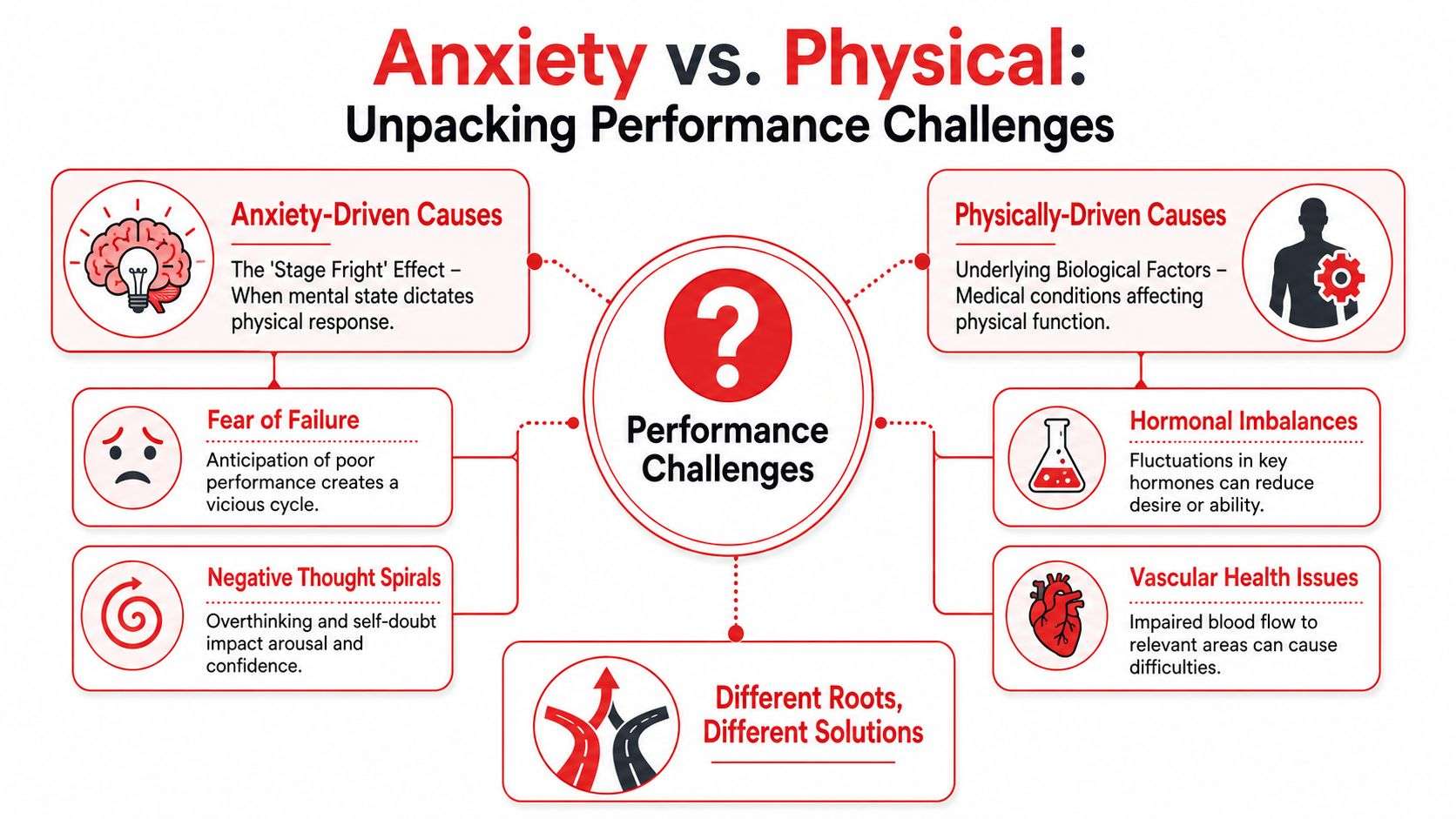
The most important early question is simple: Is anxiety causing the problem, or is anxiety reacting to a real change in sexual function? In practice, both are common.
It's comparable to stage fright. A person who fears public speaking can feel their throat tighten, hands shake, and mind go blank. The fear is psychological, but the effects are physical. Sexual response can work the same way. Worry activates a stress response that directly interferes with arousal and erection.
A major clinical review notes that sexual performance anxiety affects 6% to 16% of women and can severely inhibit sexual desire, while also contributing to common sexual dysfunctions. The same review emphasizes that clinicians should separate anxiety-driven symptoms from vascular, hormonal, or medication-related causes before treatment is chosen (clinical review on sexual performance anxiety in Sexual Medicine Reviews).
To make that distinction easier, this visual helps frame the two main pathways.
Clues that point more toward anxiety
When anxiety is the dominant driver, the history often has a pattern. Symptoms may appear suddenly, vary from one situation to another, or improve in lower-pressure settings. A person may have good desire outside the bedroom but lose arousal once performance becomes the focus.
A clinician often asks questions like these:
- Does the problem happen every time, or mainly in specific situations?
- Did it begin after one upsetting experience, relationship rupture, or period of intense stress?
- Are erections or arousal better during sleep, on waking, or in less pressured contexts?
- Does desire drop mainly because sex now feels risky or disappointing?
These questions don't diagnose the problem by themselves, but they help reveal whether fear is leading the body or reacting to it.
Clues that suggest a physical contributor
A different set of clues raises concern for a medical contribution. Symptoms may become more consistent, less situational, or tied to broader health changes. People may report reduced rigidity, declining morning erections, fatigue, reduced libido, pain, medication changes, worsening blood sugar control, or signs of hormonal decline.
Clinical rule: If sexual difficulties are becoming more consistent across situations, don't assume anxiety is the whole story.
Often, online advice falls short. It tells people to breathe, communicate, and think positively, but doesn't explain what to do when sexual performance anxiety is intertwined with erectile dysfunction, diabetes, or other health issues. Recent clinical guidance stresses that treatment may require CBT, mindfulness, and medical evaluation, and that anxiety can persist even after physical function improves, which is why an integrated plan matters (clinical guidance on integrated care when anxiety and medical issues overlap).
Why one-size-fits-all treatment fails
If the problem is mostly anxiety, medication alone may not end the cycle. The body may improve while fear remains. If the problem is partly vascular, hormonal, or medication-related, therapy alone may help coping but leave the physical bottleneck untouched.
A good sexual performance anxiety treatment plan starts with differential diagnosis. Not because patients need complexity for its own sake, but because the wrong first step wastes time and deepens discouragement. When mind and body are both assessed, treatment gets more precise and recovery feels less random.
Retraining Your Brain with Therapy
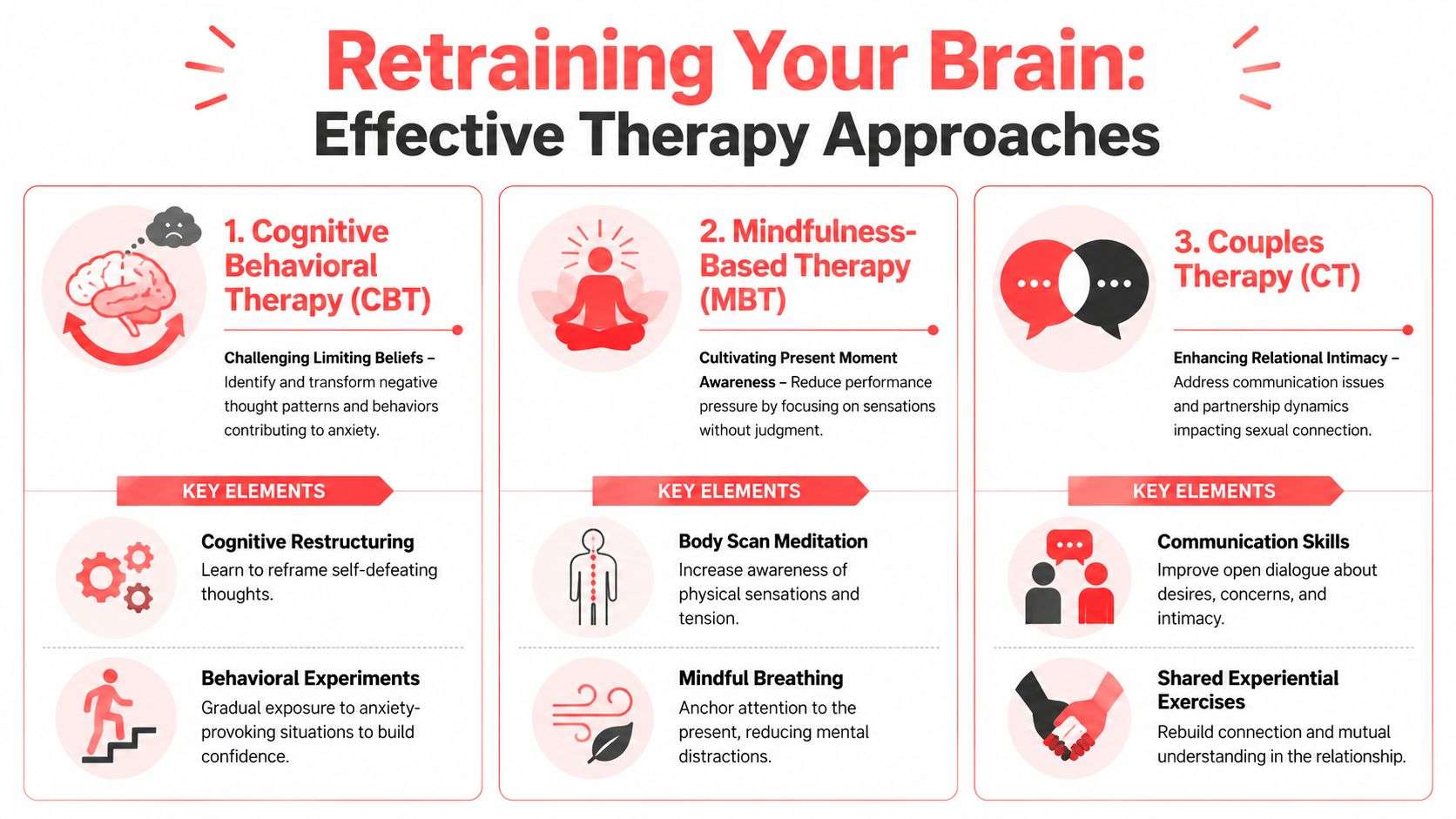
Once the main pattern is identified, first-line psychological treatment usually focuses on reducing fear, shifting attention back into the body, and replacing avoidance with structured success. In clinical practice, the most useful therapies aren't abstract. They give patients specific things to notice, practice, and change.
Clinical reviews support CBT and mindfulness meditation training as helpful approaches for sexual performance anxiety, even though controlled trials remain limited. That matters because it gives us a practical starting point grounded in what clinicians repeatedly see work. If you're interested in hearing a sex therapist discuss how emotional patterns and sexual function intersect in real relationships, this interview with sex therapist Jessa Zimmerman and Jeff Nuziard is a useful companion piece.
Cognitive behavioral therapy
CBT helps patients identify thoughts that create pressure and then test whether those thoughts are accurate or useful. In this setting, the problem usually isn't one dramatic belief. It's a cluster of rigid rules.
Common examples include:
- Perfectionistic rules such as "I have to perform well every time."
- Mind reading such as "If my partner notices any change, they'll lose interest."
- Catastrophic predictions such as "If this happens once more, my sex life is over."
In treatment, those thoughts get challenged and replaced with more accurate ones. Not fake positive thinking. Accurate thinking.
For example:
| Thought pattern | More useful replacement |
|---|---|
| "I have to prove myself tonight." | "This is intimacy, not an exam." |
| "Any change in erection means failure." | "Sexual response varies, especially under pressure." |
| "If I feel anxious, the encounter is ruined." | "Anxiety can rise and fall during intimacy without defining the outcome." |
CBT also uses behavioral exercises. A patient who has started avoiding sex may practice graded re-entry into intimacy rather than waiting to feel perfectly confident first.
Mindfulness and the end of spectatoring
Mindfulness matters because anxious patients often leave their bodies and move into analysis. They track performance rather than sensation. Therapy aims to reverse that.
A simple mindfulness shift sounds small but changes a great deal. Instead of asking, "Am I doing well enough?" the person learns to notice touch, temperature, breath, muscle tension, pleasure, and distraction without immediately judging any of it. Attention returns to the present moment.
"Presence is often more therapeutic than reassurance."
Some patients also respond well to approaches that explicitly work through body awareness, tension, and stored defensiveness. For readers exploring a more somatic lens, this overview of body-centered sexual healing can help explain why some people need more than cognitive strategies alone.
Sensate focus and couples work
Sensate focus is one of the most useful behavioral techniques because it removes the goal that has become toxic. Instead of aiming straight for intercourse or orgasm, partners follow structured touch exercises with clear limits. The task is to feel, notice, and communicate. Not to achieve a specific sexual outcome.
That works for a reason. Pressure drops when intercourse is no longer the test. The nervous system gets repeated experiences of intimacy without failure-based scoring. Patients often rediscover desire only after they stop trying to force it.
Couples therapy can also help when the problem has become relational. Repeated disappointments can make one partner anxious and the other cautious, hurt, or afraid of making things worse. Therapy creates a language for discussing fear without blame.
A useful sequence often looks like this:
- Reduce performance demands for a defined period.
- Rebuild nonjudgmental touch through structured exercises.
- Practice direct communication about pressure, pacing, and what helps.
- Reintroduce sexual goals gradually once fear is no longer driving the room.
Good therapy doesn't just calm the patient. It changes the conditions that kept the anxiety alive.
When Medication Can Help Break the Cycle
Medication isn't a magic answer for sexual performance anxiety. It is, however, often a very effective tool when anxiety and erectile difficulty are feeding each other.
For men with performance anxiety that overlaps with erectile dysfunction, PDE5 inhibitors can help by improving erection physiology and interrupting the fear-failure loop. A PubMed review notes that these medications are effective for psychogenic erectile dysfunction and premature ejaculation, and can be especially relevant when diabetes or low testosterone also contributes to erectile difficulty (PubMed review on PDE5 inhibitors in psychogenic ED and related conditions).
Why medication helps psychologically
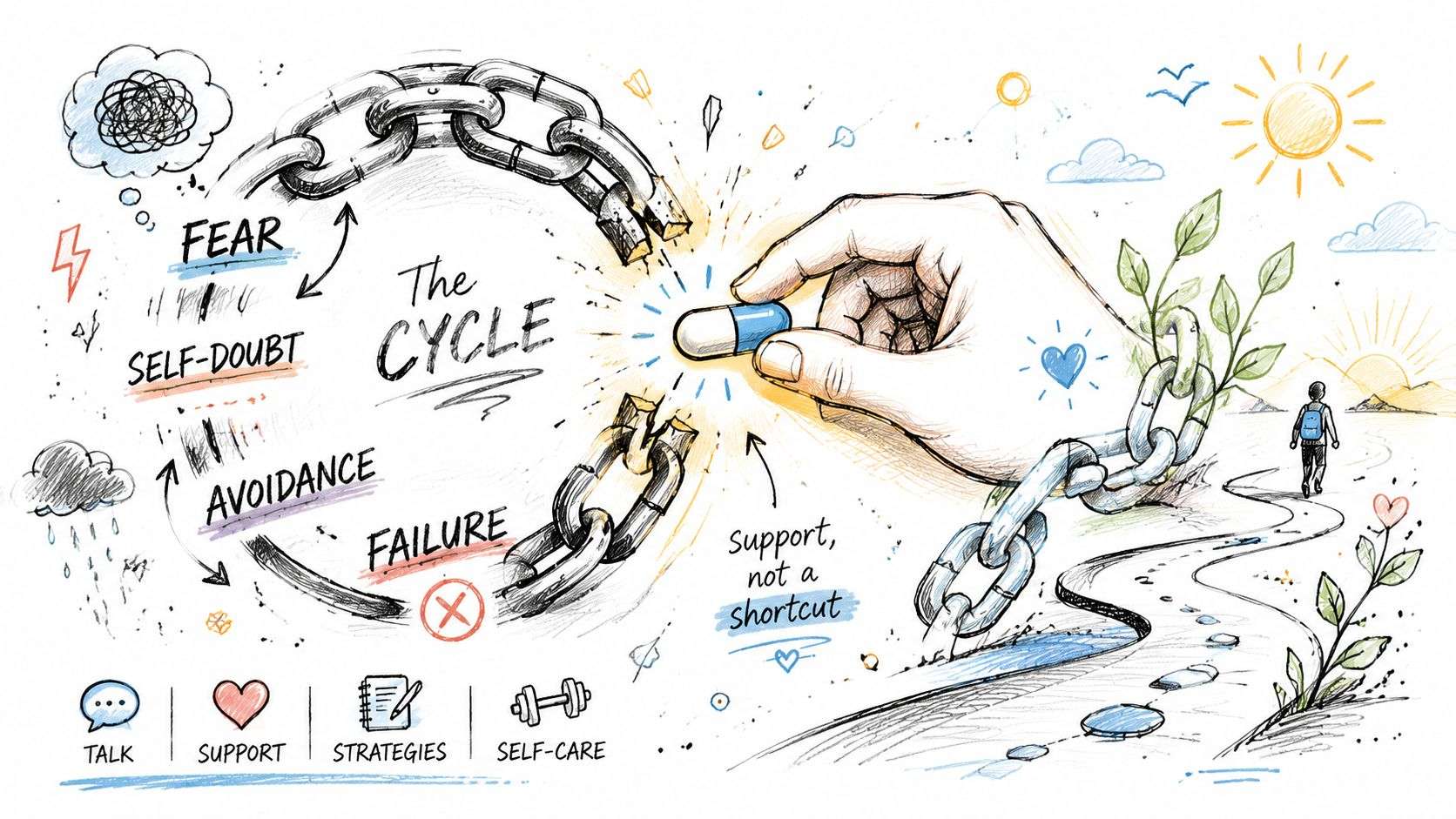
Patients sometimes resist medication because they worry it means the problem is "real" in a bad way, or that they'll become dependent on it for confidence. I frame it differently. In the right patient, medication creates scaffolding. It supports the physical side long enough for the mind to stop expecting failure.
That matters because a few reliable sexual experiences can change anticipation dramatically. Instead of entering intimacy braced for collapse, the patient starts with a sense that the body will respond. That shift gives therapy room to work.
If you'd like a plain-language explanation of mechanism and timing, this article on how erectile dysfunction treatment pills actually work is a practical reference.
What medication can and can't do
Medication can improve the body's response. It can't by itself resolve shame, perfectionism, relationship tension, or fear of disappointing a partner. That's why patients with longstanding anxiety often do best when medication is paired with therapy, communication work, or both.
Medication also isn't right for everyone. A proper prescribing discussion should include:
- Medical fit: current health conditions, medication interactions, and whether erectile symptoms may signal a broader cardiovascular or hormonal issue.
- Treatment goal: short-term confidence support, ongoing symptom management, or part of a broader integrated plan.
- Expectation setting: better physiology doesn't guarantee instant emotional ease.
In selected cases, clinicians may also consider anti-anxiety medication. That decision needs care because some agents can blunt desire, delay orgasm, or create other sexual side effects. For that reason, routine self-experimentation is a poor strategy.
The practical trade-off
The most productive mindset is this: medication can be a bridge, not a verdict. If a patient uses it as part of a broader sexual performance anxiety treatment plan, it often reduces avoidance and accelerates recovery. If a patient uses it to avoid an honest conversation about fear, relationship strain, or health problems, progress usually stalls.
Building a Foundation for Sexual Wellness
People often separate sexual function from the rest of their health until something stops working. In reality, sexual response reflects the same systems that govern energy, stress tolerance, sleep quality, vascular health, and hormone balance.
That means treatment isn't only about what happens during sex. It's also about the conditions you bring into sex.
The body doesn't compartmentalize stress
Poor sleep, chronic stress, heavy alcohol use, inactivity, and inconsistent eating habits can all make sexual response less reliable. They also make anxious thinking more sticky. A person who is exhausted, tense, and physiologically overactivated has less margin for erotic focus and less resilience when something feels off.
This doesn't mean lifestyle change alone will solve a significant sexual problem. It does mean that ignoring these basics makes every other intervention less effective.
Practical rule: If you want more reliable sexual function, build a more regulated nervous system outside the bedroom.
The foundations worth tightening first
Some changes have outsized value because they support both sexual function and anxiety control:
- Sleep protection: Keep a regular sleep window and treat chronic sleep disruption as a health issue, not an inconvenience.
- Alcohol honesty: Many patients call alcohol a confidence tool when it is worsening erection quality, lubrication, orgasm, or presence.
- Stress discharge: Exercise, breathing work, therapy, and recovery time help if they're done consistently, not only after a bad sexual experience.
- Medical condition control: Better management of conditions such as diabetes supports the vascular and nerve function that sexual response depends on.
Lifestyle work is also a useful diagnostic tool. If someone improves sleep, reduces alcohol, manages stress, and still has persistent dysfunction, that points more strongly toward a medical workup rather than endless self-blame.
Why this matters for long-term confidence
Sustainable confidence doesn't come from trying harder in the moment. It comes from repeated evidence that your body is supported and your sexual response isn't operating under constant strain.
For a broader perspective on why desire, arousal, mood, and physical health belong in the same conversation, this article on why sexual health is more than just physical is a helpful read.
When to Consider Clinic-Based Treatments
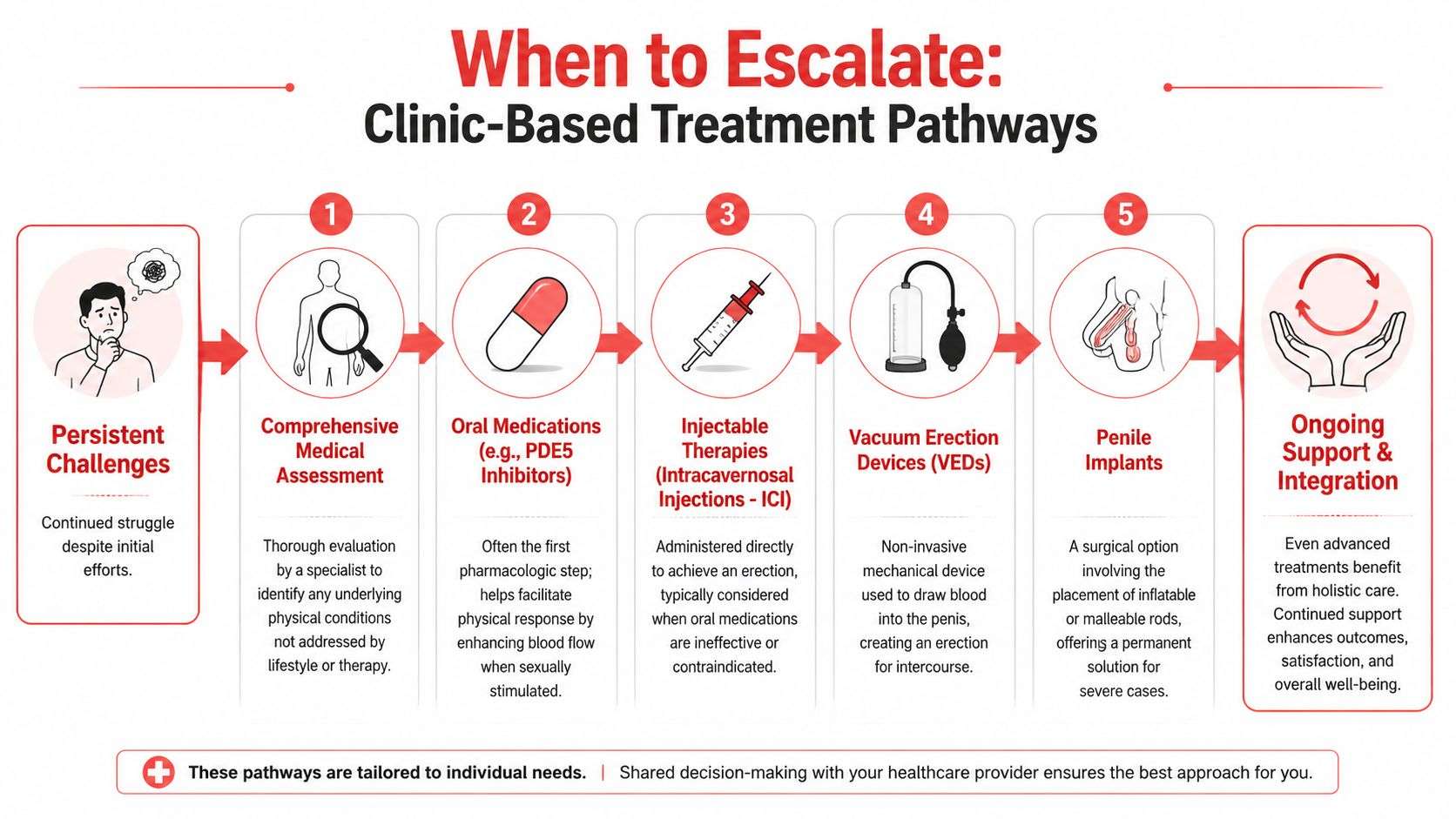
Some patients do thoughtful therapy, improve communication, clean up lifestyle factors, and still struggle. At that point, it isn't helpful to keep repeating advice that assumes the problem is primarily fear-based. If physical function has declined, anxiety may be a rational response to a real limitation.
Here, escalation matters.
A modern treatment model for sexual dysfunction has moved toward multimodal care, and one practical reason is that combined treatment has been reported to produce the highest response rates for erectile dysfunction compared with either psychological intervention or medication alone. The same source also describes widespread avoidance behavior, citing a survey-based report that nearly 60% of men in a young British sample avoided sex because of performance anxiety (discussion of multimodal treatment and avoidance behavior in men with performance anxiety).
Signs it's time to escalate
Escalation makes sense when one or more of these are true:
- Symptoms are persistent: the problem is no longer occasional or highly situational.
- Medical risk is present: diabetes, vascular concerns, hormonal symptoms, or medication effects may be part of the picture.
- First-line treatment plateaued: therapy helped insight but not function, or medication helped function but not enough.
- Avoidance is growing: sex has become something you work around rather than participate in.
What clinic-based treatment can address
In clinic settings, evaluation may move beyond the basic question of "anxiety or not" and into what part of sexual function is failing. Blood flow, tissue responsiveness, hormonal status, nerve function, medication burden, and relationship context can all matter.
Depending on the patient, later-line options may include more detailed erectile dysfunction management, vacuum devices, injectable therapies, or surgical options such as implants. Some clinics also offer regenerative approaches intended to improve the health of the underlying tissue and support blood flow, going beyond a temporary response.
That distinction matters. If anxiety grew out of repeated physical unreliability, then rebuilding the physical foundation can change the emotional experience at its source. Talk therapy still matters, but it stops carrying the impossible burden of solving a structural problem alone.
The trade-off to understand
Advanced treatment isn't a shortcut for everyone. It requires proper evaluation, realistic expectations, and a willingness to match the intervention to the problem. But for patients with mixed or clearly physical contributors, escalating care can be the step that finally makes confidence believable again.
Your Stepwise Treatment Algorithm
A good sexual performance anxiety treatment plan should feel orderly, not overwhelming. This is the sequence I generally want patients to think through.
Step 1
Name the pattern accurately. If sex has become associated with dread, monitoring, avoidance, or repeated disappointment, stop calling it "just a bad streak." Talk with your partner in simple language. Tell them whether the dominant feeling is fear, frustration, embarrassment, physical unreliability, or all of the above.
Step 2
Look for clues that suggest mixed causes. Ask whether symptoms are situational or consistent, sudden or gradual, isolated to partnered sex or present more broadly. If there's any sign of a medical contributor, schedule a medical evaluation rather than guessing.
Step 3
Start first-line therapy if anxiety is clearly part of the picture. CBT, mindfulness-based work, sex therapy, sensate focus, or couples therapy can all be appropriate depending on the pattern. Commit long enough to practice the skills. Insight without repetition rarely changes sexual response.
Step 4
Discuss medication if erectile difficulty is reinforcing the fear loop. Used strategically, it can create enough physiological reliability to reduce anticipatory panic and make therapy more effective.
Step 5
Escalate when progress stalls. If you've addressed communication, therapy, lifestyle, and initial medical management but function remains poor, seek a more thorough sexual health workup. That may include targeted treatment for erectile dysfunction, hormonal issues, diabetes-related factors, or other physical contributors.
Recovery usually speeds up once patients stop asking, "Is this all mental or all physical?" and start asking, "Which parts of this problem need to be treated together?"
Your Questions on Performance Anxiety Answered
Below are concise answers to the questions patients ask most often. If you want another plain-language mental health resource that complements this medical view, this comprehensive guide from Refresh Psychiatry is a solid overview.
| Question | Answer |
|---|---|
| Can women have sexual performance anxiety too? | Yes. A major review reported that sexual performance anxiety affects 6% to 16% of women and can severely inhibit sexual desire. It isn't limited to erection problems or to men. |
| Is performance anxiety the same as erectile dysfunction? | No. Performance anxiety is a fear-based process. Erectile dysfunction describes difficulty with erection. Some people have one, some have the other, and many have both. |
| Can anxiety continue even after the body improves? | Yes. Once fear gets conditioned to intimacy, the body may improve before confidence does. That's one reason integrated treatment matters. |
| Should I talk to my partner about it directly? | Usually yes. Calm, specific language reduces misunderstanding. Secrecy tends to increase pressure for both people. |
| Is there a cure? | Many people improve substantially, but the path depends on the cause. Anxiety-driven cases often respond to therapy and structured behavioral work. Mixed cases usually improve most when physical and psychological factors are treated together. |
If you're ready for a more detailed evaluation, Sexual Wellness Centers of America offers clinic-based care focused on sexual health, erectile dysfunction, hormone optimization, and regenerative wellness for adults who need more than one-dimensional advice.