
Why the Depo Provera Gluteal Injection Site Matters for Long-Acting Birth Control
The gluteal region is the most common location for administering the Depo-Provera injection, a long-acting contraceptive. Here’s what you need to know about the depo provera injection site gluteal approach:
Quick Answer for Healthcare Providers:
- Primary site: Gluteus maximus muscle (upper outer quadrant)
- Preferred technique: Ventrogluteal approach for safety
- Needle specifications: 1.5-inch needle at 90-degree angle
- Dosage: 150 mg every 12-13 weeks
- Alternative site: Deltoid muscle (for smaller volumes)
Depo-Provera (medroxyprogesterone acetate) is a progestin-only injectable contraceptive that prevents pregnancy for at least 12 weeks. Each injection contains 150 mg of hormone that stops ovulation, thickens cervical mucus, and thins the uterine lining. Clinical studies show it’s over 99% effective when administered on schedule, with only about 1 in 100 women becoming pregnant during the first year of use.
The gluteal muscle is preferred because it’s large, well-developed, and can safely absorb the full dose of this aqueous suspension. However, proper technique is critical. The ventrogluteal site is considered safer than the dorsogluteal site because it avoids major nerves and blood vessels, particularly the sciatic nerve.
Key considerations for gluteal injection include:
- Site selection matters for safety and efficacy
- Proper landmarking prevents nerve injury
- Deep intramuscular placement ensures correct absorption
- Inadvertent subcutaneous injection can cause tissue reactions
- Body habitus assessment determines needle length
I’m Jeff Nuziard, CEO of Sexual Wellness Centers of America, and I’ve spent years helping patients steer complex wellness treatments including hormone therapies and proper administration of medications. Our team in Colleyville, Texas, ensures every patient receives safe, effective care with proper injection protocols.
Important related topics:
- IM muscle injection
- Places for intramuscular injection
- Why the dorsal gluteal site is dangerous for IM injection
Recommended Intramuscular Sites for Depo Provera
When it comes to administering Depo-Provera, the goal is to ensure optimal absorption and effectiveness of the medication. This means injecting it deep into a large, well-developed muscle. The two primary recommended intramuscular (IM) injection sites are the gluteus maximus and the deltoid muscle. Both sites offer distinct advantages, but the choice often comes down to the volume of medication, the patient’s body habitus, and the specific formulation of Depo-Provera being used.
The gluteal muscle, particularly the gluteus maximus, is a prime location because of its significant size and depth. This allows for safe administration of the 150 mg dose of Depo-Provera without concern for the medication being too close to the surface or inadequately absorbed. Research indicates that the gluteal muscle is large and deep enough to safely administer deep injections, which is essential for Depo-Provera’s effectiveness. This ensures that each injection goes into the muscle tissue for optimal hormone absorption and distribution.
On the other hand, the deltoid muscle, located in the upper arm, is also a viable option. However, it’s typically used for smaller volumes of medication, generally up to 1 mL. While Depo-Provera is 1 mL, the gluteal site is often preferred due to its larger muscle mass, providing a greater margin of safety for depth of injection and minimizing potential discomfort or complications. For a deeper dive into IM injections, you can explore our guide on IM Injections.
Choosing Between Gluteal and Deltoid Sites
The decision between using the gluteal or deltoid site for a Depo-Provera injection isn’t arbitrary. Several factors play a crucial role in making the best choice for each patient:
- Injection Volume: Depo-Provera is typically 1 mL. While the deltoid can accommodate this volume, the gluteal site is generally considered safer for larger doses due to its increased muscle mass. The ventrogluteal site, a specific area within the gluteal region, is often preferred for larger doses because of its safety and lower risk of nerve injury compared to other gluteal areas.
- Patient Habitus: A patient’s body size and muscle development are key. In individuals with less muscle mass or significant subcutaneous fat in the deltoid, the gluteal site might be a more reliable option to ensure the medication reaches the muscle rather than being inadvertently injected into fat. Conversely, a well-developed deltoid might be perfectly suitable. We always assess each patient’s body habitus to determine the most appropriate site and needle length.
- Tissue Depth: Ensuring the needle penetrates deep enough into the muscle is paramount. For some body types, a longer needle might be necessary to reach the gluteal muscle effectively, while for others, a standard 1.5-inch needle is sufficient. The goal is to avoid subcutaneous injection, which can lead to improper absorption and potential site reactions.
- Medication Distribution: Both sites, when injected correctly, allow for proper medication distribution and absorption. However, the larger surface area and vascularity of the gluteal muscle can sometimes offer a slightly more consistent absorption profile, although clinical differences are often negligible when proper technique is followed at either site.
Our team at Sexual Wellness Centers of America in Colleyville, TX, prioritizes patient safety and comfort. We carefully consider these factors for every Depo-Provera injection, ensuring the chosen site and technique are optimal for your individual needs.
Mastering the Gluteal Injection Technique for Depo-Provera
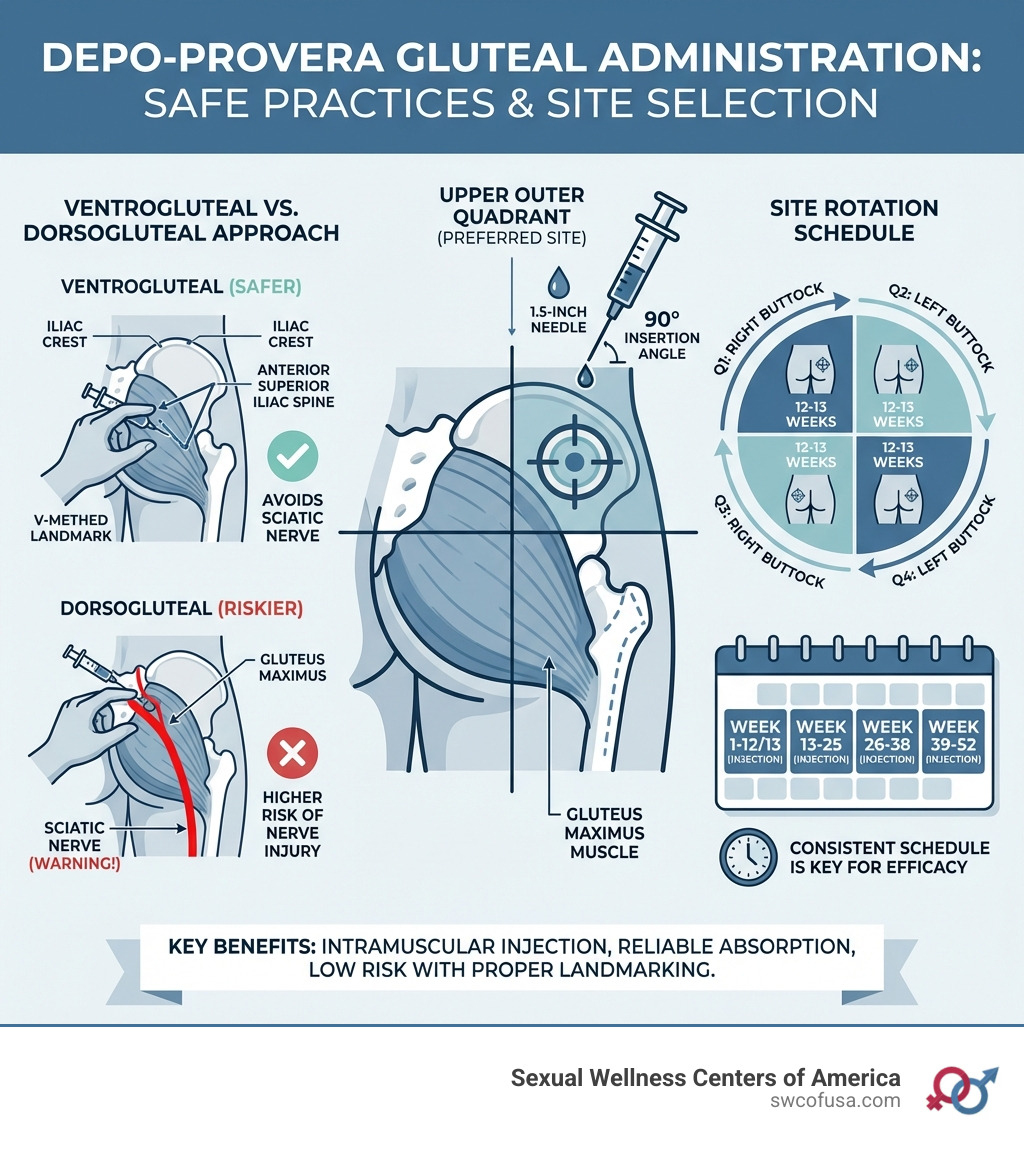
When selecting the gluteal region as the depo provera injection site, precision is key. While the gluteal area offers ample muscle mass, it’s crucial to identify the safest and most effective location. The ventrogluteal site is widely recognized as the preferred gluteal injection site due to its anatomical safety. This area is free from major nerves and blood vessels, significantly reducing the risk of complications.
The dorsogluteal site, historically a common choice, is now largely discouraged. Why? Because it carries a higher risk of damaging the sciatic nerve, which can lead to severe pain, numbness, or even paralysis. Protecting the sciatic nerve is paramount, and the ventrogluteal approach effectively minimizes this risk.
For a successful gluteal injection, the needle should be inserted at a 90-degree angle, deep into the muscle. A 1.5-inch needle is typically recommended to ensure the medication reaches the muscle tissue, although needle length may vary based on the patient’s body habitus. We always aim for deep intramuscular penetration to ensure optimal absorption and efficacy of the 150 mg Depo-Provera dose. For more information on gluteal injections, check out our resource on IM Injection Gluteal Muscle.
Step-by-Step Administration Guide
Proper technique is non-negotiable for safe and effective Depo-Provera administration. Our protocol at Sexual Wellness Centers of America ensures every step is followed carefully:
- Aseptic Preparation: We begin by washing our hands thoroughly with soap and water and donning gloves. The injection site, usually the upper outer quadrant of the buttock for gluteal injections, is then cleaned with an alcohol swab. We allow the alcohol to air dry completely to ensure maximum antiseptic effect.
- Gather Supplies: We gather all necessary supplies: the Depo-Provera CI vial or pre-filled syringe, a sterile syringe, a 1.5-inch needle, gloves, and alcohol wipes.
- Vigorous Shaking: The Depo-Provera suspension must be vigorously shaken for at least one minute just before use. This ensures the medication is uniformly distributed, as it’s a suspension and can settle. We then draw up the precise 150 mg dose into the syringe, tapping it gently to remove any air bubbles.
- Patient Positioning and Site Selection: We position the patient comfortably, typically lying prone or on their side, to relax the gluteal muscle. To locate the ventrogluteal site, we place the palm of our hand over the greater trochanter, with the index finger pointing towards the anterior superior iliac spine and the middle finger extended back towards the iliac crest. The injection is given in the “V” formed by these fingers. This landmarking is crucial to avoid nerves and blood vessels.
- Deep IM Penetration: With one hand, we apply slight skin tension near the cleaned area. The needle is uncapped, ensuring not to touch the needle itself. We then quickly insert the needle deep into the gluteal muscle at a 90-degree angle. Assessing the patient’s body habitus beforehand helps us confirm if a 1.5-inch needle is sufficient or if a longer needle is needed to reach the muscle tissue, avoiding inadvertent subcutaneous injection.
- Plunger Pressure: Once the needle is in place, we slowly press down on the syringe’s plunger until the entire medication is injected. This slow, steady pressure ensures the full dose is delivered effectively.
- Needle Withdrawal and Pressure: After the medication is fully injected, we quickly withdraw the needle and immediately apply gentle pressure with a clean cotton ball or gauze to the injection site. It’s important not to rub or massage the area, as this can affect absorption or cause irritation.
- Needle Disposal: The used needle and syringe are immediately and safely discarded in a sharps container.
By adhering to these rigorous steps, we ensure that every Depo-Provera injection is administered safely and effectively, maximizing its contraceptive benefits and minimizing potential complications for our patients in Colleyville, TX.
Minimizing Discomfort and Managing Site Reactions
Receiving an injection, especially a regular one, can sometimes cause discomfort. Our priority at Sexual Wellness Centers of America is to make your Depo-Provera experience as comfortable as possible. We understand that patient comfort significantly reduces anxiety and improves the overall experience.
One of the simplest yet most effective strategies is muscle relaxation. Keeping the gluteal muscle relaxed minimizes pain and prevents unnecessary tension during the injection. We encourage deep breathing exercises and a calm environment to help you relax. For some, even applying a warm compress to the area beforehand can help ease muscle stiffness and improve comfort. Managing anxiety around injections is a key part of our patient care.
Site rotation is another best practice we diligently follow. With each Depo-Provera injection, we alternate between recommended sites, typically between the left and right gluteal muscles and sometimes the deltoid, if appropriate. This helps prevent localized irritation, scar tissue formation, and discomfort that can arise from repeated injections in the exact same spot. It also ensures consistent absorption over time. For more on the gluteus maximus as an injection site, you can read our detailed guide on Gluteus Maximus IM Injection Site.
Handling Potential Complications
While complications are rare with proper technique, we believe in being proactive and educating our patients about potential reactions and how to manage them.
Common, minor reactions at the gluteal injection site can include pain, tenderness, swelling, bruising, or a small lump. These are usually temporary and resolve on their own. To minimize these:
- Cold Compress: Applying a cold compress to the injection site for 10-15 minutes immediately after the injection can help reduce swelling and discomfort.
- Over-the-Counter Pain Relievers: Medications like ibuprofen or acetaminophen can help manage any post-injection soreness.
- Avoid Rubbing: We advise against pressing, massaging, or rubbing the injection site, as this can interfere with medication absorption and potentially increase bruising or irritation.
- Movement: Gentle movement of the limb or body part after the injection can help reduce post-injection soreness, as mobility often minimizes pain faster than rest.
More significant, though rare, potential complications associated with injection sites include:
- Injection Site Nodules or Lumps: Sometimes, a small, firm lump or nodule can form at the injection site. This is often due to the medication creating a depot under the skin or in the muscle. While usually harmless, persistent or painful lumps should be brought to our attention.
- Skin Dimpling or Persistent Atrophy: In some cases, particularly with inadvertent subcutaneous injection or repeated injections in the same spot, the fat tissue can atrophy, leading to a dimpled or indented appearance of the skin. Site rotation is crucial to mitigate this.
- Infection: Although rare with sterile technique, signs of infection (increased redness, warmth, significant swelling, pus, or fever) require immediate medical attention. We instruct our patients to monitor for these symptoms.
- Abscess Formation: An abscess is a more severe form of infection, a pocket of pus that can form at the injection site. This is extremely rare but requires prompt medical intervention.
Our commitment to continuous training and adherence to best practices, informed by scientific research on gluteal injection effectiveness, helps us minimize these risks. We want you to feel confident and secure in the care you receive from us in Colleyville, TX.
Long-Term Considerations and Patient Safety
Depo-Provera is an incredibly effective long-acting contraceptive, but its use comes with important long-term considerations, particularly regarding bone mineral density (BMD). Each 150 mg injection works by suppressing ovulation and providing contraception for at least 12 weeks (+/- 5 days), requiring consistent administration every 12 to 13 weeks.
One of the most significant concerns associated with Depo-Provera use is the potential for Bone Mineral Density (BMD) loss. This reduction in serum estrogen levels can lead to a decrease in bone density, which is greater with increasing duration of use and may not be completely reversible. For this reason, Depo-Provera should generally not be used as a long-term birth control method (i.e., longer than 2 years) unless other birth control methods are considered inadequate. If continued long-term, we recommend BMD evaluation.
Another common long-term consideration is weight gain. Studies indicate that women tend to gain weight while on Depo-Provera therapy. Over the first 1-2 years of use, average weight gain is typically 5-8 lbs. For those completing 4-6 years of therapy, the average weight gain can increase to 14-16.5 lbs. This weight gain is generally attributed to increased fat rather than anabolic effects or fluid retention.
Menstrual cycle disruption is also a well-known effect. Most women using Depo-Provera experience irregular or unpredictable bleeding and spotting initially. With continued use, amenorrhoea (absence of periods) becomes common, affecting up to 55% of women by month 12 and 68% by month 24. While this can be a benefit for some, it’s an important aspect of patient education.
Bone Health and Adolescent Use
The impact on bone health is especially critical for adolescents and young adults. Adolescence is a crucial period for achieving peak bone mass, which is a key determinant of osteoporosis risk later in life. Any significant BMD loss during this time could have long-lasting implications.
- BMD Loss in Adolescents: In adolescent females, Depo-Provera use is associated with a significant decline in BMD. Mean decreases in lumbar spine BMD were reported at -2.1% after 4.6 years, with even more pronounced decreases at the total hip (-6.4%) and femoral neck (-5.4%) at 240 weeks.
- Reversibility: While some BMD recovery occurs after Depo-Provera is discontinued and ovarian estrogen production increases, full recovery can take time. In adolescents, recovery to baseline BMD required 1.2 years at the lumbar spine, but 4.6 years at the total hip and femoral neck after discontinuation. For those treated for more than two years, femoral neck and total hip BMD did not recover to baseline levels even up to 60 months post-treatment.
- Mitigation: To support bone health, we strongly recommend adequate calcium intake and Vitamin D supplementation for all patients using Depo-Provera, especially adolescents. Regular weight-bearing exercise can also contribute to bone strength. We engage in thorough discussions with our younger patients about these risks and explore all suitable contraceptive options.
| Feature | Intramuscular (IM) Depo-Provera (e.g., Depo-Provera CI) | Subcutaneous (SubQ) Depo-Provera (e.g., Depo-subQ Provera 104) |
|---|---|---|
| Dosage | 150 mg medroxyprogesterone acetate | 104 mg medroxyprogesterone acetate |
| Frequency | Every 12-13 weeks | Every 12-14 weeks |
| Injection Site | Gluteal or Deltoid muscle | Anterior Thigh or Abdomen (fatty tissue) |
| Needle Angle | 90 degrees | 45 degrees |
| Needle Length | Typically 1.5 inches (adjusted for body habitus) | Smaller, shorter needle (pre-filled syringe) |
| Administration | Deep IM injection | Subcutaneous injection |
| Self-Administration | Generally not recommended (requires professional) | Can be self-administered after training (in some regions) |
This table highlights the key differences between the two formulations. While the IM version is the focus of our discussion for the depo provera injection site gluteal, it’s important to be aware of the SubQ option and its distinct administration.
Frequently Asked Questions about Depo-Provera Gluteal Injections
We often receive questions about the specifics of Depo-Provera injections, especially concerning the gluteal site. Here are some of the most common inquiries and our expert answers.
Can I self-administer Depo-Provera at the gluteal site?
Generally, no. The intramuscular Depo-Provera (Depo-Provera CI) is designed for deep muscle injection and requires precise technique and anatomical knowledge to ensure safety and efficacy. Self-administering at the gluteal site is not typically recommended or approved. The gluteal area, while large, requires careful landmarking to avoid vital structures like the sciatic nerve.
However, there is a subcutaneous (SubQ) formulation, Depo-subQ Provera 104, which is designed for self-administration in some regions, but this is into the fatty tissue of the thigh or abdomen, not the gluteal muscle. For IM injections, professional administration is crucial. If you’re looking for self-administration options, the vastus lateralis (thigh) muscle is sometimes considered for other IM shots, or you might consider the SubQ Depo-Provera for its easier self-injection profile. You can learn more about thigh injections on our page: IM Shot in Thigh.
What are the risks of gluteal injection for Depo-Provera?
While the gluteal site is generally safe when administered correctly, there are potential risks, particularly if proper technique is not followed:
- Sciatic Nerve Injury: As discussed, the dorsogluteal site carries a risk of striking the sciatic nerve, leading to pain, numbness, or weakness in the leg. This is why the ventrogluteal site is preferred for its anatomical safety.
- Subcutaneous Infiltration: If the needle is not long enough or not inserted deeply enough, the medication can be injected into the subcutaneous fat layer instead of the muscle. This can lead to improper absorption, reduced effectiveness, and localized reactions like persistent atrophy, indentation, or dimpling of the skin.
- Abscess Formation: Although rare with sterile technique, any IM injection carries a minimal risk of infection leading to abscess formation at the site.
- Hematoma: Improper technique can also lead to rupture of small blood vessels, causing bruising or a hematoma (a localized collection of blood).
- Injection Site Reactions: Common reactions like pain, swelling, or redness are usually mild and temporary, but more severe reactions like persistent nodules or lumps can occur.
Our experienced healthcare providers in Colleyville, TX, are trained to minimize these risks through meticulous technique and patient assessment. For more on IM injections and recovery, check out IM Injections for Athletes: Benefits and Recovery.
How does subcutaneous administration differ from the gluteal IM approach?
The key differences between intramuscular (IM) administration at the gluteal site and subcutaneous (SubQ) administration (Depo-subQ Provera 104) are significant:
- Dosage: IM Depo-Provera (e.g., Depo-Provera CI) contains 150 mg of medroxyprogesterone acetate. SubQ Depo-Provera (Depo-subQ Provera 104) contains a lower dose of 104 mg.
- Injection Site: IM Depo-Provera is injected into large muscles like the gluteal or deltoid. SubQ Depo-Provera is injected into the fatty tissue, typically in the anterior thigh or abdomen.
- Needle Angle: IM injections are given at a 90-degree angle to penetrate deep into the muscle. SubQ injections are given at a 45-degree angle into the pinched skin fold to reach the subcutaneous layer.
- Needle Size: SubQ injections use a smaller, shorter needle compared to the 1.5-inch needle typically used for IM gluteal injections.
- Administration: IM Depo-Provera requires professional administration due to the need for precise muscle targeting and depth. SubQ Depo-Provera is often available in a pre-filled syringe designed for easier self-administration after proper training, making it a more convenient option for some patients.
- Absorption: Both methods provide effective contraception, but the absorption profiles differ due to the different tissue layers. The lower dose of SubQ Depo-Provera is effective because it bypasses some of the first-pass metabolism that IM injections undergo, leading to similar systemic progestin levels.
While both formulations offer effective contraception, the choice depends on patient preference, medical considerations, and the desire for self-administration versus in-office visits. We can discuss which option is best suited for your lifestyle and health needs in Colleyville, TX.
Conclusion
Ensuring the safe and effective administration of Depo-Provera is a cornerstone of responsible healthcare, particularly when using the gluteal muscle as the injection site. From understanding the anatomical considerations to mastering the precise injection technique, every step is vital for patient well-being and medication efficacy. We’ve explored the critical differences between gluteal and deltoid sites, emphasized the importance of the ventrogluteal approach to protect the sciatic nerve, and outlined the meticulous steps involved in preparing and administering the injection.
We also covered how to minimize discomfort through muscle relaxation and site rotation, and equipped you with knowledge to manage potential reactions like nodules or swelling. Long-term considerations, especially concerning bone mineral density and weight gain, are crucial discussions we have with all our patients, advocating for adequate calcium and Vitamin D intake, particularly for adolescents. The clear distinction between intramuscular and subcutaneous administration, including the potential for self-injection with Depo-subQ Provera 104, provides a comprehensive overview of your contraceptive options.
At Sexual Wellness Centers of America in Colleyville, TX, we are dedicated to providing personalized care that extends beyond medication administration. Our expertise in sexual wellness, backed by innovative treatments like HEshot®, SHEshot®, and REGENmax® technology, allows us to offer comprehensive care custom to your unique needs. We believe in empowering our patients with knowledge and ensuring that every treatment, including your Depo-Provera injection, is administered with the utmost precision, safety, and comfort. We’re here to help you steer your health journey with confidence and support.
For more information about our IM injection services and how we can support your sexual health and wellness, please visit our website: More info about IM injection services.