
Rogaine can help a receding hairline, but it's not a guaranteed fix. Minoxidil alone works for about 59% of men on the frontal hairline, while the combination of minoxidil and finasteride reaches a 94% success rate for frontal regrowth, and Rogaine is still FDA-approved specifically for the crown rather than the hairline.
If you're here, you've probably already done the mirror check. You pull your hair back under bright bathroom light, compare old photos, and wonder whether the corners are creeping higher or whether you're just overthinking it. That moment matters, because with hairline loss, timing changes what's possible.
The honest way to answer does Rogaine work for receding hairline is this: yes, sometimes, especially early. But it works best when you treat it as the first move in a strategy, not the whole plan. For some people, it can slow loss and thicken miniaturized hairs at the front. For others, especially when the temples are already smooth and bare, it won't be enough on its own.
That's where most articles fall short. They either oversell Rogaine like it can rebuild any hairline, or dismiss it too quickly. The more useful approach is to see it for what it is: a practical starting point, a way to preserve viable follicles, and a marker for when you should escalate to stronger options.
Table of Contents
- The Honest Answer to a Worrying Question
- How Minoxidil Actually Revives Hair Follicles
- Receding Hairline vs Crown Thinning The Critical Difference
- The Window of Viability Why Early Action Is Everything
- Getting The Most from Minoxidil Application and Timeline
- When Rogaine Is Not Enough The Power of Combination Therapy
- Frequently Asked Questions About Rogaine for Hairlines
The Honest Answer to a Worrying Question
Many don't notice a receding hairline all at once. They notice it in fragments. More scalp in selfies. A sharper M-shape at the temples. Styling that suddenly takes more effort. By the time they ask whether Rogaine can help, they usually want a straight answer, not marketing.
Here's the straight answer. Rogaine may help a receding hairline if the follicles are still alive, but results at the front are usually more limited than results at the crown. That's why some men see thicker, healthier-looking hair at the edges, while others use it faithfully and feel disappointed.
The key mistake is treating every hairline the same. Early thinning at the frontal edge is different from advanced temple recession. Fine, miniaturized hairs can sometimes be rescued. Slick, shiny skin usually can't.
What Rogaine can and can't realistically do
- What it can do: support thicker growth in weakened follicles, slow visible progression, and help maintain hair that's starting to miniaturize.
- What it can't do: create brand-new follicles where they're gone, fix the hormonal driver of male pattern loss, or rebuild a significantly receded hairline by itself.
- What that means in practice: if you still see thinning hairs at the hairline, there's something to work with. If the area is smooth and bare, you need a broader treatment plan.
Clinical reality: Over-the-counter treatment is often a useful first step, but it's rarely the final step for frontal recession.
If you want a practical companion read focused specifically on the frontal region, this overview of does minoxidil work for frontal balding is a helpful place to compare expectations with what the front hairline usually does in real life.
A good treatment plan starts with one question: are you trying to maintain, regrow, or rebuild? Rogaine is strongest in the first two categories. It's much weaker in the third.
How Minoxidil Actually Revives Hair Follicles
Minoxidil helps follicles that are still alive work better. That is the core mechanism, and it is why some hairlines respond while others barely change.
In practice, minoxidil is used to support weakened follicles that have shortened their growth cycle and started producing thinner, softer hairs. As a topical vasodilator, it improves the local environment around the follicle and helps extend the anagen, or active growth phase. With more time in growth mode, a follicle can produce a longer, thicker strand than it was producing before.
Why the 5 percent version matters
Dose matters with minoxidil. In clinic, the 5% version is usually the starting point for men because it tends to produce a stronger response than lower-strength formulations. The trade-off is tolerability. Some users do well with it. Others develop irritation, flaking, or itching and need to adjust the vehicle, frequency, or the broader plan.
That is an important point for hairline cases. A stronger over-the-counter option can improve what is still salvageable, but it still works within the limits of the follicles you have left.
What users often misunderstand
Minoxidil does not force immediate regrowth. Hair responds on a cycle, not on demand, so visible change takes time and depends on follicle condition.
| Follicle state | What minoxidil is likely to do |
|---|---|
| Dormant but still active | May stimulate thicker, longer growth |
| Miniaturized | May improve strand quality and density |
| Completely inactive | Little to no response |
The best candidates still have stressed, miniaturizing follicles. Fully bare, shiny areas rarely improve with minoxidil alone.
This is why I view Rogaine as a foundation, not a full restoration plan. It is often the right first move because it can preserve and strengthen viable follicles at home. If response is limited, that does not mean treatment has failed. It usually means the next step should be more targeted, such as combination therapy or an in-office approach designed for areas that over-the-counter treatment cannot rebuild on its own.
Receding Hairline vs Crown Thinning The Critical Difference
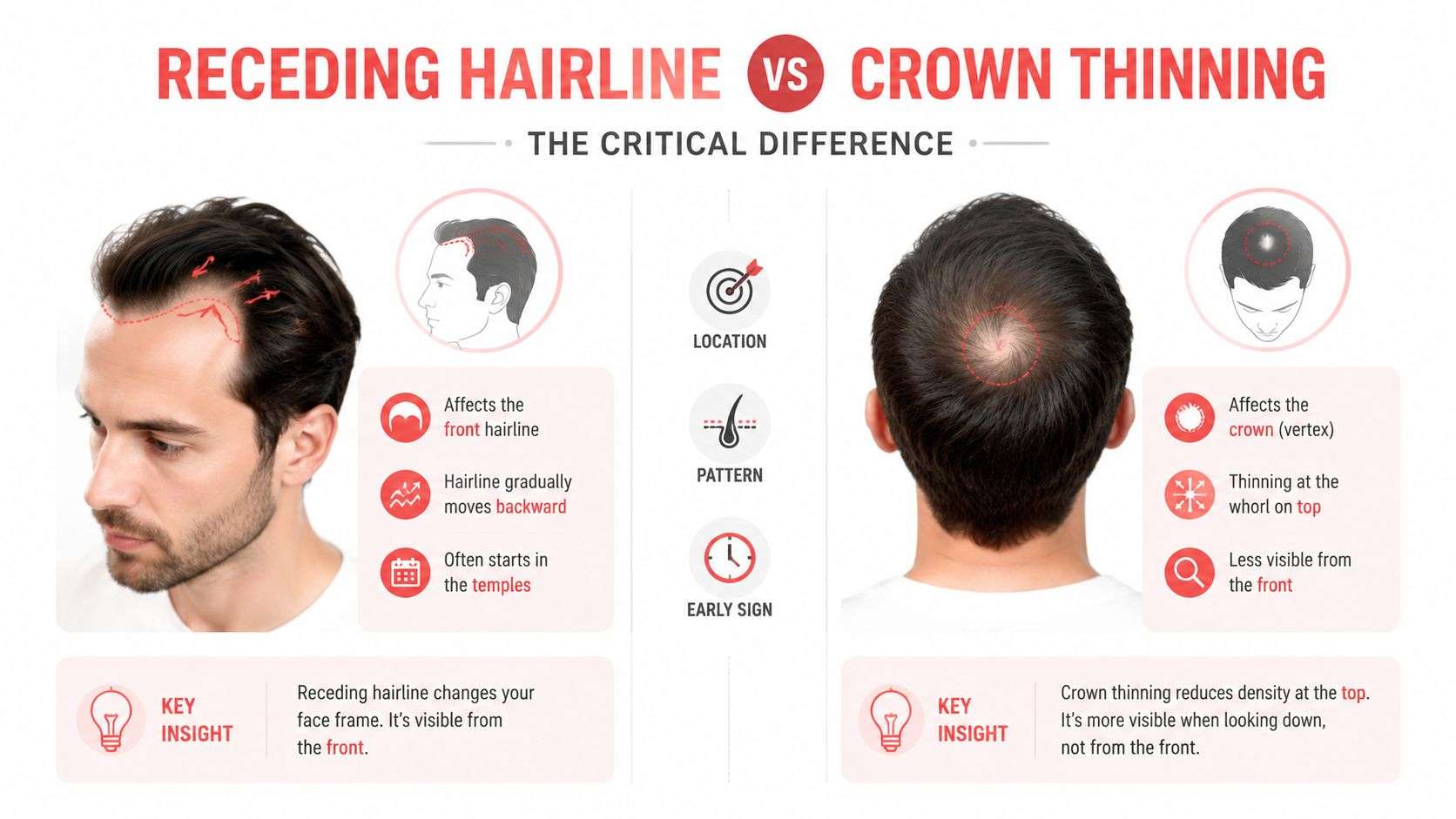
The reason this topic is confusing is simple. People hear that Rogaine works for hair loss, then assume the scalp behaves the same everywhere. It doesn't.
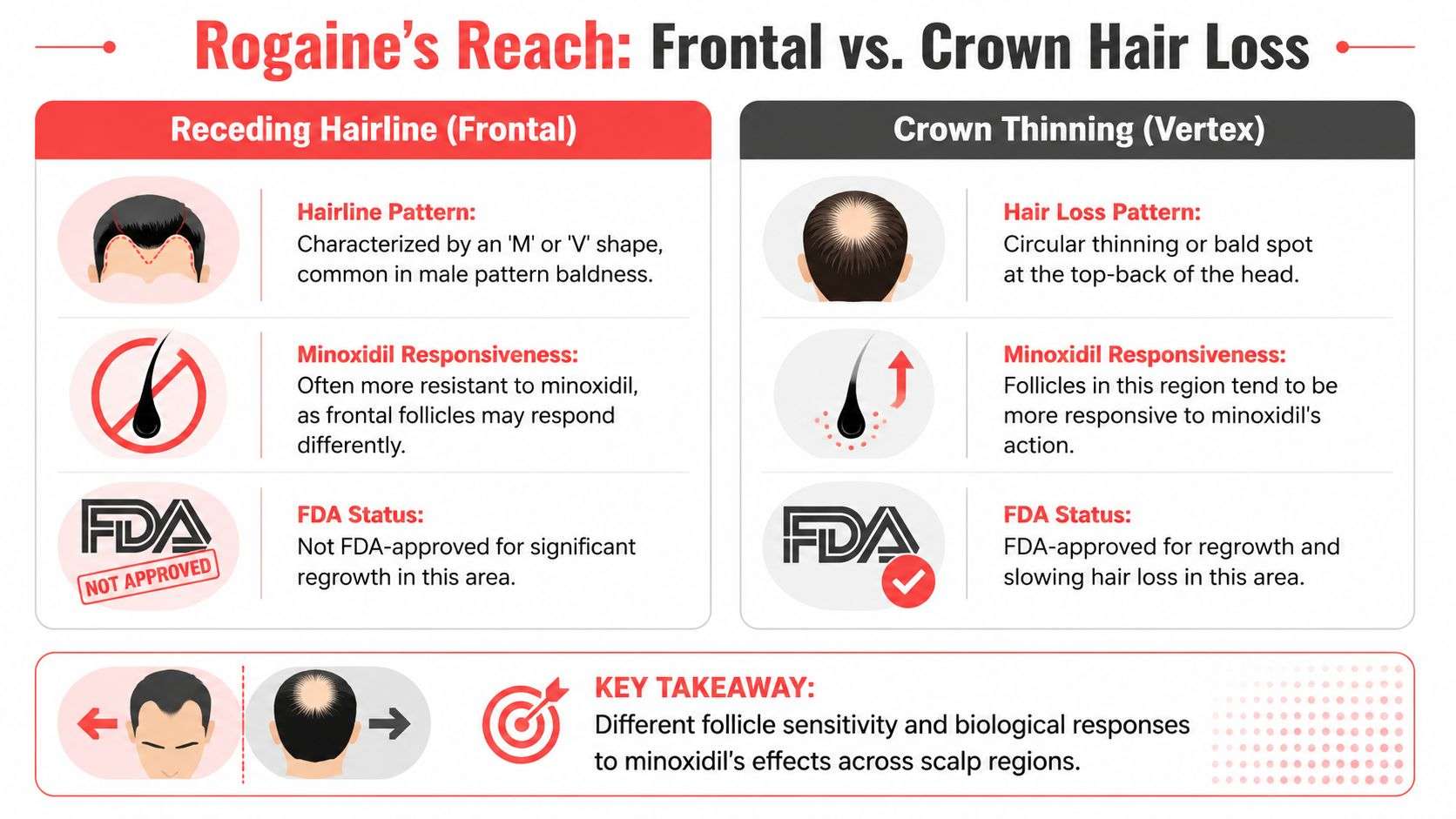
Rogaine is FDA-approved specifically for the vertex, or crown, of the scalp. It is not formally approved for significant regrowth on a receding hairline. That distinction matters because the crown is generally more responsive, while the frontal hairline is more stubborn and less predictable. Healthline also notes that a 2014 study showed 5% minoxidil can stimulate growth at the front of the scalp in men, but only when follicles are dormant and still active, not in fully bald areas, as explained in Healthline's review of whether Rogaine works.
Why the hairline is harder to treat
The frontal hairline usually presents with more biologic resistance. In clinic conversations, adjustments to expectations are often most necessary here. Men often want the temples restored first, but the temples are commonly the least forgiving area.
A few practical differences stand out:
- Crown thinning often leaves more recoverable follicles.
- Hairline recession tends to show up earlier as shape loss, not just diffuse thinning.
- Temple areas become visibly bare faster, which reduces what topical treatment can salvage.
What this means for your expectations
If your main concern is crown thinning, minoxidil has a clearer lane. If your main concern is the front corners, Rogaine may still play a role, but the role is usually modest unless you catch it early and combine it with a broader plan.
That's the mistake I see most often in hair restoration decision-making. People judge the product by the wrong target. They use a crown-focused medication on an aggressive hairline recession and expect a dramatic rebuild.
Hairline treatment is less about miracles and more about preserving opportunity.
The Window of Viability Why Early Action Is Everything
The phrase “start early” gets repeated so often that it stops meaning anything. In hair restoration, early has a biological meaning. It means the follicles are still present and capable of responding.
Minoxidil can't regrow hair on fully bald skin where follicles are no longer active. For early-stage frontal recession, users in Norwood 1 to 2 may have about a 60% success rate, but this falls to near 0% in Norwood 4 and beyond, according to Felix's discussion of frontal baldness and minoxidil.
How to tell whether the window is still open
Use the mirror test carefully:
- Fine, fading hairs along the edge: this is the group most worth treating early.
- Patchy thinning with visible miniaturized hairs: still potentially responsive.
- Smooth, shiny temple skin: usually a poor target for minoxidil alone.
This is also where people get tripped up by the first few months. Hair shedding early in treatment can be alarming, but that phase is often part of the transition as weaker hairs cycle out and thicker ones start replacing them.
The timeline people quit too soon on
The same source notes that visible regrowth typically takes 3 to 4 months, which is right around the point many people stop because they think nothing is happening. That's often the wrong move.
If you stop during the early shedding phase, you may quit before the treatment has had time to help.
If you're trying to support scalp health while thinking more broadly about regenerative options, this article on why GHK-Cu is the secret sauce for your scalp adds useful context around the kind of layered approach many patients eventually explore.
The practical takeaway is blunt. If you still have thinning hairs, act now. If the area is already bare and polished-looking, don't waste months expecting topical minoxidil to reverse biology it can't reverse.
Getting The Most from Minoxidil Application and Timeline
A common scenario in clinic goes like this. Someone uses minoxidil for six weeks, misses applications on busy days, gets worried by early shedding, then decides it is not working. In many cases, the product did not fail. The routine did.
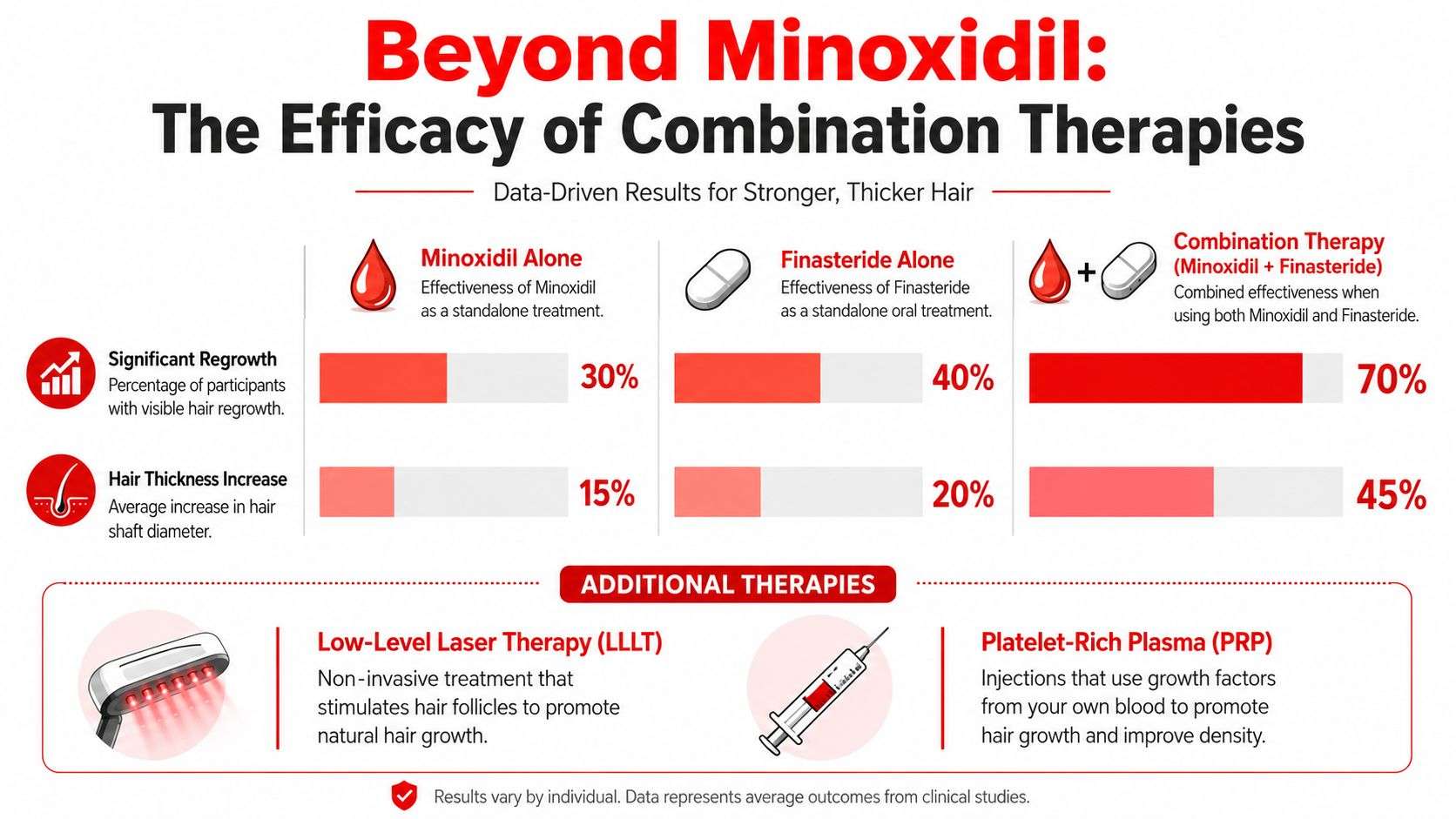
Minoxidil works best when it is treated as a disciplined first step in a longer hair restoration plan. It needs consistent scalp contact, enough time to push follicles through a new growth cycle, and realistic expectations about what over the counter treatment can and cannot do. As noted earlier, visible improvement usually takes a few months, and results only last while treatment continues.
Application mistakes that quietly lower results
Technique matters more than many people expect.
- Applying it to the hair instead of the scalp: the medication has to reach the skin where the follicles sit.
- Using it inconsistently: missed days reduce the cumulative effect that makes minoxidil useful.
- Stopping during an early shed: that phase can be part of the hair cycle shift, not proof that treatment is harming the hairline.
- Using too much product: more is not better. It raises the chance of irritation without improving the outcome.
- Expecting it to hold gains after stopping: minoxidil is ongoing support, not a permanent fix.
A routine that gives minoxidil a fair trial
Keep it simple and repeatable.
- Apply to a dry scalp. This improves contact with the treatment area and makes placement easier.
- Part the hair and target the thinning edge directly. The goal is scalp coverage, especially along the temples or frontal margin.
- Let it dry before adding other products. That helps keep the dose where it belongs.
- Stay on schedule every day. Consistency usually matters more than small differences in formulation.
Patients who want to support hair shaft quality and scalp condition alongside minoxidil often benefit from a broader topical routine. This guide to boosting hair density with serums covers that part well.
Side effects are usually manageable. The common ones are itching, dryness, flaking, and irritation from the vehicle rather than the active ingredient itself. In practice, adjusting the formulation, cleaning up the application technique, or reducing scalp irritation from other styling products often solves the problem.
There is also a point where good technique and patience are no longer the issue. If someone has used minoxidil correctly for several months and the hairline is still losing ground, I treat that as a signal to reassess rather than keep repeating the same plan. Patients who are researching next-step regenerative options often start by understanding PRP hair restoration, because minoxidil makes the most sense as a foundation, not always the full strategy.
When Rogaine Is Not Enough The Power of Combination Therapy
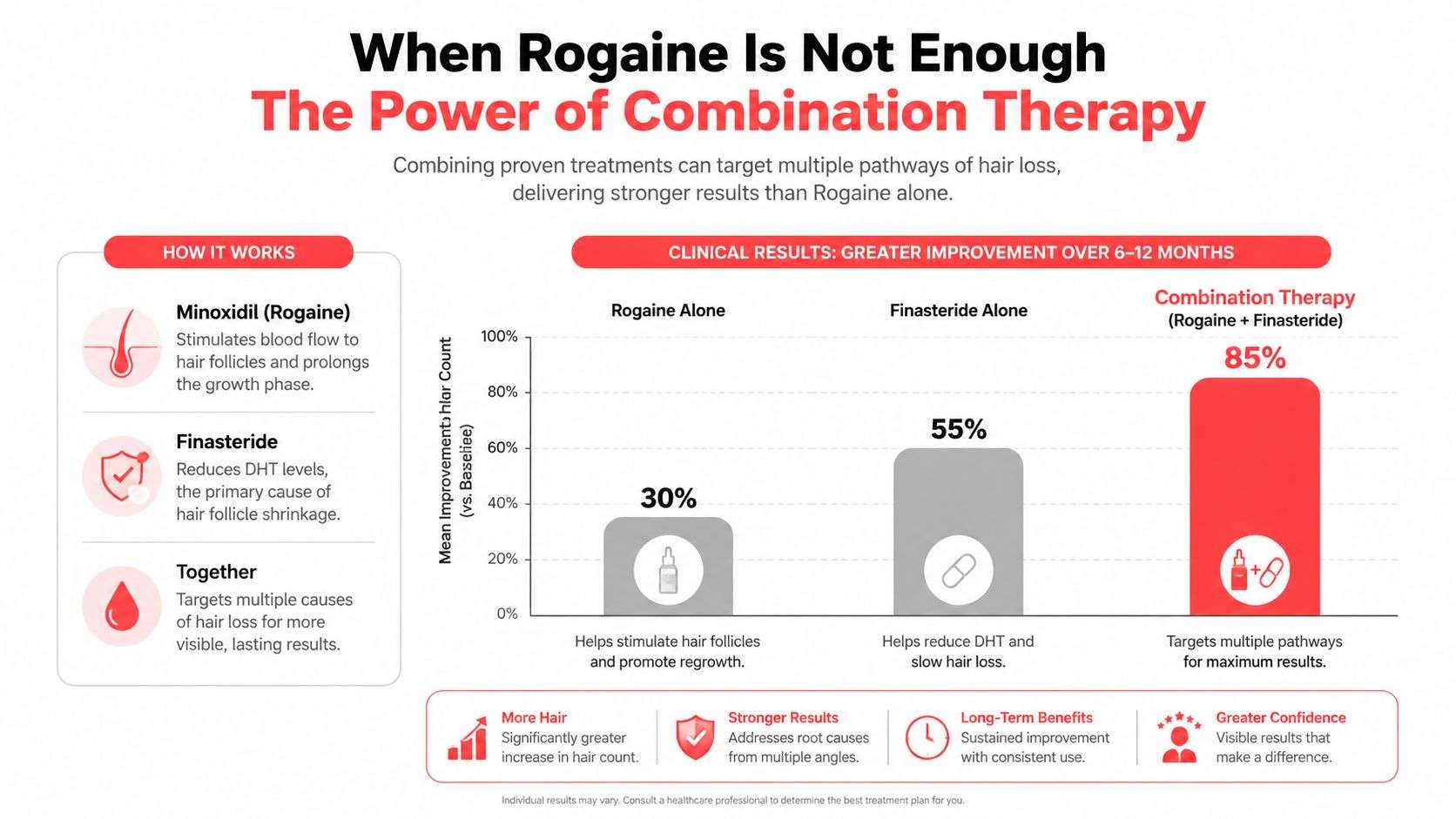
A common scenario in clinic is this: someone has used Rogaine faithfully, the shedding has slowed, a few thinner hairs look healthier, but the hairline still sits farther back each month. That pattern usually means minoxidil is helping the follicles that are still alive, while the underlying androgen-driven miniaturization continues.
That is the main limitation of Rogaine at the frontal hairline. It supports growth. It does not meaningfully reduce DHT activity, which is often the force pushing temple recession forward.
Why combination therapy changes the game
Minoxidil and finasteride have distinct mechanisms of action.
| Treatment approach | Main role |
|---|---|
| Minoxidil | Stimulates and prolongs growth in viable follicles |
| Finasteride | Lowers the hormonal pressure that drives miniaturization |
| Combination | Improves retention while increasing the chance of visible regrowth |
That combination is often where treatment becomes more strategic. Rogaine remains the foundation, especially early, but many hairlines need more than stimulation alone. If the goal is to keep existing hairs, strengthen weak follicles, and slow further frontal loss, pairing therapies usually makes more clinical sense than waiting for minoxidil to deliver a result it cannot fully deliver on its own.
When to escalate beyond over-the-counter care
There are clear signs that over-the-counter treatment has reached its ceiling:
- You have some stabilization, but the cosmetic change is too small
- The hairline continues to recede despite consistent use
- The temples look increasingly sparse or smooth
- You want visible rebuilding, not just slower loss
At that point, the discussion should widen. Some patients are appropriate for prescription therapy. Others benefit from regenerative options that aim to improve follicle function in areas that still have viability. A good starting point for that side of treatment is understanding PRP hair restoration, especially if you are comparing medication-based care with in-office procedures.
Some patients also want a more structured path that goes beyond maintenance and adds biologic support to a medically guided plan. If you are exploring that category, this beginner's guide to hair regrowth peptides gives useful context on how these protocols fit into broader restoration planning.
Rogaine is a strong opening move. It is rarely the final answer for an advancing hairline.
The strategic approach is simple. Start with minoxidil while follicles are still viable. Add combination therapy when the pattern shows ongoing miniaturization. Move to advanced restoration, including options such as REGENhair™, when the goal shifts from preservation to meaningful hairline recovery.
Frequently Asked Questions About Rogaine for Hairlines
What happens if I stop using Rogaine
Minoxidil is maintenance therapy. If you stop using it, the gains you got from treatment usually don't hold. The hair that benefited from the medication tends to shed over time, and the loss pattern resumes.
Can women use minoxidil on the hairline
Women do use topical minoxidil for pattern thinning, but the right formulation and plan should be individualized. Hairline change in women can have different causes, including diffuse thinning patterns that don't behave exactly like male temple recession.
Does generic minoxidil work like brand-name Rogaine
The active ingredient is minoxidil. In practice, what matters most is the formulation, scalp tolerance, and whether you use it consistently enough to judge it fairly.
When should you see a specialist
Don't wait forever to “see if it works.” Get expert input if any of these apply:
- Your temples are becoming smooth and bare
- Your hairline is changing quickly
- You've used minoxidil consistently and still aren't satisfied
- You want a plan that goes beyond an over-the-counter product
- You're considering combining medication with procedural options
For readers looking at cosmetic planning as well as treatment strategy, this guide to minoxidil, finasteride, and SMP is also useful for understanding how medical and appearance-based approaches can fit together.
So does Rogaine work for receding hairline
Yes, but only in the right circumstances. It works best when the recession is early, the follicles are still viable, and you treat it as the opening step in a larger plan. If you expect it to fully restore an advanced hairline by itself, you'll probably be disappointed.
If you use it strategically, though, it can buy time, preserve options, and improve the outcome of whatever comes next.
If you're ready for a more personalized hair restoration plan, Sexual Wellness Centers of America offers advanced regenerative wellness services, including REGENhair™ hair restoration. For patients who want more than over-the-counter maintenance, a professional evaluation can help clarify whether you need simple support, combination therapy, or a more advanced path.