
You started Xanax because anxiety or panic was interfering with daily life. Then something else changed. Maybe sex feels less spontaneous. Maybe you're interested but your body isn't cooperating. Maybe you're lying awake wondering whether the medication helping your mind is now hurting your erections.
That concern is common, and it deserves a careful answer. The short version is yes, Xanax can be associated with sexual side effects, including erectile difficulties. But that doesn't automatically mean the pill is the whole story. In many men, the harder question is whether the problem comes from the medication, the anxiety itself, relationship stress, alcohol, poor sleep, another medication, or several factors at once.
If you're trying to figure out what changed and what to do next, you need more than a yes-or-no headline. You need a way to sort out the pattern safely and without making a rushed decision that could worsen either your anxiety or your sex life.
Table of Contents
- The Worry Behind the Question
- How Xanax Can Affect Sexual Function
- Anxiety Versus the Medication Untangling the Cause
- Other Health Factors That Complicate the Picture
- Your Action Plan for Finding a Solution
- Restoring Foundational Health with Regenerative Treatments
- Frequently Asked Questions About Xanax and ED
The Worry Behind the Question
A pattern I hear often goes like this. A man starts Xanax during a stretch of panic, racing thoughts, or constant physical tension. The medication helps him feel calmer. He sleeps better. He stops feeling on edge all day. Then he notices that sex feels different, and what should be reassuring starts to feel confusing.
For some, the change is weaker desire. For others, it's trouble getting fully hard, staying hard, or feeling mentally present during intimacy. That can trigger another layer of anxiety. Now the original problem and the sexual problem start feeding each other.
Why this feels so personal
Erectile changes rarely stay in one lane. They affect confidence, closeness, and the way a man interprets his own health. Many patients quickly jump to one conclusion: “Xanax caused this.” Sometimes that's true. Sometimes it's only partly true. Sometimes the medication gets blamed for a problem that was already developing beneath the surface.
That's one reason sexual health can't be viewed as only a mechanical issue. It sits at the intersection of stress, hormones, circulation, nerve signaling, sleep, medications, and relationship dynamics. This broader view is well captured in this discussion of why sexual health is more than just physical.
ED after starting an anxiety medication doesn't mean you have to choose between mental stability and a healthy sex life. It means the pattern needs to be evaluated carefully.
What patients usually want to know
Most men aren't asking for a textbook explanation. They want answers to practical questions:
- Is Xanax known to affect erections?
- If it is, how do I know whether that's what's happening to me?
- Should I stop it, lower it, switch it, or wait?
- What if the problem is anxiety, alcohol, poor sleep, or another medication?
Those are the right questions. The useful answer isn't just whether Xanax can play a role. It's how to tell whether it's the main driver in your case.
How Xanax Can Affect Sexual Function
Xanax is a benzodiazepine. Its main job is to quiet an overactive nervous system. A simple way to think about it is this: when anxiety turns the brain's alarm system up too high, Xanax helps turn the volume down.
That calming effect can help panic and acute anxiety. But sexual arousal also depends on coordinated brain signaling, attention, physical responsiveness, and energy. If the nervous system is dampened too much, some men feel less mentally engaged, less physically responsive, or less interested in sex.
What the trial data shows
In clinical trials for panic disorder, sexual dysfunction was reported in 7% of people taking Xanax, compared with 4% of people taking placebo, which supports a measurable but relatively uncommon association with sexual side effects that can include erectile dysfunction, according to this review of Xanax and ED trial findings.
The same trial data reported decreased libido in 14% of users and increased libido in 8%, which is a useful clue. Xanax-related sexual effects don't move in only one direction. For some men, desire drops. For others, desire may shift in the opposite direction. That variability suggests the experience is often less about a direct structural problem in the penis and more about changes in arousal, inhibition, sedation, and mental state.
Why the body may respond this way
A good erection isn't just blood flow. It also requires the brain to register desire, safety, focus, and stimulation. Xanax can interfere with that chain in a few practical ways:
- Reduced arousal: You may want sex less often or feel less mentally activated by it.
- Sedation or fatigue: Feeling slowed down can blunt responsiveness.
- Less intensity: Some men describe sex as feeling flatter or more distant.
- Orgasm changes: Delayed climax or altered sensation can affect confidence and rhythm.
Practical rule: If sex problems began soon after starting Xanax or after a dose increase, the medication deserves a closer look. It still may not be the only factor.
The placebo finding matters too. Some people not taking the active drug still reported sexual side effects. That tells us baseline anxiety, panic disorder, stress, and expectation can also influence erections. So if you're asking, “Does Xanax cause erectile dysfunction?” the medically honest answer is yes, it can. But the mechanism is often indirect and mixed with other influences.
Anxiety Versus the Medication Untangling the Cause
The most overlooked part of this conversation is that anxiety itself can interfere with erections. Many men notice the timing of the prescription but miss the timing of the underlying problem. They remember when they started Xanax. They don't always notice that anxiety had already been changing their libido, concentration, or confidence for months.
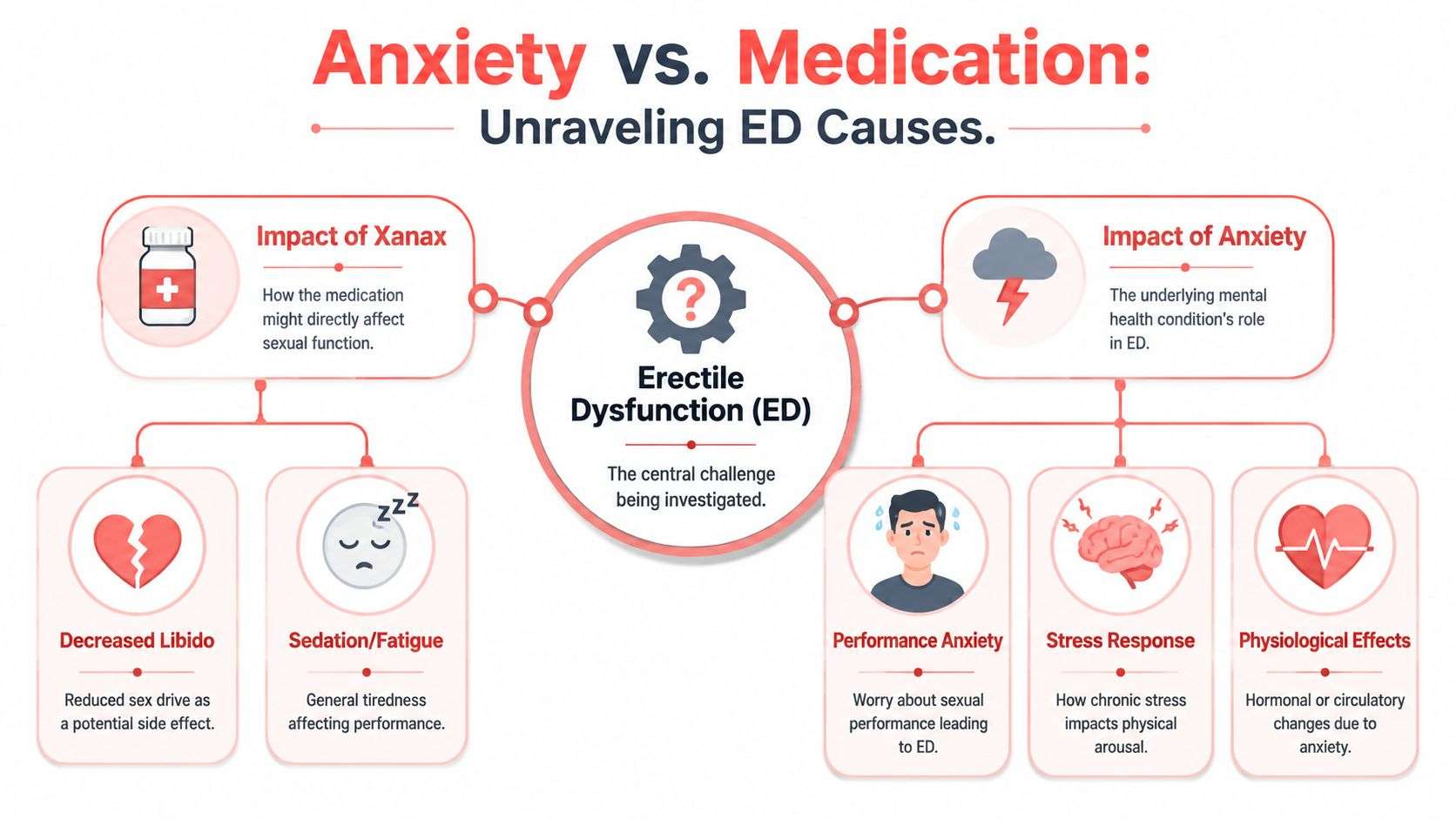
A broad sexual-medicine literature recognizes psychological factors as a major contributor to erectile dysfunction, and consumer guidance on this topic notes that some men may misattribute performance problems to alprazolam when the stronger driver is the underlying anxiety, relationship stress, or anticipatory fear, as discussed in this overview of Xanax, anxiety, and erectile dysfunction.
Clues that anxiety may be the stronger driver
Anxiety-related ED often has a distinct pattern. Erections may be inconsistent rather than absent across all situations. Desire may still be present, but performance falls apart once pressure rises. A man may do fine during masturbation and struggle with a partner, or he may have a good start and then lose the erection the moment self-monitoring kicks in.
Ask yourself:
- Did this happen before Xanax, even occasionally?
- Is it worse when you feel watched, rushed, or afraid of failing?
- Does it improve when you feel emotionally safe and rested?
- Do you get stuck in a loop of checking whether you're hard enough?
That last one is especially important. Once a man has one or two bad experiences, he may begin scanning for failure during sex. That mental surveillance alone can interrupt arousal.
Clues that medication may be contributing more
Medication-related problems often track more clearly with dosing and timing. A man may notice that he feels sexually flat after taking the medication, more sedated at night, or less interested overall rather than specifically anxious about performance.
A quick comparison can help:
| Pattern | More suggestive of anxiety | More suggestive of medication |
|---|---|---|
| Timing | Present before treatment or during stressful periods | Began after starting or changing dose |
| Situation | Varies by partner, setting, or pressure | Feels more global and less situational |
| Mental state | Racing thoughts, self-monitoring, fear of failure | Sedation, lowered drive, emotional flattening |
| Sexual pattern | Desire may be intact but interrupted by worry | Desire itself may feel reduced |
Why context matters
This is also where a broader medication and safety discussion belongs. Many people asking about ED are also weighing the risks of Xanax use more generally, especially if they've noticed sedation, dependence concerns, or interaction issues.
For some patients, support for the anxiety side of the picture may matter as much as the erectile side. Options that target stress regulation, sleep, and recovery can be part of the discussion, including approaches described in this overview of peptide therapy for anxiety.
The right question often isn't “Is it Xanax or anxiety?” It's “Which factor is carrying the most weight right now?”
Other Health Factors That Complicate the Picture
By the time a man notices ED, there's often more than one contributor in play. Xanax might matter. Anxiety might matter. But erections also reflect what's happening with sleep, alcohol, metabolism, blood vessels, hormones, and the rest of the medication list.
Start with the usual confounders
A simple self-audit catches a lot of missed clues:
- Alcohol use: Many men use alcohol to take the edge off anxiety. That can make erections less reliable, especially when combined with a sedating medication.
- Other prescriptions: Antidepressants, some blood pressure medications, sedatives, pain medications, and other centrally acting drugs can influence libido, arousal, or orgasm.
- Sleep disruption: Poor sleep lowers resilience across the board. Fatigue, low motivation, and reduced arousal often follow.
- Medical conditions: Diabetes, excess weight, circulation problems, and low hormone states can all reduce erectile quality.
Think in combinations, not single causes
A common real-world scenario looks like this: a man has baseline anxiety, starts Xanax during a rough patch, sleeps poorly, drinks more than usual in the evening, gains weight, and then notices weaker erections. In that situation, blaming one pill may be too simple. The medication may still be involved, but it may be amplifying a system that was already under strain.
That's why I usually tell patients to stop asking, “What's the one cause?” and start asking, “What changed in the same season of life?”
If your erections changed around the same time your sleep, stress, alcohol use, and medication list changed, you need a full review, not a guess.
Don't assume every supplement or habit is the problem
Men often search for a single villain online and end up blaming whatever they recently added, even when the evidence is thin. A good example is the amount of confusion around workout supplements and sexual performance. If you've gone down that rabbit hole, this piece on debunking creatine and ED myths is a useful reminder that timing alone doesn't prove causation.
A better approach is to bring your doctor a clean list of everything you take. Prescriptions, over-the-counter products, sleep aids, alcohol intake, cannabis, nicotine, and supplements all belong on the table. That's how patterns become visible.
Your Action Plan for Finding a Solution
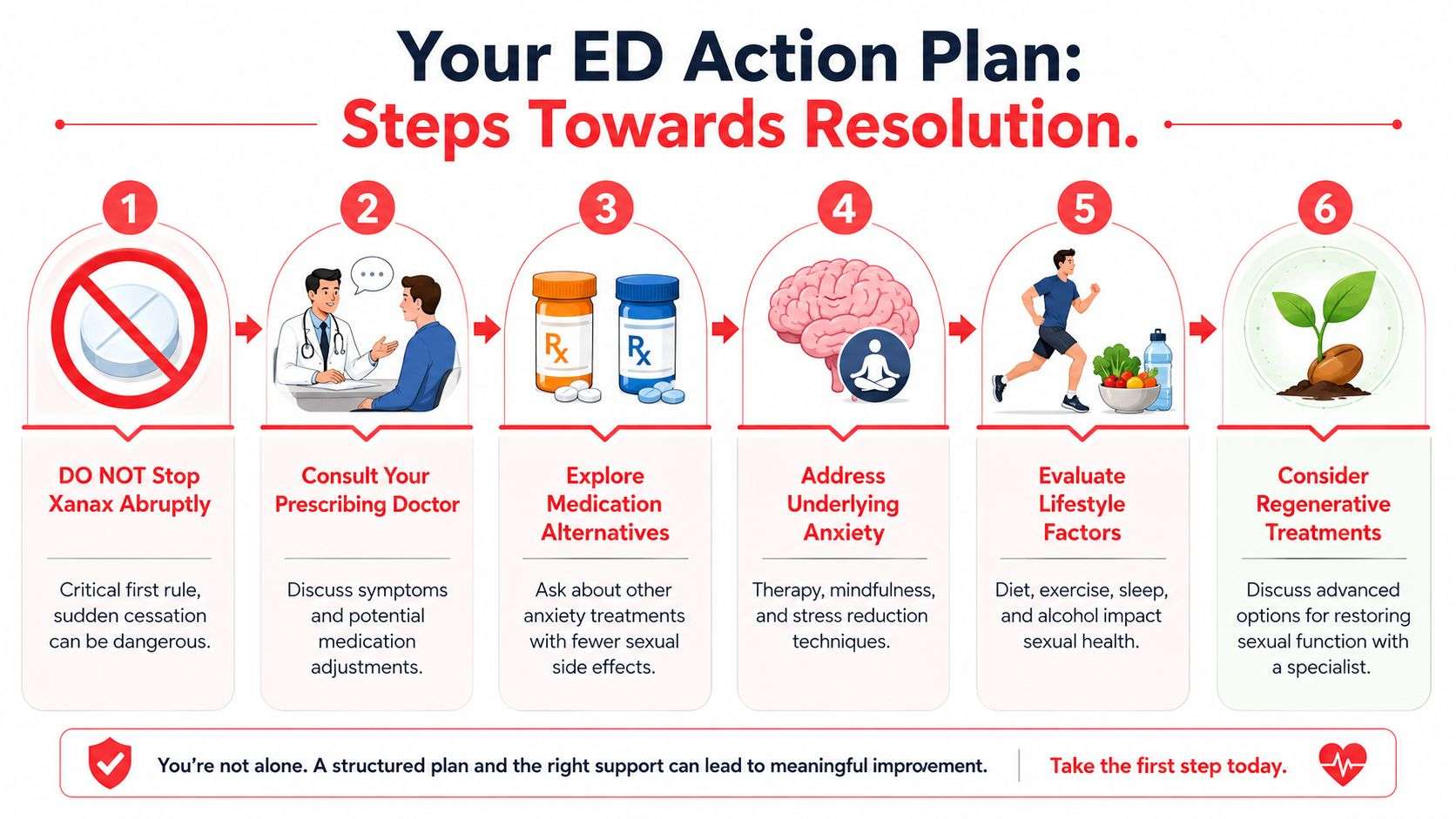
If you think Xanax may be affecting your erections, the first move is safety. Don't stop Xanax abruptly. Benzodiazepines can require a supervised plan when they're reduced or discontinued, and a sudden stop can create serious problems.
What to track before your appointment
A short symptom log is more helpful than a vague memory. You don't need anything elaborate. Write down:
- When the problem started. Include whether it began before Xanax, soon after starting it, or after a dose change.
- Your pattern of use. Note whether you take it daily, occasionally, daytime, nighttime, or before situations that trigger anxiety.
- What kind of sexual change you're having. Lower desire, weaker erections, trouble maintaining an erection, delayed orgasm, or a mix.
- What else changed. Sleep, stress, alcohol, relationship strain, new medications, illness, or weight change.
Bring that record to the prescribing clinician. It saves time and often makes the likely explanation much clearer.
What to ask your doctor
A useful appointment is specific. Instead of saying “I think Xanax ruined my sex life,” try questions like these:
- Could this pattern fit a medication side effect?
- Does the timing suggest anxiety-related ED instead?
- Should we adjust the dose, timing, or treatment plan?
- Do I need a broader ED evaluation?
That conversation may lead to several reasonable options. Sometimes the answer is changing when the medication is taken. Sometimes it's considering another anxiety treatment strategy. Sometimes the bigger need is therapy for panic, performance anxiety, or relationship strain. In other cases, the clinician may recommend a focused medical workup for hormonal, vascular, or metabolic contributors.
What usually works better than guessing
The men who improve fastest usually do three things well:
- They don't self-diagnose from one bad night.
- They don't hide alcohol, supplements, or skipped doses.
- They let both problems be treated at once. Anxiety care and ED care often need to run in parallel.
Bring a timeline, not just a complaint. The pattern often points to the answer.
If symptoms persist, ask for a complete evaluation rather than assuming the cause is purely psychological or purely medication-related. ED can be the first clue that something broader needs attention.
Restoring Foundational Health with Regenerative Treatments
Even when Xanax, anxiety, or another medication plays a role, erections still depend on healthy tissue response and blood flow. That's the part men sometimes overlook. You can sort out the trigger and still need help restoring the physical side of erectile function.

Why a restorative approach can make sense
Medication-related ED doesn't always mean the body is permanently damaged. But repeated difficulty can expose weaker baseline vascular performance, reduced tissue responsiveness, or reduced erectile confidence. When that happens, treatment shouldn't focus only on removing the suspected trigger. It can also focus on improving the erectile environment itself.
That's where non-surgical restorative options come in. The principle is straightforward: support circulation, tissue quality, and erectile responsiveness so the body performs better regardless of whether stress, aging, or medication has been part of the picture.
What this can look like in practice
Depending on the patient, care may include a medical evaluation, hormone review, sleep assessment, anxiety treatment, and targeted ED therapy. For men interested in regenerative options, shockwave therapy for ED and what the studies show is one path worth discussing with a qualified clinician.
At Sexual Wellness Centers of America, men can also ask about clinic-based regenerative services such as REGENwave™ acoustic therapy, the HEshot®, and the REGENmax® program as part of a broader ED evaluation and treatment plan. These approaches are designed to address tissue and vascular function rather than only producing a temporary erection on demand.
The practical trade-off
This approach isn't a replacement for fixing the underlying cause. If Xanax timing is the issue, that still needs attention. If anxiety is driving a performance loop, that still needs treatment. If diabetes, alcohol, or poor sleep are involved, those still matter.
What regenerative care may offer is a way to improve the physical foundation while the rest of the plan gets sorted out. For the right patient, that can reduce the sense that everything depends on one medication decision.
Frequently Asked Questions About Xanax and ED
Will the ED go away if I stop taking Xanax
It may, but that depends on what's causing the problem. If Xanax is the main driver, erections may improve after the medication is adjusted or discontinued under medical supervision. If anxiety, poor sleep, relationship strain, alcohol, or another health issue is doing most of the damage, stopping Xanax alone may not solve it.
The key point is safety. Don't stop Xanax on your own. Talk with the prescribing clinician first and make changes only with a plan.
Are there anxiety medications less likely to cause ED
Sometimes, yes. Different anxiety treatments affect sexual function differently from person to person. Some patients do better with a different medication strategy, and some do better when therapy, stress management, or non-drug approaches reduce the need for sedating medication in the first place.
This decision has to be individualized. The best choice depends on what you're treating, how often symptoms occur, whether panic is part of the picture, and what other side effects you've had.
Is it safe to take ED pills with Xanax
Some men can use both under medical guidance, but this is not something to self-prescribe casually. The underlying issue isn't only the two medications by themselves. It's the full context, including blood pressure, heart health, alcohol use, other prescriptions, and how sedated you feel.
If you're considering an ED medication, ask the clinician who prescribes your anxiety treatment or a doctor who manages sexual medicine. They can review interactions, timing, and whether ED medication addresses the right problem in your case.
What if I can still get erections sometimes
That pattern often points toward a mixed cause rather than a complete physical shutdown. Inconsistent erections are common when anxiety, pressure, medication effects, and lifestyle factors overlap. It's still worth evaluating. Intermittent function doesn't mean the issue is “all in your head,” and it doesn't prove the medication is innocent either.
When should I get evaluated sooner rather than later
Don't wait if the problem is persistent, distressing, affecting your relationship, or happening alongside other symptoms such as reduced libido, low energy, poor sleep, depressed mood, or signs of broader health changes. The longer ED goes unaddressed, the more likely it is to create avoidance, shame, and performance fear on top of the original cause.
If you're dealing with ED and you're not sure whether Xanax, anxiety, or a broader health issue is behind it, Sexual Wellness Centers of America offers adult sexual health evaluations and non-surgical treatment options that can be discussed alongside your prescribing doctor's plan. The goal isn't to guess. It's to identify the main drivers, protect your mental health, and rebuild reliable sexual function with a plan that fits your whole situation.