
Why Getting the Intramuscular Buttock Injection Site Right Actually Matters
The intramuscular buttock injection site you choose can mean the difference between medication that works and medication that doesn’t — or worse, a serious nerve injury.
Here’s a quick answer if you need it fast:
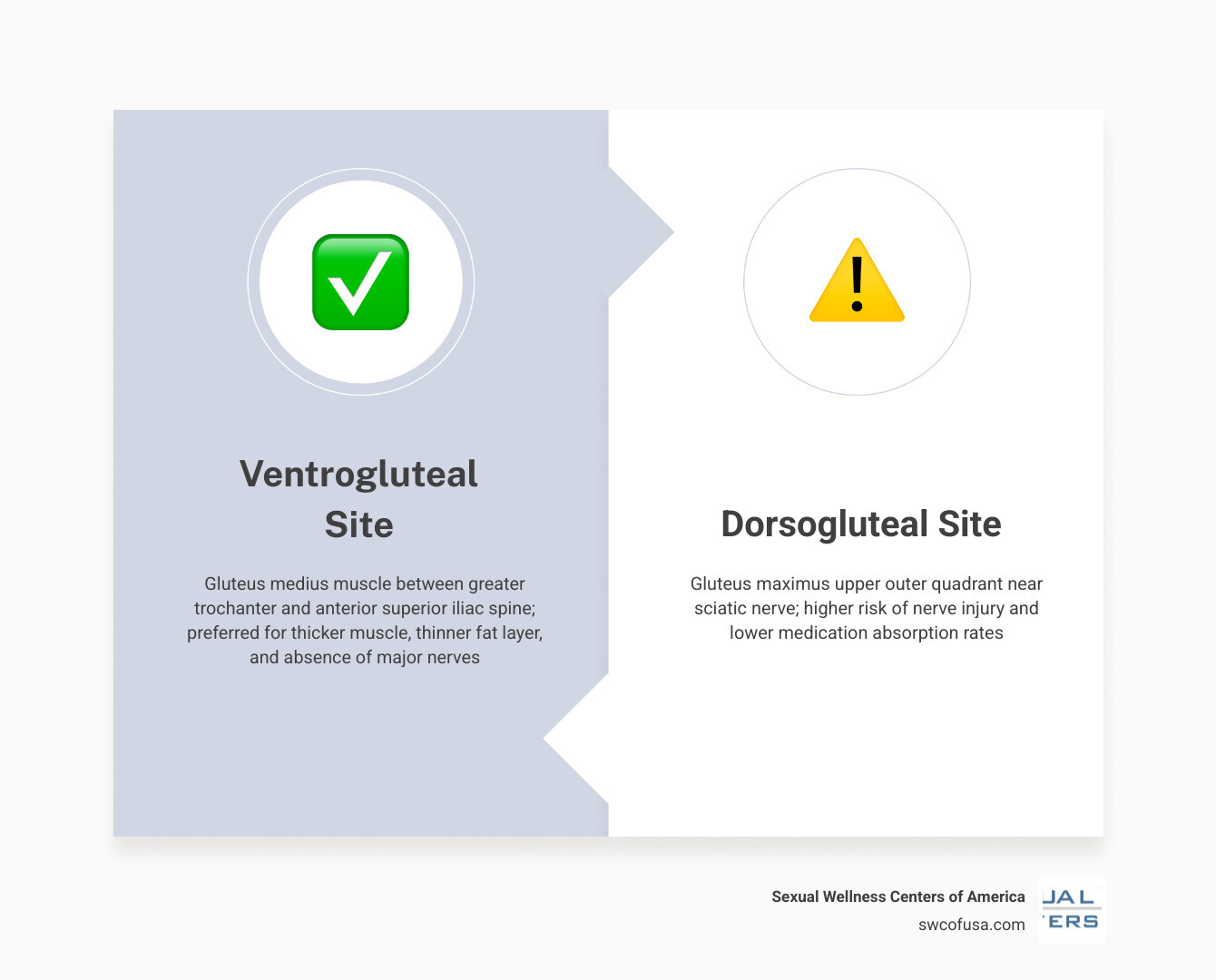
The two main gluteal IM injection sites are:
| Site | Location | Safety Level |
|---|---|---|
| Ventrogluteal | Where your leg and hip bones meet (gluteus medius) | Preferred — fewer nerves and blood vessels |
| Dorsogluteal | Upper outer quadrant of the buttock (gluteus maximus) | Higher risk — sciatic nerve nearby |
The ventrogluteal site is the recommended choice for most adults. It has thicker muscle, a thinner fat layer, and no major nerves running through it.
That said, site selection isn’t the only thing that matters. Needle length, patient body type, injection technique, and medication type all play a role in whether the medication actually reaches the muscle — or gets lost in subcutaneous fat.
Research shows this is a real problem. Studies confirm that only 32–58% of intended gluteal IM injections actually reach the muscle. In women, that number drops as low as 8%. Getting the site and technique right isn’t optional — it’s essential for the medication to work.
I’m Jeff Nuziard, CEO of Sexual Wellness Centers of America, where our team has extensive hands-on experience guiding patients through hormone therapies and wellness treatments that rely on precise intramuscular buttock injection site selection and technique. In the sections below, I’ll walk you through exactly how to locate the right site, choose the right needle, and inject safely and effectively.
Intramuscular buttock injection site basics:
Choosing the Safest Intramuscular Buttock Injection Site
When it comes to giving an injection in the gluteal region, we have two primary options: the ventrogluteal site and the dorsogluteal site. While both have been used in clinical practice for decades, modern medical consensus has shifted dramatically in favor of one over the other.
The Ventrogluteal Site: The Modern Gold Standard
The ventrogluteal site is located on the side of the hip, utilizing the gluteus medius and gluteus minimus muscles. Clinical guidelines widely recognize this as the safest intramuscular buttock injection site for several compelling reasons:
- No Major Nerves or Blood Vessels: Unlike other areas of the buttocks, this site is completely free of large blood vessels and significant nerve pathways, meaning the risk of accidental nerve damage is virtually zero.
- Thinner Adipose Tissue: The layer of subcutaneous fat overlying the gluteus medius is naturally thinner than the fat layer on the back of the buttocks. This makes it much easier for a standard needle to successfully reach the target muscle.
- Thick Muscle Bulk: The gluteus medius offers a substantial, well-developed muscle mass that can easily tolerate larger volumes of medication (up to 3 mL in an average adult).
The Dorsogluteal Site: A Traditional, Yet Risky Choice
The dorsogluteal site is located in the traditional “buttock” area, targeting the massive gluteus maximus muscle. While it was once the default site taught to healthcare professionals, it has fallen out of favor. If you want to know more about the underlying anatomical hazards, you can read about Why the dorsogluteal site is dangerous.
The primary danger of the dorsogluteal site is its proximity to the sciatic nerve and the superior gluteal artery. If a needle strikes the sciatic nerve, the patient can experience immediate, excruciating pain, and potentially suffer temporary or permanent paralysis of the leg.
Furthermore, a landmark study published in Evaluating the effectiveness of gluteal intramuscular injection highlighted that the dorsogluteal site has a much thicker layer of subcutaneous fat. In many patients—especially those with a higher BMI—a standard needle fails to penetrate the fat layer, delivering the medication into the subcutaneous tissue instead. This leads to poor absorption, increased injection-site pain, and a higher risk of sterile abscesses or granulomas.
Anatomical Landmarks and Needle Selection Guidelines
To successfully deliver medication into the muscle tissue, you must know how to navigate the body’s natural bony landmarks. Muscle tissue has an abundant blood supply compared to subcutaneous fat, which allows for faster, more reliable absorption of therapeutic compounds. To understand the physiological benefits of this route, read more about Why buttock injections?.
To hit the muscle consistently, you have to bypass the subcutaneous fat layer. Fat thickness varies wildly based on biological sex, genetics, and overall patient BMI. Because women naturally carry more adipose tissue in the gluteal region than men, choosing the correct landmarks and needle length is absolutely critical.
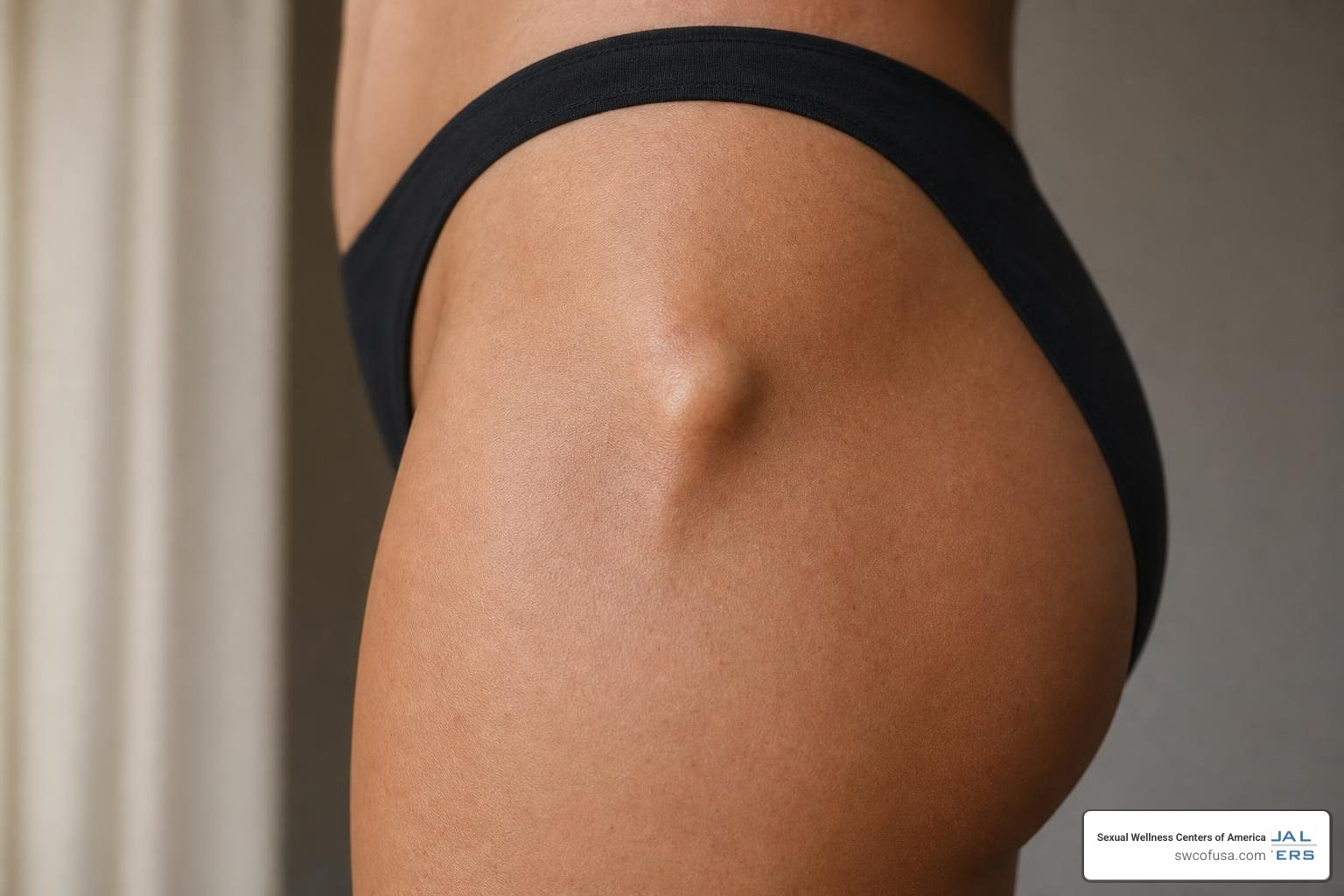
Locating the Ventrogluteal Intramuscular Buttock Injection Site
To find the ventrogluteal site without getting lost, we use a reliable anatomical mapping technique known as the V-method. Here is how to perform it:
- Identify the Greater Trochanter: Have the patient lie on their side. Locate the bony, protruding part of the upper thigh bone where it meets the hip. This is the greater trochanter.
- Position Your Hand: Place the heel of your hand directly over the greater trochanter. (If you are injecting into the patient’s left hip, use your right hand. If injecting into the right hip, use your left hand).
- Point Your Fingers: Point your thumb toward the patient’s groin/belly button. Point your index finger straight up toward the anterior superior iliac spine (the prominent bony point at the front of the hip).
- Spread Your Fingers: Spread your middle finger backward toward the iliac crest (the curved upper ridge of the hip bone), forming a distinct “V” shape between your index and middle fingers.
- Target the Center: The ideal injection site is right in the middle of the triangle formed by your index finger, middle finger, and the top of the iliac crest.
For a deeper dive into mastering this specific technique, check out our guide on How to find the ventrogluteal site.
Locating the Dorsogluteal Intramuscular Buttock Injection Site
If the dorsogluteal site must be used, extreme caution is required. To avoid the sciatic nerve, you must accurately map out the upper outer quadrant of the buttock:
- Divide the Buttock: Imagine a vertical line running down the center of one buttock cheek, and a horizontal line crossing it exactly halfway. This divides the buttock into four equal quadrants.
- Target the Upper Outer Quadrant: The safe zone is located in the upper outer quadrant, approximately 5 to 8 centimeters below the iliac crest.
- Confirm with Bony Landmarks: To verify this spot, draw an imaginary diagonal line from the posterior superior iliac spine (the bony dimple on the lower back above the buttock) to the greater trochanter. The injection should be placed above and lateral to this diagonal line.
To make sure you never miss the mark, you can refer to No more guesswork locating your gluteal spot.
Needle Length, Gauge, and Volume Specifications
Selecting the wrong needle is the number one cause of failed intramuscular injections. If the needle is too short, the medication is deposited into fat. If it is too long, you risk striking bone or deep neurovascular structures.
The viscosity of the medication also dictates your needle gauge. Thick, oil-based solutions (such as testosterone or hormone replacement therapies) require a wider needle (lower gauge) to flow smoothly, whereas thin, water-based solutions can easily pass through a narrower needle (higher gauge).
To help you choose, we have put together a quick-reference guide based on patient weight and BMI, pulling data from clinical standards outlined in Intramuscular Injection – StatPearls and our own Ultimate guide to buttock needle gauges and lengths.
| Patient Weight / BMI Category | Recommended Needle Length | Recommended Needle Gauge | Max Injection Volume |
|---|---|---|---|
| Underweight / Thin Adults (<130 lbs) | 5/8 inch to 1 inch | 22G – 25G (Water-based) 21G (Oil-based) |
1.0 – 2.0 mL |
| Average Weight Adults (130 – 260 lbs) | 1 inch to 1.25 inches | 21G – 23G (Water-based) 18G – 21G (Oil-based) |
2.5 – 3.0 mL |
| Obese / High BMI Adults (>260 lbs) | 1.5 inches | 21G – 22G (Water-based) 18G – 20G (Oil-based) |
3.0 mL (up to 5.0 mL if divided) |
Note: For large-volume injections exceeding 3 mL to 5 mL, we highly recommend dividing the dose into two smaller injections and administering them at separate anatomical sites to prevent tissue trauma and ensure proper absorption.
Step-by-Step Guide to Administering a Gluteal IM Injection
Administering an injection can feel intimidating, but breaking it down into a structured, aseptic routine ensures safety and minimizes discomfort.
Essential Supplies Checklist
Before you begin, gather the following items on a clean, flat surface:
- Prescribed medication vial (brought to room temperature)
- Sterile syringe of appropriate volume (typically 3 mL)
- Two sterile needles: one for drawing up the medication (often a filter needle) and one fresh needle for the actual injection
- 70% Isopropyl alcohol prep pads
- Sterile gauze pads or clean cotton balls
- Adhesive bandage
- FDA-cleared sharps disposal container
The Step-by-Step Injection Protocol
1. Prepare and Wash
Thoroughly wash your hands with warm water and soap for at least 20 seconds. Clean the rubber stopper of the medication vial with an alcohol prep pad for 15 seconds and let it air dry completely.
2. Draw Up the Medication
Attach your drawing needle to the syringe. Pull back the plunger to fill the syringe with an amount of air equal to your medication dose, inject that air into the vial, turn the vial upside down, and draw the correct dose of medication. Swap the drawing needle for your sterile injection needle.
3. Position the Patient
Ensure the patient is in a comfortable position that completely relaxes the gluteal muscles. (A tensed muscle makes needle insertion significantly more painful!)
4. Cleanse the Site
Identify your anatomical landmarks (ventrogluteal or dorsogluteal). Clean the skin with a fresh alcohol wipe using a firm, circular motion starting at the center and moving outward. Let the skin air dry for 30 seconds—do not blow on it or wave your hand, as this introduces bacteria.
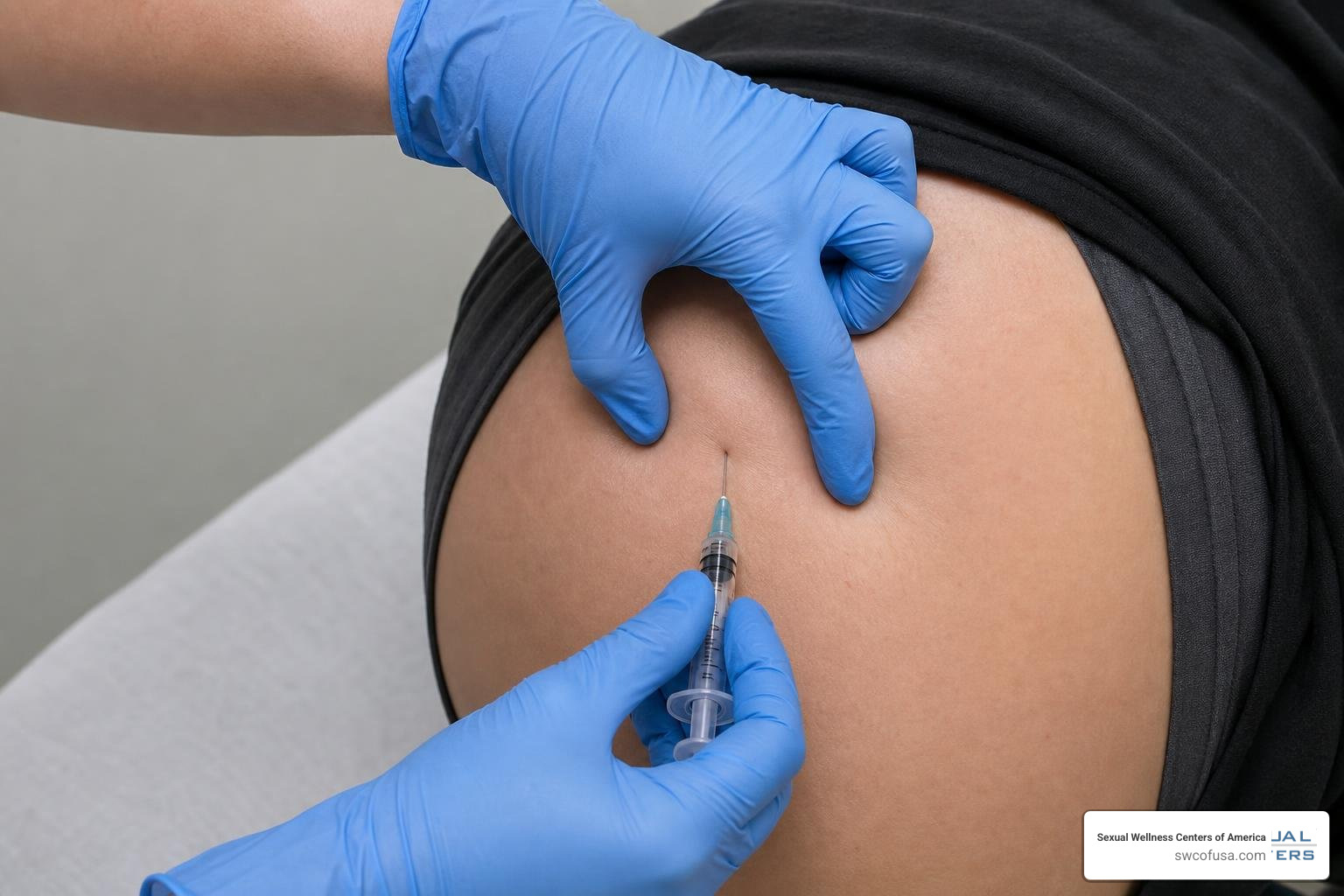
5. Apply the Z-Track Method
The Z-track method is a vital clinical technique used to lock the medication deep inside the muscle and prevent it from leaking back into the delicate subcutaneous tissue.
To perform the Z-track:
- Use your non-dominant hand to firmly pull and displace the skin and subcutaneous tissue about 1 inch (2.5 cm) to the side of your chosen injection site.
- Hold this tension steadily throughout the injection.
6. Insert the Needle
Hold the syringe like a dart in your dominant hand. Insert the needle at a strict 90-degree angle with a quick, firm, and smooth motion.
7. Inject Slowly
Depress the plunger at a slow, steady rate of approximately 10 seconds per milliliter (mL). This slow rate allows the muscle fibers to expand gently, drastically reducing post-injection soreness.
8. Pause and Withdraw
Once the medication is fully delivered, wait exactly 10 seconds with the needle still in place to allow the pressure within the muscle tissue to equalize. Then, withdraw the needle quickly at the exact same 90-degree angle.
9. Release and Protect
Release the skin held by your non-dominant hand. The displaced tissue layers will slide back over the needle track, sealing the medication deep inside the muscle. Lightly press a sterile gauze pad or cotton ball over the site. Do not massage the area, as this can force medication back into the subcutaneous tissue. Apply an adhesive bandage if necessary.
For a comprehensive walk-through on avoiding common self-administration mistakes, you can read our Step-by-step guide to giving an IM injection.
Frequently Asked Questions about Gluteal IM Injections
Should I pull back on the plunger (aspirate) before injecting?
Historically, clinical training required pulling back on the syringe plunger for 5 to 10 seconds after inserting the needle to check for blood return. If blood appeared, it meant the needle was in a blood vessel, requiring the clinician to discard the syringe and start over.
Today, CDC guidelines and World Health Organization (WHO) recommendations do not advise routine aspiration for vaccinations, as vaccines are given in areas without major vessels (like the deltoid or vastus lateralis). However, for deep gluteal injections—especially when using the dorsogluteal site or administering heavy, oil-based hormone therapies—many clinicians still prefer to gently aspirate to guarantee the needle has not entered the superior gluteal artery. If you are using the highly safe ventrogluteal site, aspiration is generally considered unnecessary due to the lack of major vessels in that zone.
What is the best patient position for a buttock injection?
The absolute key to a pain-free injection is complete muscle relaxation. We recommend two primary positions:
- The Lateral (Side-Lying) Position: Excellent for the ventrogluteal site. Have the patient lie on their side with their top leg bent slightly forward. This completely relaxes the gluteus medius.
- The Prone (Face-Down) Position: Ideal for the dorsogluteal site. Have the patient lie flat on their stomach with their toes pointed inward (pigeon-toed). Pointing the toes inward naturally rotates the hips and fully relaxes the massive gluteus maximus muscle.
Why does it feel like the medication stayed under my skin?
If you feel a firm, painful lump under your skin after an injection, or if the area feels bruised and irritated for days, the medication was likely accidentally delivered into your subcutaneous fat rather than the muscle.
This usually happens because the needle used was too short, or the needle was not inserted at a strict 90-degree angle. Because fat tissue has poor blood circulation, the medication pools there instead of absorbing, which can cause localized inflammation, tissue scarring, or a condition called lipohypertrophy (the accumulation of extra fat tissue). Always ensure you are using a needle long enough to bypass your specific subcutaneous fat layer.
Conclusion
Finding the correct intramuscular buttock injection site is a fundamental skill that directly impacts the success of your health and wellness journey. Whether you are managing vital hormone therapies, receiving therapeutic vitamin compounds, or undergoing specialized wellness protocols, utilizing the safe, nerve-free ventrogluteal site along with the Z-track technique ensures that your medications absorb perfectly with minimal discomfort.
At Sexual Wellness Centers of America in Colleyville, TX, we understand that medical self-care can feel overwhelming. That is why we specialize in creating highly customized, comprehensive wellness programs. From analyzing your baseline health with detailed hormone and vitamin panels to offering advanced, proprietary therapies like our HEshot® and SHEshot® treatments, and our cutting-edge REGENmax® technology, we are here to support you every single step of the way.
If you want to ensure your treatments are delivered safely, effectively, and under the guidance of leading experts, Schedule an IM injection consultation in Colleyville, TX with our team today. Let us help you take the guesswork out of your health and wellness routine!