
Why Accurate Gluteal Injection Site Location Matters for Your Health
How to find gluteal injection site correctly is essential for safe medication delivery and avoiding serious complications like nerve damage or reduced treatment effectiveness. Here’s the quick answer:
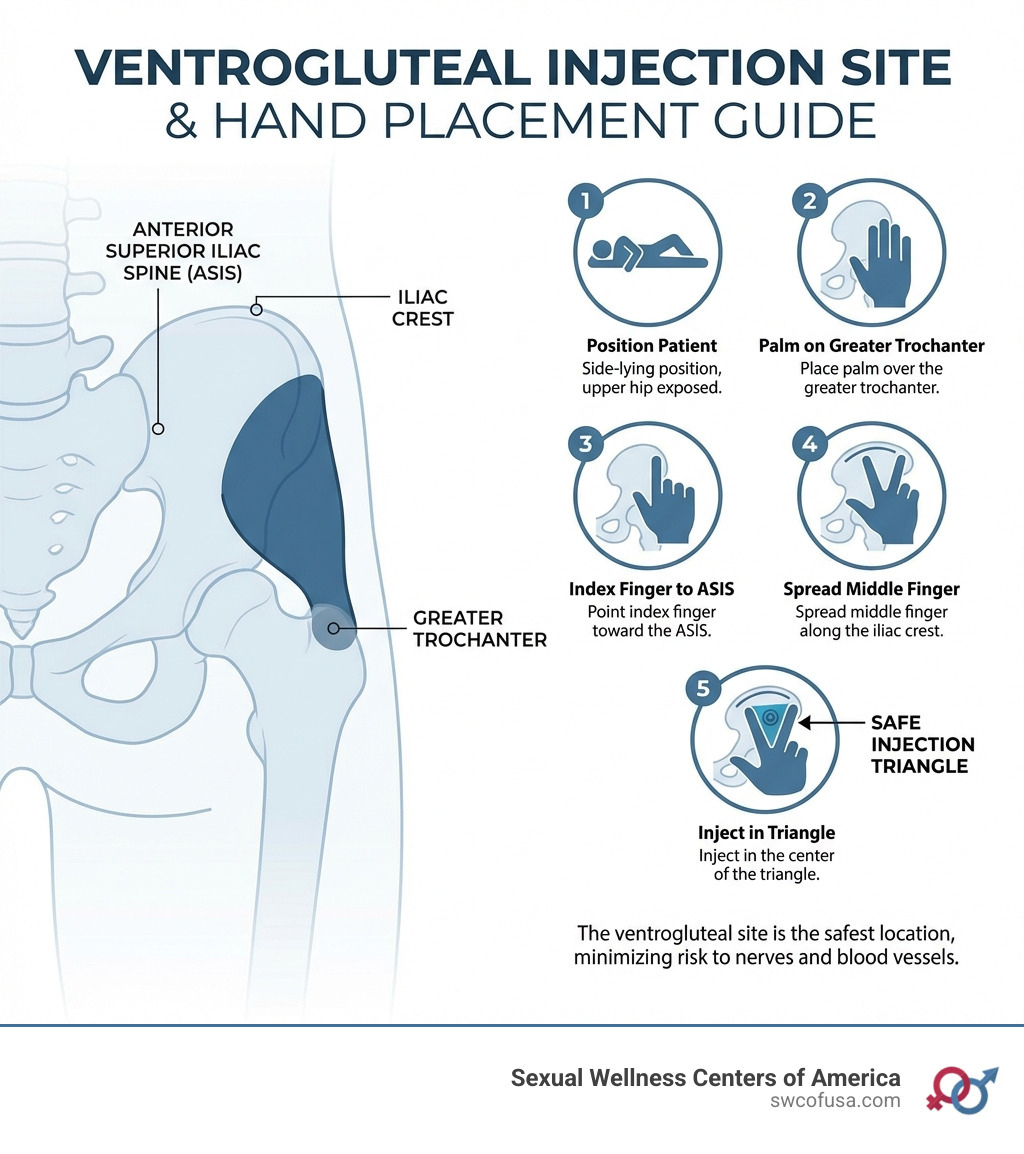
To Find the Ventrogluteal Gluteal Injection Site:
- Position the patient lying on their side with the injection side up
- Place your palm on the greater trochanter (the bony bump on the outer hip)
- Point your index finger toward the anterior superior iliac spine (front of the hip bone)
- Spread your middle finger back along the iliac crest (top of the hip bone)
- Inject in the center of the V-shaped triangle formed between your index and middle fingers
This ventrogluteal site is the safest option because it has thick muscle tissue positioned away from major nerves and blood vessels, dramatically reducing the risk of hitting the sciatic nerve or puncturing a blood vessel.
If you’ve been prescribed intramuscular injections for hormone therapy, vitamin supplementation, or other treatments, knowing exactly where to inject makes all the difference. The wrong location can mean hitting a nerve, injecting into fatty tissue instead of muscle, or causing unnecessary pain and complications.
The ventrogluteal site is now recognized as the gold standard for gluteal injections. Studies show that only 32% to 52% of injections actually reach the muscle in the traditional dorsogluteal area, dropping to just 8% in women due to increased fatty tissue. The ventrogluteal site avoids these problems entirely.
Many people still use outdated techniques that put them at risk. The dorsogluteal site (upper outer buttock) was standard for decades, but medical guidelines have shifted dramatically. We now know this older site sits dangerously close to the sciatic nerve and major blood vessels.
Whether you’re self-administering testosterone, receiving B12 shots, or managing other medications through intramuscular injection, proper technique starts with proper site selection.
As Jeff Nuziard, CEO of Sexual Wellness Centers of America, I’ve guided countless patients through wellness treatments involving intramuscular injections, ensuring they understand how to find gluteal injection site locations safely and effectively. Our commitment to evidence-based practices means we always prioritize patient safety and treatment efficacy in every injection we administer or teach.
Quick how to find gluteal injection site terms:
- giving a gluteal im injection
- places for intramuscular injection
- why is dorsal gluteal site is dangerous for im injection
Why the Ventrogluteal Site is the Gold Standard
When it comes to intramuscular injections in the gluteal region, the ventrogluteal site is widely considered the safest and most reliable option. It is generally safer due to its lower risk of nerve and blood vessel injury compared to other gluteal sites, particularly the dorsogluteal.
Why the shift away from the once-common dorsogluteal site? The main concern is the sciatic nerve, a major nerve that runs through the gluteal region. An injection placed too close can cause severe pain, numbness, tingling, or weakness in the leg and foot. The dorsogluteal area is also closer to major blood vessels such as the superior gluteal artery, which increases the risk of bleeding or hematoma.
The ventrogluteal site targets the gluteus medius and minimus, offering thick muscle tissue that is positioned away from these critical neurovascular structures. That improves safety and helps ensure the medication reaches muscle (rather than subcutaneous fat), which supports predictable absorption.
Scientific research on evidence-based injection technique highlights why this matters: studies have found that only 32% to 52% of injections reach the muscle in the dorsogluteal area, dropping to 8% in women due to increased fatty tissue.
To summarize the key differences:
| Feature | Ventrogluteal Site | Dorsogluteal Site |
|---|---|---|
| Main muscles | Gluteus medius/minimus | Gluteus maximus area |
| Nerve/blood vessel risk | Lower | Higher (closer to sciatic nerve and major vessels) |
| Likelihood of true IM delivery | Higher | Lower (more subcutaneous fat, especially in some patients) |
If you want a deeper overview of glute anatomy and injection placement, see our guide on IM Injection Gluteal Muscle.
Why Accurate Gluteal Injection Site Location Matters for Your Health
How to find gluteal injection site correctly is essential for safe medication delivery and avoiding serious complications like nerve damage or reduced treatment effectiveness. Here’s the quick answer:
To Find the Ventrogluteal Gluteal Injection Site:
- Position the patient lying on their side with the injection side up
- Place your palm on the greater trochanter (the bony bump on the outer hip)
- Point your index finger toward the anterior superior iliac spine (front of the hip bone)
- Spread your middle finger back along the iliac crest (top of the hip bone)
- Inject in the center of the V-shaped triangle formed between your index and middle fingers
This ventrogluteal site is the safest option because it has thick muscle tissue positioned away from major nerves and blood vessels, dramatically reducing the risk of hitting the sciatic nerve or puncturing a blood vessel.
If you’ve been prescribed intramuscular injections for hormone therapy, vitamin supplementation, or other treatments, knowing exactly where to inject makes all the difference. The wrong location can mean hitting a nerve, injecting into fatty tissue instead of muscle, or causing unnecessary pain and complications.
The ventrogluteal site is now recognized as the gold standard for gluteal injections. Studies show that only 32% to 52% of injections actually reach the muscle in the traditional dorsogluteal area, dropping to just 8% in women due to increased fatty tissue. The ventrogluteal site avoids these problems entirely.
Many people still use outdated techniques that put them at risk. The dorsogluteal site (upper outer buttock) was standard for decades, but medical guidelines have shifted dramatically. We now know this older site sits dangerously close to the sciatic nerve and major blood vessels.
Whether you’re self-administering testosterone, receiving B12 shots, or managing other medications through intramuscular injection, proper technique starts with proper site selection.
As Jeff Nuziard, CEO of Sexual Wellness Centers of America, I’ve guided countless patients through wellness treatments involving intramuscular injections, ensuring they understand how to find gluteal injection site locations safely and effectively. Our commitment to evidence-based practices means we always prioritize patient safety and treatment efficacy in every injection we administer or teach.
Quick how to find gluteal injection site terms:
- giving a gluteal im injection
- places for intramuscular injection
- why is dorsal gluteal site is dangerous for im injection
Why the Ventrogluteal Site is the Gold Standard
When it comes to intramuscular injections in the gluteal region, the ventrogluteal site has emerged as the clear front-runner for safety and effectiveness. This isn’t just preference; it is supported by research and clinical guidance. The ventrogluteal site is generally considered safer due to its lower risk of nerve and blood vessel injury compared to other gluteal sites, particularly the dorsogluteal.
Why the shift away from the once-common dorsogluteal site? The primary concern is the risk of striking the sciatic nerve. Damage to this nerve can lead to severe pain, numbness, tingling, or weakness in the leg and foot. Additionally, the dorsogluteal area is closer to major blood vessels (including the superior gluteal artery), which increases the risk of bleeding or hematoma.
The ventrogluteal site, by contrast, targets the gluteus medius and minimus and is positioned away from those critical neurovascular structures. That means fewer complications and a higher likelihood the medication reaches muscle tissue as intended.
Scientific research on evidence-based injection technique highlights the practical impact: only 32% to 52% of injections reach the muscle in the dorsogluteal area, and this can drop to 8% in women due to increased fatty tissue. When medication ends up in subcutaneous fat instead of muscle, absorption can be slower and less predictable, and local irritation may be more likely.
In short, the ventrogluteal site reduces guesswork, improves consistency, and is widely taught as the preferred gluteal IM site.
| Feature | Ventrogluteal Site | Dorsogluteal Site |
|---|---|---|
| Main muscles | Gluteus medius/minimus | Gluteus maximus area |
| Proximity to sciatic nerve/major vessels | Farther away | Closer (higher risk) |
| Likelihood of true IM delivery | Higher | Lower in many patients (fat thickness varies) |
Ventrogluteal Site: The Gold Standard for IM Injections
The ventrogluteal site is generally considered the safest and most effective location for intramuscular (IM) injections in adults. This preference is rooted in the site’s anatomy, which provides thick muscle mass while minimizing the risk of damage to vital structures.
Anatomical Landmarks for Identification
To accurately locate the ventrogluteal site, identify three key anatomical landmarks:
- Greater Trochanter: The prominent bony bump on the upper, outer part of your thigh bone (femur), near your hip. You can feel it by rotating your leg inward and outward.
- Anterior Superior Iliac Spine (ASIS): The bony projection at the front of your hip bone, often palpable just below your waistline.
- Iliac Crest: The curved upper border of your hip bone, extending from the ASIS towards your back.
These three landmarks form the boundaries of the safe injection zone.
Using the V-Method to Find Gluteal Injection Site
The V-method is a widely taught technique for locating the ventrogluteal site:
- Patient Positioning: Have the person lie on their side with the injection-side leg slightly flexed at the hip and knee. This relaxes the gluteal muscles and makes landmarking easier.
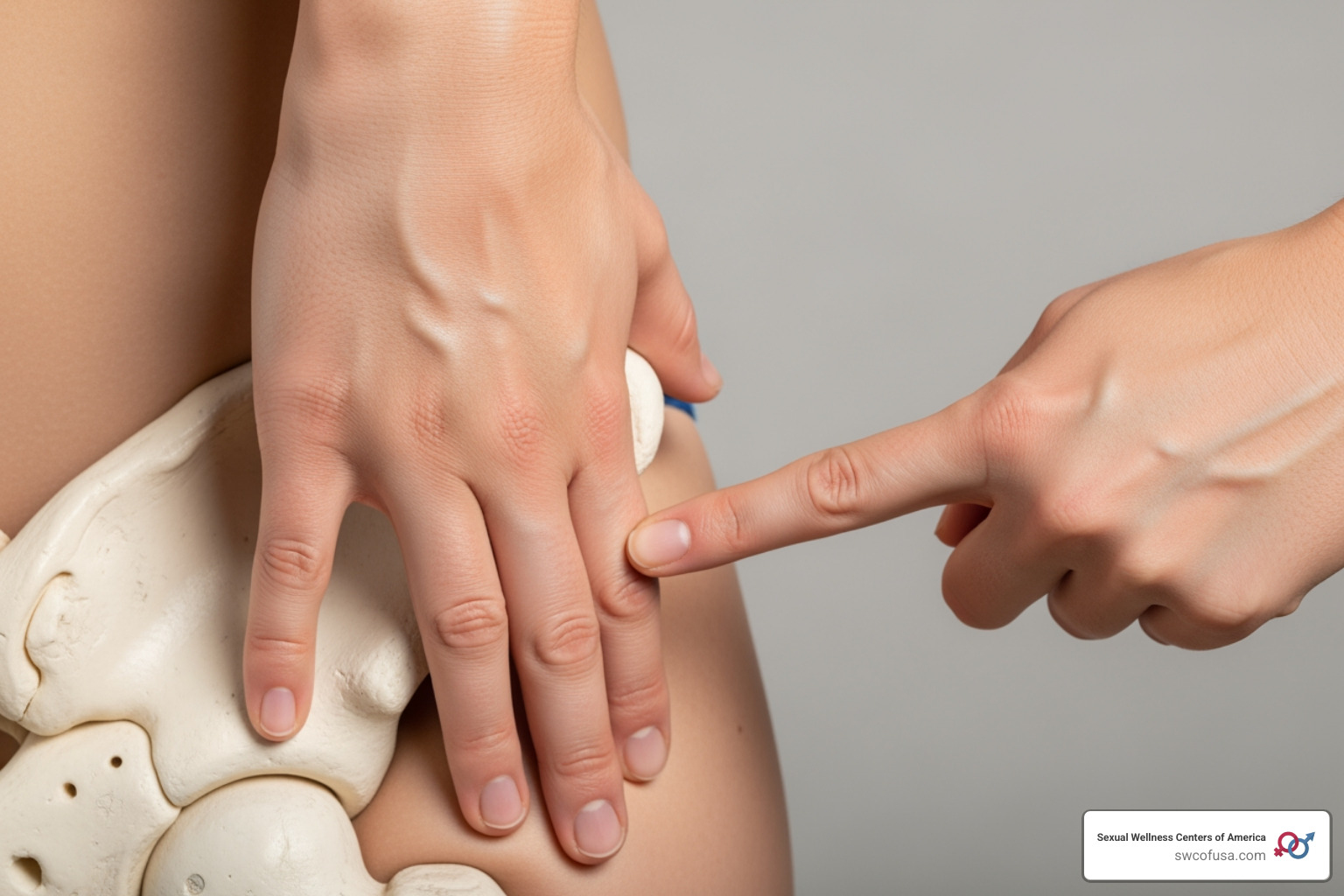
- Hand Placement:
- Place the heel of your hand on the greater trochanter. If injecting the right hip, use your left hand; for the left hip, use your right hand.
- Point your index finger towards the anterior superior iliac spine.
- Spread your middle finger back along the iliac crest.
- Forming the “V”: Your index and middle fingers will form a “V” shape. The injection site is within the center of this “V,” at the level of your knuckles. This area targets the gluteus medius muscle, ensuring good medication absorption.
This method is recommended by guidelines such as those in the Australian Immunisation Handbook guidelines due to its reliability in avoiding critical structures.
For more general information on IM injections, visit our page More info about IM injections.
The G-Method for Finding Gluteal Injection Site
While the V-method is common, the geometric (G) method offers even greater precision. Research indicates that the G method has a higher success rate for intramuscular injection (75%) compared to the V method (57%). Studies show a 92% success rate for intramuscular injections using the G method in males of all BMI categories.
The G-method uses the same anatomical landmarks but emphasizes a slightly different hand position. You still place your palm on the greater trochanter, your index finger on the ASIS, and spread your middle finger posteriorly along the iliac crest. The injection site is located in the center of the triangle formed by the index finger, middle finger, and the iliac crest. This geometric technique provides improved anatomical precision, ensuring the needle enters the thickest part of the gluteus medius muscle.
For athletes or individuals undergoing recovery, precise injection techniques like the G-method are crucial for optimal medication delivery. Learn more on our page, IM Injections for Athletes: Benefits and Recovery.
Mastering the Injection Technique and Safety
Once you’ve accurately identified the how to find gluteal injection site, the next step is mastering the injection technique itself, including needle selection, insertion angle, and the Z-track method.
The Z-Track Technique
The Z-track technique helps seal medication within the muscle, preventing leakage into subcutaneous tissue. This is especially beneficial for medications that can irritate tissues.
Here’s how it works:
- Displace the Skin: Before inserting the needle, use your non-dominant hand to pull the skin and subcutaneous tissue about 1 to 1.5 inches laterally from the injection site. Hold firmly.
- Inject: While holding the skin taut, insert the needle into the muscle.
- Administer Medication: Slowly inject the medication.
- Withdraw and Release: Wait approximately 10 seconds after injecting, then withdraw the needle quickly and smoothly. Only after withdrawing, release the displaced skin.
This creates a zigzag pathway that blocks the medication’s escape route, enhancing absorption and reducing irritation.
Needle Insertion Angle and Depth
For intramuscular injections in the gluteal region, insert the needle at a 90-degree angle to the skin surface. A quick, dart-like motion minimizes pain and discomfort.
Needle Size (Gauge and Length) and BMI Considerations
Choosing the correct needle size is paramount for effective IM injections:
- Needle Gauge: For adults receiving IM injections in the ventrogluteal site, a 20 to 25 gauge needle is typically recommended.
- Needle Length: For adults, a 1 to 1.5 inch (2.5 to 3.8 cm) needle is generally suitable.
- BMI Influence:
- For women with a BMI greater than 24.9 kg/m² or hip circumference greater than 90 cm, a needle longer than 1.5 inches may be required.
- For women with a BMI less than 23 kg/m² or weighing less than 60 kg, a shorter needle might be appropriate.
- For obese patients (BMI 30+), a 5 cm (2-inch) needle is often required.
- The ventrogluteal site is generally more appropriate for males across all BMI categories.
- Children: Needle sizes range from 22 to 25 gauge and 5/8 to 1.25 inches in length, depending on age and muscle development.
Always confirm the appropriate needle size with your healthcare provider or refer to official guidelines from the National Library of Medicine resources. Using the wrong needle size can lead to injecting into fat instead of muscle.
While we’re focusing on gluteal injections here, other sites like the thigh (vastus lateralis) are also used for IM injections. Explore more on our page dedicated to IM Shot in Thigh.
Post-Injection Care and Avoiding Complications
Proper post-injection care is crucial for minimizing discomfort, preventing complications, and ensuring medication effectiveness.
Post-Injection Care Essentials
After withdrawing the needle:
- Apply Gentle Pressure: Use a clean gauze pad or cotton ball. Do not rub or massage the area, as this can force medication into subcutaneous tissue or cause bruising.
- Band-Aid (Optional): Apply if there’s any continued oozing or a small drop of blood.
- Normal Discomfort: Mild soreness, tenderness, or a small bruise at the injection site is normal.
- Cold Compress: Apply for 15-20 minutes if soreness or swelling occurs.
Site Rotation
If you require frequent injections, site rotation is vital. Injecting into the same spot repeatedly can lead to tissue damage, scarring, muscle fibrosis, and increased pain. Always alternate injection sites – if you use the right ventrogluteal site for one injection, use the left for the next. Keeping a simple log of injection dates and sites is helpful.
Recognizing and Preventing Complications
While the ventrogluteal site is very safe, be aware of potential complications:
- Infection: Signs include persistent redness, warmth, swelling, increasing pain, pus/drainage, or fever of 100.4°F (38°C) or higher.
- Nerve Injury: Though less likely with the ventrogluteal site, watch for numbness, tingling, burning, or weakness in the leg or foot.
- Allergic Reaction: Watch for rash, hives, severe itching, swelling of the face or throat, or difficulty breathing. These require immediate medical attention.
If you experience severe or worsening symptoms, contact your healthcare provider immediately. For general patient instructions, MedlinePlus patient instructions are a great resource.
Safe Disposal of Sharps
Never recap a used needle, and never dispose of needles or syringes in household trash or recycling bins. Always use an FDA-cleared sharps disposal container – a puncture-resistant plastic container available at pharmacies. If unavailable, a heavy-duty plastic container with a tight-fitting lid can serve temporarily. Label it clearly as “SHARPS” and keep it out of reach of children and pets. Once full, follow your local guidelines for disposal.
Frequently Asked Questions about Gluteal Injections
Should I aspirate for blood at the gluteal site?
Aspiration means pulling back on the syringe plunger after needle insertion (before injecting) to check for blood return. If blood appears, the needle may be in a blood vessel and the injection should not be given at that location.
Guidance on aspiration varies. Because the ventrogluteal site has relatively low vascularity and is away from major vessels, some modern protocols do not require routine aspiration for certain medications and populations. Other sources and some clinicians still recommend it as an added safety step.
The safest approach is to follow the instructions provided by your prescribing clinician or the protocol used by your clinic. If you are unsure, ask your healthcare provider what they recommend for your specific medication and site.
What needle size is best for a gluteal injection?
Needle size depends on age, muscle mass, body fat, and medication viscosity. Common ranges discussed in practice include:
- Adults (ventrogluteal): often 20 to 25 gauge and 1 to 1 1/2 inch length.
- Higher BMI patients: may require a longer needle (for example, up to 2 inches/5 cm) to ensure the medication reaches muscle.
- Children: commonly 22 to 25 gauge and 5/8 to 1 1/4 inch, adjusted by age and size.
Always confirm the appropriate needle size with your prescribing clinician.
Can I self-inject in the gluteal muscle?
Self-injecting into the gluteal muscle is often difficult because the area is hard to see and reach while keeping proper landmarking and a 90-degree angle. That can increase the risk of incorrect placement.
For self-administered IM injections, many people find the vastus lateralis (thigh) easier and safer to access. If your treatment requires a gluteal injection, consider having a trained professional or trained helper administer it, and follow the technique your provider teaches.
Conclusion
Mastering how to find gluteal injection site accurately is a fundamental step towards safe and effective intramuscular injections. By understanding the anatomical landmarks and consistently using the ventrogluteal site, you significantly reduce the risk of complications and ensure your medication is delivered precisely where it needs to go. Precise technique, proper needle selection, the Z-track method, and diligent site rotation are all crucial components of a successful injection experience.
At Sexual Wellness Centers of America in Colleyville, TX, we are dedicated to empowering our patients with the knowledge and support they need for their wellness journeys. Whether you’re receiving cutting-edge treatments like HEshot®™, SHEshot®™, or therapies utilizing regenMAX® technology, our team ensures that every intramuscular injection is administered with the highest standards of safety and efficacy. We believe in personalized wellness plans that include not just innovative treatments, but also the education to make informed decisions about your health.
For those in Colleyville, TX, seeking expert guidance or professional administration of IM injections, our experienced team is here to support you every step of the way. Learn more about our comprehensive services and how we can help you achieve your health goals by visiting our page on IM Injections Colleyville, TX.
“`