
Why Proper Intramuscular Vaccine Administration Matters
Intramuscular vaccine administration is the process of injecting a vaccine directly into muscle tissue so it absorbs quickly and triggers a strong immune response. Here is a quick overview of how it works:
- Select the site – Deltoid muscle (adults/older children) or anterolateral thigh (infants/toddlers)
- Choose the right needle – 22-25 gauge; length depends on age, weight, and sex
- Prep the skin – Clean with 70% isopropyl alcohol and let it dry
- Inject at 90 degrees – Quick, firm insertion straight into the muscle
- No aspiration needed – Withdraw smoothly and apply light pressure
Getting this right matters more than most people realize. Out of 12 billion injections given globally each year, true intramuscular delivery is only achieved in 32-52% of cases — dropping to just 8% in females. Injecting too shallow, too high, or at the wrong angle can reduce vaccine effectiveness and cause serious complications like shoulder injury or nerve damage.
Whether you are a healthcare provider or someone managing hormone or wellness injections at home, understanding the correct technique protects both safety and results.
I’m Jeff Nuziard, CEO of Sexual Wellness Centers of America, where our clinical team applies evidence-based protocols for intramuscular vaccine administration as part of our broader wellness and hormone therapy services. My work at the intersection of healthcare innovation and patient wellness gives me a grounded perspective on why precision technique is non-negotiable.
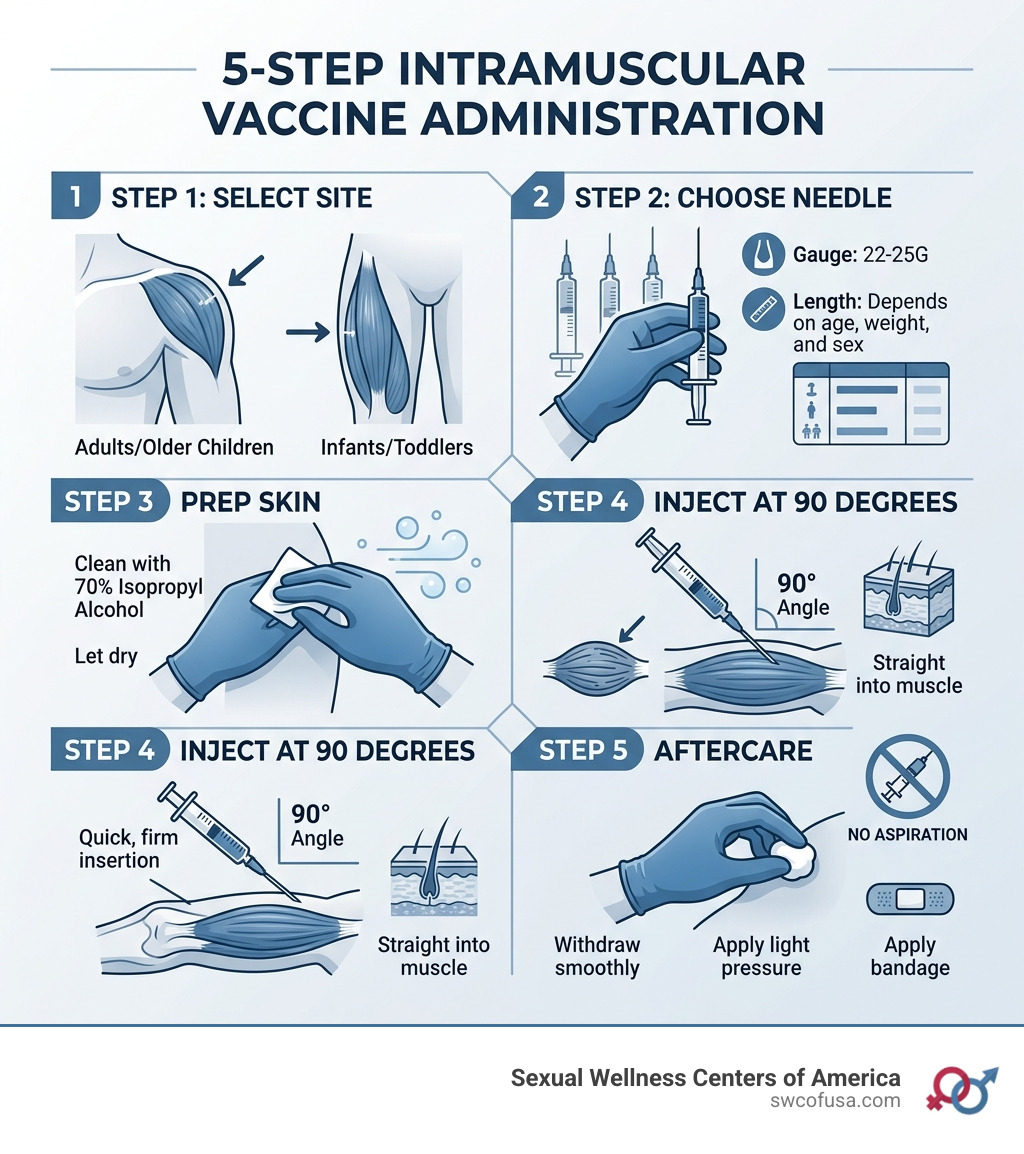
Basic intramuscular vaccine administration terms:
Selecting the Right Anatomical Site for Intramuscular Vaccine Administration
Choosing the right spot for an injection isn’t just about convenience; it’s about safety and efficacy. When we talk about intramuscular vaccine administration, we are looking for a “bulk” muscle that is well-vascularized. This ensures the vaccine reaches the systemic circulation efficiently.
For most adults and older children, the deltoid muscle in the upper arm is the gold standard. However, the choice changes based on the patient’s age and muscle development.
- Deltoid Muscle (Upper Arm): This is the preferred site for adults and children aged 3 years and older. It is a large, triangular muscle that is easy to access.
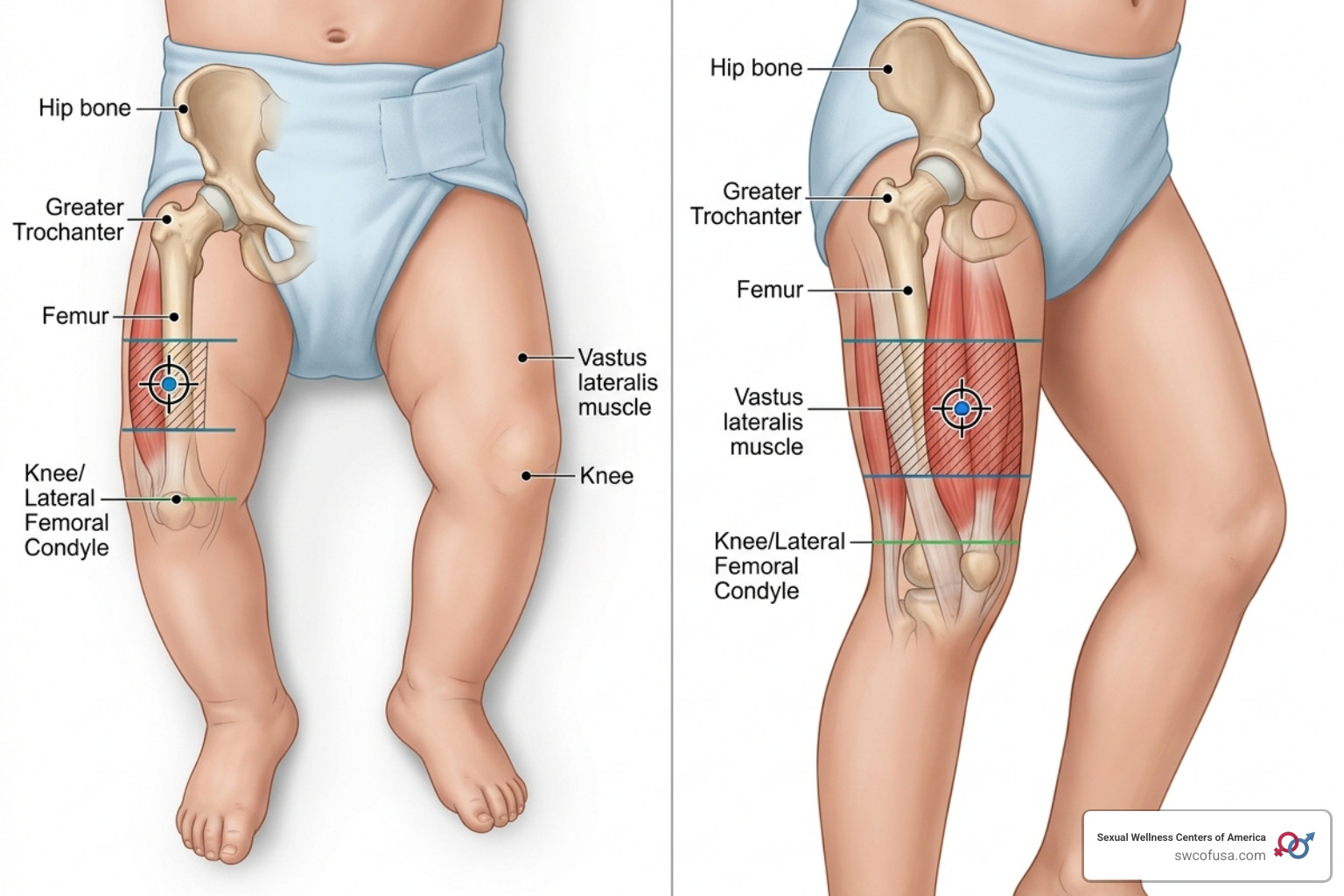
- Vastus Lateralis (Anterolateral Thigh): This is the go-to site for infants and toddlers. Because their arm muscles aren’t fully developed, the thigh offers a much larger, safer target.
- Ventrogluteal Site (Hip): While less common for routine vaccinations, this site has a better safety profile than the traditional “buttock” (dorsogluteal) site because it has thinner subcutaneous fat and avoids major nerves.
Using the correct places for intramuscular injection is critical to avoid “hitting” something you shouldn’t, like the radial nerve or the shoulder joint.
Site Selection by Age and Patient Weight
We don’t treat a 200-pound adult the same way we treat a 20-pound toddler. Here is how we break down site selection:
- Infants (Birth to 12 months): The vastus lateralis in the anterolateral thigh is the only recommended site.
- Toddlers (1 to 2 years): The thigh remains the preferred site, though the deltoid can be used if the muscle mass is adequate.
- Children/Adolescents (3 to 18 years): The deltoid is preferred. According to the CDC, the thigh is a viable alternative if the deltoid cannot be used.
- Adults (19+ years): The deltoid is the primary site. For adults with very low muscle mass in their arms, the anterolateral thigh is the backup.
When landmarking the deltoid, we look for the acromion process (that bony bit at the top of your shoulder). The injection should go about 2 inches (or 2-3 fingerbreadths) below that bone and above the axillary fold (the armpit line). If you go too high, you risk a shoulder injury; too low, and you might hit the radial nerve. Check out the CDC’s guide on Vaccine Administration: Intramuscular (IM) injections for Adults for detailed visual references.
Choosing Needle Gauge and Length Based on Patient Profile
One of the biggest mistakes in intramuscular vaccine administration is using a needle that is too short. If the needle doesn’t reach the muscle, the vaccine ends up in the subcutaneous fat. This can lead to increased local reactions, pain, and potentially a weaker immune response.
We typically use a 22- to 25-gauge needle. The “gauge” refers to the thickness—the higher the number, the thinner the needle. The length, however, is what we must customize.
| Patient Category | Weight/Sex | Needle Length | Site |
|---|---|---|---|
| Neonate/Infant | All | 5/8 inch | Thigh |
| Toddler (1-2 yrs) | All | 1 inch | Thigh (preferred) |
| Children (3-18 yrs) | All | 5/8* to 1 inch | Deltoid |
| Adult Female | < 130 lbs | 5/8* to 1 inch | Deltoid |
| Adult Female | 130–200 lbs | 1 inch | Deltoid |
| Adult Female | 200+ lbs | 1.5 inches | Deltoid |
| Adult Male | < 130 lbs | 5/8* to 1 inch | Deltoid |
| Adult Male | 130–260 lbs | 1 inch | Deltoid |
| Adult Male | 260+ lbs | 1.5 inches | Deltoid |
*5/8 inch needles should only be used if the skin is stretched flat and the tissue is not bunched.
For patients with obesity, a 1.5-inch needle is often necessary to ensure we bypass the adipose tissue. Conversely, for those with very low muscle mass, we must be careful not to hit the bone. Research on Intramuscular Injection highlights that sex and BMI are the two biggest factors in whether an injection actually reaches the muscle.
Step-by-Step Guide to Intramuscular Vaccine Administration Technique
Now, let’s get into the “how-to.” Precision is key. You want to be quick, but you also want to be accurate.

Preparation and Aseptic Technique for Intramuscular Vaccine Administration
Before the needle even touches the patient, the preparation must be flawless. We follow strict aseptic protocols to prevent infection.
- Hand Hygiene: Wash your hands thoroughly or use an alcohol-based sanitizer.
- Syringe Selection: Most vaccines use a 1-mL or 3-mL syringe.
- Check the Vaccine: Ensure it is the correct medication, it hasn’t expired, and it has been stored at the right temperature.
- Labeling: If you are preparing multiple vaccines for one patient, label each syringe immediately so you don’t mix up the sites.
- Skin Prep: Clean the site with a 70% isopropyl alcohol swab. Use a circular motion, moving from the center outward. Crucial step: Let the alcohol dry completely. Injecting through wet alcohol causes that “sting” patients hate.
For more detailed steps, you can refer to our step-by-step guide to giving an IM injection.
The 90-Degree Method for Intramuscular Vaccine Administration
The actual injection should be one fluid motion. Here is the clinical standard:
- The Angle: Always insert the needle at a 90-degree angle to the skin. This ensures the most direct path to the muscle.
- The Thrust: Use a quick, firm motion—think of it like a dart. This actually reduces pain because it passes through the skin’s pain receptors faster.
- Aspiration: You might have been taught to “pull back” on the plunger to check for blood. Current CDC and WHO guidelines state that aspiration is NOT recommended for vaccines. There are no large blood vessels in the recommended IM sites, and skipping this step reduces pain and the time the needle is in the arm.
- The Injection: Depress the plunger at a steady rate (about 10 seconds per mL for larger volumes, though most vaccines are 0.5 mL and go in quickly).
- The Withdrawal: Pull the needle out at the same 90-degree angle. Apply light pressure with a gauze pad. Do not massage the site, as this can irritate the tissue or push the vaccine back into the subcutaneous layer.
Using the Z-track technique (pulling the skin to one side before injecting and releasing it after) can help “lock” the medication in the muscle, though it is used more often for irritating medications than for standard vaccines.
Best Practices for Multiple Injections and Pain Management
It’s April 2026, and it’s very common for patients to receive multiple vaccines at once—think COVID-19, the annual flu shot, and perhaps a Tdap booster.
If you have to give more than one injection in the same limb, follow these rules:
- Spacing: Separate the injection sites by at least 1 inch.
- Mapping: Use different limbs if possible, especially for vaccines known to be “reactive” (like the shingles vaccine or certain COVID boosters).
- Pain Management: For children, tactile stimulation (like rubbing the skin near the site) or using a “cough” trick can help. For adults, simply keeping the arm relaxed (don’t “wing” the elbow) prevents the muscle from tensing up against the needle.
We always recommend giving the most painful vaccine last. Our team at Sexual Wellness Centers of America finds that patient comfort is significantly improved when we explain the process clearly and use a calm, confident approach. If you’re looking for more info about IM muscle injections, we have resources to help.
Preventing Complications and Ensuring Safety
While intramuscular vaccine administration is generally safe, “tradition-based” rather than “evidence-based” practices can lead to trouble.
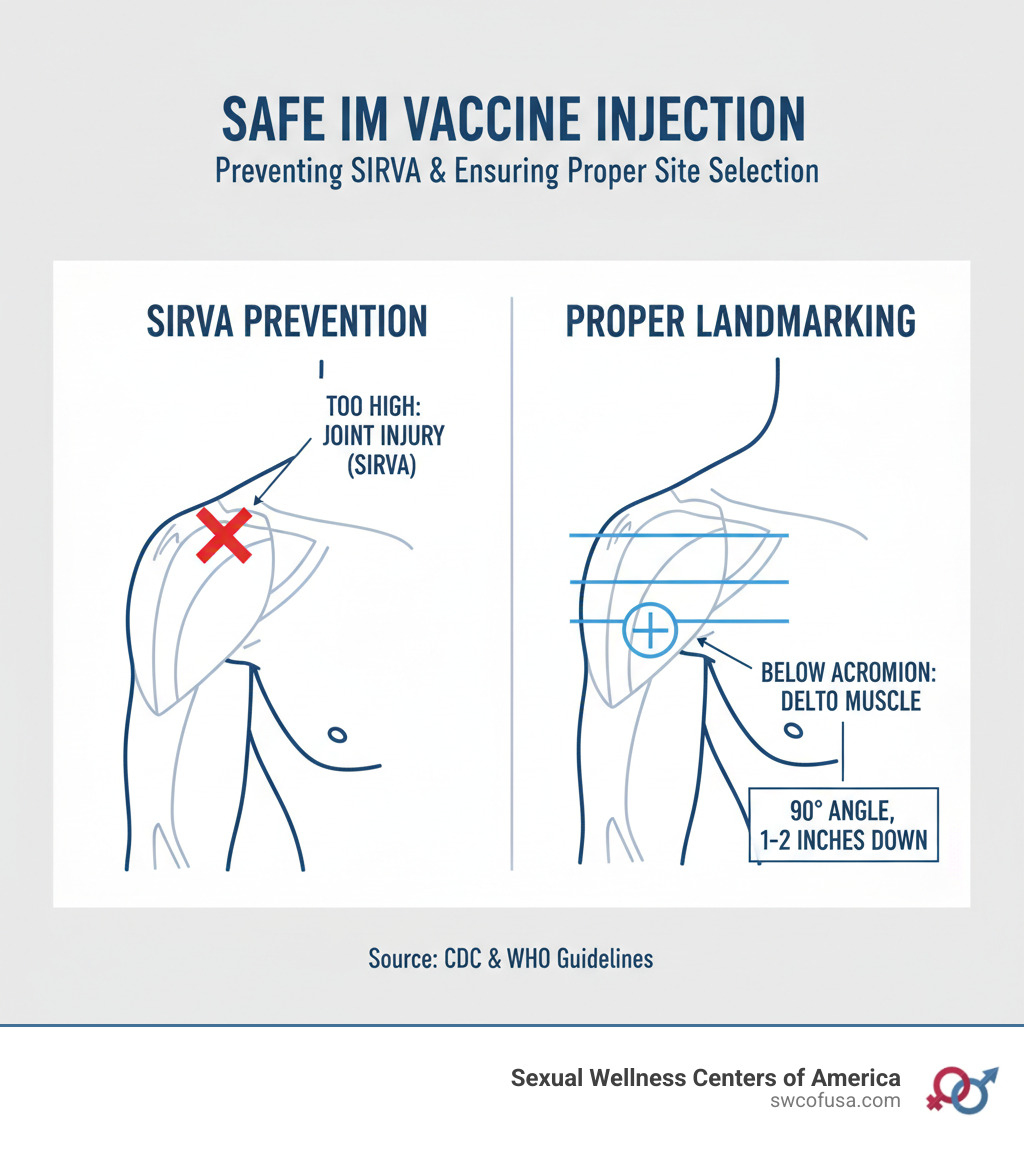
Common complications include:
- SIRVA (Shoulder Injury Related to Vaccine Administration): This happens when the vaccine is injected too high, entering the shoulder joint capsule instead of the deltoid muscle. It causes chronic pain and limited range of motion.
- Nerve Damage: Injecting too low or too far back in the arm can hit the radial nerve. In some global campaigns, the incidence of traumatic injection neuropathy has been recorded as high as 7.1 per million.
- Abscesses: Usually caused by poor aseptic technique or “tracking” of the medication into the subcutaneous tissue.
- Hematomas: More common in patients on blood thinners; applying firm pressure for 2-5 minutes post-injection is key here.
Safety doesn’t end when the needle comes out. Immediate disposal in a puncture-proof sharps container is mandatory. Never recap a needle—that is the number one cause of needle-stick injuries for healthcare workers. To learn more about navigating injection risks, stay informed on the latest clinical guidelines.
Frequently Asked Questions about IM Vaccines
Why is aspiration no longer recommended for IM vaccines?
Aspiration (pulling back the plunger) was originally intended to ensure the needle wasn’t in a blood vessel. However, the CDC and WHO have updated their standards because the recommended sites (deltoid and vastus lateralis) lack large blood vessels. Skipping aspiration makes the process faster and less painful for the patient.
What is SIRVA and how can it be avoided?
SIRVA stands for Shoulder Injury Related to Vaccine Administration. It occurs when the needle is inserted too high on the arm, striking the subacromial bursa or the shoulder joint. You can avoid it by properly landmarking: always stay 2-3 fingerbreadths below the acromion process.
Can the gluteal muscle be used for vaccines?
While the gluteal muscle (the buttock) is used for many “curative” medications, it is generally not recommended for vaccines. This is because the thick layer of fat in the buttocks can prevent the vaccine from reaching the muscle, leading to a poor immune response. Additionally, there is a risk of hitting the sciatic nerve.
Conclusion
Mastering intramuscular vaccine administration is a blend of anatomical knowledge, equipment precision, and a steady hand. By following the 90-degree rule, choosing the correct needle length for the patient’s weight, and landmarking accurately, we ensure that every dose is as effective and painless as possible.
At Sexual Wellness Centers of America in Colleyville, TX, we pride ourselves on this level of clinical excellence. Whether we are conducting hormone panels or administering specialized treatments like the HEshot®™, SHEshot®™, or using our regenMAX® technology, safety and precision are our top priorities. We believe in personalized wellness plans that help our patients reclaim their vitality.
If you are in the Colleyville area and want to learn more about our IM injection services, we invite you to visit us and experience our commitment to your health firsthand. Proper technique isn’t just a clinical requirement—it’s the foundation of great care.