
What You Need to Know About the IM Injection Site for a 2 Year Old
The IM injection site for a 2 year old matters more than most people realize — choosing the wrong spot can cause nerve damage, poor medication absorption, or unnecessary pain.
Here’s the quick answer:
| Site | Location | Recommended? |
|---|---|---|
| Vastus lateralis (thigh) | Front outer thigh, middle third | ✅ Yes — preferred site |
| Deltoid (upper arm) | Upper arm, below acromion | ⚠️ Only if muscle mass is adequate |
| Dorsogluteal (buttock) | Upper outer buttock | ❌ No — sciatic nerve risk |
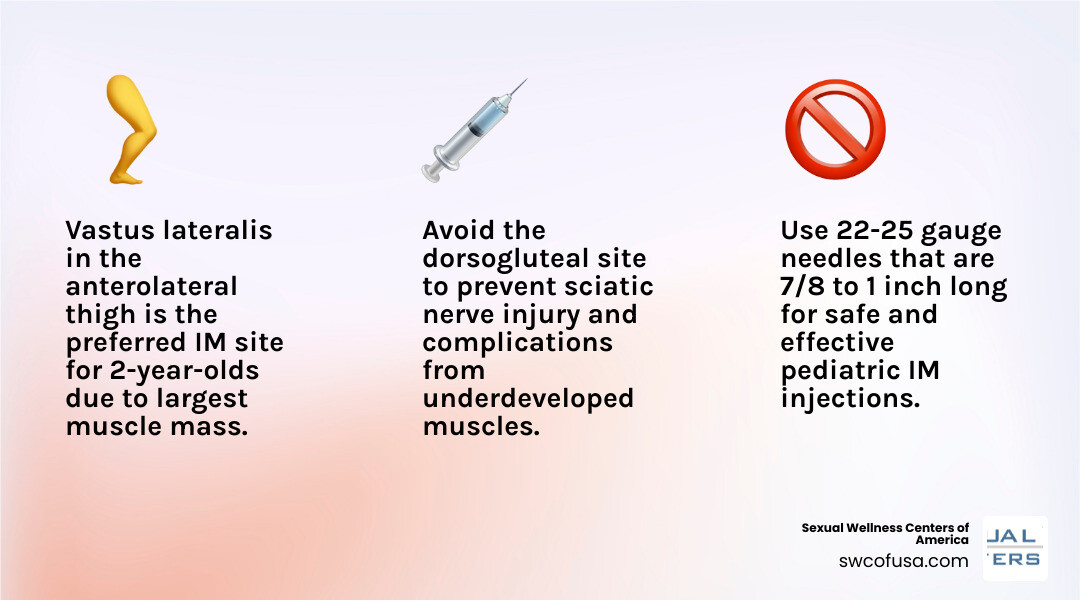
The anterolateral thigh (vastus lateralis) is the #1 recommended IM injection site for children aged 2 and under. It has the largest muscle mass at this age, and it sits far away from major nerves and blood vessels.
The deltoid can be used as a secondary option — but only if the child has enough muscle development there, and volumes must stay under 0.5 mL.
Getting this right reduces pain, lowers the risk of complications, and makes the whole experience less stressful — for your child and for you.
I’m Jeff Nuziard, CEO of Sexual Wellness Centers of America, where our clinical team regularly administers IM injections as part of advanced wellness protocols — giving us deep practical insight into proper IM injection sites for 2 year olds and all age groups. In this guide, I’ll walk you through everything you need to know to do this safely and with far less drama.
Choosing the Right IM Injection Site for a 2 Year Old
When administering an intramuscular (IM) injection to a toddler, site selection is your most critical safety decision. At two years of age, a child’s musculoskeletal system is in a rapid state of development. Muscles that are fully formed in adults are still thin and maturing in toddlers, meaning that using adult injection sites can lead to serious complications.
According to the official Anatomical guidelines for pediatric injections, the primary goal of site selection is to deliver the medication deep into healthy muscle tissue while avoiding major blood vessels and nerves. If an injection is given too shallowly, the medication may settle into the subcutaneous fat layer, leading to poor absorption, localized tissue necrosis, or painful sterile abscesses.
To prevent this, healthcare providers must evaluate the toddler’s individual muscle development. For a comprehensive overview of how site selection shifts as children grow, you can read our guide on Where to Give Your Next IM Injection.
Vastus Lateralis: The Preferred IM Injection Site for a 2 Year Old
The vastus lateralis muscle, located on the anterolateral (front outer) aspect of the thigh, is the gold standard im injection site for 2 year old children. Pediatric medical guidelines favor this site because it offers the largest muscle mass in children under three years of age.
Because this muscle is highly developed from walking and crawling, it can safely accommodate the fluid volume of an injection with minimal risk of penetrating deep neurovascular structures. To locate the vastus lateralis properly, use the following landmarking steps:
- Divide the thigh into three equal segments between the greater trochanter (hip joint) and the knee.
- Focus entirely on the middle third segment.
- Locate the outer, front quadrant of this middle section (the anterolateral area).
- Always avoid the inner thigh or the direct back of the leg, as major blood vessels and nerves run through these zones.
| Specification | Vastus Lateralis (Thigh) | Deltoid (Upper Arm) |
|---|---|---|
| Preferred Age | Birth through 2 years (and older) | 3 years and older (sometimes 1–2 years) |
| Maximum Volume | 1.0 to 1.5 mL | 0.5 mL |
| Needle Length | 7/8 to 1 inch (22–25 mm) | 5/8 to 1 inch (16–25 mm) |
| Primary Advantage | Largest muscle mass, lowest nerve risk | Easier access for cooperative children |
| Primary Risk | Temporary limp if soreness occurs | Nerve injury if injected too high or low |
Deltoid Muscle: An Alternative IM Injection Site for a 2 Year Old
The deltoid muscle in the upper arm is sometimes used as an alternative site for toddlers, but it requires extreme caution. In a two-year-old child, the deltoid muscle is often small and underdeveloped.
We only recommend using the deltoid if the child has adequate muscle mass in the upper arm and the injection volume is highly restricted. According to clinical protocols, the maximum volume for a deltoid injection in a toddler is 0.5 mL.
To find the deltoid site:
- Locate the acromion process (the bony point at the top of the shoulder).
- Find the midpoint of the arm in line with the armpit (axillary fold).
- The injection zone is a small triangle in the middle of these two points, roughly 1 to 2 inches below the acromion process.
Injecting too high can damage the shoulder joint capsule, while injecting too low can damage the radial nerve. For a deeper breakdown of upper body injection techniques, review our guide on How to Administer Intramuscular Vaccines Correctly.
Selecting the Correct Needle Size and Equipment
Using the correct needle size is just as important as finding the right anatomical location. If the needle is too short, the medication will be deposited into subcutaneous fat. If it is too long, it may strike the underlying bone (periosteum), causing severe pain and potential damage.
For a toddler aged 1 to 2 years, the standard recommendation for a vastus lateralis injection is a 22- to 25-gauge needle that is 7/8 to 1 inch (22–25 mm) in length.
If you are using the deltoid muscle (and the child’s muscle mass has been deemed adequate), a shorter 5/8- to 1-inch needle is appropriate. Always consult the Pediatric injection equipment guidelines to match the needle length to the child’s physical build. Thin or small-for-age toddlers will require the shorter end of these ranges, while larger toddlers may require a full 1-inch needle to successfully reach the muscle bed.
Step-by-Step Guide to Administering the Injection

Administering an injection to an active toddler requires preparation, speed, and precision. By organizing your workspace beforehand and understanding the physical steps of the injection, you can minimize the time your child spends feeling anxious.
Before starting, gather all necessary supplies:
- The prescribed medication (brought to room temperature to reduce stinging).
- The correct syringe and needle.
- Alcohol or antiseptic wipes.
- Sterile gauze or a clean cotton ball.
- A colorful bandage.
- A designated sharps disposal container.
For a general overview of these prep steps, you can read our comprehensive walkthrough on Giving an IM Intramuscular Injection: A Step-by-Step Guide.
Preparing the Toddler and Reducing Anxiety
A toddler’s emotional state plays a massive role in how they perceive pain. Children take their emotional cues directly from their parents and caregivers; if you appear anxious, hurried, or tense, your toddler will immediately sense that something is wrong.
To keep the environment calm, utilize these proven pediatric coping strategies:
- Distraction: Use bubbles, a favorite video on a phone, a noisy toy, or a search-and-find book to draw their eyes away from the syringe.
- Comfort Positioning: Do not pin the child flat on an exam table if it can be avoided. Instead, have a parent hold the child in a comforting “hug” position on their lap. This secures the child’s limbs safely while providing emotional security.
- Topical Anesthetics: Ask your healthcare provider about prescription EMLA cream or over-the-counter lidocaine patches. Applying these to the site 30 to 60 minutes before the injection can significantly numb the skin surface.
- Honest, Simple Language: Avoid saying “this won’t hurt.” Instead, say, “You will feel a quick little pinch, and then we will put a cool sticker on it.”
For parents managing therapeutic regimens at home, the resource on Intramuscular injections: Injecting at home offers excellent clinical tips for maintaining a stress-free environment.
Executing the Injection Safely
Once the toddler is securely held and distracted, follow these clinical steps to deliver the injection safely:
- Perform Hand Hygiene: Wash your hands thoroughly with soap and water.
- Clean the Site: Clean the selected im injection site for 2 year old (the middle third of the outer thigh) with soap and water or an antiseptic wipe. Use a circular motion, moving outward, and allow the skin to air-dry completely. Do not blow on the skin to dry it, as this introduces bacteria.
- Prepare the Needle: Remove the needle cap. Hold the syringe like a dart between your thumb and forefinger.
- Stretch the Skin: Use your non-dominant hand to stretch the skin flat and tight over the muscle. This stabilizes the tissue and makes needle penetration smoother and less painful.
- Insert the Needle: Insert the needle at a 90-degree angle directly into the skin with a quick, firm motion.
- Inject the Medication: Inject the fluid slowly and steadily. A good clinical rule of thumb is to inject at a rate of roughly 1 mL per 10 seconds.
- Withdraw the Needle: Pull the needle out quickly at the exact same 90-degree angle to prevent tearing the tissue.
- Apply Pressure: Immediately press a sterile gauze pad or cotton ball firmly against the injection site for 30 seconds. Do not massage the site, as this can force medication back into the subcutaneous tissue and cause irritation.
- Secure and Dispose: Apply a bandage and immediately drop the unsheathed needle into your sharps container.
Managing Complications and Post-Injection Care
Once the injection is complete, the focus shifts to comfort and monitoring. Minor local reactions are incredibly common and are generally not a cause for alarm.
You can expect to see mild redness, slight swelling, or a tiny pinpoint of blood or bruising at the site. This is a natural inflammatory response to tissue penetration. To manage these symptoms:
- Apply a cool, damp cloth or a cold pack wrapped in a towel to the thigh for 10 to 15 minutes to reduce swelling.
- Encourage your toddler to move their leg. Walking, crawling, or playing helps circulate the medication and actually reduces muscle stiffness.
- If the child is fussy or experiencing pain, consult your pediatrician about administering an age-appropriate dose of acetaminophen or ibuprofen.
If your child requires ongoing, repeated injections, it is vital to rotate injection sites. Giving multiple injections in the exact same spot can lead to lipohypertrophy (a buildup of fatty tissue) or localized scarring, which impairs how future medications are absorbed. Always alternate between the left and right thigh. For general principles on managing thigh-based injection sites over time, check out The Ultimate Guide to Subcutaneous Thigh Injections.
Frequently Asked Questions About Toddler IM Injections
Why is the dorsogluteal site avoided in a 2-year-old?
The dorsogluteal site (the upper outer quadrant of the buttock) is strictly avoided in infants, toddlers, and young children. The primary reason is the high risk of permanent damage to the sciatic nerve, which runs directly through this region.
Additionally, the gluteal muscles do not fully develop until a child has been walking independently for a significant period. Injecting into an underdeveloped muscle increases the likelihood of depositing the medication into subcutaneous fat rather than deep muscle. To learn more about when and how this site is used in older populations, read Mastering the Art of Giving an IM Injection in the Buttocks.
Should you aspirate before injecting a toddler?
No. Modern clinical guidelines from the CDC and the Advisory Committee on Immunization Practices (ACIP) state that aspiration (pulling back on the syringe plunger to check for blood) is not recommended for pediatric vaccinations and standard IM injections.
Because the recommended injection sites (the vastus lateralis and deltoid) do not contain any major blood vessels, the risk of accidental intravenous injection is virtually nonexistent. Skipping aspiration reduces the time the needle remains in the muscle, which significantly decreases pain and anxiety for the child.
When should I call a healthcare provider after an injection?
While mild redness and tenderness are normal, you should contact your child’s healthcare provider immediately if you observe any of the following warning signs:
- A high fever (above 101°F or 38.3°C) that does not respond to fever-reducing medication.
- Swelling, redness, or warmth at the injection site that continues to spread after 24 to 48 hours.
- Any pus, drainage, or oozing from the injection site.
- Hardness or a firm lump at the site that does not go away after a few days.
- Signs of an allergic reaction, such as hives, swelling of the face or mouth, or difficulty breathing (call 911 immediately for severe breathing issues).
- Severe, localized pain that prevents the child from using or moving their leg.
Conclusion
Administering an IM injection to a two-year-old doesn’t have to be a dramatic or traumatic event. By selecting the im injection site for 2 year old children—the vastus lateralis muscle of the outer thigh—using the correct needle size, and employing calming distraction techniques, you can ensure a safe, swift, and highly effective administration.
At Sexual Wellness Centers of America in Colleyville, TX, we understand that medical treatments require a compassionate, highly precise touch. While we specialize in cutting-edge adult sexual health and vitality therapies—such as our customized hormone panels, HEshot®™, SHEshot®™, and advanced regenMAX®™ clinical protocols—we maintain the absolute highest standards of medical safety and clinical excellence across all healthcare disciplines.
If you are looking for professional, expert clinical care in the Colleyville, TX area, we invite you to explore our comprehensive range of services. Visit our Services: IM Injections Colleyville TX page to learn how our dedicated medical team can support your family’s wellness journey.