
You booked the hotel room, chose the lingerie, and expected the evening to shift the mood instantly. Instead, your husband walked in distracted, tired, or emotionally elsewhere. You felt rejected, and he may have felt pressured to perform.
That scenario is common because arousal isn't a button that one outfit, fragrance, or technique reliably activates. For how to turn my husband on, start with a more useful question: what helps this specific man feel relaxed, connected, interested, and physically responsive?
Men's desire varies with stress, sleep, relationship tension, timing, and personal cues. A large daily-diary study collected 6,656 data points and found substantial day-to-day variation in desire for both men and women. The average scores were 3.14 for men and 2.84 for women on a 0–6 scale, a difference that wasn't statistically significant, while a longer window from the same project showed a different pattern, with men's average desire at 53.12 compared with women's 41.89. The practical lesson is clear: desire isn't a fixed male baseline. It responds to context and changes over time. The full study on daily sexual desire offers the evidence behind that conclusion.
Your strongest strategy is personal, gradual, and collaborative. Learn his cues, reduce pressure, strengthen the relationship outside the bedroom, and separate an occasional low-response evening from a persistent health concern.
Table of Contents
- Start With Desire Beyond Technique
- Build Arousal With Partner-Specific Cues
- Communicate Desire Without Pressure
- Create Connection Outside the Bedroom
- Notice Health and Relationship Barriers
- Know When Medical Support May Help
- Put the Guidance Into Practice
Start With Desire Beyond Technique
A wife once planned what she believed was an irresistible night. She arranged childcare, reserved a hotel suite, wore lingerie, and expected her husband to be eager the moment he saw her. He arrived after a difficult workday, checked his phone repeatedly, and struggled to shift his attention toward sex. She read his distraction as a verdict on her attractiveness. He experienced the evening as an expectation he might disappoint.
The problem wasn't necessarily the lingerie or the setting. The problem was the assumption that a seductive setup works independently of stress, fatigue, emotional closeness, and perceived pressure.
A 2011 review described male sexual arousal as a multi-component state triggered by internal and external stimuli, with responses that can appear in verbal, genital, and behavioral forms. A separate meta-analysis of 132 laboratory studies, covering 2,505 women and 1,918 men, found stronger agreement between self-reported and genital arousal in men, with r = .66 for men versus r = .26 for women. Those findings don't create a universal recipe for husbands. They do support a practical point: immediate erotic cues and the surrounding environment can strongly shape male sexual response. The review of male sexual arousal and related findings provides useful context.
Practical rule: Don't ask, “What turns men on?” Ask, “What helps my husband become available for pleasure?”
Begin with observation rather than performance. Does he become more engaged after affectionate conversation, playful teasing, quiet time, or physical closeness? Does conflict need to be repaired before he can enjoy sex? Does he prefer anticipation during the day, or does that make him feel watched?
You can also explore the broader role of emotional connection through this resource on understanding connection and what enhances intimacy. The goal isn't to manage him like a project. It's to replace guesswork with mutual understanding, while remembering that arousal never overrides consent.
Build Arousal With Partner-Specific Cues
Generic seduction advice fails when it ignores the person in front of you. Your husband may respond to visual cues, but he may also respond more strongly to warmth, privacy, verbal desire, humor, or an unhurried pace.
Start by gathering information in ordinary moments.
- Observe where he lingers. Notice the subjects, scenes, conversations, or forms of affection that hold his attention. Don't treat every glance as a sexual signal. Look for recurring interest and ask about it naturally.
- Notice physical responses. A smile, sustained eye contact, a relaxed posture, leaning closer, or a change in breathing can indicate engagement. None of these signals guarantees consent, so use them as information, not permission.
- Ask open questions. Try, “What helps you shift out of work mode?” or “Do you like anticipation, or would you rather keep intimacy spontaneous?” Questions about pace and pressure are more useful than asking him to grade your technique.
- Lower distractions first. Put phones aside, choose a time when neither of you is rushing, and make the room comfortable. Arousal has little chance to develop when one partner is monitoring notifications or worrying about unfinished tasks.
- Escalate gradually. Move from a warm greeting to affectionate contact, then pause and notice whether he reciprocates. If the response is positive, you can add more sensual touch or clearer sexual language. If he pulls back, slow down without turning the moment into a test.
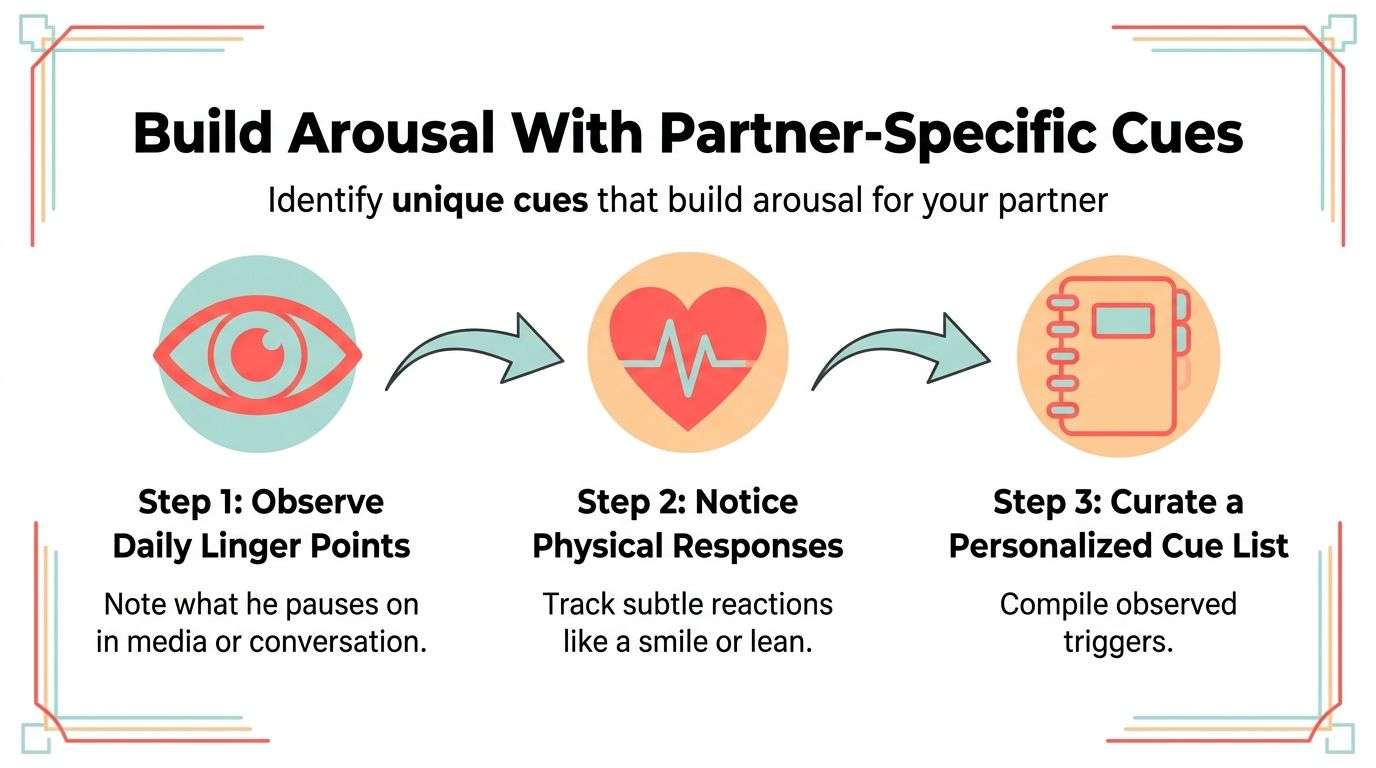
A practical way to organize what you learn is an arousal map. Write down settings that help, words he enjoys, types of touch he welcomes, and situations that tend to shut him down. Keep the map flexible. Desire changes with health, stress, relationship circumstances, and experience.
A 2010 review identified four validated desire triggers in women, including emotional bonding, explicit erotic cues, visual or proximity cues, and romantic or implicit cues. While that research focused on women, it supports a broader principle: partners don't all respond to the same category of initiation. The review of desire triggers and arousal inhibitors also reinforces the value of matching the cue to the individual and escalating with care.
Communicate Desire Without Pressure
Before the conversation, the couple guessed at everything. She sent suggestive messages, he didn't respond quickly, and she withdrew. Later, he tried to initiate, but she was still hurt. Neither partner said what had happened, so each encounter carried the disappointment of the previous one.
Afterward, they changed the script. She said, “I'd love it if we could be closer tonight, but there's no pressure if you're exhausted.” He explained that suggestive messages during work made him feel distracted rather than aroused. They agreed that a short affectionate message and a planned evening worked better for him. The change wasn't a clever phrase. It was the removal of mind-reading.
Use language that expresses desire without assigning him a duty.
- “I want to feel close to you tonight. How does that sound?”
- “Would you enjoy a back rub, or would you rather decompress first?”
- “I'd like to explore something together. We can stop whenever either of us wants.”
- “If tonight isn't right, let's choose another time instead of leaving this vague.”
Avoid questions that turn intimacy into an evaluation, such as “Why don't you want me?” or “What's wrong with you?” Those questions often force him to defend himself while leaving you without the information you need.
Research supports this conversational approach. A 2019 meta-analysis found that sexual communication was positively associated with desire, arousal, erection, orgasm, and overall sexual function in both partners. A 2025 study also found that daily positive communication predicted same-day and next-day desire and relationship satisfaction for both partners. The meta-analysis on sexual communication and sexual function gives the strongest source for making communication part of your intimate routine, not a crisis response.
If he declines, accept the answer without punishment. You can offer reconnection later, plan a date, or share non-sexual affection. A refusal to have sex isn't a refusal to care about the relationship, and your invitation doesn't create an obligation.
Create Connection Outside the Bedroom
Many couples try to solve low desire with bedroom tactics while ignoring the emotional climate that precedes them. A husband who feels criticized, disconnected, or treated like a roommate may not become receptive just because the lights are dimmed.
Daily connection doesn't need to be elaborate. It needs to be reliable and free from hidden demands.
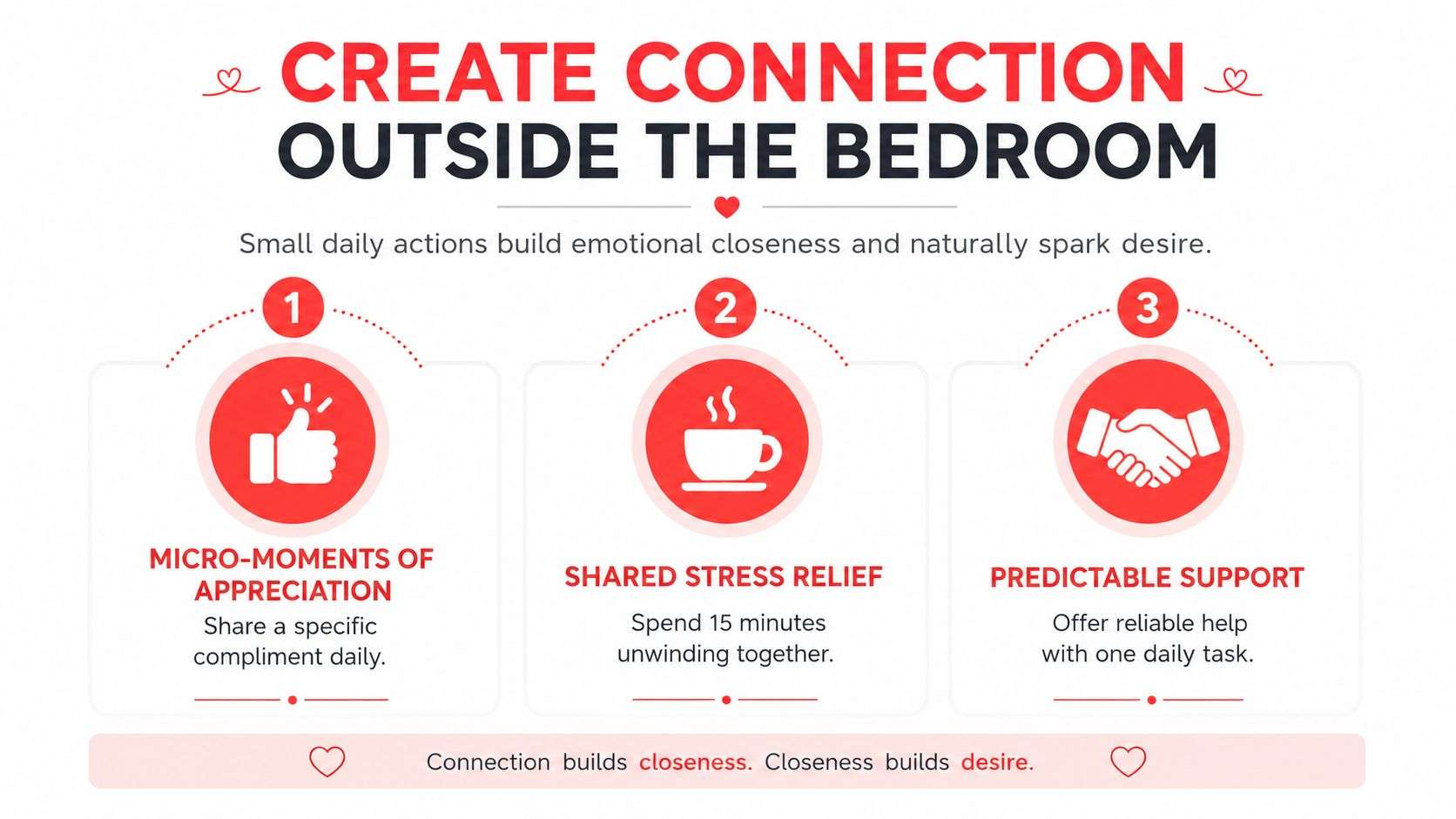
- Use a screen-free check-in. Ask what felt heavy, what went well, and what support would help. Listen without immediately fixing the problem.
- Offer non-sexual touch. A hand on the shoulder, a hug in the kitchen, or a back rub can restore physical warmth without making every touch a prelude to sex.
- Restore teamwork. Cook together, walk after dinner, or handle an ordinary errand as partners rather than parallel workers.
- Give specific appreciation. “You handled that stressful call patiently” lands better than a general compliment because it shows that you noticed him.
- Repair criticism directly. If resentment is present, acknowledge your part and discuss the issue outside an intimate moment.
The connection between communication and desire matters here. Positive daily interaction gives partners evidence that they are safe, valued, and noticed. That doesn't guarantee arousal, but it creates a better environment for arousal to develop.
Pain also belongs in this conversation. Recent research on menopause and genitourinary syndrome of menopause found that vaginal discomfort contributed to men losing desire and women avoiding sex because of pain, while only about 49% of partners knew about the symptoms. The research on menopause, vaginal discomfort, and partner awareness shows why a husband's lower interest may reflect concern, confusion, or avoidance rather than a lack of attraction.
For couples rebuilding trust after compulsive behavior, betrayal, or another destabilizing experience, this guide to connection in recovery offers broader relationship context. You can also find practical ideas in this guide on how to enhance intimacy in marriage. Think of outside-the-bedroom connection as the soil where sexual interest can take root.
Notice Health and Relationship Barriers
A single off night doesn't diagnose anything. Sleep loss, acute stress, alcohol before sex, dehydration, long periods of sitting, and pressure from cycling can all interfere with interest or erection quality. A tense conversation earlier in the day can have the same effect.
Persistent patterns deserve a different response. Reduced morning erections, low motivation, fatigue, mood changes, ongoing erection difficulty, pain, or a sudden loss of interest can point toward a medical or psychological issue. Relationship factors matter too, including unresolved resentment, different initiation styles, anxiety after earlier rejection, and performance worry following a difficult sexual experience.
Track observations for 2–4 weeks before drawing conclusions, but don't use the record to police him. Note frequency, context, ease of arousal, erection firmness, whether he can complete sexual activity comfortably, and what was happening emotionally that day.
| Barrier Category | Situational, Usually Temporary | Persistent, Warrants Attention |
|---|---|---|
| Energy and stress | A short period of poor sleep, workload, or emotional strain | Ongoing fatigue, low motivation, or mood change |
| Sexual response | Difficulty during one encounter or under a particular condition | Consistent trouble getting or keeping an erection |
| Relationship climate | A recent argument or awkward initiation | Repeated resentment, avoidance, or fear of rejection |
| Physical comfort | Temporary discomfort or distraction | Pain, curvature changes, or recurring discomfort |
| Desire | A brief dip in interest | Sudden or sustained loss of interest |
Don't overlook the partner's experience. Menopause-related symptoms, sexual pain, or fear of causing discomfort can change how a husband approaches sex. For a plain-language discussion of anger and hormonal changes affecting relationships, Lila's explanation of hormonal rage may help couples find less blaming vocabulary.
Try this opening: “I've noticed sex has felt different lately. I'm not blaming you. Can we look at the timing, stress, comfort, and health factors together?” That invites investigation instead of accusation.
Know When Medical Support May Help
Medical support isn't a defeat, and it shouldn't be reserved for a crisis. If your husband has trouble getting or maintaining an erection most times for several weeks, loses morning erections, experiences reduced libido with fatigue or mood changes, feels pain during sex, or notices a change in penile curvature, an evaluation is sensible.
A clinician may review medications, sleep, alcohol use, stress, relationship factors, and medical history. The assessment can include a physical examination, bloodwork for testosterone, blood sugar, lipids, and thyroid function, along with attention to cardiovascular risk. Erectile changes can have overlapping causes, so guessing at supplements or blaming attraction often wastes time.
Lifestyle support is foundational. A contemporary review identifies increased physical activity, smoking cessation, glycemic control, and weight loss as first-line measures. It also reports that a 5–10% weight reduction in obese men produces meaningful improvement in erectile function. The clinical review on lifestyle optimization and erectile function explains why a staged plan should address cardiometabolic health before or alongside targeted treatment.

Treatment may include lifestyle changes, management of an underlying condition, medication such as a PDE5 inhibitor when appropriate, or counseling for anxiety-related arousal difficulties. Evidence reviews also support combining medical care with counseling or relationship-focused intervention when psychological factors contribute.
If your husband feels embarrassed starting the conversation in person, a confidential consultation, lab work, and personalized treatment planning through a sexual-health clinic can provide a structured entry point. For general background on a prescription peptide sometimes discussed in sexual medicine, review this PT-141 peptide breakdown, but don't use any peptide or medication without qualified medical guidance.
You can also explore erectile dysfunction treatment with a doctor to understand how an evaluation may fit the problem. Removing uncertainty often reduces the pressure that has been affecting both partners.
Put the Guidance Into Practice
Don't attempt to overhaul your sex life in one dramatic evening. Use a first week to gather information, build warmth, and see which invitations feel mutual.
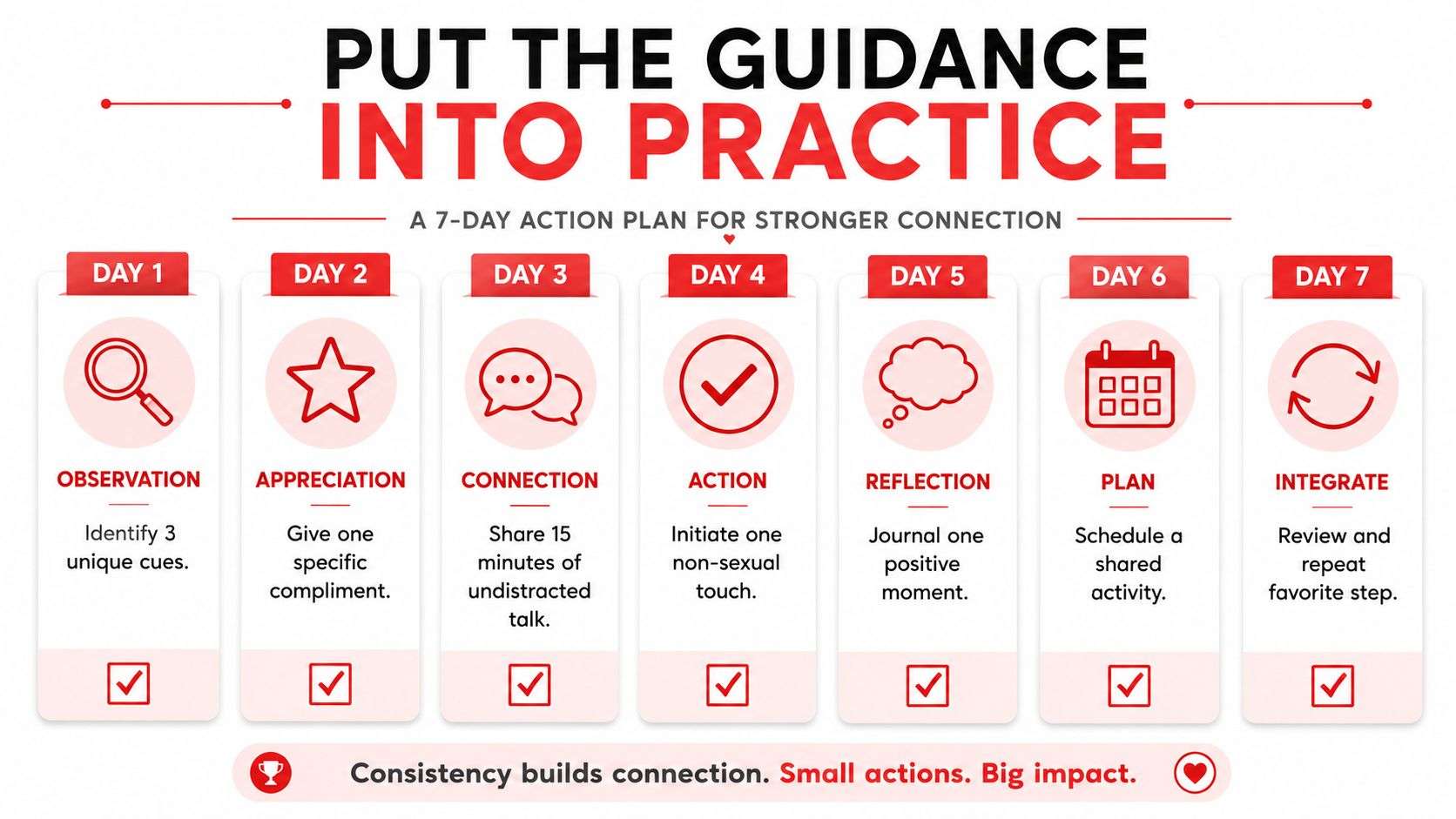
A focused first week
- Day 1, observe. Notice three cues that seem to increase his engagement, such as relaxed conversation, privacy, or affectionate contact.
- Day 2, appreciate. Give one specific compliment unrelated to sexual performance.
- Day 3, connect. Share uninterrupted conversation and ask what has been occupying his mind.
- Day 4, touch. Initiate one non-sexual touch, then let it remain non-sexual unless both of you clearly want more.
- Day 5, reflect. Write down one positive moment and what made it feel easy.
- Day 6, plan. Choose a shared activity that lowers stress, whether that's cooking, walking, or sitting together without phones.
- Day 7, integrate. Ask what felt good, what felt pressured, and which small action you'd both repeat.
Keep consent active throughout. Say, “Do you want more?” and accept “not tonight” without sulking, bargaining, or demanding an explanation. He should be able to pause, and so should you.
Common troubleshooting questions
What if our schedules don't match? Choose a smaller moment instead of waiting for a perfect evening. A brief connection can be meaningful when neither partner is rushing.
What should I do after he rejects an advance? Respond warmly, give space, and suggest another form of closeness only if he seems receptive. Revisit the pattern later, not in the immediate aftermath.
What if a technique doesn't land? Don't repeat it harder. Ask what felt off, remove the expectation, and treat the answer as useful information.
When should we postpone this plan? Pause the experiment when there is pain, a sudden change in desire, persistent erection difficulty, serious mood change, or fear around intimacy. Those signs call for professional support rather than more seduction tactics.
Sexual Wellness Centers of America provides evaluations and individualized treatment plans for erectile dysfunction, hormone concerns, sexual performance, and related conditions, with non-surgical options delivered in a clinic setting. If persistent symptoms are affecting your relationship, visit Sexual Wellness Centers of America to schedule a confidential discussion and identify an appropriate next step.