
For most healthy men, daily ejaculation isn't harmful, and men reporting 21 or more ejaculations per month had a lower later risk of prostate cancer than men reporting 4 to 7 per month. In the major prospective data, the adjusted hazard ratio was 0.81 for men aged 20 to 29 and 0.78 for men aged 40 to 49, but the question is which man and which outcome you care about.
That distinction matters because prostate associations, semen quality, testosterone, mood, sleep, pelvic pain, erectile function, and compulsive sexual behavior don't have the same evidence behind them. A frequency that feels neutral for one healthy man may worsen irritation or pelvic discomfort in another, while a man trying to conceive may care more about semen analysis timing than about a theoretical prostate benefit.
The most accurate answer to “is it healthy to ejaculate daily” is therefore conditional. Daily ejaculation is usually a normal, sustainable behavior for healthy men, but it isn't a medical requirement, a guaranteed cancer-prevention strategy, or a substitute for evaluating symptoms.
Table of Contents
- The Short Answer Most Men Are Looking For
- What Actually Happens in the Body During Ejaculation
- Daily Ejaculation and Prostate Cancer Risk
- What Happens to Sperm Quality and Count
- Testosterone, Mood, and Sleep
- Who Should Be Cautious About Daily Ejaculation
- Practical Recommendations for Daily Frequency
- When to Talk to a Clinician and What to Ask
The Short Answer Most Men Are Looking For
For most healthy men, daily ejaculation is not harmful. The strongest reassuring evidence concerns prostate cancer associations, while the sperm research suggests that daily ejaculation may lower semen volume and sperm count early in a short protocol without necessarily damaging motility or morphology. The evidence is less definitive for long-term testosterone changes, mood, sleep, or sexual performance.
Separate the outcome from the habit
A useful clinical approach is to ask what you're trying to accomplish:
- Prostate health: Higher ejaculation frequency is associated with lower prostate cancer risk in observational cohort data, but association doesn't prove that ejaculation prevents cancer.
- Fertility: Daily ejaculation can reduce the number of sperm available in each individual sample, even when sperm movement and shape remain stable. That distinction matters when timing conception or a semen analysis.
- Hormones: Orgasm can produce short-lived neurochemical and hormonal changes, but the available evidence doesn't support the idea that daily ejaculation permanently raises or lowers testosterone.
- Mood and sleep: Some men feel relaxed or sleepy afterward. Those effects depend on context, stress, relationship quality, and whether the behavior feels chosen.
- Compulsive behavior: Frequency becomes clinically relevant when it interferes with work, relationships, sleep, or sexual function.
The evidence base has developed over time rather than producing a universal “healthy” number. Historical analyses and later research have continued to find an inverse association between ejaculation frequency and prostate cancer risk, including a pooled odds ratio of 0.83 in an updated dose-response meta-analysis, equivalent to an overall 17% lower risk among men with more frequent ejaculation, as reported in the reviewed evidence on ejaculation and prostate health.
Clinical bottom line: Don't chase a number simply because it appears healthy online. Judge daily ejaculation by symptoms, goals, function, and control.
What Actually Happens in the Body During Ejaculation
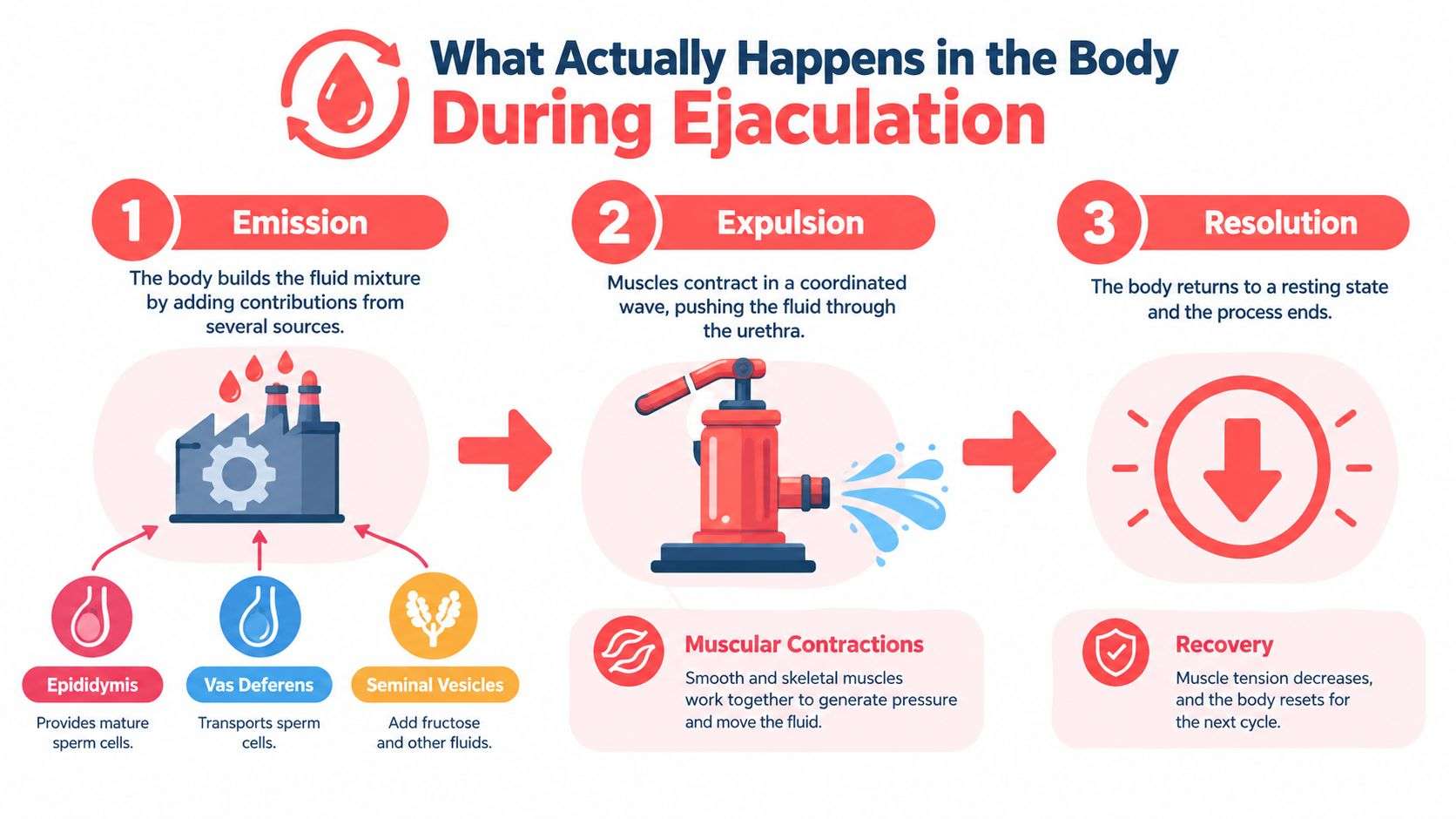
Ejaculation is easier to understand as a two-stage hydraulic system followed by a reset. The reproductive glands produce and move fluid, then coordinated muscles act like a pump to push that fluid through the urethra.
During emission, sperm travels from the epididymis through the vas deferens. The seminal vesicles add much of the fluid that supports sperm, and the prostate contributes its own secretion. Sympathetic nerve activity contracts the reproductive ducts and glands, moving the mixture into the posterior urethra.
The second stage, expulsion, uses rhythmic contractions of the pelvic and penile muscles, especially the bulbospongiosus muscle. These contractions propel semen outward in pulses. Orgasm and ejaculation usually happen together, but they're not identical: orgasm is a central nervous system experience involving arousal, reward, and emotional processing, while ejaculation is a peripheral reflex involving ducts, glands, nerves, and muscles.
The recovery phase is normal
After ejaculation, many men experience a refractory period, during which arousal and erection temporarily become more difficult. Prolactin rises after orgasm and appears to contribute to the relaxed, less sexually responsive state, while dopamine and oxytocin participate in reward, bonding, and pleasure pathways.
The refractory period varies widely. Younger men may recover quickly, while age, medication, fatigue, vascular health, stress, and the sexual context can lengthen it. That built-in recovery mechanism helps explain why daily ejaculation is sustainable for many men without requiring the body to operate at maximum sexual output continuously.
Why the physiology matters
Ejaculation doesn't permanently empty the reproductive system or deplete a fixed reserve of sexual energy. The body continually produces sperm and seminal fluid, then adjusts output according to timing and demand. That doesn't mean every man should ejaculate daily. It means the act itself is generally a repeatable physiological function, not a damaging event.
Daily Ejaculation and Prostate Cancer Risk
The prostate evidence is reassuring, but it needs careful interpretation. Researchers have mainly studied ejaculation frequency through observational cohorts, meaning men reported their behavior and researchers later compared health outcomes. Researchers didn't assign men to ejaculate at a particular frequency, so these studies can identify an association but can't prove that ejaculation itself lowers cancer risk.
A major prospective analysis from the U.S. Health Professionals Follow-up Study followed 31,925 men for 16 years. Men reporting 21 or more ejaculations per month had a lower later risk of prostate cancer than men reporting 4 to 7 per month. The adjusted hazard ratio was 0.81 for ages 20 to 29 and 0.78 for ages 40 to 49, corresponding to approximately 19% and 22% lower risk in those age groups, respectively, according to the study record published by the Journal of Clinical Oncology.
Harvard's summary of the same research reports a 31% lower risk when comparing men with 21 or more ejaculations per month with men reporting 4 to 7 per month across their lifetimes, as described in its review of ejaculation frequency and prostate cancer.
How to read the cohort findings
The pattern appears dose-related in the available research, with more frequent ejaculation associated with lower prostate cancer risk. Possible explanations include regular emptying of prostatic secretions, reduced concentration of potentially irritating substances, or differences in inflammation and sexual health. Those mechanisms remain possibilities, not established clinical conclusions.
The studies also have limitations:
- Self-reporting: Men may not remember or classify ejaculation frequency consistently.
- Confounding: Exercise, relationships, healthcare use, diet, stress, and screening behavior may differ between groups.
- Healthy-screener effects: Men who are sexually active may also be more engaged with preventive healthcare.
- No randomization: Researchers can't ethically or practically assign lifelong ejaculation patterns to participants.
Regular ejaculation is reasonable as one part of a healthy sexual life. It isn't a replacement for age-appropriate prostate discussions, symptom evaluation, or screening decisions.
If you've had prostate surgery and are concerned about erections or ejaculation during recovery, the questions change from frequency to healing, nerve function, medication, and rehabilitation. A focused resource on erectile dysfunction after prostatectomy surgery may help frame that discussion.
| Study | Cohort size | Comparison | Outcome | Adjusted hazard ratio |
|---|---|---|---|---|
| U.S. Health Professionals Follow-up Study | 31,925 men | 21 or more ejaculations per month versus 4 to 7 | Later prostate cancer risk | 0.81 for ages 20 to 29, 0.78 for ages 40 to 49 |
What Happens to Sperm Quality and Count
The statement “daily ejaculation lowers sperm count” is partly true, but it's too incomplete to guide fertility decisions. The relevant question is whether you mean sperm available in one ejaculate, overall sperm quality, or the probability of conception over time.
In a prospective study of 20 healthy men who ejaculated daily for 14 days, semen volume and sperm count fell early and then stabilized. Motility and morphology remained stable throughout the protocol, and the review concluded that daily ejaculation can preserve overall semen quality in healthy men. The same review noted that shorter abstinence, defined as 2 days or less, may produce fresher sperm with better motility and DNA integrity, particularly in men with subfertility, as summarized in the review of frequent ejaculation and semen parameters.
Count and quality are different measurements
A man can release fewer sperm in a given sample without producing damaged sperm. Frequent ejaculation gives the reproductive tract less time to accumulate sperm, so the next sample may contain less semen and a lower total count. That doesn't automatically mean that sperm movement, shape, or DNA integrity has deteriorated.
For a fertile man having regular intercourse, daily ejaculation may be compatible with conception. For a man with a low baseline count, however, ejaculating daily could reduce the number of sperm available for each attempt. Fertility clinics commonly standardize abstinence before a semen analysis because the result needs to be interpreted against a known collection interval, rather than compared casually with a sample produced after a different interval.
| Parameter | After 1 day | After 3 to 4 days | After 7 or more days |
|---|---|---|---|
| Semen volume | Often lower | Usually higher | May continue to accumulate |
| Total sperm count per sample | Often lower | Usually higher | May be higher, depending on baseline |
| Motility | Can be favorable with shorter abstinence | Variable | May not improve simply with longer waiting |
| Sperm morphology | Generally interpreted with the full analysis | Generally interpreted with the full analysis | Longer abstinence isn't automatically better |
| DNA integrity | Shorter intervals may be favorable in some men | Depends on the individual | Longer storage may not benefit every patient |
If fertility is the goal, don't use daily ejaculation or prolonged abstinence as a universal rule. Ask for a semen analysis and follow the collection instructions provided by the clinic. Men using testosterone replacement should also separate questions about ejaculation frequency from questions such as does TRT make men infertile, because external testosterone can affect sperm production through hormonal feedback mechanisms.
Testosterone, Mood, and Sleep
Internet discussions often turn ejaculation into a testosterone strategy. The physiology is less dramatic. Orgasm can produce an acute hormonal and neurochemical response, but that's different from permanently recalibrating testosterone through a daily habit.
Abstinence research has reported a temporary testosterone rise after a period without ejaculation, while daily ejaculation hasn't been shown to create a sustained hormonal change in healthy men. That finding doesn't make abstinence a treatment, and it doesn't make daily ejaculation harmful. It means that short-term fluctuations shouldn't be confused with a durable improvement in hormone status.
Short-term effects are not long-term treatment
After orgasm, prolactin rises and many men feel calmer, less alert, or ready for sleep. Dopamine and oxytocin also contribute to the reward and bonding experience. These effects are real, but they're brief and strongly shaped by the setting, emotional connection, stress level, and whether the sexual activity was satisfying.
Men may sleep better after partnered sex or masturbation, but self-reported sleep benefits don't establish that ejaculation treats insomnia. A man who stays awake using stimulating content, feels guilty afterward, or loses sleep to a compulsive routine may experience the opposite result.
What to monitor instead
Track the outcome you care about rather than assuming frequency determines it. If your concern is low libido, fatigue, erectile function, anxiety, or persistent sleep disruption, a clinician may need to evaluate medication effects, sleep disorders, mood, vascular health, metabolic factors, and hormone levels.
Men exploring testosterone treatment should also understand that hormone optimization requires medical assessment rather than an ejaculation schedule. An overview of integrative psychiatry and TRT for men's mental health can provide context for why mood and hormone concerns need to be assessed together. For men whose concern is treatment cost or eligibility, the testosterone replacement therapy cost guide offers a practical starting point.
Who Should Be Cautious About Daily Ejaculation
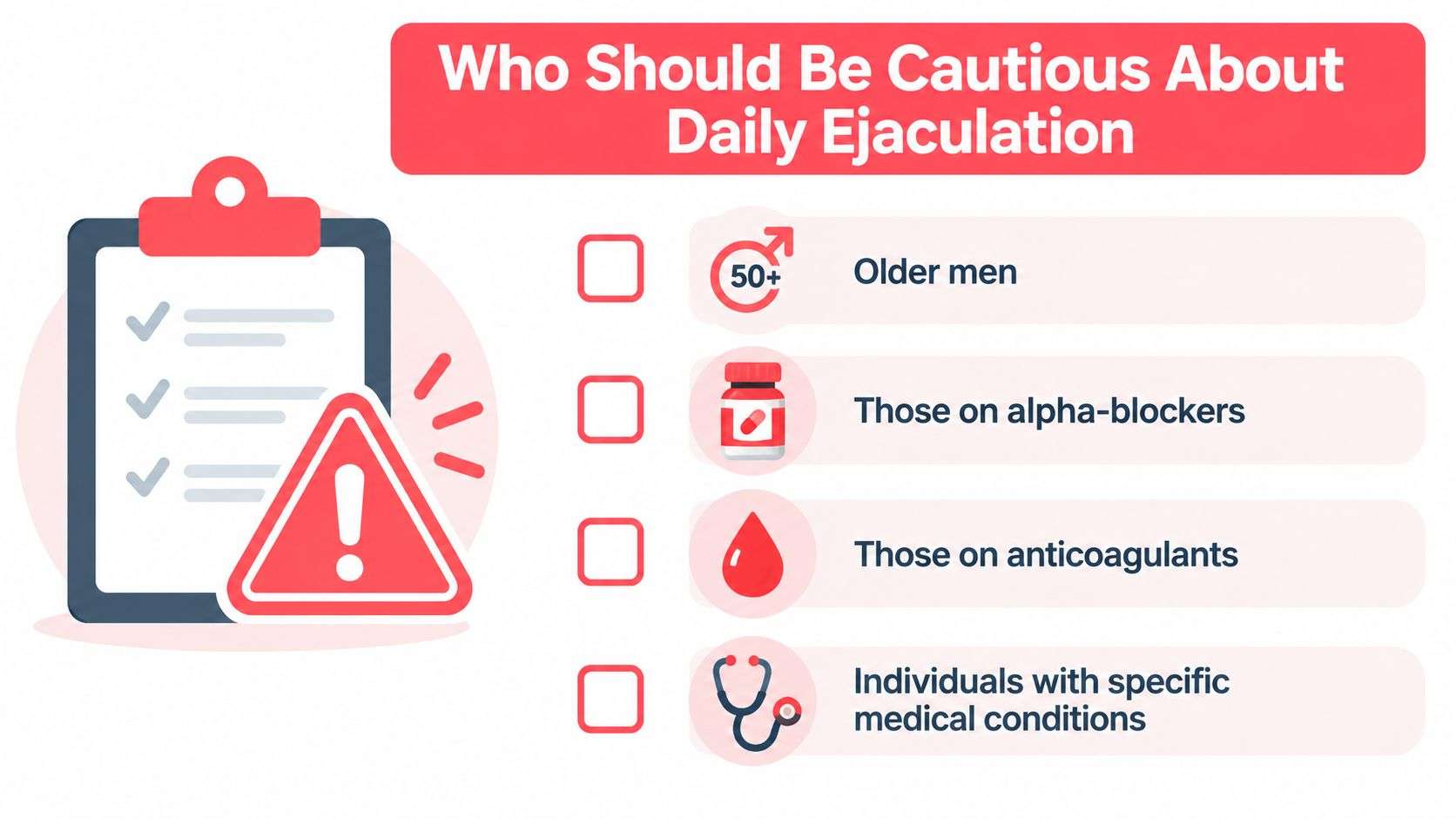
The blanket statement “daily ejaculation is healthy” becomes misleading when a man has pain, a recent procedure, medication-related bleeding risk, or a pattern he can't control. In those cases, the frequency itself isn't the diagnosis. It's a behavior that may interact with another condition.
Symptoms should override generic reassurance
Men with chronic pelvic pain syndrome may notice that ejaculation increases perineal tension or pain. Men with active prostatitis, a urethral stricture, or a urinary infection should follow treatment advice and avoid aggravating activity during a flare. Recent pelvic surgery also changes the question, because tissues, nerves, and pelvic floor muscles may need a staged recovery plan.
Older men taking alpha-blockers or anticoagulants should mention blood in the urine or semen to a clinician, especially if it follows vigorous sexual activity or appears repeatedly. The medication isn't automatically a reason to avoid ejaculation, but it can change the threshold for evaluation.
Men with post-finasteride or post-SSRI sexual symptoms may also need individualized guidance. A strategy designed around maximal frequency may not fit someone dealing with reduced sensation, delayed orgasm, erectile changes, or uncertain recovery.
Compulsion is different from high desire
High libido isn't the same as compulsive sexual behavior. A man may choose daily sex or masturbation, enjoy it, and remain fully present in work and relationships. Concern rises when the behavior feels driven, escalates despite negative consequences, or becomes the main way to manage loneliness, anxiety, boredom, or distress.
Ask yourself whether you can comfortably skip a day without agitation or loss of control. Consider whether pornography, masturbation, or sexual activity is displacing sleep, responsibilities, intimacy, or personal values. If the answer is yes, the appropriate help may involve behavioral health support, not just advice to ejaculate less.
For men with pain, bleeding, recent surgery, or loss of control, “How often should I ejaculate?” is the wrong first question. Start with “What is causing this pattern or symptom?”
Practical Recommendations for Daily Frequency
A healthy daily pattern should feel physically comfortable and remain compatible with the rest of your life. You don't need a special diet, calorie plan, or supplement routine because you ejaculate daily. Semen contains fluid and small amounts of minerals and nutrients, but ordinary food and drink replace those materials without special effort.
Use comfort as your first guide
Lubrication can reduce friction on penile skin and the urethral opening. If you develop soreness, redness, swelling, numbness, or burning, pause until the tissue settles and change the technique or amount of lubrication. Repeated irritation means the current routine isn't working, even if the frequency seems medically acceptable.
The refractory period also limits most men naturally. Some men can become aroused again relatively soon, while others need much longer. Age, fatigue, medication, arousal, stress, and vascular health all influence recovery, so trying to force another ejaculation isn't a useful health practice.
Match the behavior to the goal
Partnered sex, masturbation, and pornography-assisted masturbation can create different demands. Partnered activity may involve more movement and pelvic floor recruitment, while solo activity may involve a very specific pressure or rhythm. Repeatedly using intense grip or a narrow stimulation pattern can make partnered sex feel less responsive for some men, so varying technique and reducing pressure may help.
Pornography isn't automatically a problem, but it can become part of a habit loop when it repeatedly delays sleep, replaces intimacy, or becomes necessary for arousal. If daily ejaculation is comfortable without those consequences, frequency alone doesn't establish a disorder.
Try a simple personal check over two to four weeks:
- Body: Note penile irritation, perineal pressure, urinary symptoms, or pain.
- Function: Watch for changes in erection quality, sensation, orgasm, or partnered sexual response.
- Recovery: Track sleep, energy, mood, and libido rather than assuming ejaculation caused every fluctuation.
- Control: Notice whether you're choosing the behavior or automatically responding to stress or boredom.
Reduce or pause the activity during a urinary infection, prostatitis flare, or pelvic floor spasm, and seek guidance if symptoms persist.
When to Talk to a Clinician and What to Ask
Pain is the clearest reason to stop treating frequency as a self-management question. Arrange medical evaluation for pain during or after ejaculation, blood in semen, painful urination, new erectile dysfunction, persistent pelvic or perineal pain, or a noticeable drop in libido that doesn't resolve.
A clinician should also assess ejaculation problems that affect your quality of life. Premature ejaculation, delayed ejaculation, inability to ejaculate, and orgasm changes can arise from medication effects, anxiety, pelvic floor dysfunction, nerve problems, hormonal issues, or relationship context. The right treatment depends on the cause, not on increasing or decreasing frequency.
A focused appointment checklist
Bring a short symptom history rather than relying on memory:
- Describe the timing: When did the symptom begin, and does it occur every time or only after frequent activity?
- Identify associated signs: Mention urinary changes, fever, discharge, blood, pelvic pressure, or changes in erections.
- Review medications: Include antidepressants, prostate medicines, blood thinners, and hormone treatments.
- Clarify your goal: Say whether you're concerned about prostate health, fertility, pain, performance, mood, or compulsive behavior.
- Ask about testing: Discuss whether PSA context, a prostate examination, infection screening, hormone testing, or semen analysis makes sense for you.
If daily ejaculation feels driven rather than chosen, interferes with work or relationships, or accompanies escalating pornography use, say so directly. That concern belongs in behavioral health as well as sexual medicine, and shame can make an otherwise treatable pattern harder to address.
For men whose concerns extend to erections or sexual performance, a clinician can assess vascular, metabolic, hormonal, medication-related, and pelvic floor contributors. A dedicated erectile dysfunction treatment doctor may discuss established medical options alongside selected regenerative approaches, such as acoustic wave therapy, platelet-rich plasma protocols, or hormone evaluation, when clinically appropriate. Those treatments target function, not ejaculation frequency, and they should be considered only after a proper assessment.
Sexual Wellness Centers of America provides private men's sexual health evaluations in Colleyville, Texas, including assessment of hormonal, vascular, metabolic, and lifestyle factors that may affect erections, libido, ejaculation, and pelvic comfort. If your question about daily ejaculation is connected to erectile dysfunction, Peyronie's disease, hormone concerns, or sexual performance, visit Sexual Wellness Centers of America to learn about available evaluation and treatment options.