
Many individuals think sexual health education is something you finish in school and never revisit. That idea falls apart the first time an adult has to make sense of erectile dysfunction, vaginal dryness, low desire, painful sex, diabetes-related intimacy changes, or the way hormones reshape sexual function over time. Adult sexual health education is not a recycled health class. It's a practical skill set for real bodies, real relationships, and real medical conditions.
The problem is that many people were taught fragments, not a framework. In the U.S., formal sex education reaches nearly everyone before age 18, but the content is uneven, and key skills are often missing or badly timed. Globally, sexuality education is increasingly treated as a public-health tool, not a school topic, because the need doesn't stop at graduation. For adults, that means learning how to ask better questions, read a body's signals, and connect education with care that fits the life you're living.
Table of Contents
- Why Sexual Health Education Does Not End After High School
- The Core Pillars of Adult Sexual Health Education
- The Evidence Behind Sexual Health Education
- Sexual Health Education for Specific Adult Populations
- How Modern Clinics Integrate Education with Regenerative Therapies
- Where Adults Actually Find Sexual Health Information Today
- Your Next Steps for Better Sexual Health Education
Why Sexual Health Education Does Not End After High School
Sexual health education reaches beyond school because adult bodies, relationships, and medical histories keep changing. People deal with intimacy after surgery, diabetes-related changes in arousal, menopause-related discomfort, and medications that affect desire or erectile function. Those questions rarely fit into a school lesson, yet they show up often in adult care.
Adult needs change faster than old lessons do
The main gap is not whether someone once heard about condoms or STDs. The gap is whether they learned how to use that information inside a marriage, after a divorce, with a chronic condition, during hormone shifts, or after months of avoidance. Lifelong sexual health education gives adults language and tools for situations that never came up in adolescence.
Practical rule: if your body, medications, or relationship structure has changed, your sexual health education needs have changed too.
Many adults still carry the school-era idea that asking for help means they missed something. In clinical practice, adult learning is routine care. A person can know the basics and still need a clearer map for libido changes, erection quality, vaginal comfort, or STI prevention later in life.
Why this matters in everyday life
Analysts at the CDC data brief show the core issue clearly. Formal sex education is nearly universal before age 18, but the timing and content are uneven, and many teens do not get complete instruction before first sex. That leaves plenty of adults entering their 30s, 40s, 50s, and beyond with partial information and no structured way to fill the gaps later in life.
That is why sexual health education and whole-person care belong together. Adult sexual health education helps people connect physical symptoms, emotional strain, relationship changes, and medical treatment instead of treating each piece in isolation. When adults take it seriously as a lifelong skill, they are correcting for the fact that many individuals were never taught how sexual health changes over time.
The Core Pillars of Adult Sexual Health Education
Adult sexual health education works best as a connected system. Consent shapes communication, communication shapes contraception choices, STI prevention depends on honesty and follow-through, and inclusivity determines whether advice fits real bodies, real identities, and real relationships.
Consent and boundaries in adult relationships
Adult consent is ongoing communication, not a single yes or no. In long-term partnerships, after childbirth, during recovery, or when pain and fatigue change desire, people need language for checking in and adjusting expectations. That matters because adult consent includes body changes, emotional pressure, and shared history, all of which can complicate what a simple school lesson never covered.
STI prevention and contraception in the real world
Prevention in adulthood starts with matching the method to the situation. That may mean understanding barrier methods, testing timing, changes in monogamy, fertility goals, and the gap between assuming safety and confirming it. Adults also need clear guidance on how to get and use contraception correctly, because theoretical knowledge does not help much if access, technique, or follow-through breaks down in practice.
Communication and inclusivity
Communication is the piece many people avoid until problems build. Adults need to talk about pain, desire, frequency, boundaries, and risk without every conversation turning into a conflict. Inclusivity matters for the same reason. Education that leaves out LGBTQ+ people, disabled adults, and culturally diverse relationships gives people advice they cannot use.
A practical way to organize these pillars is simple:
- Consent keeps sex mutual and current.
- Prevention keeps sex safer.
- Contraception helps align sex with reproductive goals.
- Communication makes the other three possible.
- Inclusivity keeps the education usable for the person in front of you.
The strongest adult sexual health education ties these pillars together and shows how they reinforce each other in daily life, during clinic visits, and inside long-term relationships.
The Evidence Behind Sexual Health Education
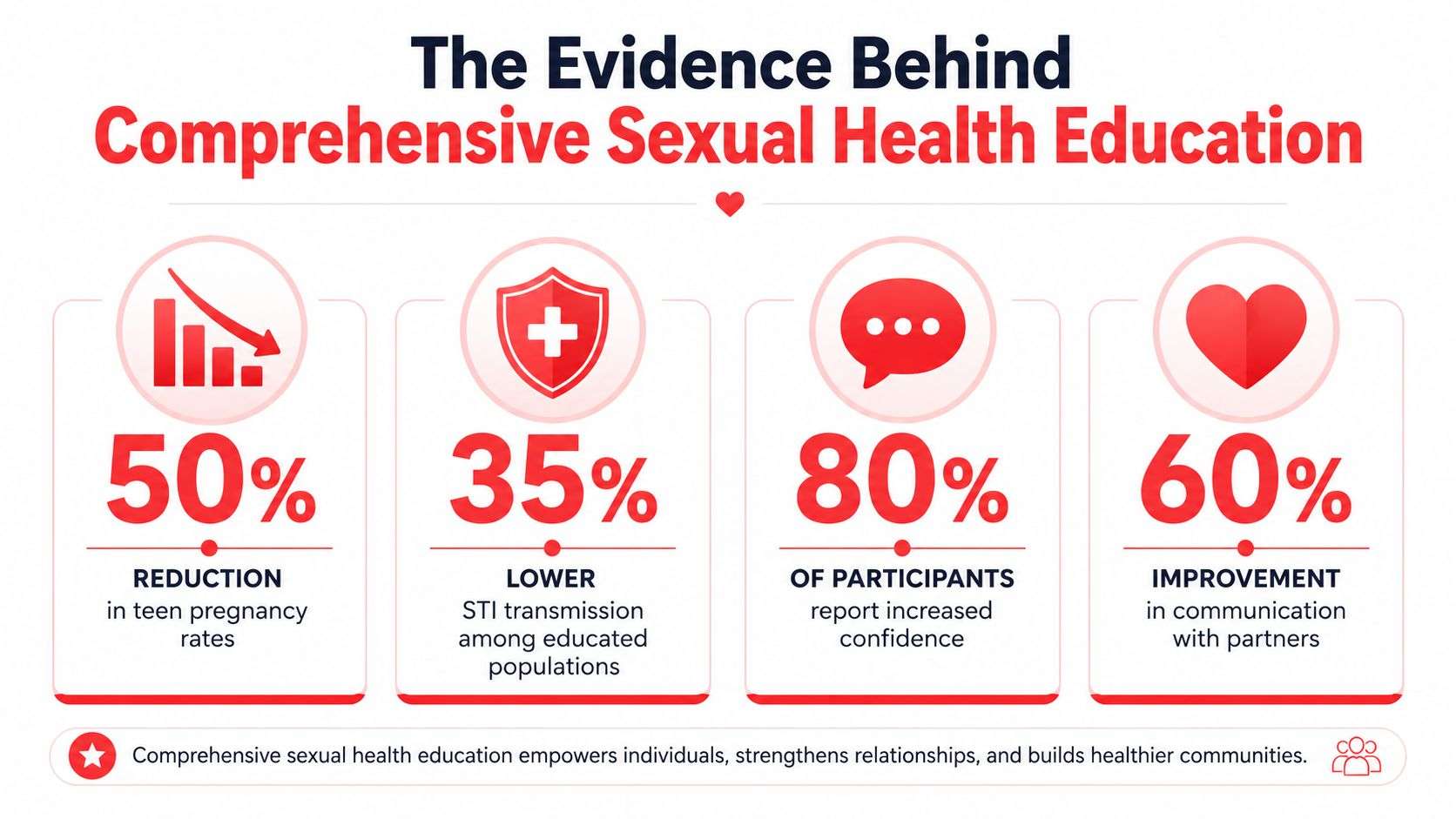
The public-health case for sexuality education is stronger than many adults realize. The World Health Organization describes it as age-appropriate and scientifically accurate, and the broader global evidence base links sexuality education with better prevention behavior and healthier outcomes (WHO fact sheet).
What the data do and don't show
The most important point is that education isn't just about knowledge. It changes behavior. Global secondary analyses summarized in the WHO material report 30% lower teen birth rates and a 15% increase in contraceptive use after sex education (WHO fact sheet). Those are prevention outcomes, but they matter to adults too because they show that structured instruction can change what people do, not just what they know.
The same global picture also shows uneven implementation. Only 55% of countries require sex education for secondary school, 70% have policies supporting it, 80% lack funding for programs, and only 12 countries allocate more than 5% of education budgets to sex education (WHO fact sheet). Policy support exists in many places, but delivery still lags.
Why adults should care about youth data
Some adults dismiss teen-focused findings as irrelevant to them. That misses the point. Youth outcomes show whether a system teaches usable skills well enough to change behavior. If the foundation is weak in adolescence, adults often carry the gap forward into long-term relationships, fertility planning, and chronic-disease care.
The U.S. implementation gap makes that obvious. CDC data show that 96% of female and 97% of male teenagers received some formal sex education before age 18, but instruction on specific prevention skills was uneven, especially around birth control methods. Guttmacher reports that in 2015 to 2019, only 53% of females and 54% of males received sex education meeting the minimum Healthy People 2030 standard, and fewer than half of teens who had penile-vaginal intercourse got that instruction before first sex (Guttmacher fact sheet).
That gap matters in clinic work. Adults who never got clear instruction on contraception, STI prevention, or consent often show up later with avoidable uncertainty, especially when symptoms or relationship changes make the old assumptions stop working. A practical adult approach also connects education with care pathways, including guidance for a women's sexual health clinic, because patients need advice that fits real bodies, real risks, and real treatment decisions.
The core lesson is simple. The issue is not whether education exists. It is whether it arrives early enough, covers the right skills, and stays useful when life changes.
Sexual Health Education for Specific Adult Populations
Adults need sexual health education that matches the condition in front of them. A man with erectile dysfunction needs a clear explanation of vascular, nerve, medication, and hormone factors. A perimenopausal woman needs plain language about dryness, comfort, libido shifts, and what is medically worth evaluating. A person with diabetes needs integrated education because blood sugar, circulation, nerve function, and sexual response all interact.
Men dealing with erectile dysfunction or Peyronie's disease
For many men, the first mistake is treating erection changes as a morale problem instead of a health issue. Sexual health education should explain that function can change with age, cardiovascular status, medication use, stress, and hormone balance. When Peyronie's disease is part of the picture, the conversation also needs to include curvature, discomfort, and realistic expectations about improvement.
Direct questions help here. What might be contributing to the change. Which part is vascular, which part is hormonal, and which part is mechanical. What can be addressed with lifestyle changes, and what needs medical treatment or regenerative care. Men who want a sense of what a clinic experience looks like can also see Advanced Urology reviews to understand how other patients describe their care journeys.
Perimenopausal and postmenopausal women
Women are often told that discomfort or lower desire is just part of aging, which is lazy medicine. Sexual health education should explain how hormone shifts can affect lubrication, tissue sensitivity, arousal, and orgasmic response. It should also make room for the emotional side of the experience, because pain and avoidance can become a cycle if nobody names what's happening.
Targeted guidance matters. A patient may need to discuss hormonal options, vaginal rejuvenation approaches, or symptom patterns that deserve evaluation rather than dismissal. The right conversation is practical, not apologetic. It should help a woman decide what kind of support makes sense for her body and her goals, not force her into a one-size-fits-all script. For a focused care model, this guide to a women's sexual health clinic is a useful place to start.
People with diabetes-related sexual dysfunction
Diabetes changes the sexual health conversation because it can affect blood vessels, nerves, energy, and confidence at the same time. Education here has to be integrated. It should connect metabolic control with intimacy, not treat them as separate worlds.
A patient in this group needs to know what symptoms are likely related to circulation or nerve function, how blood sugar management supports sexual health, and why sexual concerns should be raised during routine care. That kind of instruction is useful because it turns embarrassment into a plan. It also helps people stop blaming themselves for a problem that often has multiple medical drivers.
Barriers to usable information
Adults often know where sexual health information lives, but still cannot use it. Shame, rushed appointments, conflicting advice, and language that skips over real symptoms all get in the way. Education works better when it names the actual problem and gives patients a route to care they can act on.
That is especially true for people who have already spent years making do with partial answers. They need explanations that connect symptoms to likely causes, and they need to hear which changes are worth watching and which ones deserve evaluation now. In practice, that means education must be specific enough to reduce uncertainty, while still leaving room for individual differences in age, medication use, relationship context, and health history.
STI prevention and contraception in practice
Adult prevention is usually about matching method to situation. People in new relationships need different guidance than people in long-term partnerships. Someone who is managing a chronic condition, using hormone therapy, or planning pregnancy needs a prevention plan that fits those realities.
Sexual health education should cover condoms, regular screening, contraception choices, and partner communication in plain terms. It should also address consent and disclosure without making the conversation feel abstract. The goal is not a lecture. It is helping adults choose methods they can realistically use, maintain, and discuss with a partner.
Prevention also changes over time. A method that made sense during one period of life may no longer fit after a diagnosis, a new medication, or a change in relationship status. Adults do better when the conversation stays flexible and reflects what is happening now, not what was true years ago.
How Modern Clinics Integrate Education with Regenerative Therapies
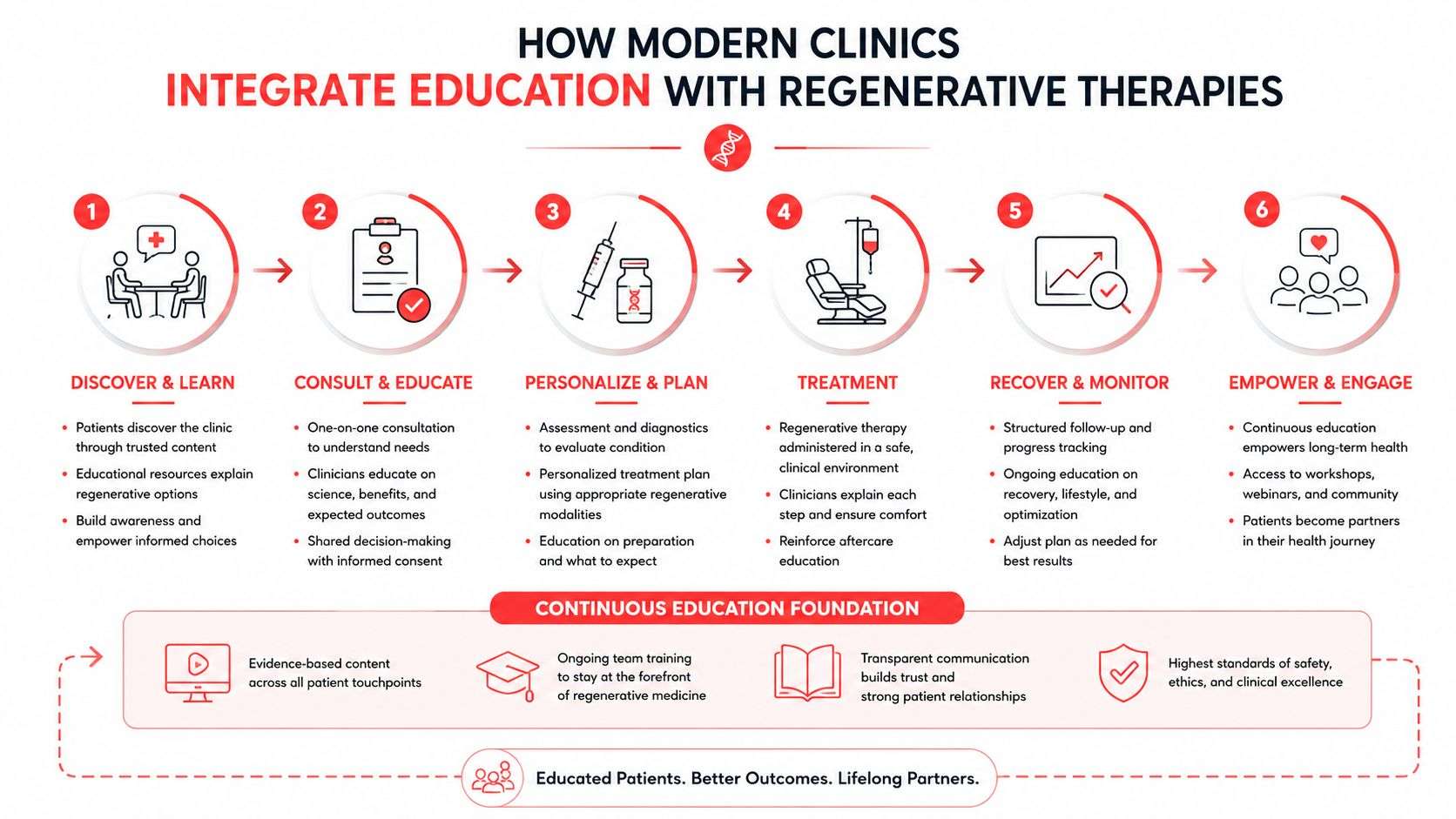
Modern sexual wellness clinics are starting to treat education as part of the treatment, not a separate handout. That matters because adults rarely benefit from procedures they don't understand. When a clinic explains what the lab work means, why a therapy was chosen, and what changes to expect over time, the patient can participate instead of guessing.
How education and treatment fit together
A practical clinic process often starts with a detailed history, then adds hormone and vitamin blood panels, then uses those results to shape recommendations. That's education in action, because the patient learns what the numbers mean and why the next step follows from them. In a sexual wellness setting, that can include options such as acoustic wave therapy, laser therapy, regenerative injections, hormone optimization, peptide support, and complementary care.
The value of that approach is clarity. Adults don't just want a treatment label, they want to know what problem it is targeting and how it fits into the larger picture of sexual function. When those details are explained well, patients are less likely to see care as a series of disconnected procedures.
A clinic model that teaches while it treats
One example is Sexual Wellness Centers of America, which provides adult sexual health and regenerative wellness care in Colleyville, Texas, including the REGENmax® program for men, REGENlase™ laser therapy, REGENwave™ acoustic therapy, HEshot®, SHEshot®, hormone replacement therapy, and lab-guided supplementation. In that kind of setting, the educational part is not separate from the clinical part. It happens when a provider explains why a therapy is being used, what the patient's labs suggest, and how follow-up is structured.
The screenshot below reflects the clinic's education-and-treatment model:
You can also see how this fits into a broader regenerative wellness center model, where symptom relief, education, and maintenance planning are handled together. That combination matters because adults usually need more than a one-time intervention. They need a framework they can carry forward.
Where Adults Actually Find Sexual Health Information Today
Most adults don't get sexual health education from a classroom. They piece it together from search results, conversations, patient portals, social media, and the occasional clinic visit. That creates a quality problem, because not every source is accurate, understandable, or relevant to the person asking the question.
The real barriers to usable information
A recent PLOS One behavior-change analysis identified several barriers to online sexual-health support, including low awareness that services exist, information overload, low perceived relevance, distrust of automated or chatbot responses, and long wait times, especially for underserved populations and people with lower digital literacy (PLOS One analysis). Those barriers explain why good content can still fail. If people can't find it, don't trust it, or don't see themselves in it, they won't use it.
That's also why format matters as much as content. A well-researched page still misses the mark if it's written for an audience that doesn't share the reader's language, culture, or comfort level. Adults need information that feels clinically grounded and personally relevant.
What works better
Clinical education usually works better than generic pages when the issue is personal, sensitive, or tied to a medical condition. A provider can ask follow-up questions, interpret labs, and explain trade-offs in real time. Community education can be useful too, especially when it is culturally responsive and easy to access.
The strongest standard for adults is simple. Good information should be accurate, understandable, and specific enough that you can act on it. If it only gives general reassurance, it probably isn't enough. If it makes the issue feel shameful, it's probably not trustworthy.
Your Next Steps for Better Sexual Health Education
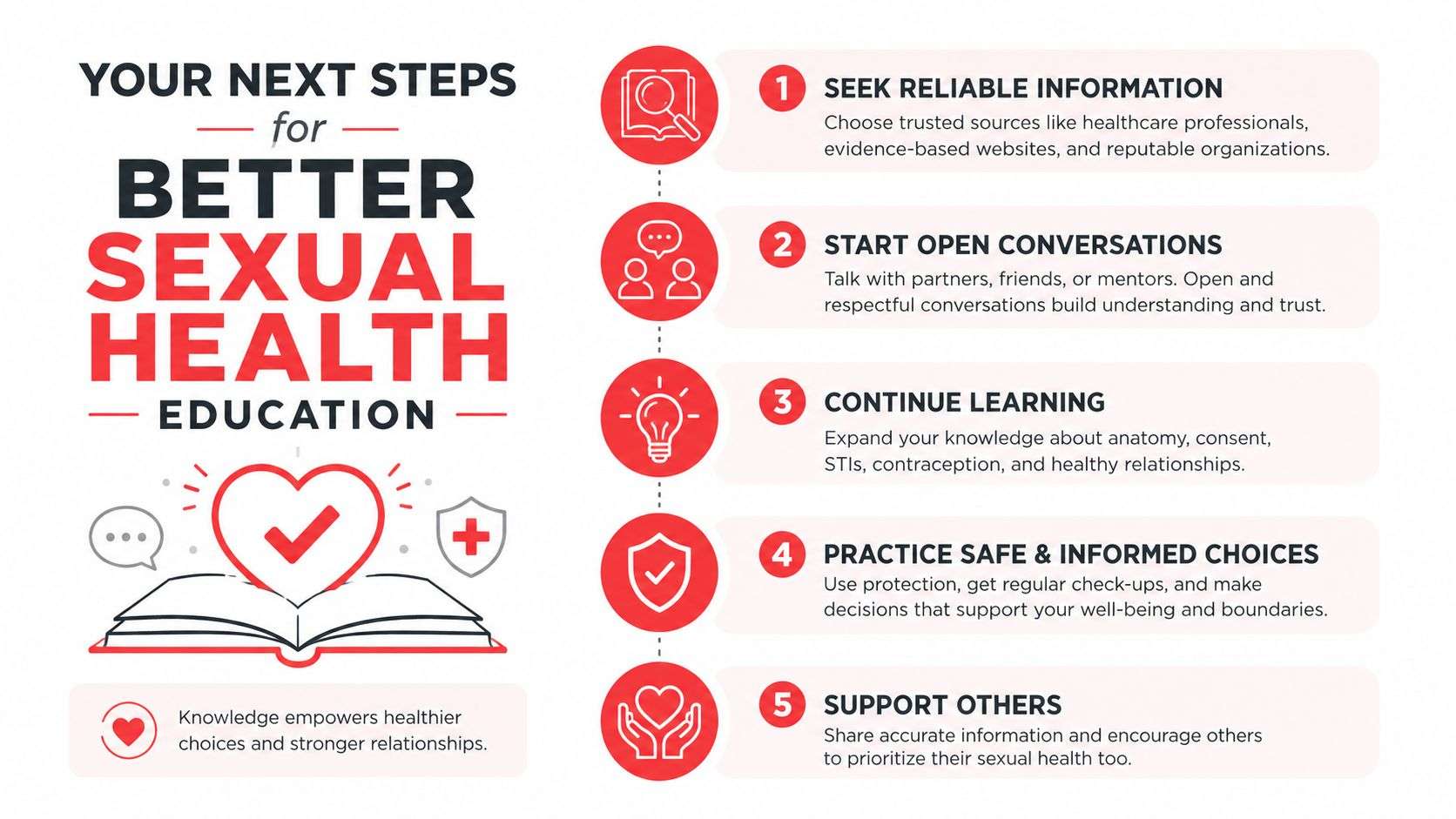
Start by naming the gap, not by trying to learn everything at once. Ask yourself which pillar needs the most attention right now, consent, prevention, contraception, communication, or inclusivity. If your body has changed, your education should change with it.
A simple way to prepare for care
Before an appointment, write down your symptoms, your questions, and the moments that feel confusing or uncomfortable. If you're dealing with erectile concerns, vaginal dryness, low desire, painful sex, or diabetes-related changes, be specific about when the problem started and what makes it better or worse. That level of detail helps a provider tailor education instead of guessing.
A useful consultation should leave you clearer about three things. What is likely driving the issue, what options exist, and what follow-up looks like. If the conversation stays vague, keep asking. Adult sexual health education only works when it becomes practical.
Choosing a provider or program
Look for a clinic that treats education as part of the visit, not an afterthought. Ask whether they explain lab results, discuss trade-offs, and offer maintenance planning when needed. If financing, follow-up, or travel support matters to you, bring that up early so the plan fits your life.
Good care teaches while it treats. If you leave with a procedure but no understanding, you probably didn't get the full benefit.
Keep going after the first appointment. Sexual health education is a living process, and the best results come from staying curious, asking better questions, and updating your plan as your body changes.
If you're ready to turn that knowledge into care, Sexual Wellness Centers of America offers adult sexual health education alongside regenerative therapies, hormone optimization, and structured follow-up in a clinical setting. Visit Sexual Wellness Centers of America to explore options that connect education with treatment for your specific goals.