
A man may notice the pattern after sex, during masturbation, or even after a spontaneous morning erection. Blood enters normally, the penis becomes firm, and then rigidity fades before he wants it to. He may have already tried tablets, injections, or a vacuum device, yet the erection still won't stay hard. That experience can feel psychological, but a persistent failure to maintain rigidity can also reflect veno-occlusive dysfunction, commonly called penile venous leakage.
The right treatment for penile venous leakage depends on whether a true leak exists, how much blood escapes, and whether broader vascular or metabolic erectile dysfunction is contributing. The practical ladder runs from medical and mechanical aids, through acoustic, laser, and regenerative protocols, to embolization and, when necessary, a penile implant. No modality is a universal cure, and severity grading has to come before choosing a procedure.
Table of Contents
- When the Problem Is Not in Your Head
- How an Erection Stays Hard and Where Venous Leak Breaks the Seal
- Grading Severity Before Choosing Any Treatment
- First-Line Medical and Mechanical Options
- Why Regenerative Protocols Come Next in the Modern Pathway
- Embolization as the Modern Interventional Option
- Why Open Venous Surgery Faded and Where Implants Still Fit
- Building a Realistic Treatment Plan You Can Actually Follow
When the Problem Is Not in Your Head
The moment is often simple. A man reaches a firm erection, begins intercourse, and then feels the penis soften without a clear change in desire or stimulation. He may change positions, increase stimulation, or try to ignore the loss of rigidity. The more he monitors it, the more anxious he becomes, but anxiety may be the reaction rather than the original cause.
A physical pattern tends to repeat across settings. The erection may fade with a partner, during masturbation, or after an otherwise normal spontaneous erection. That pattern doesn't prove venous leakage, but it deserves a vascular evaluation rather than an assumption that the problem is purely emotional. Psychological contributors can coexist with vascular ED, and men who need support with that part of the picture can review psychological erectile dysfunction care alongside their medical workup.
What the treatment ladder can and cannot do
The first step is usually a careful history, medication review, examination, and objective testing. If the problem is mild, tablets may improve the nitric-oxide response enough to maintain rigidity. If blood enters but escapes too quickly, a vacuum device with a constriction ring can mechanically hold blood in place, while injections can create a stronger erection through direct smooth-muscle relaxation.
Regenerative acoustic, laser, and injection protocols are sometimes used before an invasive procedure, particularly when the clinician sees a broader vascular ED pattern rather than one isolated draining vein. Their role is to support erectile tissue and vascular function, not to promise that a confirmed high-volume leak has been sealed.
Clinical rule: A man shouldn't buy a treatment based only on the symptom “I lose my erection.” He should first establish whether the problem is arterial inflow, venous trapping, medication response, hormones, metabolic health, anxiety, or a combination.
For a confirmed focal leak that persists despite conservative care, embolization offers a less invasive way to close abnormal venous drainage. A penile implant remains the most dependable option when severe dysfunction persists after other approaches, but it's an irreversible surgical decision and should be discussed without sales language.
How an Erection Stays Hard and Where Venous Leak Breaks the Seal
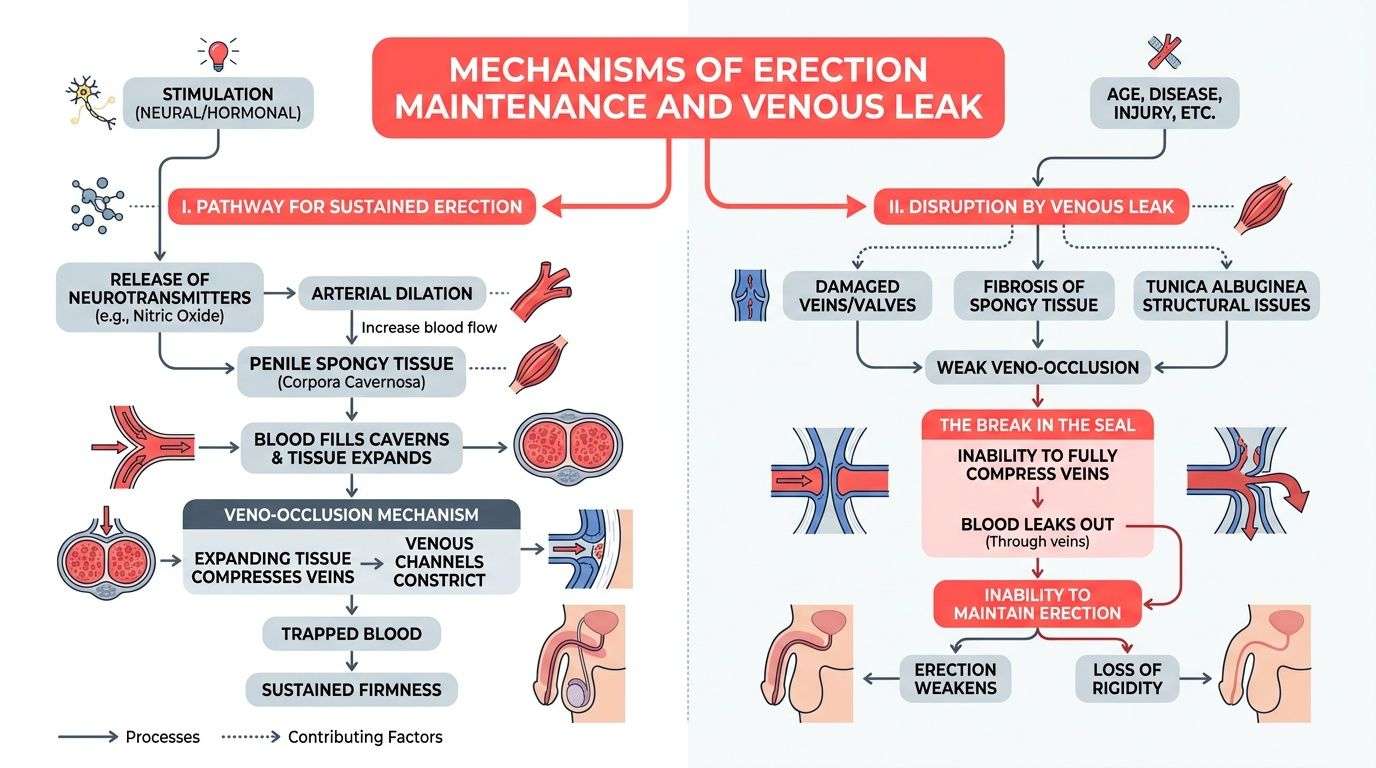
An erection depends on two coordinated events. Arteries bring blood into the corpora cavernosa, the erectile chambers inside the penis. At the same time, smooth muscle relaxes and the expanding erectile tissue presses the small veins against the surrounding tunica, limiting outflow.
That pressure system works like a seal. If the subtunical venules don't compress adequately, if the tunical tissue doesn't provide enough counterpressure, or if abnormal channels drain blood through structures such as the deep dorsal, cavernosal, or crural veins, the penis may fill but fail to remain rigid.
How specialists confirm the suspected leak
A penile duplex Doppler ultrasound usually comes first. The clinician uses an intracavernosal vasodilator to create a controlled erection, then evaluates arterial inflow and the velocity of blood leaving the penis. An end-diastolic velocity above 5 cm/s after pharmacostimulation can support veno-occlusive dysfunction, but the result has to be interpreted with erection quality, medication response, and the testing conditions rather than treated as an isolated diagnosis. The threshold and diagnostic approach are described in the clinical discussion of vascular erectile dysfunction treatment.
If the ultrasound is equivocal, or if an invasive treatment is being considered, dynamic infusion cavernosometry and cavernosography can add information. Cavernosometry measures the infusion required to maintain rigidity, while cavernosography maps the pathways through which contrast leaves the erectile bodies.
The distinction matters because an apparent leak can reflect inadequate smooth-muscle relaxation during testing, anxiety, arterial insufficiency, or a broader vascular problem. A specialist should confirm the hemodynamic pattern before recommending vein occlusion.
Grading Severity Before Choosing Any Treatment
Severity is more useful than the label alone. Two men may both receive a report mentioning venous leakage, yet one may respond to oral medication while the other loses rigidity despite injections. Their treatment plans shouldn't be identical.
Cavernosometry provides one way to estimate leak volume. Maintenance flow below 5 mL/min suggests a milder leak, while flow above 30 mL/min indicates severe veno-occlusive dysfunction. Those figures come from the diagnostic framework described in the supplied clinical plan, but they shouldn't be used as a self-diagnosis. A trained clinician has to connect the flow result with erection quality, Doppler findings, medical history, and the patient's functional experience.
A practical severity framework
The IIEF-5 score adds a patient-reported measure of erectile function. It captures how reliably a man can obtain and maintain an erection, complete intercourse, and remain satisfied. The score doesn't identify a venous leak by itself, but it helps show how the hemodynamic problem affects daily life and whether treatment is producing a meaningful functional change.
| Severity tier | Maintenance flow | IIEF-5 score | Best-match treatments |
|---|---|---|---|
| Mild | Under 5 mL/min | Often closer to the functional range with partial medication response | PDE-5 inhibitors, vascular risk management, selected regenerative protocols |
| Moderate | Between mild and severe patterns | Persistent difficulty despite inconsistent medication benefit | Injections, vacuum therapy, combined regenerative and medical care |
| Severe | Over 30 mL/min | Marked dysfunction with poor durability despite medication | Embolization evaluation, or implant consultation when less invasive options fail |
These tiers are directional, not rigid boxes. A man with a moderate measured leak may prefer a vacuum device because he wants to avoid needles. Another may choose injections because he values stronger rigidity and accepts the inconvenience.
Practical insight: The severity grade prevents a common mistake, spending months repeating a treatment that can't overcome the amount of venous outflow.
A measured leak also doesn't automatically mean the penis is the only vascular system involved. Diabetes, lipid abnormalities, high blood pressure, obesity, sleep disruption, medication effects, and hormonal disorders can all influence erectile performance. Treating those contributors may improve the response to every later rung.
First-Line Medical and Mechanical Options
Most men encounter medication or a mechanical aid before they receive a complete vascular workup. These tools remain useful, but each solves a different part of the problem.
PDE-5 inhibitors amplify the body's nitric-oxide signaling. They can improve inflow and smooth-muscle relaxation, which may help a mild leak become manageable. They don't directly close abnormal veins, so severe veno-occlusive dysfunction often overwhelms the benefit. Food can delay the effect of some oral medications, while others offer a longer response window, but the important clinical question is whether the erection remains firm enough for the patient's intended activity.
A vacuum erection device takes a different approach. Negative pressure draws blood into the penis, and a constriction ring limits outflow mechanically. The device can maintain usable rigidity for about 15 to 20 minutes, according to Cleveland Clinic's overview of venous leak. Some men appreciate its reliability, while others dislike the coolness, hinge effect, or interruption.
Intracavernosal injections, including compounded combinations, act directly on penile smooth muscle. They may begin working within about 10 minutes, as described in the same clinical source. Injections can produce stronger rigidity than tablets, including in moderate or severe cases, but they require instruction and carry risks such as prolonged erection, pain, bruising, and scar formation.
| Option | Onset | Best for severity | Main drawback |
|---|---|---|---|
| PDE-5 inhibitor | Depends on the medication, dose, food, and individual response | Mild leak or mixed vascular ED | Often inadequate when venous outflow is substantial |
| Vacuum device with constriction ring | Rapid mechanical effect | Any severity when the patient accepts the device | Sensation and appearance may feel unnatural |
| Intracavernosal injection | About 10 minutes | Moderate to severe leak | Needle use, dosing risk, pain, and possible fibrosis |
The choice should reflect the man's priorities, not just the test result. A tablet may be worth trying when some spontaneous function remains. A vacuum device can be a practical bridge. Injections are often the strongest nonsurgical option, but they shouldn't be prescribed without careful training and follow-up.
Why Regenerative Protocols Come Next in the Modern Pathway
When oral therapy stops producing a reliable response, surgery is not automatically the next choice. Venous leakage can appear within a broader vascular erectile dysfunction pattern, so tissue-focused care may be reasonable before an irreversible intervention, especially when the diagnosis does not point to one isolated vein.
Low-intensity extracorporeal shockwave therapy is the most developed acoustic option in this group. Proposed effects include mechanotransduction, endothelial signaling, microvascular remodeling, and support for cavernosal smooth-muscle function. It does not close a leaking vein. Its practical role is to improve the erectile tissue environment and possibly increase responsiveness to medication or other treatments. Clinics should not sell it as a dependable seal for severe, anatomically confirmed leakage.
Where laser and platelet-based injections fit
Focused low-level laser protocols use light energy to influence cellular and microcirculatory activity. Their evidence base is smaller and less consistent than that of acoustic treatment, which makes patient selection, baseline testing, and outcome tracking particularly important. Platelet-rich plasma, platelet-rich fibrin matrix, and related injections deliver concentrated biological factors to the treated area. Published findings remain heterogeneous, so no universal success promise is justified.
Descriptions of Sunridge Medical clinic therapies illustrate how non-surgical, tissue-focused care may be presented in clinical practice. Patients can also review educational material on PRP penile injections to understand the treatment category, including its proposed uses and limitations. The diagnosis still determines whether either approach fits.
The case for regenerative care is narrower than claiming it will cure venous leakage. These protocols are repeatable, non-surgical, and can be combined with medication, metabolic care, and sexual counseling. For mild or moderate dysfunction, a better tissue response may make a tablet effective again. With severe leakage demonstrated on testing, regenerative treatment is more appropriately viewed as an adjunct or as a way to assess whether the dysfunction extends beyond the venous finding.
A responsible protocol establishes a baseline, records IIEF scores and erection quality, and sets a review point if function fails to improve. Without those measures, a man may repeat sessions for months without knowing whether the change is clinically meaningful. That uncertainty is the main trade-off: lower procedural burden, but less predictable correction of a confirmed structural leak.
Embolization as the Modern Interventional Option
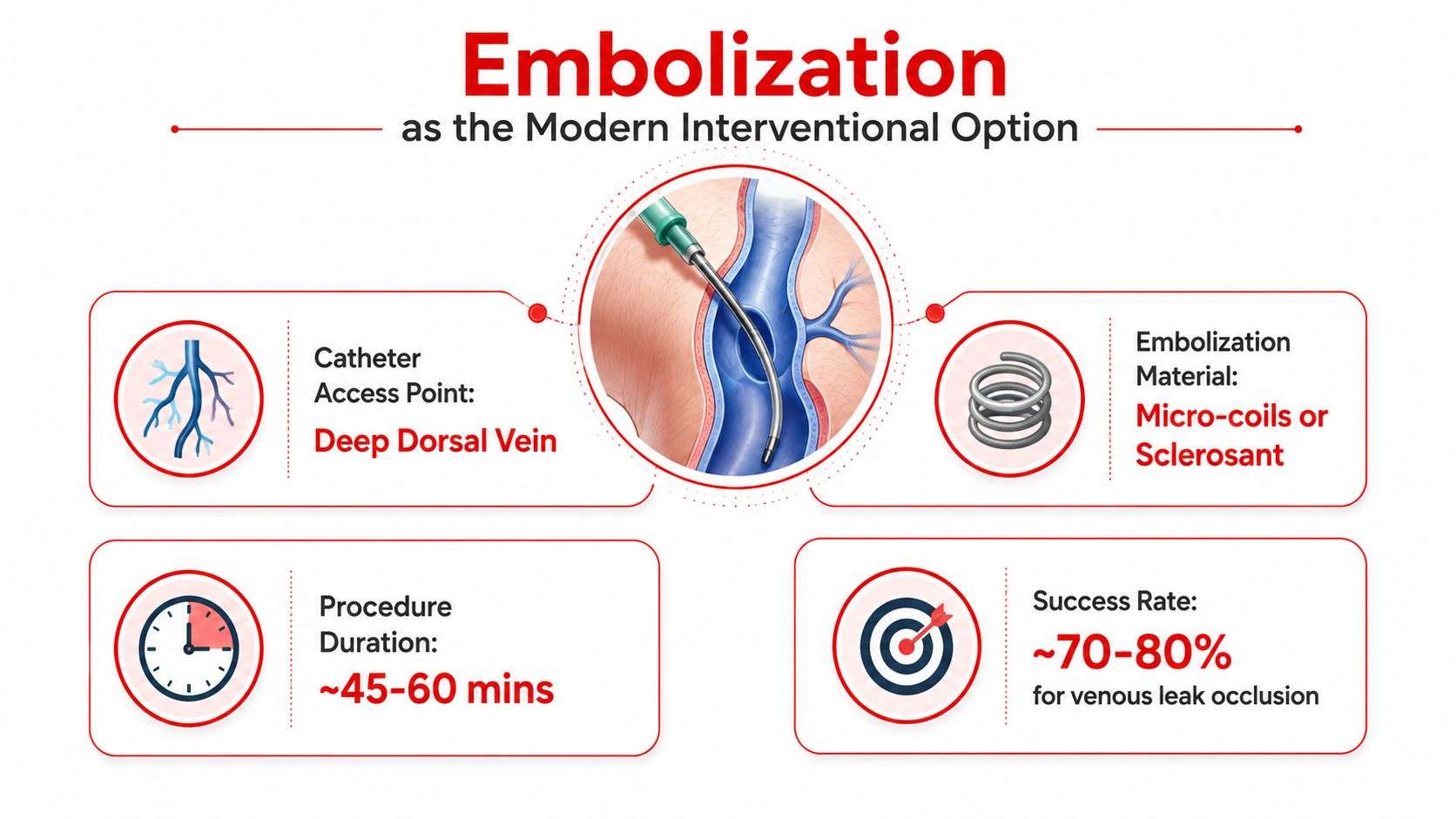
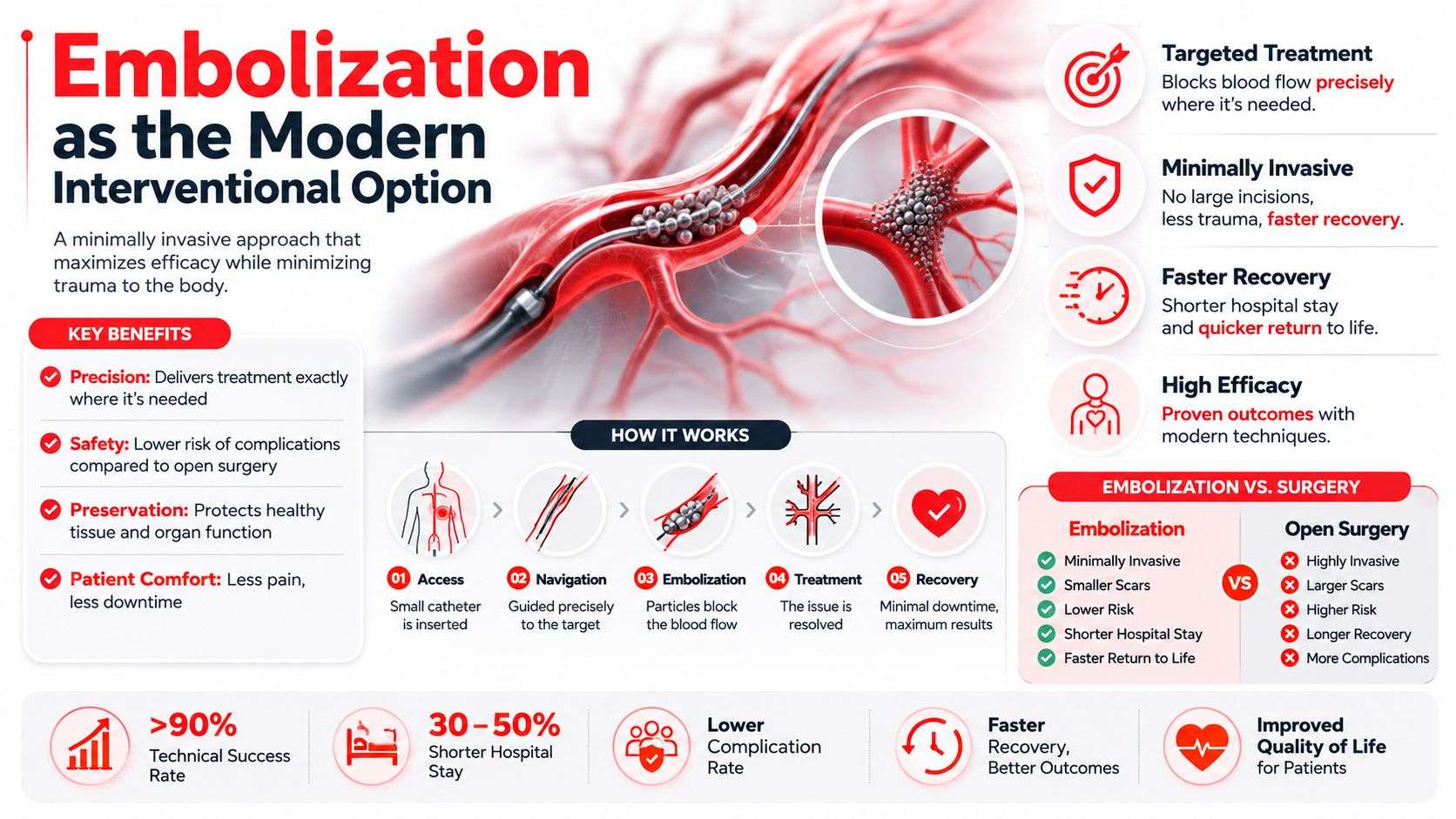
Embolization is a catheter-based procedure designed to close abnormal venous drainage without the incision and dissection associated with older ligation surgery. An interventional specialist uses venography or cavernosography to identify the pathway, advances a catheter through venous access, and delivers an occluding material such as glue, coils, or a sclerosant.
Contemporary reviews describe the deep dorsal penile vein as a preferred antegrade route in appropriate anatomy. The technique is technically demanding because the operator must occlude the target while limiting unwanted migration into adjacent venous channels. Materials and access routes vary according to the anatomy identified during the procedure.
Technical success is not the same as sexual success
A 2021 review reported an overall clinical success rate of 59.5%, with published results ranging from 21.9% to 100%, depending on technique and how success was defined. A 2023 review summarized a meta-analysis with 59.8% overall clinical success, again with a wide range from 22% to 100% across studies. These figures describe clinical outcomes, not a guarantee of unassisted intercourse for every patient, and the definitions varied between studies. The review data are available through the published interventional review.
Technical success can look much higher. A 2022 review reported technical success as high as 97%, with complications around 5%, mostly minor, while major complications such as pulmonary embolism were reported as rare, below 1%. A newer 2026 midterm outcomes study reported technical success in 193 of 194 cases, or 99.5%, while the main feasibility endpoint was met in 82 of 138 patients, or 59.4%. Recurrence or persistence occurred in 18 of 175 patients, or 10.2%, at approximately 16 months. Those outcomes are summarized in the same cited review source.
The trade-offs patients should hear
The procedure is less invasive than open ligation and can be repeated or revised in selected cases. It still carries procedural risks, including contrast reactions, access-site problems, post-procedure pain, temporary sensory changes, thrombosis, and unintended embolization. The most important limitation is that a technically closed vein doesn't guarantee a durable functional result. Collateral drainage and unrecognized arterial or metabolic disease can limit improvement.
Embolization makes the most sense for a man with objective veno-occlusive dysfunction, an anatomically identifiable drainage pattern, and inadequate results from conservative treatment. It's not a substitute for diagnosis, and it isn't automatically preferable to an implant when the leak is severe and the patient wants the most dependable long-term rigidity.
Why Open Venous Surgery Faded and Where Implants Still Fit
Open venous ligation once appealed because it seemed to address the problem directly. Surgeons tied or removed veins thought to be responsible for premature outflow, and early series reported encouraging short-term results. In one long-term follow-up study of venous leak surgery, 19 of 27 men, or 70%, resumed sexual intercourse by three months, while 14 of 22 men remained able to achieve intercourse-sufficient erections at one year. The historical data are reported in the PubMed record for the surgical follow-up study.
The problem emerged over time. The penis has more than one venous drainage route, and collateral channels can develop after the original veins are tied or removed. A 2020 expert review noted that ligation or resection often loses efficacy after 12 months, while medical therapy doesn't directly correct the underlying venous leakage. That durability problem explains why open surgery has largely faded from modern treatment pathways.
Implant surgery answers a different question
A penile implant doesn't try to restore the natural veno-occlusive mechanism. It provides a mechanical means of producing rigidity when the erectile tissue can't deliver a dependable response. Malleable devices remain firm and are positioned manually, while inflatable systems allow the patient to create and release an erection using an implanted pump.
For severe dysfunction, an implant can be the most durable option after medication, injections, vacuum therapy, regenerative care, and embolization have failed or been rejected. It also carries a permanent commitment. The erectile tissue is altered, the operation requires recovery, and infection, mechanical failure, pain, and dissatisfaction remain possible even in experienced hands.
| Outcome metric | Venous ligation, historical | Penile implant |
|---|---|---|
| Primary concept | Close selected draining veins | Create rigidity mechanically |
| Early result | Meaningful short-term improvement reported in historical series | Designed for dependable use after recovery |
| Long-term limitation | Collateral drainage and loss of efficacy | Irreversible surgery and device-related risks |
| Best clinical role | Rarely selected after careful evaluation | Severe, persistent ED when other options aren't acceptable or effective |
Current guidance is conservative about venous ligation because long-term results have been poor, and there isn't a universally standardized venous-leak pathway. Embolization has expanded the interventional choices, but an implant remains the clearest endpoint for men who need reliable rigidity and have exhausted less invasive approaches.
Building a Realistic Treatment Plan You Can Actually Follow
A practical plan begins with confirmation, not a procedure. A man with possible mild dysfunction may start with medication, vascular risk reduction, and careful reassessment. Moderate dysfunction may justify a combination of medical treatment and tissue-focused care before an interventional referral. Severe, confirmed dysfunction deserves an early discussion of embolization anatomy and implant expectations, rather than repeated cycles of treatment that have already failed.
Bring useful information to the consultation
Ask the clinician to review:
- Erection pattern: Record whether rigidity fails during masturbation, partner sex, or spontaneous erections.
- Medication response: Note the medication, dose, timing, food effects, rigidity, and duration.
- Functional score: Complete an IIEF-5 assessment so the baseline is documented.
- Vascular testing: Bring the penile Doppler report and ask whether pharmacostimulation produced an adequate erection.
- Laboratory review: Discuss fasting glucose, lipids, testosterone, and other tests selected for your history.
- Medication and health factors: Review blood-pressure drugs, antidepressants, diabetes, sleep quality, smoking, alcohol, weight, and exercise.
The final pillar is maintenance. Glucose control, lipid management, blood pressure, sleep, weight, smoking cessation, and appropriate hormone evaluation can influence whether an intervention remains useful. A procedure may address one drainage pathway, but it won't erase the vascular conditions that continue to injure erectile tissue.
A 2026 analysis of men with metabolic syndrome and venogenic dysfunction evaluated combined treatment approaches rather than procedure-only care. A related 2026 review reported that only 44% of patients with available follow-up achieved a four-point or greater IIEF-6 improvement after embolization at nine months, reinforcing the need to discuss partial response and adjunctive care rather than promise a standalone cure. The findings are discussed in the published analysis of venogenic dysfunction and metabolic factors.

A useful treatment plan has an exit point for every stage. If tablets don't work, reassess. If regenerative care doesn't produce a measurable functional change, don't continue indefinitely. If embolization improves the scan but not sexual function, investigate arterial inflow, metabolic disease, hormones, medications, and psychological stress before assuming the procedure failed.
Sexual Wellness Centers of America evaluates erectile dysfunction through medical history, vascular assessment, laboratory review, and individualized non-surgical options such as acoustic, laser, and regenerative injection protocols. If you're struggling to maintain an erection and want a structured discussion of treatment for penile venous leakage, visit Sexual Wellness Centers of America to request an evaluation and discuss which step fits your confirmed findings.