
You're probably here because you've seen vitamin D mentioned as a fix for low sex drive, weak erections, low arousal, or just feeling flat in your body. That curiosity makes sense. When libido drops, people often look for a single missing piece, and vitamin D gets a lot of attention because it sits at the intersection of hormones, mood, energy, and overall health.
The problem is that most advice skips the most important point. Vitamin D isn't a universal libido booster. It seems most useful when a real deficiency is present. If your level is already adequate, taking more usually isn't the answer. That distinction changes everything. It shifts the conversation from guessing and supplement stacking to testing, interpretation, and a full sexual health workup.
Low desire is rarely “just in your head,” and it's rarely caused by one thing alone. Stress, relationship strain, vascular health, hormone shifts, metabolic issues, fatigue, depression, medications, pain, and sleep quality can all lower sexual interest. If you've ever felt dismissed or told to relax, this is a better place to start. Sexual wellness is tied to the whole person, which is why sexual health is more than just physical.
Table of Contents
- Is Vitamin D the Missing Link for Your Libido
- How the Sunshine Hormone Fuels Your Sex Drive
- What Clinical Studies Reveal About Vitamin D
- Are You at Risk for Vitamin D Deficiency
- Testing Vitamin D and Understanding Your Results
- A Guide to Safe Supplementation and Realistic Goals
- Beyond Vitamin D A Comprehensive Path to Wellness
Is Vitamin D the Missing Link for Your Libido
Vitamin D is often treated like a simple nutrient, but clinically it behaves more like a prohormone. That matters for libido. Sexual desire and function depend on coordinated hormone signaling, blood flow, nerve function, brain chemistry, sleep, and energy. A deficiency can disturb several of those systems at once.
That's why vitamin D keeps coming up in sexual medicine. It doesn't act like a stimulant. It supports the terrain underneath sexual function. If that terrain is weak because your vitamin D status is low, correcting it may help restore what was missing. If your level is already normal, there's far less reason to expect a dramatic change.
Why the topic gets so confusing
People tend to lump together different problems under the word “libido.” But low desire, difficulty with arousal, erectile dysfunction, reduced orgasm satisfaction, and fatigue-related sexual disengagement are not the same thing. Vitamin D may affect some of the pathways behind them, but it's not a cure-all.
A better question is this: Are your symptoms happening in the setting of deficiency? That's a medical question, not a marketing one.
Clinical mindset: Don't ask whether vitamin D is “good for sex drive” in general. Ask whether low vitamin D is contributing to your specific symptoms.
What works and what doesn't
What works is using vitamin D as one part of a targeted evaluation. What doesn't work is assuming every low-libido problem comes from a vitamin issue. In practice, the most useful role for vitamin D is often foundational. Correct the deficiency, then reassess desire, arousal, stamina, and mood in the context of the rest of the picture.
That's especially important if your symptoms came on gradually. Many patients don't notice one dramatic shift. They notice a cluster of changes. Less interest. More fatigue. Less responsiveness. Less confidence. More avoidance. Vitamin D deficiency can overlap with that pattern, but it rarely explains all of it.
How the Sunshine Hormone Fuels Your Sex Drive
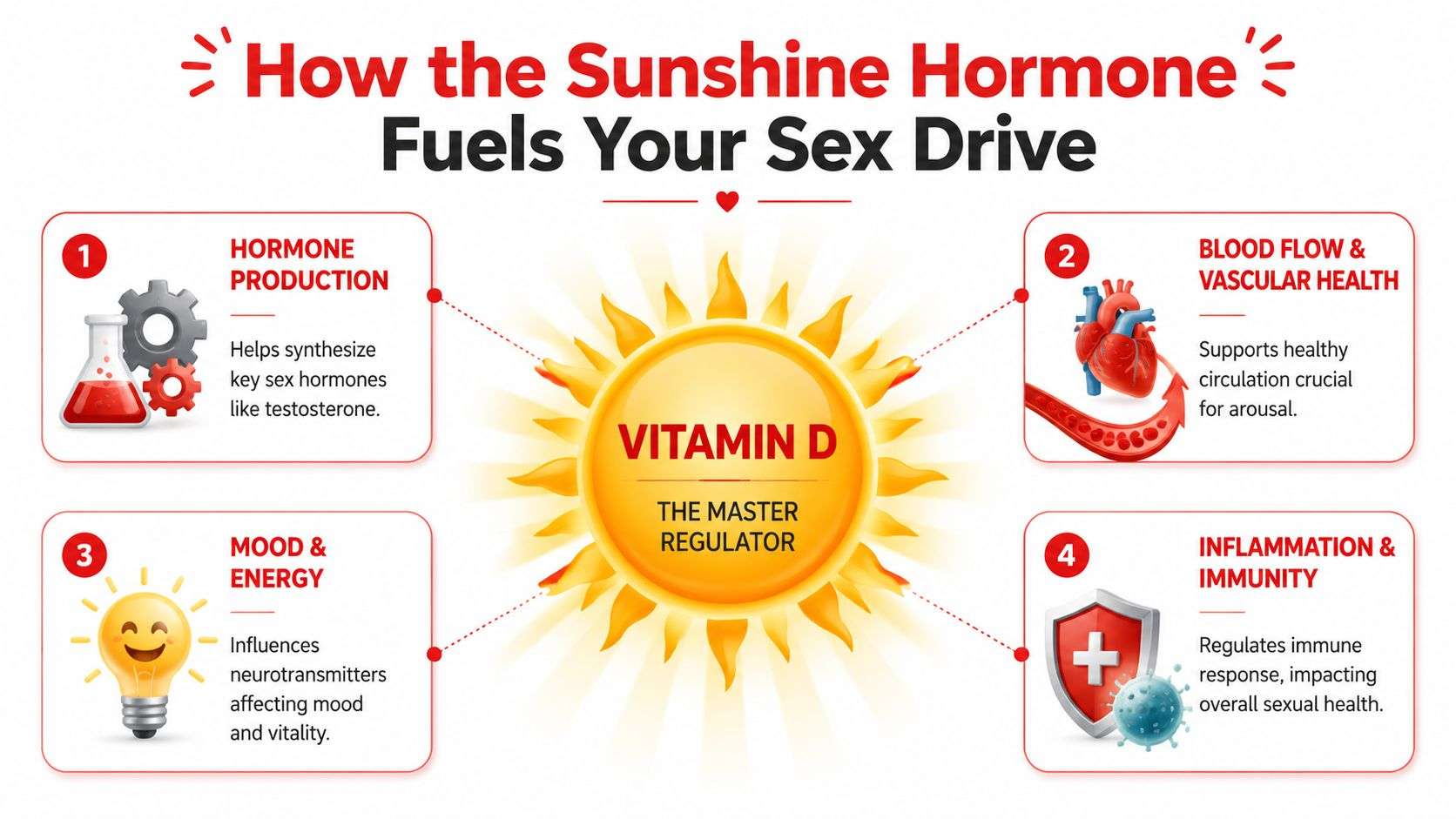
Vitamin D works less like a switch and more like a conductor. It doesn't “create” libido by itself. It helps coordinate several systems that have to function well for desire and performance to feel normal.
Hormones and sexual signaling
A 2025 review on vitamin D and male sexual function summarized several plausible mechanisms. Vitamin D appears to influence steroidogenesis, which is part of the body's hormone production process, and it may support testosterone-related pathways. It also appears to inhibit prolactin, which matters because increased prolactin can suppress sexual interest and function in some patients.
That doesn't mean vitamin D acts like testosterone therapy. It means it may support hormonal balance in the background, especially when deficiency is disrupting normal physiology.
Blood flow and erection quality
The same review noted that vitamin D appears to support erections through endothelial nitric oxide production. That phrase matters more than it sounds. The endothelium is the inner lining of blood vessels, and nitric oxide helps those vessels relax. Good vascular response is essential for erection quality and for healthy genital arousal more broadly.
The review also described a clinically relevant threshold. Men with vitamin D deficiency below 20 ng/mL had a higher rate of erectile dysfunction than men with sufficient levels above 30 ng/mL. One cited analysis found men with low vitamin D were about 30% more likely to have erectile dysfunction than men with adequate levels. Those aren't abstract wellness claims. They point to a measurable blood marker tied to a real sexual symptom pattern.
Brain, motivation, and overall vitality
Libido isn't only about hormones and blood flow. It also depends on motivation, anticipation, reward, and energy. When patients say, “I love my partner, but I just never feel in the mood,” that often reflects a broader drop in vitality.
Vitamin D's role here is indirect. By supporting endocrine and vascular function, and by affecting whole-body wellbeing, it can remove barriers that blunt sexual interest. But that's different from saying it directly creates desire.
Low vitamin D may lower the systems that support desire. Correcting it can help restore baseline function. It doesn't reliably push libido above your normal baseline.
The practical takeaway
If you're thinking about vitamin D libido benefits, focus on mechanism and threshold. Ask whether your body has enough vitamin D to support sexual physiology. Don't expect it to behave like an aphrodisiac. The most realistic expectation is improved support for hormone signaling, vascular response, and energy when deficiency is part of the problem.
What Clinical Studies Reveal About Vitamin D
Mechanisms are useful, but patients want to know something more practical. Does vitamin D improve sexual function in real people? The answer is promising, but mixed.
The strongest pattern in the research
A 2024 systematic review of vitamins and sexual function found that vitamin D was the only vitamin with repeated signals of benefit for female sexual function. That makes it stand out in a field full of bold claims and weak evidence.
But the same review also showed why headlines can be misleading. The outcomes were not uniformly positive.
- One trial used intramuscular vitamin D at 300,000 IU and reported a significant improvement (p<0.05).
- In that study, the Female Sexual Function Index increased from 17.1 to 25.0, which is a substantial absolute difference.
- Another study used 2,000 IU daily for 6 months and found no significant effect (p>0.05).
Those findings matter because they show that dose, route, duration, and baseline deficiency may change the outcome. If two studies use different patient populations and different treatment strategies, they may not answer the same clinical question.
Why one person improves and another doesn't
The threshold-based model offers a useful perspective. If someone starts out deficient and that deficiency is contributing to low desire, poor arousal, or reduced sexual satisfaction, correcting it may help. If someone starts out adequate and takes more vitamin D hoping for a performance boost, the effect may be minimal or absent.
That's the difference between restoring function and trying to “optimize” something that isn't broken.
Evidence-based rule: Mixed research doesn't mean vitamin D doesn't matter. It usually means the right patients benefit more than the wrong patients.
Women, hormones, and life stage changes
Clinical interpretation also has to consider life stage. In perimenopause and menopause, libido changes may involve estrogen shifts, sleep disruption, vaginal dryness, mood changes, and relationship factors alongside nutrient status. For a useful patient-friendly overview of that overlap, Lila's guidance on vitamin D and perimenopause is worth reading.
The bottom line is simple. Vitamin D has some of the better evidence in this category, but it's still not a standalone libido treatment. The best use of the data is to identify who is most likely to respond, then treat with a plan instead of hope.
Are You at Risk for Vitamin D Deficiency
Some people are much more likely to have low vitamin D than others. If your libido has changed and you also feel run down, deficiency becomes a more sensible question to investigate.

Common patterns that raise suspicion
Risk rises when your body makes less vitamin D, absorbs less, or stores it differently. In practice, I'd think harder about deficiency if any of these apply:
- Limited sun exposure: Indoor work, covering most of the skin, or avoiding sunlight for long stretches can reduce natural production.
- Darker skin pigmentation: More melanin can reduce vitamin D synthesis from sunlight.
- Older age: Skin becomes less efficient at producing vitamin D over time.
- Higher body fat: Vitamin D can become less bioavailable.
- Digestive or metabolic issues: Malabsorption and chronic illness can interfere with nutrient status.
If you also have diabetes or insulin resistance, the conversation becomes broader because vascular and metabolic health often affect sexual function at the same time. That's one reason many patients benefit from understanding how diabetes affects your sex life and what to do.
Symptoms people often overlook
Vitamin D deficiency rarely announces itself in one dramatic way. More often, people describe a background decline.
You may notice:
- Fatigue that doesn't fit your schedule
- Lower mood or less resilience
- Muscle weakness or diffuse aches
- Feeling less interested in intimacy
- Less sexual satisfaction, even when desire is present
A trial in vitamin D-deficient women with sexual dysfunction found that vitamin D3 therapy improved sexual function, and the benefit did not appear to be mediated by improved depressive symptoms. That's useful clinically because it suggests the sexual benefit wasn't just a side effect of feeling emotionally better. Other research summarized in the same source supports a link between deficiency and lower self-rated sexual desire, orgasm function, and satisfaction.
When to stop guessing
If your libido has fallen at the same time you've developed fatigue, low energy, reduced motivation, or vague body aches, it's reasonable to test. It's less useful to self-diagnose based on internet checklists alone.
Deficiency symptoms are often nonspecific. Sexual symptoms become more informative when they show up beside fatigue, low mood, and poor overall vitality.
Testing Vitamin D and Understanding Your Results
The only reliable way to know your vitamin D status is a blood test called 25-hydroxyvitamin D, often written as 25(OH)D. This is the lab value clinicians use to assess whether you're deficient, insufficient, or likely adequate.
Testing matters because symptoms alone aren't specific enough. Two people can have the same low libido complaint and need entirely different treatment. One may have a true deficiency. Another may have normal vitamin D but low testosterone, medication side effects, pelvic pain, chronic stress, or sleep apnea.
What the lab actually tells you
The sexual-health relevance of vitamin D starts to become clearer when you view it in ranges rather than as a yes-or-no issue.
| Status | Lab Value (ng/mL) | Implication for Libido & Sexual Function |
|---|---|---|
| Deficient | Below 20 | More reason to suspect vitamin D may be contributing to erectile issues, low arousal, reduced sexual satisfaction, or low vitality. Correction may help if symptoms fit. |
| Insufficient | 20 to 29 | May or may not be clinically relevant. Sexual symptoms could improve if this is part of a broader pattern, but interpretation should stay individualized. |
| Sufficient | 30 and above | Less reason to expect vitamin D repletion alone to improve libido. Other drivers should be evaluated more closely. |
| Potentially high | Above the desired clinical range | More isn't better. Oversupplementation can create avoidable problems and doesn't reliably enhance sexual function. |
How to use the result wisely
A test result should guide a decision, not end the conversation. If your 25(OH)D is low, that's actionable. If it's normal, that's also useful because it helps rule out one common contributor.
Use your result alongside:
- Symptom pattern: low desire, erectile issues, poor arousal, fatigue, pain, or low satisfaction
- Hormone context: testosterone, estrogen balance, thyroid status, and prolactin when appropriate
- Metabolic and vascular factors: blood sugar issues, weight changes, blood pressure, and circulation
- Medication review: many common medications can affect sexual function
One mistake to avoid
Don't start high-dose supplementation blindly and assume you're solving the problem. If you never test, you can't know whether deficiency was present, whether the treatment was necessary, or whether the level improved.
That's especially important with vitamin D libido questions. Patients often spend months taking supplements for a symptom that comes from another cause. A basic lab test can save time and redirect care faster.
A Guide to Safe Supplementation and Realistic Goals
Once deficiency is confirmed, supplementation can make sense. The key is to treat vitamin D like a medical correction, not a performance hack.
D2 versus D3
You'll usually see two forms on supplement labels:
- Vitamin D2, also called ergocalciferol
- Vitamin D3, also called cholecalciferol
In practice, many clinicians prefer vitamin D3 when repleting low levels. But the exact form, dose, schedule, and follow-up plan should match your lab result and clinical situation.
Correction, not endless escalation
The most important expectation to set is this: the goal is to correct deficiency, not chase higher and higher numbers.
A practical evidence summary on this topic notes that the key clinical question is whether vitamin D helps libido only when deficiency is present, and the evidence suggests a threshold-based benefit. Raising vitamin D when levels are already normal may not change libido. That's the nuance many supplement ads leave out.
If your level is low, treatment may help restore sexual function that was being held back by deficiency. If your level is already adequate, more vitamin D usually won't create extra desire.
How to think about dosing
There isn't one universal dose that fits every adult. A person with mild insufficiency, a person with clear deficiency, and a person with malabsorption won't necessarily need the same approach.
What matters most is:
- Confirm the level first
- Choose a clinician-guided dose
- Retest after treatment
- Adjust based on response and labs
That last point gets missed all the time. If symptoms improve but not fully, vitamin D may have been one contributor rather than the only cause. If the lab corrects and nothing changes sexually, that's also useful information. It tells you to look elsewhere.
What safe use looks like
Good supplementation has a clear purpose and a stop point. You identify deficiency, replace appropriately, recheck, and decide what still needs work. Randomly adding more because “it's good for hormones” isn't a strong strategy.
Many individuals feel disappointed. They wanted a simple fix. But sexual medicine rarely rewards oversimplification. It rewards accurate diagnosis.
Beyond Vitamin D A Comprehensive Path to Wellness
Vitamin D matters. It can support hormone signaling, vascular health, and sexual function. It may improve symptoms in the right patient. But it's usually one piece of a larger puzzle.
Why libido problems rarely have one cause
Low desire and sexual performance changes often reflect several overlapping drivers:
- Hormone shifts: testosterone, estrogen, thyroid, and prolactin can all matter
- Vascular issues: arousal depends on healthy blood flow
- Metabolic problems: insulin resistance and inflammation can suppress sexual function
- Pelvic or genital symptoms: dryness, pain, sensitivity changes, or erectile tissue changes
- Stress and sleep: even strong relationships struggle when the body is exhausted
That's why broad education can help. If you're exploring lifestyle support alongside clinical care, this guide to natural ways to enhance female libido offers a practical overview of non-drug factors that can influence desire.
What a mature treatment plan looks like
The best plans don't chase one trendy deficiency after another. They identify the main bottlenecks, then address them in order of impact. Sometimes that starts with vitamin D. Sometimes it starts with hormone evaluation, vascular treatment, medication review, sleep assessment, or a focused discussion about pain, dryness, or relationship strain.
For many adults, hormone balance becomes part of that conversation. If you're evaluating a broader sexual health picture, it helps to understand how hormone replacement therapy can improve sexual health.
Sexual function improves most reliably when care matches the root cause. A nutrient deficiency can matter. So can hormones, blood flow, metabolism, and tissue health.
A clearer way to think about vitamin D libido
Here's the cleanest takeaway. Vitamin D libido support is real in some patients, but it appears to be threshold-based rather than limitless. If you're deficient, correcting that deficiency may help restore normal sexual function. If you're already replete, taking more is unlikely to be the breakthrough you're hoping for.
That's good news, not bad news. It means there's a more precise way to approach the problem. Test first. Interpret the result in context. Treat the deficiency if it exists. If symptoms persist, keep looking until the true drivers are identified.
If you're dealing with low libido, erectile dysfunction, arousal changes, or hormone-related sexual concerns, Sexual Wellness Centers of America offers medical evaluation and personalized treatment for adults who want a clearer answer than trial-and-error supplements. A thorough workup can identify whether vitamin D deficiency is part of the problem, or whether hormones, vascular health, metabolic factors, or regenerative treatment options deserve more attention.