
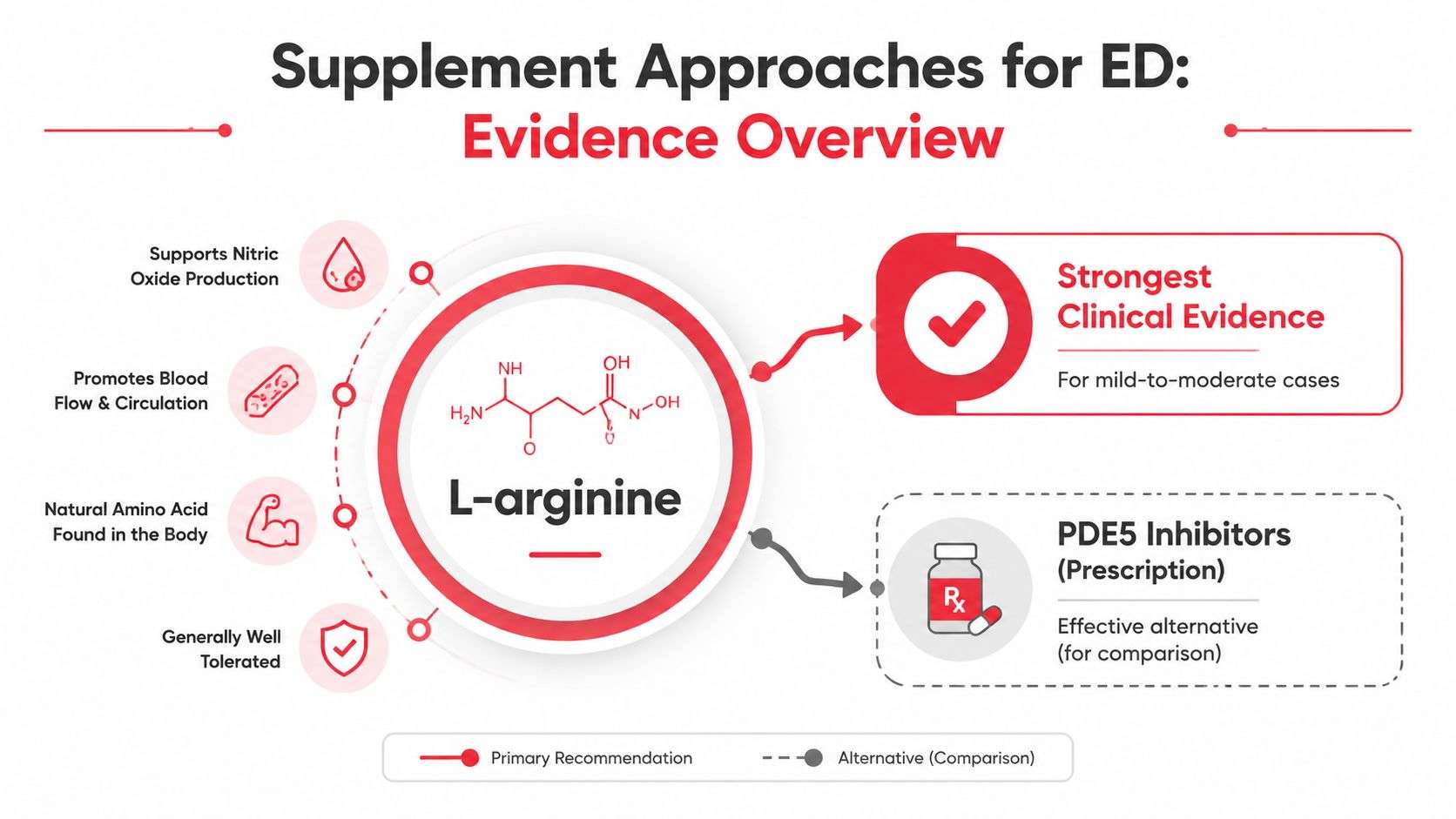
L-arginine is the most evidence-backed supplement for mild-to-moderate erectile dysfunction, with studied doses of 1,500 to 5,000 mg daily. Prescription PDE5 inhibitors remain significantly more effective for moderate-to-severe ED, so supplements shouldn't be treated as universal replacements.
That conclusion is more nuanced than either extreme commonly found online. Natural products aren't automatically ineffective, but they're also not interchangeable with prescription treatment. The meaningful question isn't, “What supplements help with ED?” It's which supplement has a reproducible clinical signal, what degree of improvement is realistic, and when does self-treatment become a reason to seek medical evaluation?
Table of Contents
- How Supplement Approaches Fit Into ED Treatment
- What the Research Actually Shows About Popular Supplements
- How Supplements Target the Biology of Erectile Function
- Practical Dosing, Safety, and Medication Interactions
- When to Pursue Clinic-Based Treatments Instead
- Common Misconceptions About ED Supplements to Avoid
How Supplement Approaches Fit Into ED Treatment
L-arginine has the strongest human evidence among commonly discussed supplements for mild-to-moderate ED. A 2019 systematic review and meta-analysis of 10 randomized controlled trials involving 540 men found that doses from 1,500 to 5,000 mg daily improved erectile function compared with placebo or no treatment. The reported odds ratio was 3.37, with a 95% confidence interval of 1.29 to 8.77 (2019 meta-analysis of L-arginine).
Unlike prescription PDE5 inhibitors, which produce a direct pharmacological effect, supplements support underlying blood-flow biology. L-arginine is involved in nitric oxide production, but any response may be gradual or modest and depends heavily on why ED developed. It should not be treated as a dependable substitute for established medical therapy.
Set a realistic treatment expectation
A supplement trial is easier to justify when symptoms are relatively mild, developed gradually, and a clinician has considered possible contributors such as medication effects, vascular health, metabolic problems, psychological stress, or hormonal changes. Repeatedly switching products is a poor strategy when erections are consistently unreliable, symptoms are worsening, or other health changes have appeared.
Supplement use belongs within supportive care, not diagnostic care. L-arginine may address part of the blood-flow component of ED, but it cannot correct every underlying cause or show whether an apparently healthy man has an untreated condition affecting sexual function.
Practical rule: A supplement can be reasonable to discuss with a clinician, but persistent ED deserves an evaluation instead of an endless search for a stronger bottle.
The evidence has a clear hierarchy. L-arginine shows a reproducible signal in controlled trials, while ginseng has weaker and less certain support. Prescription therapies have a more established role when ED is moderate or severe. Broader lifestyle measures are discussed in this guide to natural remedies for erectile dysfunction, but lifestyle support and supplement evidence should not be treated as equivalent.
Why ED should not be treated as an isolated symptom
Erections require coordinated nerve signaling, smooth-muscle relaxation, blood flow, hormones, and psychological readiness. Supporting one pathway may provide little benefit when another part of that system limits function.
A sensible plan starts with the person, not the product. A clinician can review current medicines, sexual symptoms, health history, and relevant laboratory testing before deciding whether a supplement trial is appropriate. If the response is inadequate, reassess the diagnosis and treatment plan instead of automatically increasing the dose or choosing a more elaborate blend.
What the Research Actually Shows About Popular Supplements
The gap between marketing language and clinical evidence is especially clear when ginseng and L-arginine are placed side by side. A 2021 Cochrane review found that ginseng produced only a trivial average improvement in erectile function when measured with the IIEF-15. Across three studies, the mean difference was 3.52 points on a 1-to-30 scale, and the evidence was rated low certainty (2021 Cochrane review of ginseng).
The same review found no trial evidence comparing ginseng with PDE5 inhibitors such as sildenafil or tadalafil. That absence matters because it prevents a fair claim that ginseng performs similarly to established prescription therapy.
L-arginine has a stronger position. The 2019 analysis cited above found improvements in erectile function, intercourse satisfaction, orgasmic function, and overall satisfaction, although sexual desire didn't change. Its results are more encouraging for men with mild-to-moderate ED than for people expecting a dependable response in advanced or complex cases.
Supplement evidence comparison
| Supplement | Evidence level | Typical dose | Effectiveness |
|---|---|---|---|
| L-arginine | Reproducible signal from randomized trials | 1,500 to 5,000 mg daily | Significant improvement in several erectile-function measures in the analyzed trials |
| Ginseng | Low-certainty evidence | Not established by the cited review | Only trivial average improvement in IIEF-15 erectile function |
| L-arginine plus Pycnogenol | Positive signal across a small trial base | Not standardized in the cited evidence | Improvements across several IIEF domains, with no significant testosterone increase |
The table shouldn't be read as a guarantee. Trial results describe groups, while an individual response depends on health status, product quality, adherence, and the cause of ED. “Natural” also says nothing about interaction risk or manufacturing accuracy.
What about other products?
Many products marketed for sexual performance combine several herbs, vitamins, minerals, or hormone-related ingredients. Without reliable human trials on the exact formulation, it's difficult to know whether the finished product works, which ingredient is responsible, or whether the dose matches the research.
Vitamin deficiencies can matter for overall health, but supplementation isn't automatically an ED treatment. The discussion of vitamin D and libido is useful for understanding why laboratory-confirmed deficiency and sexual symptoms should be considered separately from broad claims made by multi-ingredient products.
Some readers also investigate non-supplement options that act through different pathways. For background on one such prescription-oriented topic, this Peptoro PT 141 guide can provide context, but it shouldn't be confused with evidence for over-the-counter supplements or used without qualified medical guidance.
How Supplements Target the Biology of Erectile Function
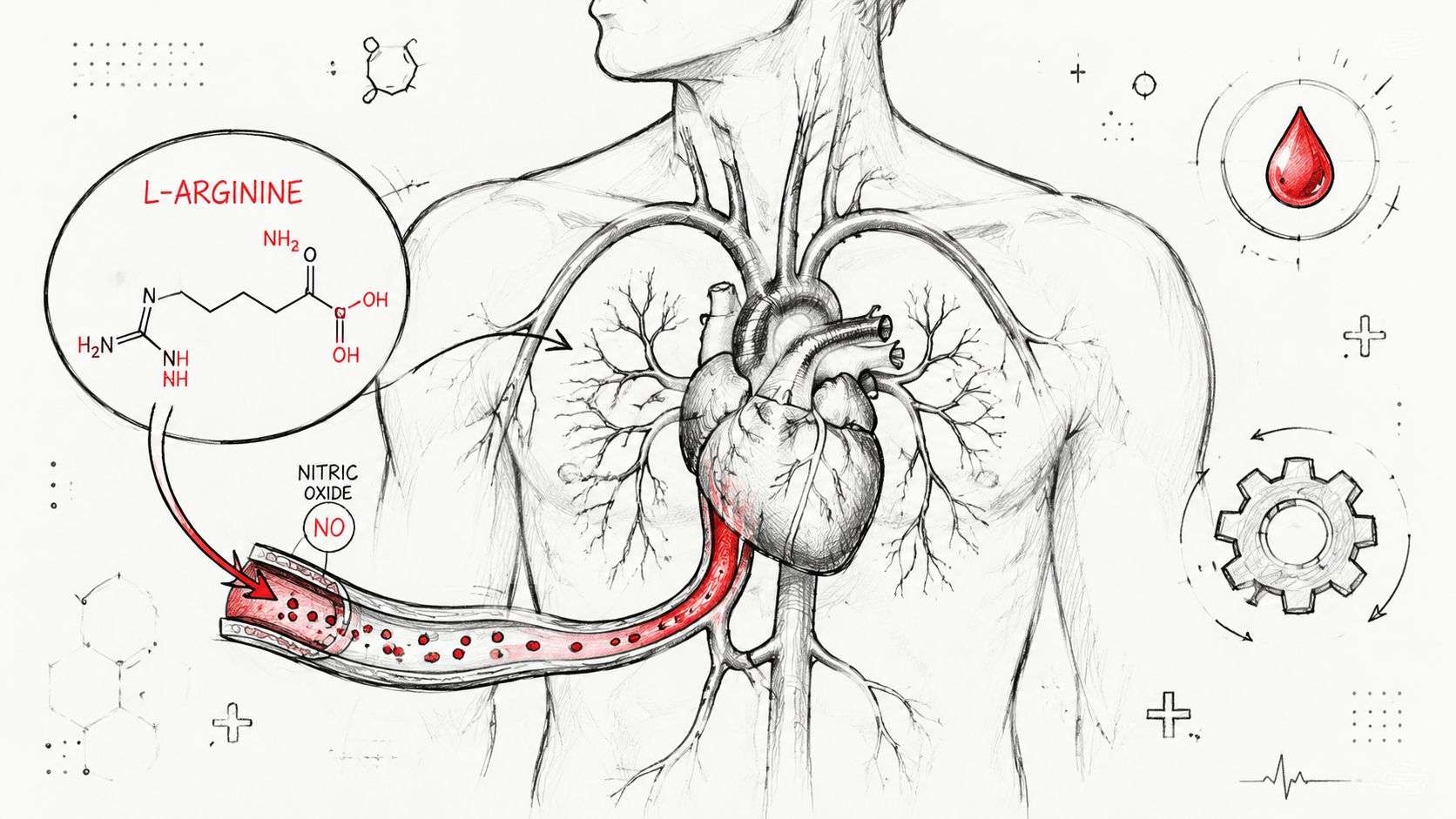
L-arginine is relevant because the body uses it as a precursor in the production of nitric oxide, a signaling molecule involved in vascular smooth-muscle relaxation. During sexual stimulation, nitric oxide helps create the conditions for increased blood flow into erectile tissue. If that pathway is limited, supporting nitric oxide biology may be one reason some men respond to L-arginine.
That mechanism explains both the promise and the limitation. ED is not caused by low nitric oxide in every patient, and an oral supplement can't be expected to overcome severe vascular disease, nerve injury, medication effects, or substantial hormonal problems by itself.
Why combinations may perform differently
A 2023 meta-analysis of L-arginine combined with Pycnogenol, also known as pine bark extract, found significant gains in IIEF erectile-domain scores, intercourse satisfaction, orgasmic function, overall satisfaction, and sexual desire across three studies involving 184 patients (2023 meta-analysis of L-arginine and Pycnogenol). The analysis found no significant testosterone increase.
That pattern suggests a primarily hemodynamic, or blood-flow-related, effect rather than a hormonal one. It also illustrates why a combination may appear more effective than a single ingredient in some populations, while still requiring cautious interpretation because the underlying trial base was limited.
A separate systematic review concluded that PDE5 inhibitors worked better than L-arginine alone. It also found that adding L-arginine to PDE5 inhibitors improved sexual-function and testosterone measures without a clear increase in adverse events. This supports a practical distinction: L-arginine may have a role as an adjunct, but the evidence doesn't support presenting it as a replacement for standard therapy.
Why testosterone is a separate question
Men often assume that stronger erections require testosterone supplementation. Testosterone can influence sexual desire and other aspects of sexual health when clinically low, but a supplement that affects blood flow isn't the same as hormone replacement. The absence of a significant testosterone increase in the L-arginine and Pycnogenol analysis reinforces that distinction.
A proper evaluation should match the intervention to the suspected mechanism. If the main issue is vascular, nitric oxide support may be relevant. If symptoms suggest hormonal dysfunction, laboratory assessment matters. If anxiety, depression, relationship distress, or medication effects are prominent, a supplement alone may miss the most important treatment target.
Practical Dosing, Safety, and Medication Interactions
Safety depends less on the label's “natural” wording than on the person taking the product, the ingredients involved, and the quality of manufacturing. A clinician should review kidney function, blood pressure, cardiovascular history, current medicines, and any other supplements before recommending an ED supplement.
L-arginine can affect vascular tone, so extra caution is appropriate when other treatments influence blood pressure or circulation. The available safety findings describe mostly mild adverse effects, but an apparently tolerable ingredient may still create problems in a person taking several medications or managing cardiovascular disease (2019 safety findings for L-arginine).
Use a cautious process
Review medicines first. Give the prescriber a complete list, including powders, herbal blends, vitamins, and combination products. This matters particularly with medicines for blood pressure, heart disease, or sexual function.
Avoid casual combinations. Nitrates and other blood-pressure-lowering medicines can create safety concerns alongside supplements that affect vascular tone. Prescription-free sale does not establish that a product is safe for a specific person.
Choose traceable products. Prefer clear ingredient labels, batch information, expiration dates, and independent testing. The manufacturer should identify the amount of each ingredient and provide enough information to verify what you are taking.
Treat a failed trial as useful information. If a supervised trial does not help, raising the dose or stacking products can increase exposure without addressing the cause of ED. Stop and reassess rather than treating nonresponse as a reason to keep adding supplements.
A practical guide to choosing safer ED supplements explains manufacturing controls, third-party testing, and certificates of analysis. These checks improve transparency, but they do not show that an ingredient will treat an individual's ED.
When professional review comes first
Speak with a healthcare professional before using supplements if you have cardiovascular disease, take several prescription medicines, have significant blood-pressure concerns, or are considering hormone therapy. Prompt advice is appropriate if ED begins suddenly, follows a medication change, appears with other health symptoms, or continues despite reasonable attention to health and medication factors.
Zinc testing and supplementation also require context. This overview of zinc and sexual health may explain the nutrient's relationship to sexual health, but it cannot replace laboratory assessment or individualized guidance. A verified product can reduce uncertainty about its contents. It cannot replace diagnosis, medication review, or clinical follow-up.
When to Pursue Clinic-Based Treatments Instead
Supplements may be reasonable when symptoms are mild and a clinician agrees that a monitored trial fits the situation. They become a poor stand-alone strategy when ED persists, worsens, causes significant distress, or returns repeatedly despite attention to health and medication factors.
ED can accompany vascular disease, diabetes, neurological problems, medication effects, or hormonal imbalance. That doesn't mean every man with ED has a serious underlying disease, but it does mean ongoing symptoms deserve more than repeated experimentation with unverified products.
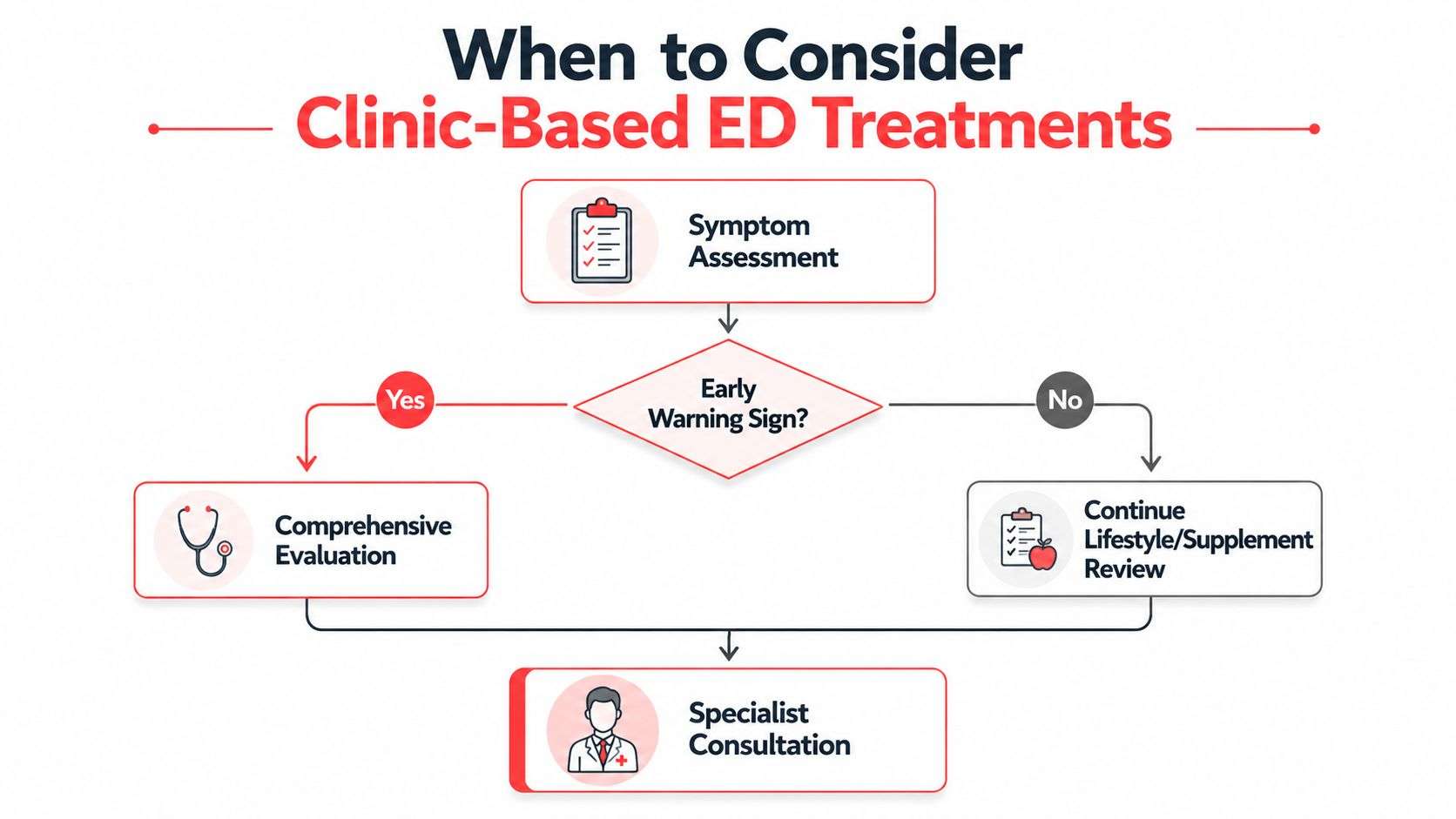
Use symptom pattern as a decision point
A thorough evaluation becomes especially important when:
- Symptoms are persistent: Ongoing difficulty getting or keeping an erection warrants assessment rather than indefinite supplement changes.
- The onset is abrupt: A sudden change can point to a medication, psychological, neurological, or medical factor that needs review.
- Other symptoms appear: Chest symptoms, exercise intolerance, neurological changes, urinary problems, pain, or major changes in libido should be discussed with a clinician.
- Self-treatment creates uncertainty: Mixing products makes it harder to identify side effects and harder to know what, if anything, is helping.
Clinic-based care can add structured evaluation and treatment options that supplements can't provide. At Sexual Wellness Centers of America, the REGENmax® program combines REGENlase™ laser therapy, REGENwave™ acoustic therapy, and concentrated HEshot® injections as a non-surgical protocol. The clinic also offers ED evaluations, hormone and vitamin blood panels, diabetes and ED management strategies, and individualized plans.
Understand what clinic care changes
A clinic protocol isn't automatically superior for every patient, and regenerative claims should be discussed with appropriate attention to evidence, risks, alternatives, and expected outcomes. Its practical value is that evaluation and treatment planning can occur together, rather than leaving a patient to infer the cause from a supplement label.
Readers comparing general men's health products with supervised care can browse a men's health collection, but product availability isn't the same as clinical assessment. The right choice depends on symptoms, health history, goals, and the quality of medical guidance available.
Common Misconceptions About ED Supplements to Avoid
Myth one, supplements can replace prescription medication. L-arginine has a meaningful signal for mild-to-moderate ED, but the evidence also indicates that PDE5 inhibitors work better than L-arginine alone. A supplement may complement treatment in selected cases, yet it shouldn't be marketed as an equivalent substitute for established therapy.
Myth two, every case of ED has a natural solution. Erectile function depends on vascular, neurological, hormonal, medication-related, and psychological factors. A nitric oxide-focused supplement can't correct every problem, and a delayed evaluation can postpone treatment for a condition contributing to sexual symptoms.
Myth three, a higher price means a better product. Cost doesn't establish dose accuracy, clinical effectiveness, purity, or suitability for your health profile. Look for transparent labeling and independent quality controls, then judge the product against actual human evidence rather than testimonials.
Be cautious when a label promises immediate, guaranteed, permanent, or prescription-level results. Be equally cautious when a product contains a long ingredient list but offers no evidence for the finished formulation. Ask a clinician whether the supplement could interact with your medicines, whether testing is appropriate, and what the next step should be if it doesn't work.
The most responsible answer to what supplements help with ED is therefore specific but limited: L-arginine is the best-supported option among the supplements covered here, especially for mild-to-moderate symptoms, while ginseng has low-certainty evidence and only trivial average benefit. Persistent, worsening, or complicated ED calls for medical evaluation rather than a longer supplement list.
Sexual Wellness Centers of America provides erectile dysfunction evaluations, individualized treatment planning, hormone and vitamin testing, targeted supplementation guidance, and non-surgical options such as the REGENmax® program. Visit Sexual Wellness Centers of America to discuss your symptoms with a qualified care team and determine whether supplementation, prescription treatment, or clinic-based therapy fits your needs.