
What Causes Peyronie’s Disease? Here’s What You Need to Know
What causes Peyronie’s disease is one of the most searched questions by men who notice an unexpected curve, pain during erections, or a hard lump under the skin of the penis. The short answer:
The main causes of Peyronie’s disease include:
- Penile trauma – repeated small injuries or a single acute injury during sex or physical activity
- Abnormal wound healing – scar tissue (plaque) forms in the tunica albuginea instead of healing normally
- Genetic predisposition – family history and connective tissue disorders like Dupuytren’s contracture
- Medical conditions – diabetes, erectile dysfunction, hypogonadism, and cardiovascular risk factors
- Prostate cancer surgery – up to 15.9% of men who undergo radical prostatectomy develop Peyronie’s disease
You are not alone in this. Peyronie’s disease affects as many as 1 in 11 men, with those aged 50 to 59 most commonly affected. And in most cases, it is not the result of one dramatic moment – it often builds quietly over time, without a single injury you can point to.
The condition happens when fibrous scar tissue, called plaque, forms inside the tunica albuginea – the tough, elastic sheath surrounding the erectile tissue of the penis. Once that plaque hardens, it stops the surrounding tissue from stretching normally during an erection. The result: bending, pain, and in many cases, difficulty with intimacy.
I’m Jeff Nuziard, CEO of Sexual Wellness Centers of America, and through years of helping men address sexual health challenges, I’ve seen how confusing and distressing what causes Peyronie’s disease can be for patients and their partners. Understanding the root causes is the essential first step toward reclaiming your confidence and quality of life.
What causes peyronie’s disease terms to know:
- Peyronie’s Disease Treatment
- Non-Surgical Treatment for Peyronie’s Disease
- What Are the Treatments for Peyronie’s Disease
What Causes Peyronie’s Disease? The Role of Penile Trauma
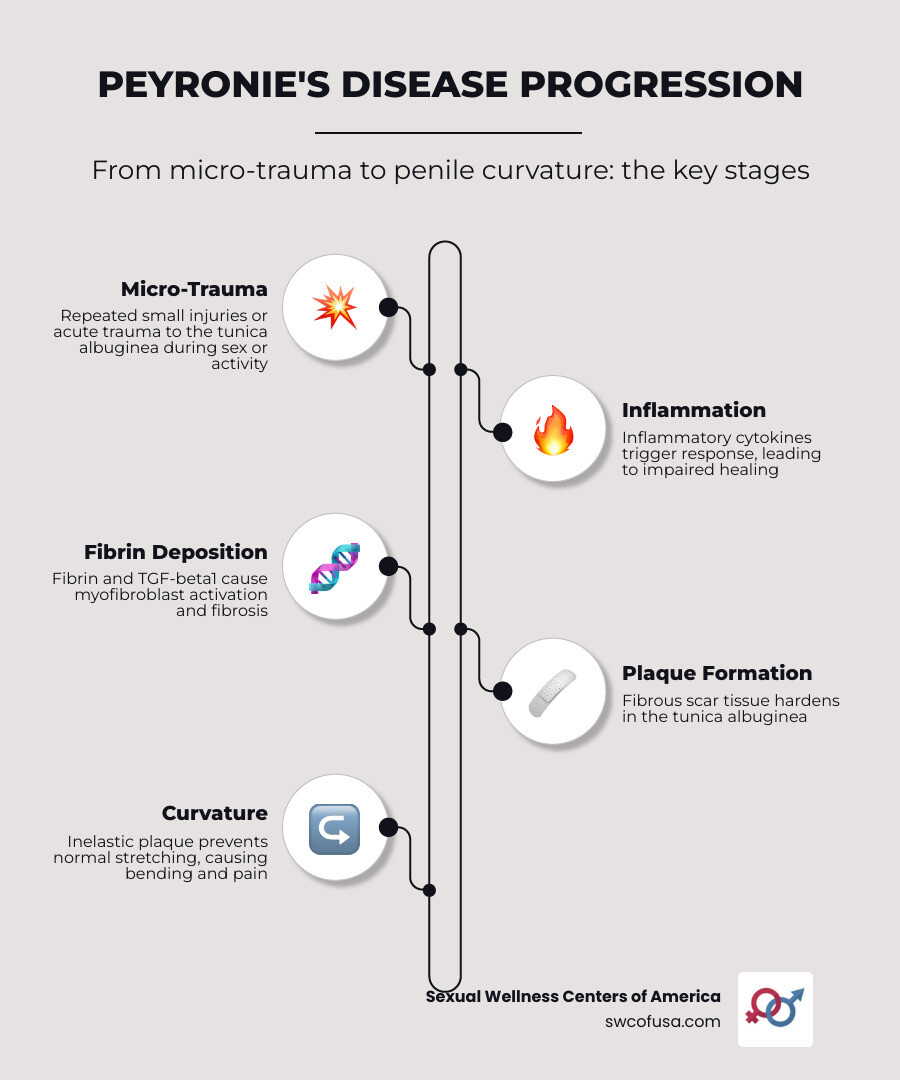
When we talk about what causes Peyronie’s disease, the most widely accepted scientific theory is the “trauma-induction” hypothesis. Think of the penis during an erection like a high-pressure vessel. To maintain rigidity, the internal chambers (the corpora cavernosa) fill with blood, pressing against a tough, fibrous outer layer called the tunica albuginea.
This layer is remarkably strong and elastic, but it isn’t invincible. Trauma to this area can happen in two primary ways:
- Acute Trauma: This is the “oops” moment. It could be a sudden buckling injury during vigorous intercourse or a sports-related accident. In these cases, the tunica albuginea suffers a significant tear or “fracture.”
- Chronic Micro-trauma: This is much more common and often goes unnoticed. It involves repeated, low-grade stress to the penis. For example, if a man has “soft” erections due to early-stage erectile dysfunction, the penis may bend slightly during intercourse. These tiny, repetitive bends cause micro-vascular injuries and microscopic tears in the fibers of the tunica albuginea.
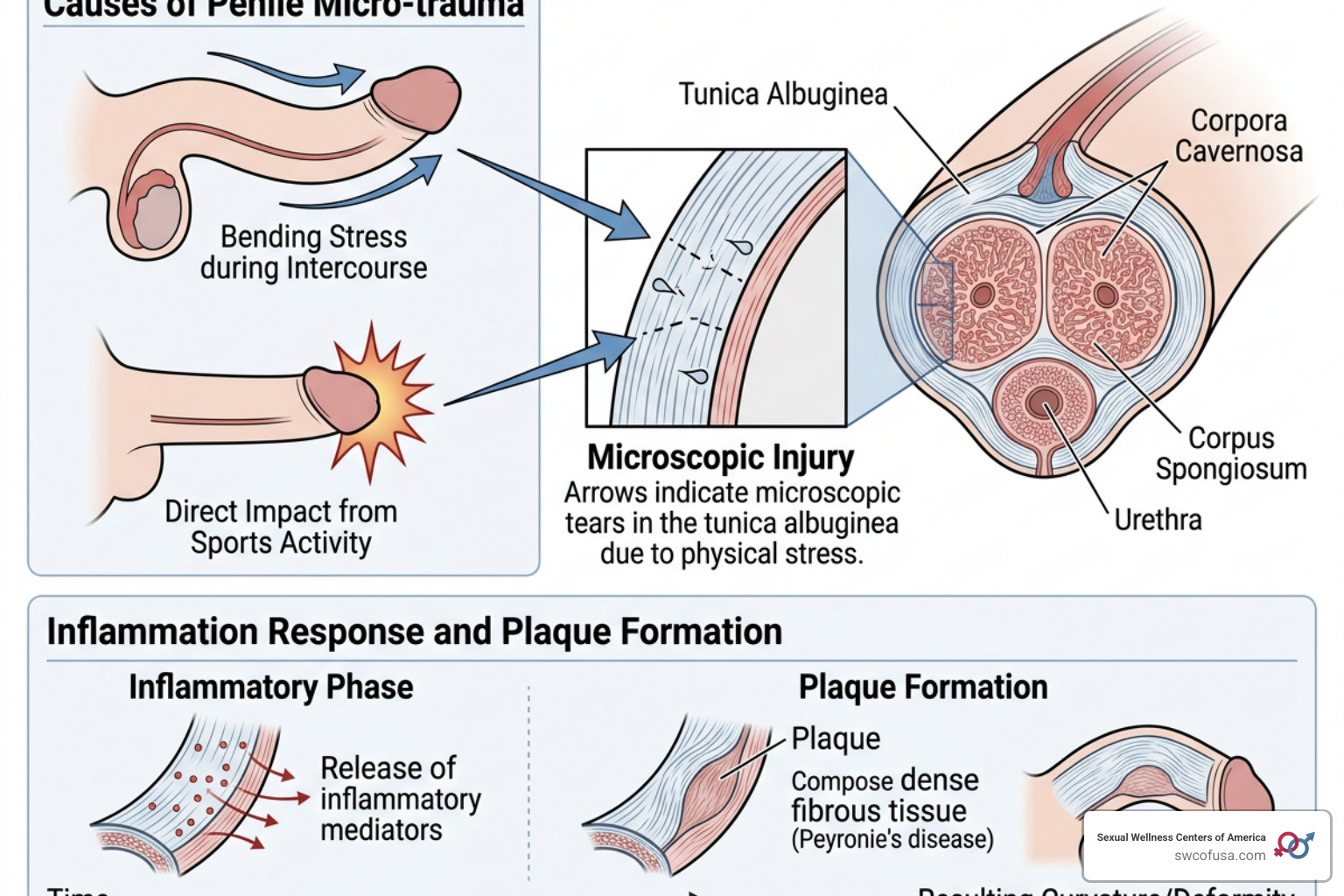
Under normal circumstances, the body heals these tiny injuries without a fuss. However, in men susceptible to Peyronie’s, the healing process goes off the rails. Instead of neatly repairing the tissue, the body initiates an exaggerated, disorganized inflammatory response. This is where the Continuing Education Activity on Peyronie disease highlights the disorder as a failure of wound healing.
Understanding what causes Peyronie’s disease at a cellular level
To truly grasp what causes Peyronie’s disease, we have to look under the microscope at the cellular “glitch” that creates the plaque.
When the tunica albuginea is injured, the body releases a protein called Transforming Growth Factor-beta 1 (TGF-β1). In a healthy person, TGF-β1 helps manage repair. But in Peyronie’s patients, this protein stays “turned on” for too long. This leads to several problematic processes:
- Fibrin Deposition: Fibrin is a protein involved in blood clotting. Research has shown that fibrin acts as an inducer of fibrosis in the penile tissue. It gets trapped in the layers of the tunica albuginea, acting like a permanent “scaffold” for scar tissue.
- Myofibroblast Activation: The body recruits cells called fibroblasts to fix the injury. Under the influence of excess TGF-β1, these cells turn into myofibroblasts—aggressive cells that produce massive amounts of collagen.
- Collagen Alterations: Instead of the flexible, organized collagen found in healthy tissue, the body produces thick, disorganized “Type I” collagen. This creates an inelastic, leathery patch.
- Oxidative Stress: The site of injury becomes flooded with “free radicals,” which further damage the surrounding healthy tissue and prevent the scar from breaking down naturally.
The result is a plaque that is essentially a biological “speed bump.” During an erection, the healthy side of the penis expands, but the side with the plaque stays rigid. This uneven expansion is exactly what creates the curve.
Inflammation and what causes Peyronie’s disease to progress
Peyronie’s disease isn’t a static condition; it evolves through two distinct phases. Understanding these phases is crucial for knowing when to seek help at our Colleyville, TX location.
- The Acute Phase (The Inflammatory Phase): This is the “active” period, which can last anywhere from 5 to 18 months. During this time, the plaque is still forming. Men often experience pain during erections, and the curvature may continue to worsen. This is the stage where the body is actively trying (and failing) to heal the injury.
- The Chronic Phase (The Stable Phase): Eventually, the inflammation subsides. The natural history of Peyronie’s disease suggests that for most men, the pain disappears during this phase. However, the plaque often becomes harder and may even undergo “calcification,” where it starts to feel like a small bone or piece of glass under the skin.
While about 12% to 13% of cases might see a slight spontaneous improvement, the vast majority of men find that their curvature either stays the same or worsens without intervention. This is why “waiting it out” is rarely a successful strategy.
Genetic Factors and Inherited Risks
Is it just “bad luck,” or is it in your DNA? Research suggests that genetics play a significant role in what causes Peyronie’s disease. If you have a family history of the condition, your risk is notably higher; studies indicate that up to 4% of first-degree relatives of affected men will also develop the disease.
One of the strongest genetic clues is the link between Peyronie’s and Dupuytren’s contracture. Dupuytren’s is a condition where the connective tissue in the palm of the hand thickens, causing the fingers (usually the ring and pinky) to curl inward.
The association between Peyronie’s and Dupuytren’s disease is striking: roughly 22.1% of men with Peyronie’s also have Dupuytren’s. They are essentially two versions of the same “over-scarring” problem.
| Connective Tissue Disorder | Association with Peyronie’s Disease | Key Characteristic |
|---|---|---|
| Dupuytren’s Contracture | High (22.1%) | Fingers curling into the palm |
| Ledderhose Disease | Moderate | Fibrous lumps on the soles of the feet |
| Tympanosclerosis | Noted in research | Scarring of the eardrum |
| Systemic Sclerosis | Rare but linked | Hardening of skin and internal organs |
Other genetic factors include the presence of specific markers like HLA-B7 antigens, which are associated with autoimmune responses. Some researchers have even found “chromosomal instability” in the fibroblasts of men with Peyronie’s, meaning their cells are naturally more prone to behaving erratically when triggered by an injury.
Associated Medical Conditions and Risk Factors
While trauma might be the “trigger,” certain medical conditions create the perfect environment for Peyronie’s to thrive. We often see these comorbidities in our patients in Colleyville, and addressing them is part of our comprehensive approach to wellness.
1. Diabetes Mellitus Diabetes is a major player in what causes Peyronie’s disease. High blood sugar levels damage small blood vessels and interfere with the body’s ability to heal. Research on Peyronie’s development in diabetic men shows that men with diabetes-related erectile dysfunction are 4 to 5 times more likely to develop the condition than the general population.
2. Erectile Dysfunction (ED) The relationship here is “bidirectional.” ED can lead to Peyronie’s because “soft” erections are more likely to bend and suffer micro-trauma. Conversely, Peyronie’s can cause ED by damaging the “vein-blocking” mechanism required to keep blood in the penis. It’s estimated that 30% to 60% of Peyronie’s patients also struggle with ED.
3. Radical Prostatectomy Surgery for prostate cancer is a life-saving procedure, but it can have side effects. Approximately 15.9% of men develop Peyronie’s disease following a radical prostatectomy. This may be due to the temporary loss of nocturnal erections, which leads to a lack of oxygen in the penile tissues (hypoxia), triggering the formation of scar tissue.
4. Hypogonadism (Low Testosterone) Testosterone is vital for maintaining the health of penile tissues. Studies have found that men with low testosterone (below 300 ng/dL) often have more severe curvature. Testosterone helps regulate the enzymes that break down collagen; without enough of it, the “scarring” process can run wild.
5. Age and Lifestyle While it can affect teenagers, the average age of presentation is 55. As we age, our tissues lose elasticity, making them more prone to injury. Smoking and high cholesterol also contribute by damaging the vascular system, which is represented by our focus on systemic vascular health.
Frequently Asked Questions about Peyronie’s Disease Causes
Is Peyronie’s disease always caused by a sudden injury?
No. In fact, up to 80% of men do not recall a specific “snap” or injury. For most, what causes Peyronie’s disease is a series of “silent” micro-injuries that occur during normal sexual activity over many years. If your erections aren’t as firm as they used to be, the risk of these micro-injuries increases significantly.
Can genetics make me more susceptible to penile scarring?
Absolutely. If you have “Viking ancestry” (where Dupuytren’s is most common) or a family history of fibrotic conditions, your body may be genetically “programmed” to over-produce scar tissue in response to minor irritation. It’s not that you’re more prone to injury, but rather that your body’s “repair crew” is overzealous.
How does diabetes increase the risk of developing plaque?
Diabetes causes a process called “advanced glycation,” where sugar molecules attach to proteins like collagen. This makes the collagen stiffer and harder for the body to break down. Combined with poor blood flow, this makes the tunica albuginea much more likely to develop permanent, inelastic plaques.
Conclusion
Understanding what causes Peyronie’s disease is the first step toward finding a solution. It isn’t just “bad luck”—it’s a complex interaction of physical stress, biological glitches, and underlying health factors.
At Sexual Wellness Centers of America in Colleyville, TX, we don’t believe in a one-size-fits-all approach. We know that your situation is unique, which is why we start with comprehensive hormone and vitamin panels to see the “big picture” of your health.
We offer innovative, non-surgical treatments designed to address the root causes of the condition:
- HEshot®™: Utilizing your body’s own growth factors to stimulate healthy tissue repair and break down fibrin.
- REGENwave®: Using low-intensity extracorporeal shockwave therapy to break up calcified plaque and stimulate new blood vessel growth (neovascularization).
- REGENmax® technology: Our specialized protocol for cellular rejuvenation.
Our goal is to move you from the “why me?” phase into the “what’s next?” phase. With a 97.2% efficacy rate in erectile dysfunction reversal and a deep specialization in Peyronie’s, we are here to help you straighten things out.
If you’re ready to take the next step, explore our comprehensive guide to Peyronie’s disease management or contact us today for a personalized consultation. You don’t have to live with the curve—let’s work together to reclaim your sexual wellness.