
You're staring at more hair in the shower, wondering whether it's B12, stress, hormones, iron, or something else entirely. That uncertainty is where many get stuck, because the supplement aisle offers a simple story while the scalp usually tells a more complicated one. B12 and hair loss is a real clinical question, but it's rarely the whole answer.
A practical approach starts with a better question, not a quicker purchase. If you're looking for a broader overview of how nutrition fits into shedding, prevent hair loss with nutrition is a useful starting point, but the value comes from pairing nutrition with a proper workup.
Table of Contents
- The B12 and Hair Loss Question So Many People Get Wrong
- How B12 Works Inside the Hair Follicle
- What the Research Says About B12 and Hair Loss
- Symptoms and Risk Groups That Should Raise a Flag
- How B12 Is Tested in a Modern Clinic
- Safe Supplementation Strategies and What to Expect
- Other Common Causes of Hair Loss That B12 Cannot Fix
- When to Seek Clinical Evaluation and What a Hair Plan Looks Like
The B12 and Hair Loss Question So Many People Get Wrong
The usual pattern is familiar. Someone notices more shedding, searches for a single cause, and lands on B12 because it sounds clean, natural, and fixable. That instinct is understandable, but it often skips the step that matters most, deciding whether the vitamin is low and whether it belongs in the causal chain at all.
B12 is a real nutrient with a real role in the body, and hair can be affected when deficiency is present. The problem is the leap from “this nutrient matters” to “this must be my problem,” which is where a lot of people spend months chasing the wrong target.
Practical rule: If the shedding is diffuse, persistent, and happening alongside fatigue or anemia-type symptoms, B12 belongs in the lab work. If the hair loss is patterned, B12 is more likely to be a side note than the main driver.
The hair-loss aisle encourages one-supplement thinking. Clinic work does the opposite. It asks what kind of shedding is happening, whether the body has signs of poor absorption or anemia, and whether other causes are sitting closer to the root. That distinction matters because low B12 can coexist with hair loss without causing it.
The older review most clinicians rely on found the evidence linking B12 to hair loss to be weak, and it does not support routine screening or supplementation for hair loss alone. That is why the modern conversation has to stay tied to the lab picture, not a guess from the supplement label, as summarized in the peer-reviewed review.
B12 still belongs in the workup when the clinical story points that way. It just should not be treated as the default answer every time someone notices extra strands in the shower. In practice, I also look at the rest of the pattern, because a vitamin fix only helps when the hair loss is being driven by deficiency. If you want a practical example of how clinicians approach the nutrition side of shedding, the logic is similar to the advice used to prevent hair loss with nutrition.
How B12 Works Inside the Hair Follicle
The supply chain behind a growing follicle
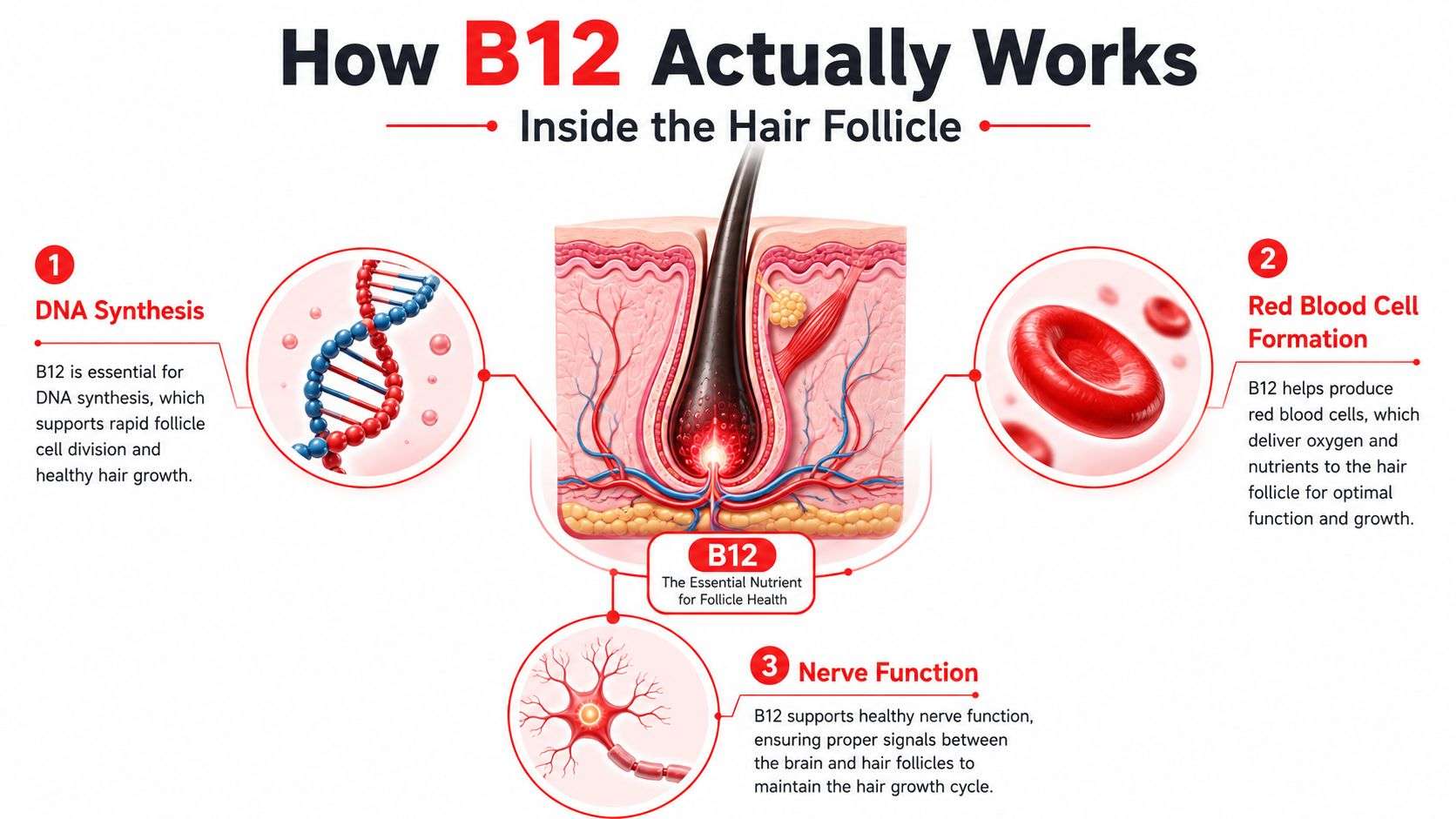
B12 helps the body make DNA, form red blood cells, and support nerve function. Those processes are not unique to hair, but they matter because follicles are among the most active cell factories in the body. When a follicle is dividing, repairing, and staying in its growth phase, it depends on the same basic setup any fast-moving tissue needs, nutrient delivery, oxygen, and a working production line.
A useful way to understand it is through the supply chain. B12 is part of the logistics system. If the trucks stop arriving, the plant does not shut down at once, but output slows, quality slips, and the effects begin to show downstream. In hair, that can mean more strands entering the resting phase too early.
The red blood cell piece is the most clinically relevant. B12 deficiency can impair red blood cell production and lead to megaloblastic anemia, and that matters because red blood cells deliver oxygen to scalp follicles. Reduced oxygen delivery is one reason diffuse shedding can appear when deficiency is real, even if the follicle itself is not permanently damaged, as explained in the clinical overview.
Why the theory still needs lab confirmation
The biology makes sense, but biology by itself does not prove causation in a real patient. Hair loss is usually multifactorial, and the scalp can respond to stress, illness, hormones, iron problems, and inflammation at the same time. That is why a clinician should never stop at “B12 is involved, therefore B12 caused it.”
The real question is whether the patient in front of you has a deficiency severe enough to affect the follicle.
That is the clinical distinction. If B12 is low enough to disrupt oxygen delivery or cell division, it can contribute to diffuse shedding. If it is only low-normal, the connection to the follicle becomes much less direct, and the next step is to look for the fuller pattern rather than forcing one nutrient to explain everything.
What the Research Says About B12 and Hair Loss
Evidence that keeps the story cautious
The older literature keeps expectations grounded. A 2018 review found the link between vitamin B12 and hair loss to be weak, and the authors said the small amount of available research was not enough to support routine B12 screening or supplementation for hair loss. That fits the broader pattern in dermatology, where B12 is treated as one possible piece of the workup, not a stand-alone explanation for shedding.
A controlled study in alopecia areata looked at holotranscobalamin, vitamin B12, folate, and homocysteine in people with the condition and in controls, and found no meaningful differences between the groups. That kind of result matters because it shows how often B12 testing fails to separate a true deficiency problem from a hair-loss diagnosis that has another driver.
The newer data are mixed, not decisive
Later studies make the picture less tidy, but they still do not settle the question. One comparative study reported lower serum B12 in people with hair loss than in controls, and the same group also had lower vitamin D and ferritin. Another study in women with hair loss found lower mean B12 levels in patients than in controls, while also showing that the values stayed above the lower reference limit. That is the gray zone that creates confusion in clinic, lower values that do not necessarily amount to a clinically important deficiency.
A separate clinical review found B12 deficiency in some patients with telogen effluvium, androgenetic alopecia, alopecia areata, and in a smaller share of hair-loss controls, but the authors still did not recommend B12 supplementation as a treatment for hair loss itself. PMC review The main lesson is simple. Coexistence is not causation.
Clinical takeaway: A low or low-normal B12 can be part of the picture, but it should not be treated as proof that B12 is the cause of shedding.
The safest reading of the literature is practical. Test B12 when the clinical context supports it, and do not assume it explains the hair loss by itself. If a patient also has a scalp complaint that seems unrelated, such as dandruff, that should be handled as a separate issue. A helpful primer on the topic is this article on whether dandruff is contagious, which reflects the same general principle, one symptom rarely explains the whole scalp story.
Symptoms and Risk Groups That Should Raise a Flag
The symptom cluster that makes testing worthwhile
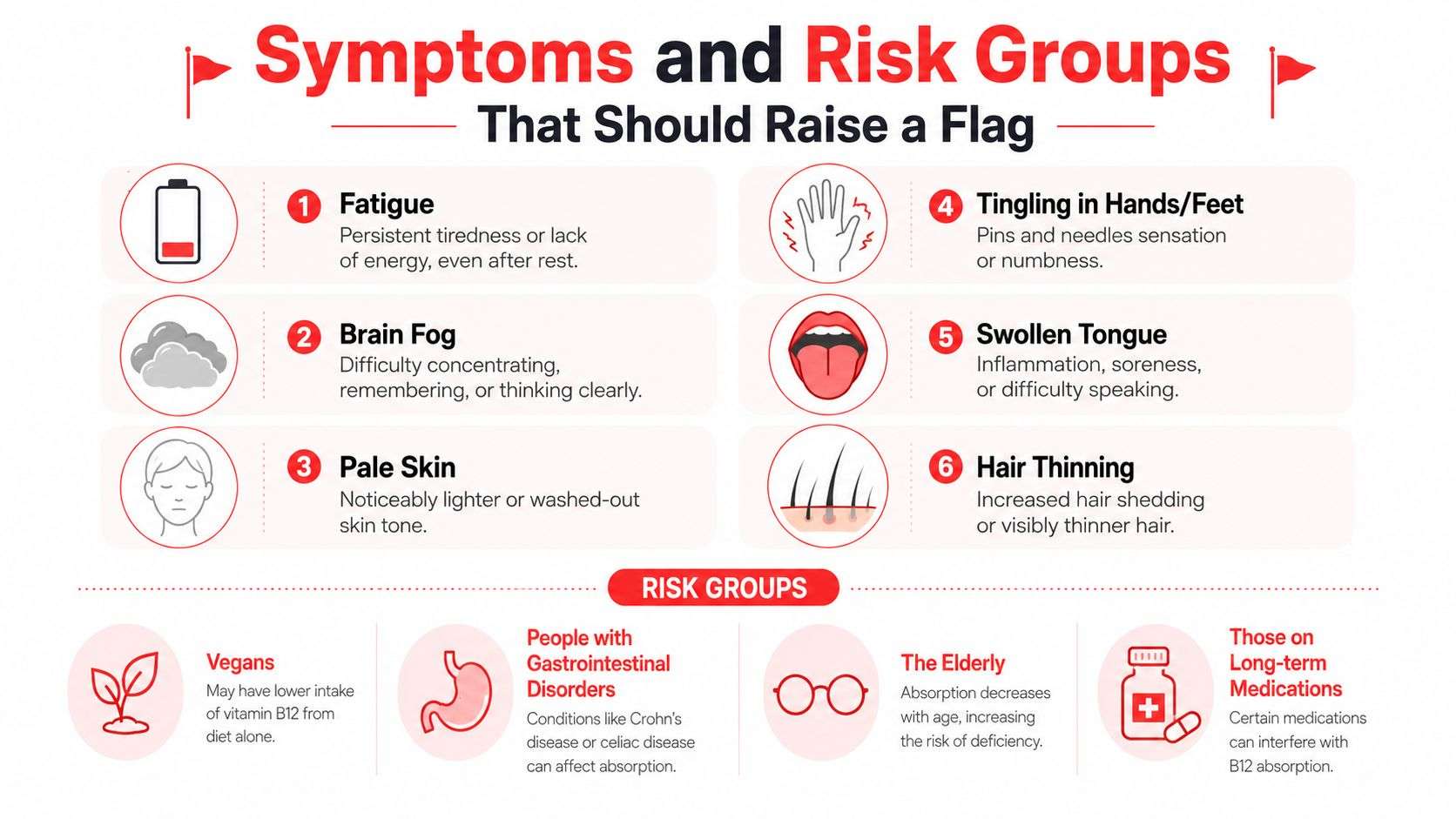
B12 deficiency rarely announces itself with hair alone. More often, hair shedding shows up alongside fatigue, brain fog, pale skin, tingling in the hands or feet, or a swollen tongue. When diffuse shedding is paired with those complaints, the odds that B12 belongs in the lab work go up.
Hair pattern matters too. Diffuse shedding points more toward a systemic trigger, while a receding hairline or crown thinning suggests a different process. That distinction helps keep patients from chasing the wrong problem for months.
- Fatigue: often the first thing people write off as stress.
- Brain fog: trouble concentrating, slower recall, a general mental drag.
- Pale skin: a clue that anemia may be part of the picture.
- Tingling in hands or feet: a nerve symptom that deserves attention.
- Swollen tongue: a classic sign that the body may be short on B12.
- Hair thinning: more meaningful when it's diffuse, not patterned.
The risk groups I pay attention to first
Testing becomes more worthwhile when someone belongs to a higher-risk group. That includes adults over 60, vegans and vegetarians, people with pernicious anemia or gut absorption problems, those on long-term metformin or proton-pump inhibitors, patients after bariatric surgery, and pregnant or breastfeeding women.
If the shedding is happening with multiple risk factors, the lab conversation becomes much more useful. If there's also scalp irritation or another skin issue, it's smart to avoid self-diagnosing from the hair alone. A quick read on whether dandruff is contagious can help separate scalp scaling from systemic shedding.
A symptom checklist is not a diagnosis. It's a reason to stop guessing.
The goal is not to make everyone a candidate for B12 treatment. The goal is to identify the people who need a closer look, because they may have a deficiency that's affecting more than the hair.
How B12 Is Tested in a Modern Clinic
The standard blood test and its limits
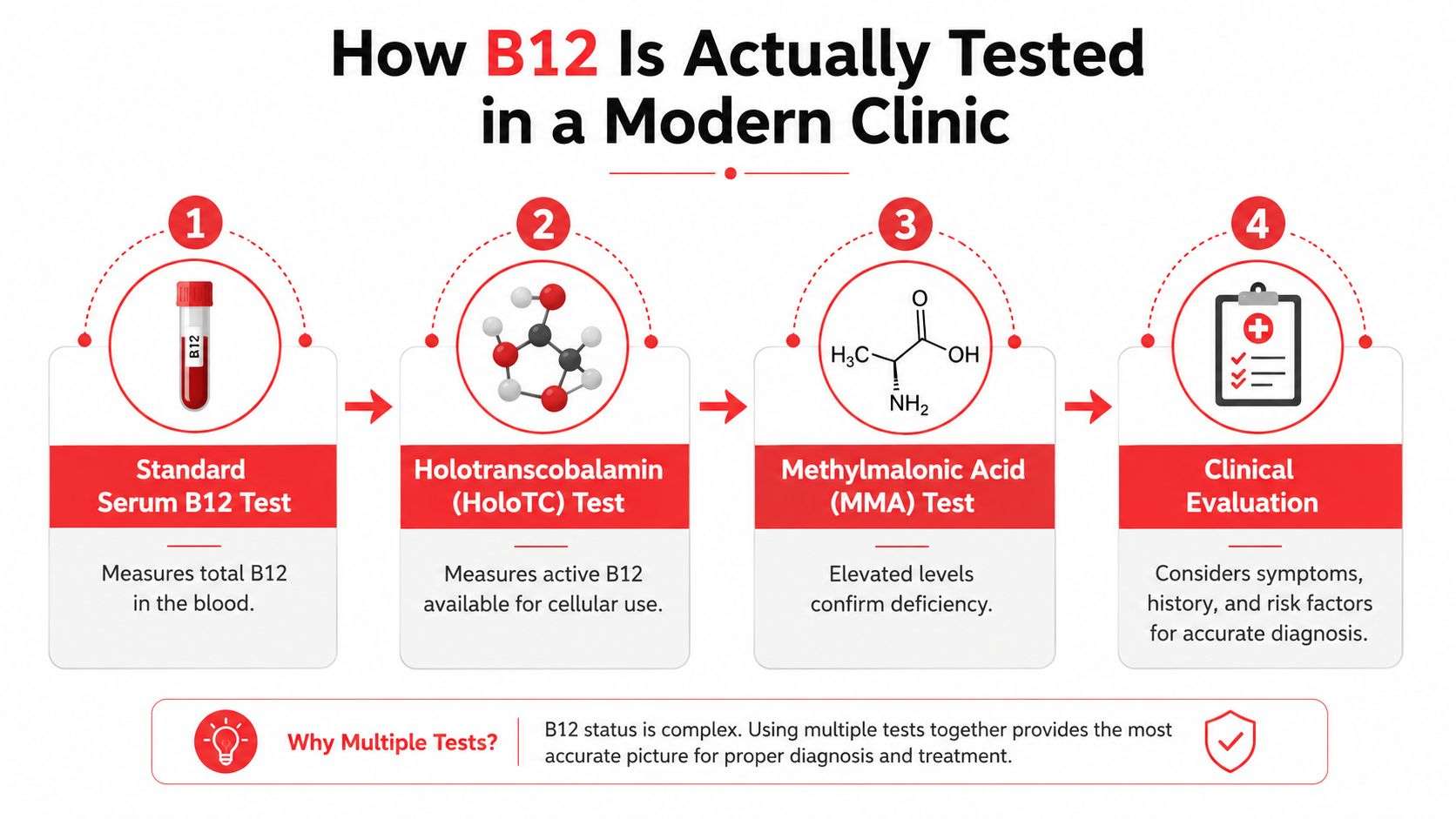
A standard serum B12 test is usually the first step, but it does not give the full picture. It measures total circulating B12, not always the active fraction the body can use right away. A result that looks acceptable on paper can still sit in a gray zone when symptoms or absorption issues are present.
That gray zone is where a more precise workup helps. Holotranscobalamin reflects the active B12 fraction, while methylmalonic acid and homocysteine help show whether B12 is functionally inadequate. If those downstream markers are abnormal, the body may be behaving as if B12 is low even when the serum number looks borderline.
For a clear, patient-friendly explanation of what a B12 panel can show, the B12 test breakdown is a helpful reference point.
Why a broader panel is usually smarter
In practice, I do not like looking at B12 in isolation when hair loss is diffuse. A regenerative-medicine style workup often pairs B12 with folate, ferritin, vitamin D, and a CBC, because anemia patterns and other nutrient gaps often travel together. That broader view gives more context than any single number.
The clinical question goes beyond “Is B12 low?” to ask whether the body shows signs of poor nutrient use or a coexisting deficiency. If the answer points that way, supplementing one nutrient without checking the rest can create a false sense of progress.
What low-normal means in real life
Low-normal B12 is common in people with hair concerns. It is not the same as a clear deficiency, but it may still justify treatment if symptoms, diet history, or absorption issues point that way. In clinic, I look at the whole picture, not just whether the lab printed a flag.
Decision rule: Treat the patient, not the number alone.
That is the practical value of testing properly. It separates true deficiency from coincidental low-normal values and helps prevent the cycle of trying supplements one by one without a diagnosis. It also keeps the workup grounded when hair shedding has another driver, like patterned loss that may respond better to targeted treatment such as Rogaine for a receding hairline.
Safe Supplementation Strategies and What to Expect
Forms that are commonly used
Oral cyanocobalamin is the most familiar option, and methylcobalamin is another common form. Sublingual products are often used by people who want an easier route, while intramuscular injections make more sense when absorption is a concern or deficiency is clear.
The main trade-off is simple. Oral forms are convenient and usually enough for many people. Injections are more targeted when the gut isn't doing its job, or when the clinical picture suggests a stronger intervention is justified.
High-dose oral B12 is generally well tolerated because the body clears excess through urine. That doesn't mean more is always better, it means B12 is not the kind of supplement people typically need to fear from a safety standpoint when it's used appropriately. It also means that self-directed overuse can create noise without solving the root problem.
What timeline is realistic
If B12 deficiency is part of the reason for shedding, improvement usually takes time because follicles move through cycles slowly. Hair that has shifted into telogen doesn't instantly jump back to active growth, so a two-week trial tells you very little. In real clinic practice, people often need months, not days, to judge whether the intervention is helping.
If the underlying cause is androgenetic alopecia, B12 won't change the pattern by itself. That's why I'm careful not to oversell vitamins as stand-alone hair treatment. They help when deficiency is real, but they don't reverse every cause of thinning.
For readers comparing approaches, the internal overview of Rogaine for a receding hairline is useful if the concern is pattern loss rather than diffuse shedding. The two problems are managed differently.
For targeted care, a clinic-based approach can also include IM injections and infusion support when appropriate. A clinic that offers a B12 injection service illustrates the kind of direct replacement strategy some patients need, especially when absorption is the issue.
Practical expectation: If hair loss is driven by deficiency, correction helps the body recover. If the cause is elsewhere, B12 support may improve general health without changing the scalp outcome.
Other Common Causes of Hair Loss That B12 Cannot Fix
The causes that usually sit higher on the list
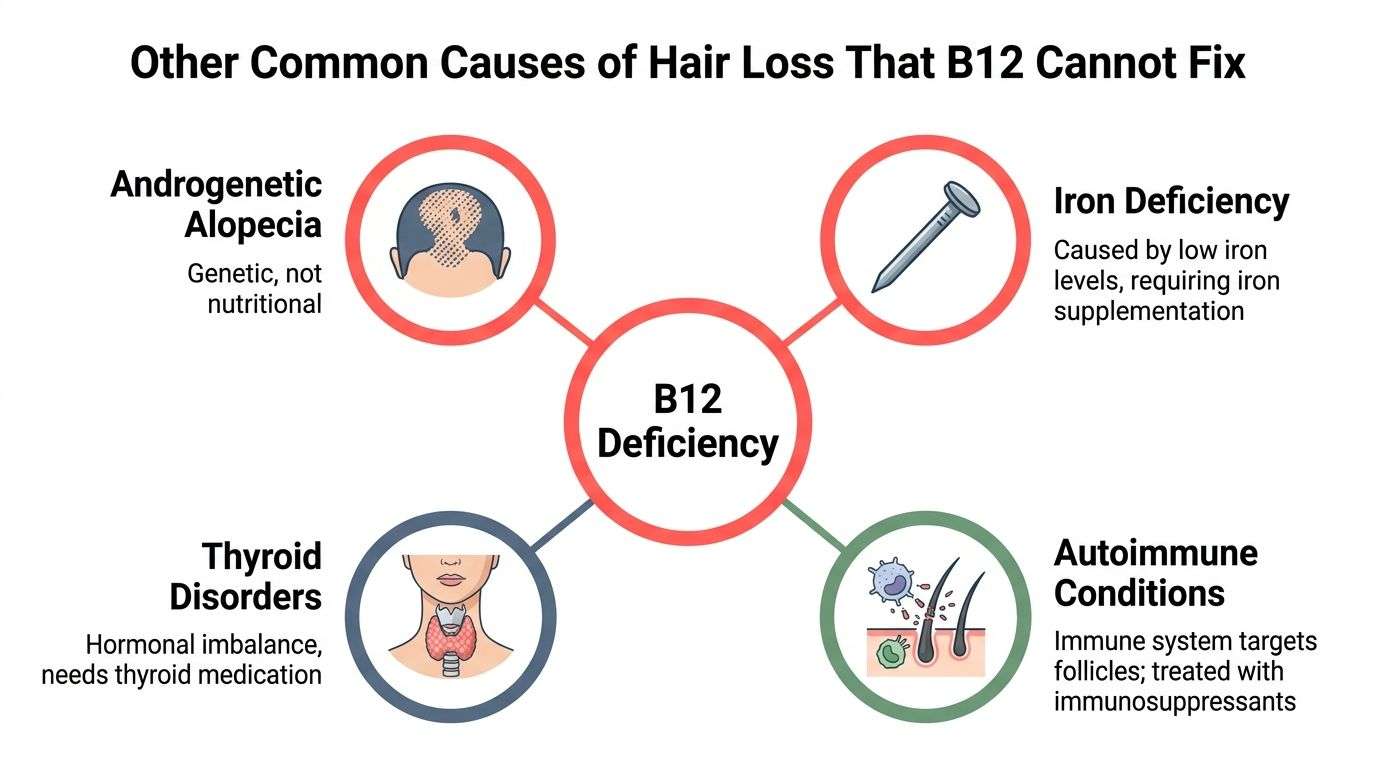
B12 is only one piece of a larger differential. Androgenetic alopecia is the classic pattern thinning problem, and it is driven by genetics and hormones, not a vitamin shortage. Telogen effluvium often follows stress, illness, surgery, postpartum changes, or other physiologic shocks, and it tends to show up as diffuse shedding rather than a receding line.
Thyroid dysfunction can also alter the hair cycle, and iron or ferritin deficiency is another frequent culprit. Autoimmune hair loss, especially alopecia areata, belongs on the list too. None of those problems is fixed by optimizing B12 alone.
A quick comparison
| Cause | Primary Driver | Typical Pattern | Role of B12 |
|---|---|---|---|
| Androgenetic alopecia | Genetic sensitivity to androgens | Pattern thinning, temples or crown | Helpful only if deficiency coexists |
| Iron deficiency | Low iron stores and impaired oxygen delivery | Diffuse shedding, fatigue often present | Indirect support, not a cure |
| Thyroid disorders | Hormonal imbalance | Diffuse thinning or shedding | Not corrective unless B12 is also low |
| Autoimmune conditions | Immune attack on follicles | Patchy loss or sudden shedding | No direct fix |
That table is the reason I push back when someone has already tried vitamins for months. If the cause is hormonal, autoimmune, or iron-related, B12 can't be expected to solve it. A smarter plan checks several variables at once instead of giving each supplement its own trial month.
The hair regrowth therapy page is a good reminder that hair loss often needs layered treatment, not one isolated fix. Nutrition helps the foundation, but the scalp still needs the right diagnosis.
When to Seek Clinical Evaluation and What a Hair Plan Looks Like
The red flags that justify a visit
A clinic visit makes sense when the part is widening quickly, shedding hasn't slowed after a few months, scalp thinning is obvious in photos, or there's a family history of pattern hair loss. The threshold gets lower if hair loss is paired with fatigue, tingling, pallor, or other anemia-type symptoms, because that combination points toward a systemic issue instead of a cosmetic one.
The first goal is to identify whether the patient is dealing with diffuse shedding, pattern loss, or both. Once that's clear, the lab strategy becomes more focused, and the treatment plan can stop wandering from one supplement to the next.
What a good plan usually includes
A practical hair-loss workup in a regenerative-medicine setting often includes a broader vitamin and hormone panel, then supplementation based on real numbers instead of guesswork. If the labs show low or low-normal B12, that can be corrected while the rest of the picture is addressed too. If the labs point elsewhere, the plan should pivot without delay.
Sexual Wellness Centers of America offers REGENhair™ as part of its broader regenerative services, which fits into a lab-driven approach when hair loss is being evaluated alongside nutritional or hormonal concerns. The important part is not the brand name, it's the clinical structure behind it, test first, treat the documented problem, and avoid guessing.
A solid hair plan is built around evidence, not hope in a bottle.
That mindset saves time and reduces frustration. It also keeps patients from assuming that every shed strand is a B12 issue when the actual driver may be hormonal, inflammatory, or genetic.
If you're dealing with ongoing shedding, the next step is a proper evaluation, not another month of trial-and-error supplements. Visit Sexual Wellness Centers of America to review clinic-based options, discuss lab testing, and build a hair-loss plan around what your body is showing.