
What the Numbers Actually Say About Hormone Therapy Success Rates
Hormone therapy success rate varies significantly depending on what it’s being used for — and the results are often more impressive than people expect.
Here’s a quick breakdown by condition:
| Use Case | Key Success Metric |
|---|---|
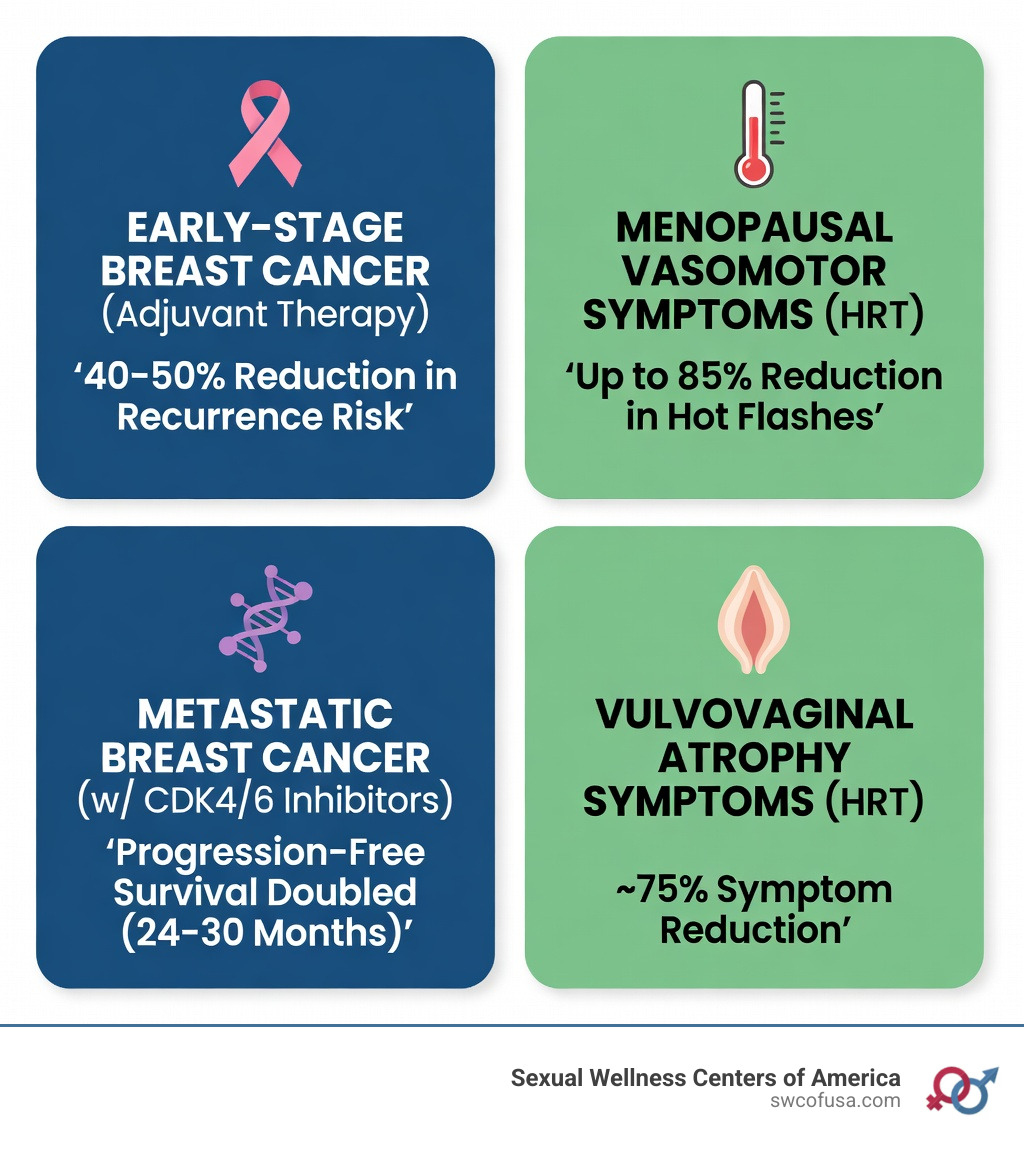
| Early-stage HR+ breast cancer (adjuvant) | 40–50% reduction in recurrence risk; 85–90% disease-free at 5 years |
| Breast cancer mortality (10-year therapy) | Mortality reduced by ~one-third |
| Metastatic HR+ breast cancer (hormone therapy alone) | 30–40% response rate; 8–14 months median progression-free survival |
| Metastatic HR+ breast cancer (with CDK4/6 inhibitors) | Progression-free survival extended to 24–30 months; overall survival exceeding 60 months |
| Menopausal vasomotor symptoms (HRT) | Up to 85% reduction in hot flashes |
| Vulvovaginal atrophy symptoms (HRT) | ~75% symptom reduction |
The picture is nuanced. Hormone therapy means very different things depending on context. For cancer treatment, it’s about starving tumors of the hormones they need to grow. For menopause, it’s about restoring hormones the body no longer produces at sufficient levels. Both approaches have strong clinical track records — but with different risk profiles and considerations.
What’s clear across the research: when hormone therapy is matched to the right person, for the right condition, the outcomes can be life-changing.
I’m Jeff Nuziard, CEO of Sexual Wellness Centers of America, and helping individuals navigate the real-world complexity of hormone therapy success rates — from sexual health optimization to hormonal balance — is at the core of what my team does every day. In the sections ahead, we’ll walk through the evidence so you can make a truly informed decision.
Understanding the Hormone Therapy Success Rate for Menopause and Cancer
When we talk about “hormone therapy,” we are actually looking at two very different medical paths. It is easy to get them confused, but understanding the distinction is the first step toward evaluating the hormone therapy success rate for your specific needs.
First, there is Menopausal Hormone Therapy (often called HRT or MHT). This is designed for symptom relief. When women go through menopause, their estrogen and progesterone levels take a dive, often leading to hot flashes, night sweats, and mood swings. HRT works by adding those hormones back into the system. According to the North American Menopause Society, HRT remains the most effective way to manage these “vasomotor symptoms,” with a success rate of about 85% in reducing hot flashes.
On the flip side, we have “endocrine therapy,” which is a form of hormone therapy used as a cancer treatment, particularly for hormone receptor-positive (HR+) breast cancer. In this case, the goal isn’t to add hormones; it’s to block them. Since HR+ cancer cells use estrogen like fuel, endocrine therapy works by cutting off that fuel supply.
Whether we are helping a client with Hormone Balancing for Women or someone is working with an oncologist to prevent cancer recurrence, the success rates are grounded in decades of clinical data. For instance, a scientific review of HRT and breast cancer risk notes that while there are risks to consider, the clinical benefits for quality of life—including bone health and cardiovascular protection—are substantial.
Success Rates of Adjuvant Hormone Therapy in Early-Stage Cancer
For those diagnosed with early-stage HR+ breast cancer, the hormone therapy success rate is nothing short of transformative. After surgery, patients often begin “adjuvant” therapy (meaning therapy given after the primary treatment to lower the risk of the cancer coming back).
The statistics are incredibly encouraging:
- Five years of adjuvant hormone therapy reduces the risk of cancer recurrence by approximately 40% to 50%.
- It reduces breast cancer mortality by 30% to 40%.
- Tamoxifen, one of the most well-known treatments, cuts the 15-year risk of recurrence by about one-third.
- Aromatase inhibitors (AIs) provide an additional 30% relative reduction in recurrence risk compared to tamoxifen for postmenopausal women.
In fact, about 85–90% of patients with early-stage HR+ breast cancer remain disease-free five years after completing their initial treatment and starting hormone therapy. As noted in the EBCTCG meta-analysis on mortality reduction, ten years of this therapy can reduce long-term mortality by a full third, leading to survival rates that exceed 85% in early-stage disease.
Hormone Therapy Success Rate in Advanced and Metastatic Cases
In the past, a metastatic diagnosis (cancer that has spread) was viewed very differently than it is today. Now, thanks to advancements in hormone therapy, many patients can manage metastatic HR+ breast cancer as a chronic condition.
When used alone in advanced disease, hormone therapy achieves response rates of 30–40%. However, the real “game-changer” has been the introduction of targeted therapies like CDK4/6 inhibitors. When we combine traditional hormone therapy with these newer inhibitors, the research on metastatic HR+ outcomes shows that:
- Median progression-free survival (PFS) doubles from 8–14 months to 24–30 months.
- Median overall survival now extends beyond 60 months.
- Five-year survival rates for these patients have jumped from less than 20% two decades ago to around 35–45% today.

Navigating Risks: What Major Studies Reveal About HRT
We can’t talk about the hormone therapy success rate without addressing the “elephant in the room”: the 2002 Women’s Health Initiative (WHI) study. For years, this study caused a massive decline in HRT use because it highlighted an increased risk of breast cancer. However, as we have analyzed the data over the last two decades, the picture has become much clearer and, frankly, much less scary for many women.
One of the most important things to understand is that not all hormone therapy is created equal. There is a massive difference between estrogen-only therapy and combined estrogen-progestin therapy.
The WHI follow-up findings on long-term mortality and other major studies like the Million Women Study have helped us refine our approach. We now know that the “timing hypothesis” matters—starting therapy closer to the onset of menopause (usually before age 60) tends to yield the best success rates with the lowest risks. Before you dive in, it is always wise to look at What to Consider Before Hormone Replacement Therapy to see how your personal health history fits into the equation.
Estrogen-Only vs. Combined Progestin Therapy
The data regarding the type of hormone used is quite striking. If you have had a hysterectomy and only require estrogen, the Collaborative Group on Hormonal Factors meta-analysis31709-X) and WHI trials found some surprising results:
- Estrogen-only therapy: Actually showed a 23% reduction in breast cancer incidence in some trials.
- Combined therapy: Showed a 29% elevation in risk, an effect that can persist for years after stopping.
At Sexual Wellness Centers of America, we pay close attention to the type of hormones used. Many experts now point toward “body-identical” hormones—like micronized progesterone—as potentially carrying a lower risk profile than the synthetic progestins used in the original 2002 studies. By personalizing the protocol, we aim to maximize the hormone therapy success rate for symptom relief while minimizing long-term concerns.
Restoring Vitality: Success Rates in Sexual Wellness and Beyond
While much of the global research focuses on cancer and menopause, we see the impact of hormone therapy in a more immediate, daily way: sexual vitality. For many of our clients in Colleyville, TX, the hormone therapy success rate is measured by the return of desire, the reversal of dysfunction, and the restoration of confidence.
Hormone balance is the engine of sexual health. When testosterone levels drop in men or estrogen and testosterone levels fluctuate in women, the bedroom is often the first place to feel the impact. We believe in a comprehensive approach that looks at the whole person. This is why our How Can Hormone Replacement Therapy Improve Sexual Health guide is so popular—it connects the dots between blood chemistry and quality of life.
Addressing Erectile Dysfunction and Low Libido
For men, the hormone therapy success rate regarding erectile dysfunction (ED) is incredibly high when combined with modern technology. At Sexual Wellness Centers of America, we don’t just “guess” at your levels. We use detailed hormone and vitamin panels to build a roadmap for your recovery.
We are proud to offer:
- HEshot®™: A specialized treatment designed to enhance male performance.
- REGENmax® technology: Our proprietary approach to cellular health and tissue repair.
- 97.2% Efficacy: We boast a 97.2% success rate in erectile dysfunction reversal for our patients.
By addressing the underlying hormonal deficiencies—often through testosterone replacement—and utilizing Hormone Therapy for ED, men can often see results that they thought were long gone.
Hormone Therapy Success Rate in Urogenital Health
For women, one of the most common but least talked about issues is vulvovaginal atrophy (VVA), now often called Genitourinary Syndrome of Menopause (GSM). This condition affects about 40% of postmenopausal women and can make intimacy painful or even impossible.
The hormone therapy success rate here is stellar. Localized vaginal estrogen therapy reduces symptoms by approximately 75%. Because these treatments are applied locally, the systemic absorption is minimal, making them a viable option even for some who might be wary of traditional oral HRT. As the StatPearls review on GSM treatment confirms, restoring the health of these tissues can drastically improve sexual function and overall comfort.
Alternatives and Management for Breast Cancer Survivors
For breast cancer survivors, managing menopausal symptoms is a delicate balancing act. Many survivors experience “induced menopause” due to chemotherapy or surgery, and their symptoms are often more severe than natural menopause. Because many survivors have ER+ (estrogen receptor-positive) disease, traditional systemic HRT is often avoided.
However, the “blanket ban” on hormones for survivors is beginning to shift toward a more nuanced, “shared decision-making” model. Experts are increasingly looking at individual risk profiles. For some, the debilitating nature of their symptoms justifies a carefully monitored trial of therapy.
| Symptom Category | Hormonal Option | Non-Hormonal Alternative | Efficacy Notes |
|---|---|---|---|
| Hot Flashes | Systemic HRT (High Risk) | SSRIs/SNRIs (e.g., Venlafaxine) | Non-hormonal options can reduce flashes by 50-60% |
| Hot Flashes | N/A | Gabapentin | Shows ~45% reduction in frequency |
| Vaginal Dryness | Vaginal Estrogen/DHEA | Moisturizers/Lubricants | Hormonal options are ~75% effective for tissue repair |
| Low Libido | Low-dose Testosterone | Counseling/Lifestyle | Testosterone can significantly improve HSDD |
If you are navigating life after treatment, checking out our resources on Hormone Replacement Therapy can help you understand the landscape of modern options.
The Role of Vaginal Estrogen and Shared Decision-Making
One of the most significant recent shifts in expert opinion involves vaginal estrogen. Recent expert consensus on MHT for survivors suggests that vaginal estrogen is unlikely to increase the risk of cancer recurrence because very little of it enters the bloodstream.
Organizations like NAMS and NICE are now more supportive of using localized treatments to improve the quality of life for survivors. Furthermore, future research like the MENO-ABC trial objectives aims to provide even more definitive data on the safety of various hormone therapies for those with a history of breast cancer. The goal is to move away from a “one size fits none” approach and toward a plan that respects both the oncology history and the patient’s current well-being.
Frequently Asked Questions about Hormone Therapy
How long does it take to see results from hormone therapy?
For menopausal symptoms like hot flashes, many people start to feel relief within 2 to 4 weeks, though it can take up to 3 months to reach the full effect. For cancer treatments (endocrine therapy), the therapy works silently over years to prevent recurrence. In our sexual wellness programs in Colleyville, TX, the timeline for treatments like HEshot®™ or SHEshot®™ can vary, but many clients report improvements in vitality and performance within the first month of their personalized plan.
Is hormone therapy safer now than it was during the original WHI study?
We believe so, primarily because we have better “tools” and more specific data. The 2002 study used a “one-size-fits-all” high-dose pill on an older population. Today, we use lower doses, transdermal (patch/gel) options that bypass the liver, and body-identical hormones. We also know much more about the “window of opportunity,” which suggests that starting therapy earlier in the menopausal transition is safer for the heart and brain.
Can I use hormone therapy if I have a history of ER+ breast cancer?
This is a conversation that must happen between you, your oncologist, and a hormone specialist. While systemic HRT is generally discouraged for ER+ survivors, localized vaginal estrogen is increasingly considered an option for severe urogenital symptoms. New consensus statements advocate for “shared decision-making,” where the risk of recurrence is weighed against the patient’s quality of life.
Conclusion
The hormone therapy success rate is a powerful testament to how far medical science has come. Whether it is reducing cancer recurrence by 50%, providing an 85% reduction in menopausal symptoms, or our own 97.2% efficacy in reversing erectile dysfunction, the numbers show that you don’t have to just “live with” hormonal imbalances.
At Sexual Wellness Centers of America in Colleyville, TX, we specialize in moving past the statistics and focusing on the person. We utilize personalized hormone and vitamin panels to ensure that your treatment is as unique as your DNA. With innovative solutions like REGENmax® technology, HEshot®™, and SHEshot®™, we are dedicated to helping you reclaim your vitality.
If you are ready to see how the odds can work in your favor, we invite you to explore our Services: Hormone Replacement Therapy Colleyville TX and take the first step toward a more balanced, vibrant life. We are here to help you navigate the science, understand the success rates, and ultimately, feel like yourself again.