
Why Finding the Best Peptide for Muscle Gain Matters in 2026
The best peptide for muscle gain depends on your goal, but here is a quick comparison of the top options to help you decide fast:
| Peptide | Primary Benefit | Best For |
|---|---|---|
| CJC-1295 + Ipamorelin | Boosts growth hormone naturally | Lean mass, recovery, sleep |
| IGF-1 LR3 | Direct muscle growth via mTOR | Nutrient partitioning, hypertrophy |
| Follistatin 344 | Blocks myostatin (your growth limiter) | Breaking genetic muscle ceilings |
| BPC-157 | Tissue repair, angiogenesis | Recovery, injury support |
| TB-500 | Soft tissue healing, inflammation | Joint health, consistent training |
| Collagen Peptides | Structural muscle and tendon support | Long-term, WADA-compliant use |
Peptides are short chains of amino acids – typically between 2 and 50 – that act as signaling molecules inside your body. Unlike steroids, they don’t replace your hormones. Instead, they tell your body to produce more of what it already makes naturally, like growth hormone and IGF-1.
The global peptide therapeutics market hit $48.5 billion in 2023, and muscle-building peptides are one of the fastest-growing segments. It’s not hard to see why. Men and women over 40 experience a natural decline in growth hormone, which makes building and holding onto muscle significantly harder. Peptides offer a targeted, lower-risk option compared to synthetic hormones or anabolic steroids.
But the research is not all equal. Some peptides have strong clinical backing. Others are supported mostly by animal studies or anecdotal reports from the bodybuilding community. That gap matters, especially if you care about safety and long-term health.
I’m Jeff Nuziard, CEO of Sexual Wellness Centers of America, where I specialize in science-backed hormone and wellness therapies – including peptide therapy – to help men and women over 40 reclaim their vitality and physical performance. My work guiding patients through personalized treatment plans gives me a grounded, real-world perspective on which options for the best peptide for muscle gain are worth your attention and which are just hype.
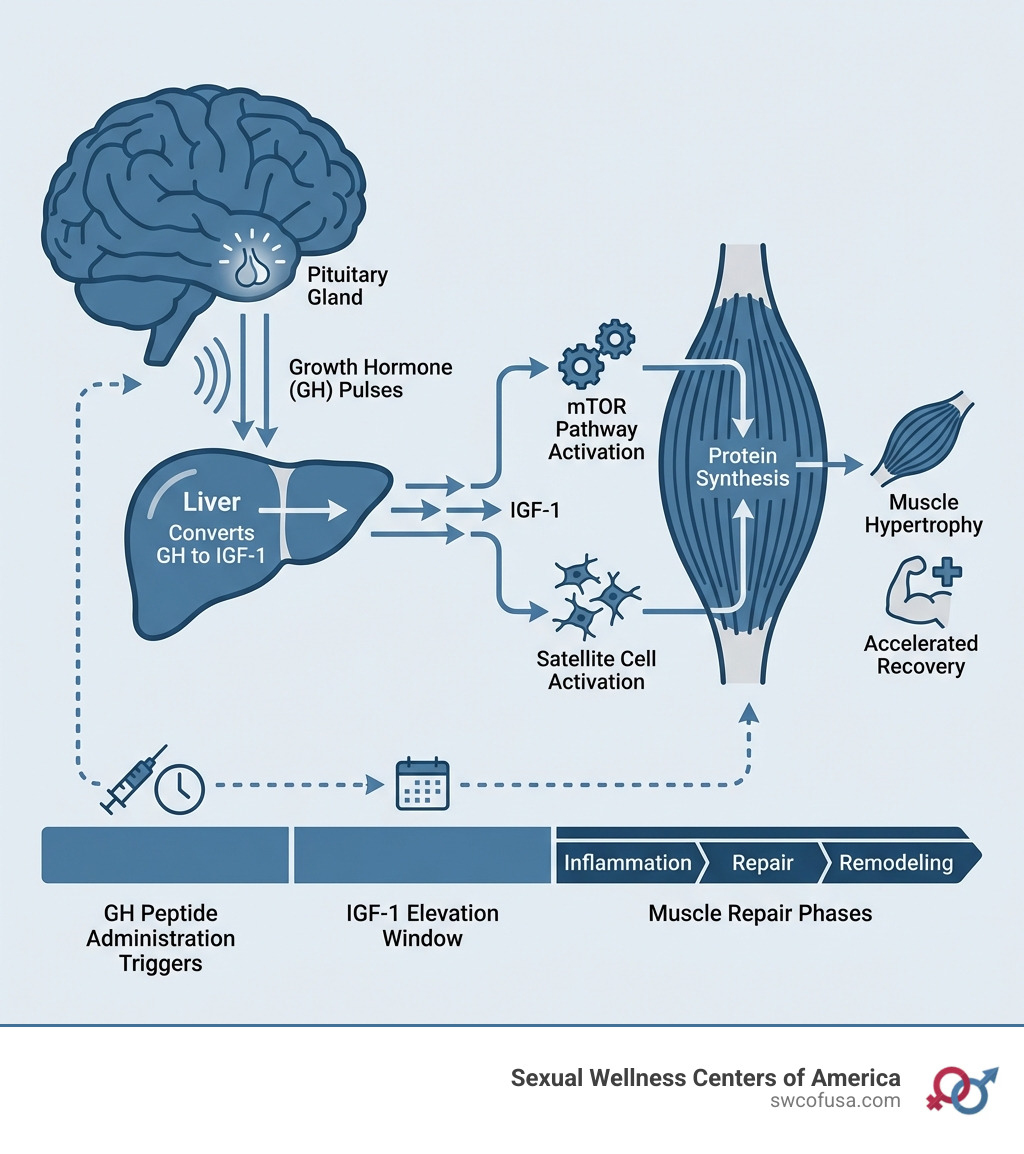
How Peptides Stimulate Muscle Hypertrophy and Repair
To understand how we use these compounds, we first have to look at what they actually are. Peptides are essentially the building blocks of proteins, but they are much smaller and more agile. While a protein is like a finished skyscraper, a peptide is more like a foreman with a megaphone. They act as messengers that coordinate complex biological responses.
The magic of peptide-therapy-benefits lies in their ability to bind to specific receptors on the surface of your cells. When a muscle-building peptide “docks” with a receptor, it sends a signal into the cell to flip on anabolic (growth) switches.
For those of us looking to pack on lean mass, we focus on three primary mechanisms:
- Growth Hormone Secretagogues: These stimulate your pituitary gland to release more of your own natural Growth Hormone (GH).
- Nitrogen Retention: By improving how your body utilizes protein, peptides help keep your muscles in an “anabolic” state longer.
- Cellular Signaling: They activate the mTOR pathway, which is the primary driver of protein synthesis and cellular growth.
By optimizing these pathways, we aren’t just making muscles bigger through water retention; we are improving the body’s fundamental ability to repair microscopic muscle tissue fibers after a grueling workout.

Top Compounds: Finding the Best Peptide for Muscle Gain
When we rank the best peptide for muscle gain, we look at more than just raw power. We evaluate half-life (how long it stays in your system), administration methods, and whether it promotes hypertrophy (making existing cells bigger) or hyperplasia (creating new muscle cells).
| Peptide | Half-Life | Administration | Primary Anabolic Benefit |
|---|---|---|---|
| CJC-1295 (no DAC) | ~30 minutes | Subcutaneous | Pulsatile GH release |
| Ipamorelin | ~2 hours | Subcutaneous | Selective GH stimulation |
| IGF-1 LR3 | 20–30 hours | Subcutaneous/IM | Direct mTOR activation |
| Follistatin 344 | ~36 hours | Subcutaneous | Myostatin inhibition |
| BPC-157 | ~4–6 hours | Subcutaneous/Oral | Angiogenesis & repair |
While most traditional training focuses on hypertrophy, some advanced peptide-supplements-for-muscle-growth are studied for their potential to trigger hyperplasia—the actual splitting of muscle fibers to create new ones—which can fundamentally change your physical potential.
CJC-1295 and Ipamorelin: The Gold Standard for Growth Hormone
In our Colleyville, TX clinic, we often see the combination of CJC-1295 and Ipamorelin referred to as the “gold standard.” These are Growth Hormone Releasing Hormone (GHRH) analogs that work together to produce and release growth hormone in a way that mimics your body’s natural rhythms.
Ipamorelin is particularly loved because it is highly selective. It stimulates GH without causing a spike in cortisol (the stress hormone) or prolactin, which can sometimes happen with older peptide-supplements.
Why this combo works:
- Pulsatile Release: It encourages the pituitary to release GH in natural “waves,” which reduces the risk of desensitization.
- Fat Metabolism: Higher GH levels help the body mobilize fat for fuel, making it easier to stay lean while bulking.
- Deep Sleep: Many of our patients report much deeper, more restorative sleep, which is when the majority of muscle repair actually happens.
IGF-1 LR3: The Best Peptide for Muscle Gain and Nutrient Partitioning
If CJC-1295 is the “slow and steady” approach, Insulin-like Growth Factor 1 Long R3 (IGF-1 LR3) is the heavy hitter. IGF-1 is the primary mediator of growth hormone’s effects. IGF-1 LR3 is a modified version with a much longer half-life (up to 30 hours) compared to the 20-minute half-life of natural IGF-1.
By facilitating protein synthesis and activating the mTOR pathway, IGF-1 LR3 helps shuttle nutrients directly into muscle cells. This is often used via im-injections-for-athletes-benefits-and-recovery to promote muscle cell proliferation and satellite cell activation—essentially recruiting “backup” cells to help build and repair muscle tissue.
Follistatin 344: The Best Peptide for Muscle Gain via Myostatin Inhibition
Every human has a “genetic ceiling” for muscle growth controlled by a protein called myostatin. Myostatin acts like a governor on an engine, preventing your muscles from getting “too big.”
Follistatin 344 (FST-344) is a powerful myostatin blocker. By inhibiting this growth-limiting protein, Follistatin allows for significant increases in lean mass and muscle density that might otherwise be impossible. While still considered experimental by many, what-are-peptide-supplements like Follistatin analogs are currently some of the most discussed compounds in high-level bodybuilding for breaking through stubborn plateaus.
Recovery and Support Peptides for Consistent Training
You can’t build muscle if you’re stuck on the couch with a torn rotator cuff or “golfer’s elbow.” This is why peptides-for-healing are an essential part of any muscle-building stack.
These compounds focus on angiogenesis (the formation of new blood vessels) and have remarkable healing and regenerative properties. When blood flow to a damaged area increases, so does the delivery of the nutrients required for repair. This is especially vital for bpc-157-bone-healing and tendon repair, where blood flow is naturally lower than in muscle tissue.
BPC-157 and TB-500 for Tissue Regeneration
Body Protecting Compound 157 (BPC-157) is a peptide originally found in human gastric juices. It has shown an incredible ability to accelerate the healing of a bpc-157-ligament or tendon injury.
When paired with TB-500 (a synthetic version of Thymosin Beta-4), the results can be synergistic. TB-500 promotes new blood vessel formation and upregulates actin, a protein critical for cell movement and tissue repair.
Many athletes looking at bpc-157-before-and-after results find that their recovery time from strains is slashed by 30-40%, allowing for more consistent, high-intensity training sessions.
Safety, Legality, and Administration Protocols
It is a common myth that peptides are just “steroids-lite.” In reality, Peptides and steroids are fundamentally different. Steroids are synthetic hormones that replace your body’s natural production, often leading to a shutdown of your own endocrine system. Peptides, conversely, work with your body’s existing signaling pathways.
However, safety and legality are paramount. Most muscle-building peptides are currently on The Prohibited List for professional athletes under WADA. While they may be legal for personal use in many contexts, they are often classified as “research chemicals” and should only be used under medical supervision.
Protocols and Best Practices:
- Administration: Most high-potency peptides require subcutaneous injection (just under the skin) for maximum bioavailability.
- Cycling: To prevent your receptors from becoming desensitized, we typically recommend cycling protocols (e.g., 8-12 weeks “on” followed by a 4-week break).
- Sourcing: Quality is everything. Unregulated peptides can contain impurities or incorrect concentrations. This is why peptide-injection-therapy should always be sourced from reputable, 503A-certified compounding pharmacies.
- Longevity: Many people integrate these into a broader anti-aging-peptide-therapy plan to maintain vitality as they age.
Frequently Asked Questions about Muscle Building Peptides
How long does it take to see muscle gains from peptides?
While recovery benefits (like reduced soreness) can often be felt within the first 7-14 days, actual changes in muscle composition usually take longer. Most users report noticeable lean mass gains after 6 to 12 weeks of consistent use paired with a caloric surplus and resistance training.
Are peptides legal for professional athletes and WADA compliant?
Generally, no. Most growth hormone secretagogues (CJC-1295, Ipamorelin), BPC-157, and TB-500 are strictly prohibited by WADA and most professional sports organizations. Collagen peptides are a notable exception and are typically permitted.
What are the most common side effects of muscle peptides?
The most common side effects are mild and include redness or itching at the injection site, water retention (edema), and occasional joint tingle or “pins and needles” sensations. More serious risks can include altered blood glucose levels, which is why monitoring by a healthcare professional is essential.
Conclusion
Finding the best peptide for muscle gain is a journey of optimization, not a shortcut. At Sexual Wellness Centers of America in Colleyville, TX, we believe that these tools work best when they are part of a holistic plan.
We utilize our proprietary REGENmax® technology alongside personalized hormone and vitamin panels to ensure your body has the foundation it needs to actually use these peptides effectively. Whether you are interested in our HEshot® for male performance, SHEshot®, or targeted peptide protocols, our goal is to help you achieve a 97.2% efficacy in your wellness goals.
Building muscle after 40 isn’t just about vanity; it’s about metabolic health, bone density, and quality of life. If you’re ready to see how science can help you break through your plateaus, we invite you to learn more info about peptide therapy services and start your personalized journey today.