
Why Getting an Intramuscular Injection in the Buttock Right Actually Matters
Knowing how to give an intramuscular injection in the buttock correctly can mean the difference between a medication that works and one that doesn’t.
Here’s a quick overview of the correct technique:
- Wash your hands thoroughly and gather your supplies
- Choose the ventrogluteal site (preferred) on the side of the hip — not the back of the buttock
- Clean the site with an alcohol swab and let it fully dry
- Use the Z-track method — pull the skin about 1 inch to the side before inserting
- Insert the needle at a 90-degree angle with a quick, dart-like motion
- Aspirate (pull back on the plunger) to check for blood
- Inject slowly — about 10 seconds per mL
- Withdraw the needle at the same angle and release the displaced skin
- Apply gentle pressure with gauze — do not massage
- Dispose of the needle immediately in a sharps container
Sounds straightforward — but the research tells a different story.
Studies using CT imaging found that only 32% of presumed intramuscular buttock injections actually reached the muscle. In women, that number drops to just 8%. That means the vast majority of injections end up in subcutaneous fat, where medication absorbs far more slowly — or not at all.
Proper technique matters more than most people realize.
I’m Jeff Nuziard, CEO of Sexual Wellness Centers of America, where our clinical team administers IM injections daily as part of hormone therapy and wellness programs — and understanding how to give an intramuscular injection in the buttock safely is something we’ve refined through extensive hands-on experience. In this guide, I’ll walk you through everything you need to know to do it correctly and confidently.

How to give intramuscular injection in buttock basics:
Understanding the Intramuscular Injection to the Buttocks
An intramuscular (IM) injection is a technique used to deliver a medication deep into the muscle tissue. But why do we use the gluteal muscle so frequently instead of just taking a pill or opting for a shallow subcutaneous shot?
The answer lies in anatomy. Muscle tissue has a incredibly rich blood supply (high vascularity) compared to subcutaneous fat. This abundance of blood vessels allows the medication to be absorbed much more rapidly and efficiently into the bloodstream. At the same time, because muscles can hold a larger volume of fluid, they act as a natural, slow-release reservoir for specific therapies. This is particularly true for oil-based, slow-absorbing, or highly viscous medications—such as those used in hormone replacement therapies—which would cause significant irritation, scarring, or poor absorption if injected into shallower tissue.
The gluteal muscle is one of the largest and thickest muscle groups in the human body. Because of its size, it can safely accommodate larger volumes of medication (typically up to 3 to 5 mL in adults) with less localized pressure and pain than smaller muscles like the deltoid in your arm. To understand more about why this site is chosen, you can read about the clinical reasoning behind Why buttock injections? and explore further More info about IM injections to see how they fit into broader wellness and therapeutic protocols.
Ventrogluteal vs. Dorsogluteal: Choosing the Safest Site
For decades, the “dorsogluteal” site—essentially the upper outer quadrant of the butt cheek—was the standard location taught in medical and nursing programs. However, modern evidence-based medicine has shifted the gold standard of care to the ventrogluteal site (located on the side of the hip).
The reasons for this shift are critical to patient safety:
- Sciatic Nerve Avoidance: The dorsogluteal site sits directly above the sciatic nerve and the superior gluteal artery. Accidental contact with the sciatic nerve can cause severe, shooting pain, temporary numbness, or even permanent paralysis of the lower leg. The ventrogluteal site is completely free of major nerves and large blood vessels.
- Subcutaneous Fat Thickness: The buttocks naturally store a significant amount of subcutaneous fat. In many individuals, particularly women, this fat layer is thicker than a standard needle can penetrate. This explains the alarming statistic that only 32% of presumed gluteal injections actually reach the muscle, with the rest lingering in the fat layer. The ventrogluteal area has a much thinner layer of subcutaneous fat, vastly improving injection success rates.
- Reduced Complications: CT scan verifications show that misdirected dorsogluteal injections frequently result in subcutaneous nodules, sterile abscesses, and poor medication efficacy.
When learning how to give intramuscular injection in buttock, choosing the ventrogluteal site is the single best way to ensure the medication goes exactly where it needs to go. For a deeper dive into the clinical safety differences, check out our guide on Safely administering IM injections in the glutes.
How to Give Intramuscular Injection in Buttock: Locating the Ventrogluteal Site
Finding the ventrogluteal site can feel intimidating at first because it is located on the side of the hip rather than the fleshy part of the backside. However, by using reliable anatomical landmarks, you can locate it perfectly every time.
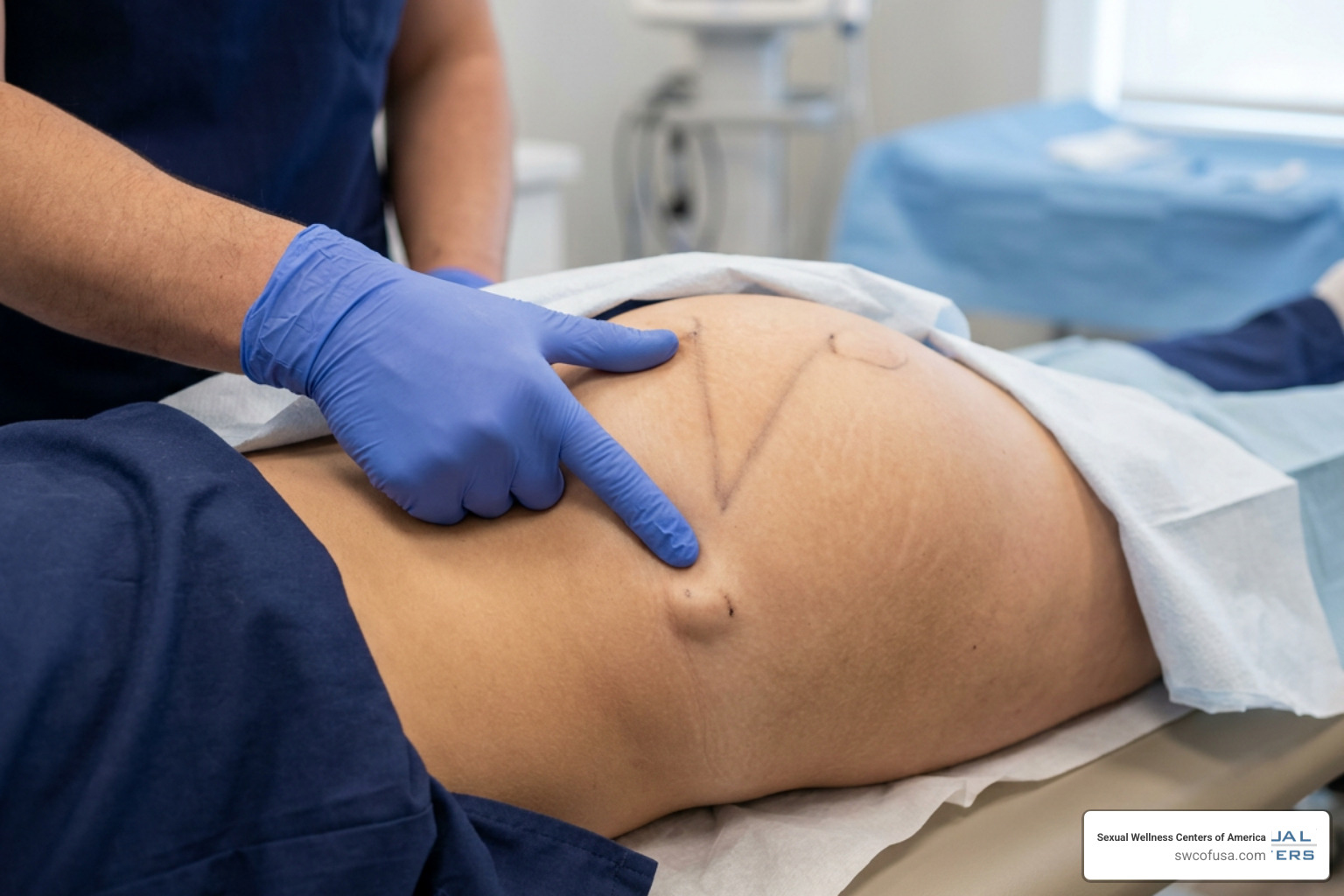
To locate this site, we use two primary methods:
1. The V-Method (The Hand Placement Technique)
This is the most common clinical method:
- Positioning: Have the patient lie on their side (lateral position) with their top knee bent slightly forward to relax the gluteal muscles.
- Hand Placement: If you are injecting into their left hip, use your right hand (and vice versa). Place the heel of your hand directly over the greater trochanter (the bony, prominent joint that juts out at the top of the thigh bone).
- Fingers Pointing: Point your thumb toward the patient’s groin or belly button. Point your index finger straight up toward the anterior superior iliac spine (the prominent bony point at the front of the hip bone).
- Spreading the “V”: Spread your middle finger back along the iliac crest (the upper ridge of the hip bone) toward the buttocks.
- The Sweet Spot: The correct injection site is the center of the “V” triangle formed between your index finger and middle finger. Palpate the area; it should feel like a firm, thick muscle.
2. The G-Method
The G-method is an alternative landmarking technique that clinical studies have shown to be highly reliable across all body mass index (BMI) levels. It involves drawing an imaginary line from the anterior superior iliac spine to the top of the intergluteal cleft (the top of the butt crack) and injecting along the upper portion of the muscle, ensuring you bypass the thicker fat pads entirely.
Using these structural bones as your map eliminates the guesswork. You can read more about perfecting this step in our article on Locating your gluteal injection spot.
The Traditional Dorsogluteal Site and Its Risks
While we strongly advocate for the ventrogluteal site, some patients or clinical scenarios may still involve the traditional dorsogluteal site. If this site must be used, you must understand how to navigate its high-risk anatomy safely.
To find the traditional dorsogluteal site, divide one buttock cheek into four equal quadrants using imaginary horizontal and vertical lines. The safe zone is strictly in the upper outer quadrant, approximately 5 to 8 centimeters (2 to 3 inches) below the curved crest of the hip bone.
Injecting outside of this narrow window carries severe risks:
- Sciatic Nerve Injury: If the needle is inserted too low or too close to the center, it can strike the sciatic nerve, leading to intense pain, permanent sensory loss, or motor dysfunction (such as “foot drop”).
- Tissue Necrosis: Certain medications can cause severe localized tissue death if they are accidentally injected into a blood vessel or if they pool in the subcutaneous fat due to a needle that is too short.
- Subcutaneous Nodules: Because the dorsogluteal fat pad is thick, medications that fail to reach the muscle often form hard, painful lumps under the skin that can take months to resolve.
Understanding these risks is vital for anyone administering therapies at home. For a detailed breakdown of this traditional site’s boundaries, explore our resources on Understanding the buttock IM injection site.
Preparing Your Supplies and Selecting the Right Needle
Before you begin, you must gather all necessary supplies and ensure you are using the correct needle size. Having the wrong needle length is the leading cause of failed IM injections.
Supplies Checklist:
- Prescribed medication vial (warmed to room temperature if it is an oil-based formula)
- Sterile syringe (typically 3 mL to 5 mL for gluteal injections)
- The correct needle for drawing up the medication (often a larger, blunt needle)
- The correct needle for injecting (sterile, single-use)
- Alcohol prep pads
- Sterile 2×2 gauze pads or a clean cotton ball
- An adhesive bandage (Band-Aid)
- An approved sharps disposal container
Selecting the Right Needle Gauge and Length
The needle’s gauge refers to its thickness (the higher the gauge number, the thinner the needle). The length determines how deep it will penetrate.
For gluteal injections, you must use a needle that is long enough to bypass the subcutaneous fat and seat deep into the muscle tissue. For most adults, a 1.5-inch (38 mm) needle is the standard requirement. Using a 1-inch needle in an average-weight adult often results in an accidental subcutaneous injection.
| Patient Profile / BMI | Recommended Needle Length | Recommended Needle Gauge |
|---|---|---|
| Lean / Low BMI (<20) | 1 inch (25 mm) | 22G to 25G (depending on medication viscosity) |
| Average BMI (20-29.9) | 1.5 inches (38 mm) | 21G to 23G (ideal for thicker, oil-based solutions) |
| High BMI (30+) | 1.5 to 2 inches (38-50 mm) | 21G to 22G (ensures the needle reaches deep muscle) |
Using a thicker needle (like a 21G) is necessary for highly viscous or oil-based medications to allow them to flow smoothly. Thinner, aqueous medications can easily pass through a 23G or 25G needle, which is generally more comfortable for the patient. For more detailed advice on matching your equipment to your specific medication, consult our Guide to buttock injection needle gauges and lengths.
Step-by-Step Guide: How to Give Intramuscular Injection in Buttock Safely
Administering an injection requires strict adherence to aseptic technique to prevent introducing bacteria into the deep muscle tissue. Follow these preparation steps carefully:
- Sanitize Your Workspace: Clean a flat surface with a disinfectant wipe.
- Perform Hand Hygiene: Wash your hands thoroughly with warm water and soap for at least 20 seconds, or use a high-quality alcohol-based hand sanitizer.
- Inspect the Medication: Check the vial’s expiration date. Ensure the liquid is clear and free of unexpected particles. If the medication is cold or oil-based, gently roll the vial between your palms to warm it up; this makes the injection significantly more comfortable.
- Prepare the Vial: Pop off the plastic cap and wipe the rubber stopper firmly with an alcohol prep pad. Let it air dry completely.
- Draw the Dose: Attach your drawing needle to the syringe. Draw an amount of air into the syringe equal to your prescribed dose, inject that air into the vial, turn the vial upside down, and pull back the plunger to draw up the medication. Tap the syringe to send any air bubbles to the top, and gently push them out.
- Switch to the Injection Needle: Carefully remove the drawing needle and twist on your sterile injection needle. Keep the cap on until the moment of injection.
- Clean the Skin: Locate your landmark on the patient. Wipe the injection site firmly with a fresh alcohol prep pad in a circular motion, starting at the center and moving outward. Crucial tip: Allow the skin to dry completely (about 30 seconds). Inserting a needle through wet alcohol will cause a sharp, burning sensation.
For more foundational tips on keeping your workspace sterile, check out our Step-by-step guide to giving an IM injection.
How to Give Intramuscular Injection in Buttock: Step-by-Step Administration
Once your patient is positioned comfortably and the skin is prepped, you are ready to administer the injection.

- Step 1: Prep the Skin (Z-Track): Use your non-dominant hand to displace the skin and subcutaneous tissue. (We explain this technique in detail below).
- Step 2: The Insertion: Hold the syringe in your dominant hand like a dart, close to the needle hub. Instruct the patient to take a deep breath in and exhale. With a swift, smooth motion, insert the needle at a strict 90-degree angle directly into the muscle. You should insert the needle all the way to its hub to ensure it reaches the muscle layer.
- Step 3: Aspirate (If Clinically Indicated): Gently hold the syringe steady with your non-dominant hand. Use your dominant hand to pull back slightly on the plunger for about 5 to 10 seconds.
- If no blood enters the syringe: You are safely in the muscle. Proceed to the next step.
- If blood appears in the syringe: You have hit a blood vessel. Do not inject. Immediately withdraw the needle, discard the syringe and medication safely, and start over with fresh supplies at a slightly different site.
- Step 4: Inject Slowly: Depress the plunger slowly and steadily. A good rule of thumb is to inject at a rate of 10 seconds per mL of medication. For large or highly viscous injections, injecting slowly minimizes tissue stretching and significantly reduces post-injection soreness.
- Step 5: Withdraw and Release: Once the medication is fully delivered, wait about 10 seconds to allow the pressure inside the muscle to stabilize. Then, withdraw the needle quickly at the exact same 90-degree angle. Immediately release the skin held by your non-dominant hand.
- Step 6: Apply Pressure: Place a sterile gauze pad or cotton ball over the site and apply firm, gentle pressure for 30 to 60 seconds. Do not rub or massage the area, as this can force the medication back up into the subcutaneous tissue. Apply a Band-Aid if there is minor bleeding.
To refine your technique and build confidence, read our clinical breakdown on Mastering the art of giving an IM injection in the buttocks.
The Z-Track Method for Preventing Leakage
The Z-track method is an essential clinical technique used for all deep intramuscular injections, especially those involving irritating, dark, or oil-based medications. It creates a physical barrier that seals the medication inside the muscle.
Here is how it works:
- During your preparation, place the side of your non-dominant hand (the ulnar edge) on the skin next to the cleaned injection site.
- Firmly pull and displace the skin and subcutaneous tissue approximately 1 inch (2.5 cm) to the side or downward. Hold it in this displaced position.
- Insert the needle at 90 degrees and administer the injection as normal.
- After pulling the needle straight out, immediately let go of the skin.
- As the skin and subcutaneous tissue slide back into their natural resting positions, they slide over the needle track. This creates a zigzag pathway (resembling a “Z”) that completely seals the medication inside the deep muscle, preventing it from leaking upward into the sensitive subcutaneous fat.
Using the Z-track method significantly reduces local skin irritation, prevents staining from certain medications, and drastically minimizes post-injection pain. You can read more about this standard of care in the clinical textbook chapter on Administering Intramuscular Medications.
Managing Post-Injection Care and Minimizing Complications
Proper post-injection care is key to preventing long-term tissue damage, scarring, and discomfort.
Best Practices for Post-Injection Care:
- Sharps Disposal: Never recap a used needle. Immediately drop the entire syringe and needle assembly into your sharps container. When the container is three-quarters full, dispose of it according to your local Texas medical waste regulations.
- Site Rotation: If you require frequent injections, never use the exact same spot twice in a row. Rotate between the left and right sides, and ensure each new injection is at least 1 inch away from previous sites. Keeping a written log of dates, times, and locations is highly recommended to prevent localized tissue scarring (lipohypertrophy).
- Managing Normal Soreness: It is normal to feel mild, dull muscle soreness for 24 to 48 hours after an injection. You can manage this by staying active (light walking helps distribute the medication) or applying a cool compress to the area for 10 to 15 minutes.
Recognizing Complications:
While minor bruising is common, you should monitor the site for signs of abnormal reactions:
- Subcutaneous Nodule: A hard, painless lump under the skin that occurs when medication leaks into the fat layer. This usually resolves on its own but indicates a need for a longer needle next time.
- Sterile Abscess: A localized inflammatory response that can occur if the medication irritates the tissue without an active infection.
- Infection: Characterized by increasing redness, warmth, swelling, throbbing pain, or pus draining from the site.
For more expert advice on managing recovery and minimizing soreness, read our Tips for giving a gluteal IM injection.
Frequently Asked Questions about Buttock Injections
Should I pull back on the plunger (aspirate) during a gluteal injection?
Yes, aspiration is still widely recommended for deep gluteal injections. While modern guidelines (like those from the CDC) have removed the aspiration step for routine vaccinations in the arm or thigh because those areas lack major blood vessels, the gluteal region contains deeper vascular structures. Pulling back on the plunger for 5 to 10 seconds before injecting ensures you have not accidentally entered a blood vessel.
What is the best position for a buttock injection?
The absolute best position for a ventrogluteal injection is lying on your side (lateral position) with your top leg bent slightly forward. For a dorsogluteal injection, the patient should lie flat on their stomach (prone position) with their toes pointed inward (pigeon-toed). Pointing the toes inward naturally rotates the hip and completely relaxes the large gluteal muscles, making the needle insertion virtually painless.
Why did my injection feel like it stayed under the skin?
This sensation usually occurs when the medication is accidentally delivered into the subcutaneous fat layer rather than the deep muscle. This happens if the needle used was too short, or if the needle was not inserted at a strict 90-degree angle. Because fat has poor blood circulation, the medication pools there, creating a firm, sometimes tender lump that absorbs very slowly.
Conclusion
Mastering how to give an intramuscular injection in the buttock takes a blend of anatomical knowledge, the right equipment, and a steady hand. By choosing the safer ventrogluteal site, utilizing the Z-track method, and selecting a needle long enough to bypass subcutaneous fat, you can ensure your therapies are both highly effective and as comfortable as possible.
At Sexual Wellness Centers of America in Colleyville, TX, we understand that managing your health and wellness therapies can feel overwhelming. Our expert clinical team is dedicated to providing personalized care, specializing in innovative treatments like our HEshot®™ for men, SHEshot®™ for women, and advanced REGENmax® technology. Backed by comprehensive hormone and vitamin panels, we tailor every treatment plan to your body’s unique chemistry—boasting a remarkable 97.2% efficacy in erectile dysfunction reversal.
If you are looking for professional guidance, hands-on injection training, or customized wellness therapies, we are here to support you every step of the way. Learn more about our IM injection services in Colleyville, TX or contact our clinic today to schedule your comprehensive consultation.