
Understanding What Disrupts Your Breathing at Night
What causes sleep apnea is a question affecting millions of Americans who struggle with interrupted breathing during sleep. The answer depends on which type you have:
Obstructive Sleep Apnea (OSA) – The most common form:
- Throat muscles and tongue relax during sleep, blocking the airway
- Excess weight creates fat deposits that narrow breathing passages
- Enlarged tonsils or adenoids physically obstruct airflow
- Structural issues like a thick neck, deviated septum, or small jaw restrict the airway
Central Sleep Apnea (CSA) – Less common:
- Brain fails to send proper breathing signals to muscles
- Often linked to heart failure, stroke, or opioid use
- Results from neurological problems rather than physical blockage
Complex Sleep Apnea:
- Combination of both obstructive and central types
- Sometimes emerges during treatment of OSA
About 30 million Americans experience interrupted breathing during sleep, yet 80% remain undiagnosed. The condition develops gradually over time, often starting with mild symptoms like occasional snoring and progressing to severe breathing interruptions that happen 30 times per hour or more.
Age, weight gain, genetics, lifestyle choices, and underlying medical conditions all play crucial roles in triggering this potentially serious disorder. Left untreated, sleep apnea increases your risk of high blood pressure, heart disease, stroke, and diabetes.
As Jeff Nuziard, CEO of Sexual Wellness Centers of America, I’ve helped countless patients understand what causes sleep apnea and how it connects to overall wellness, including hormonal health and sexual function. My experience has shown that addressing sleep disorders often open ups improvements in energy, intimacy, and quality of life.
Important what causes sleep apnea terms:
Understanding the Mechanics: what causes sleep apnea?
When we look at the mechanics of sleep, it is helpful to think of the airway as a flexible straw. Under normal conditions, that straw stays wide open, allowing air to flow freely to the lungs. However, for those suffering from sleep apnea, that straw either collapses (obstructive) or the “pump” (the brain and diaphragm) forgets to pull the air in (central).

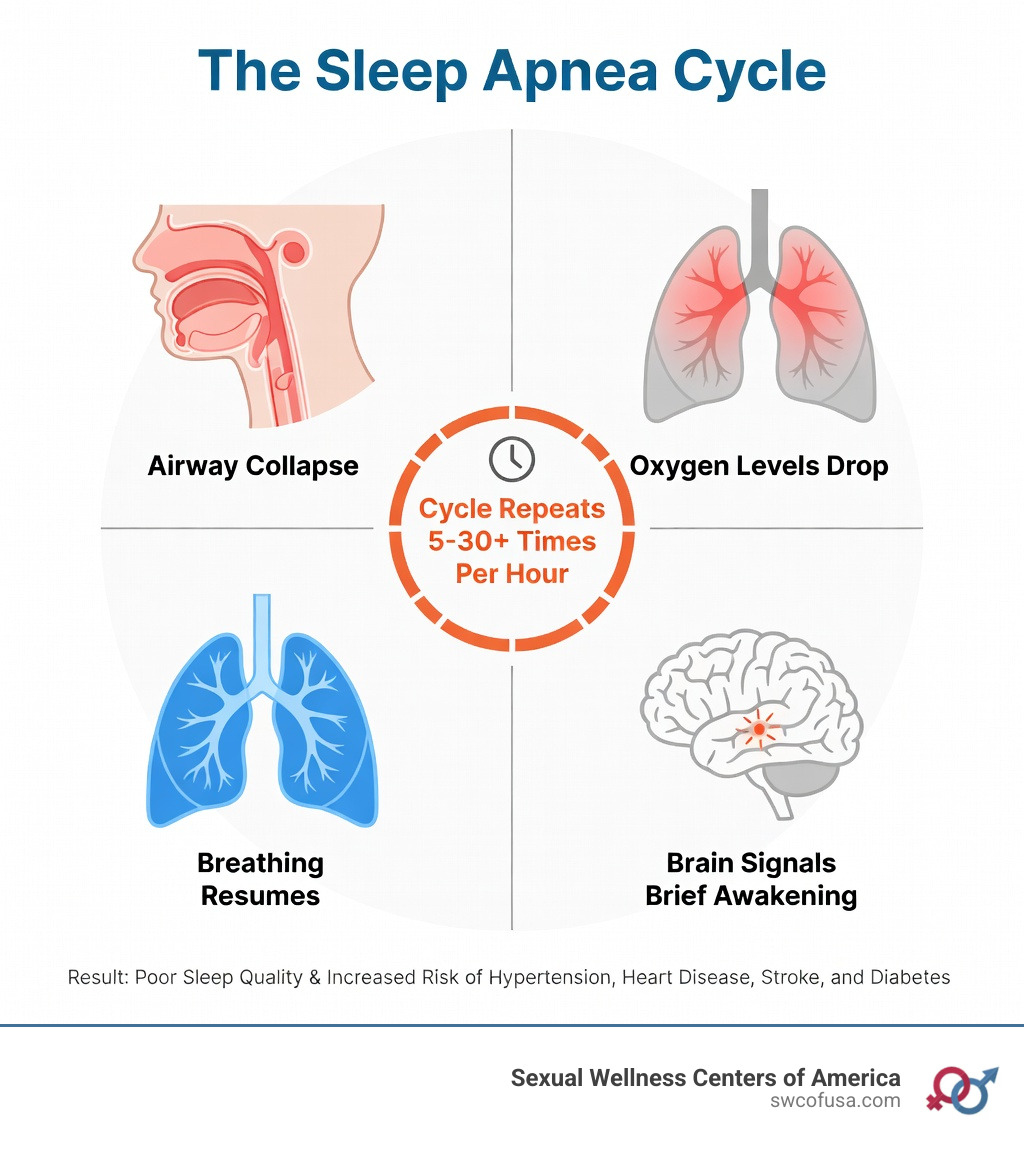
According to the Mayo Clinic overview of sleep apnea causes, the physical relaxation of the throat is the primary driver for most patients. When you drift into deep sleep, the muscles supporting the soft palate, the uvula, the tonsils, and the tongue relax. If they relax too much, the airway narrows or closes completely. This triggers a drop in blood oxygen, forcing your brain to wake you up just enough to reopen the airway—a cycle that can repeat 30 times or more every single hour.
At Sexual Wellness Centers of America, we often see that these disruptions don’t just leave you tired; they wreak havoc on your hormones. If you are constantly waking up, you never reach the deep REM sleep necessary for testosterone production and cellular repair. Recognizing sleep apnea symptoms is the first step toward reclaiming your health.
Anatomical Factors and what causes sleep apnea in Children
While lifestyle plays a huge role in adults, anatomical structure is often the culprit in younger patients. In children, the most common cause of OSA is enlarged tonsils or adenoids. These tissues, located at the back of the throat and nasal cavity, can physically “crowd” the airway. When the child’s muscles relax during sleep, these enlarged tissues act like a plug, stopping the flow of air.
Beyond tonsils, jaw structure—specifically a small or “recessed” lower jaw (micrognathia)—can cause the tongue to fall further back than it should. This anatomical narrowing makes it much easier for an obstruction to occur. If you or your child have a naturally narrow throat or a large tongue, you may be predisposed to these breathing interruptions regardless of your weight. Understanding these physical barriers is essential for determining the right Sleep Apnea OSA Treatment.
Neurological Failures: what causes sleep apnea in the Brain
Central Sleep Apnea (CSA) is a different beast entirely. It isn’t about a physical blockage; it’s about a communication breakdown. In CSA, your brain essentially “forgets” to tell your muscles to breathe. This is often seen in individuals with underlying medical conditions like congestive heart failure or those who have suffered a stroke.
Furthermore, the chronic use of certain medications, particularly opioids, can depress the central nervous system to the point where the breathing drive is suppressed. This neurological failure requires a specialized approach to sleep apnea treatment, as simply opening the airway with a dental appliance might not address the root “signaling” issue.
Obstructive Sleep Apnea: The Role of Physical Blockages
Obstructive Sleep Apnea is the most prevalent form of the disorder. It is a mechanical problem. Imagine the soft tissues in your throat as a curtain; when you sleep, that curtain loses its tension and begins to flap or close entirely.
The primary “players” in this blockage are the soft palate, the tongue, and the side walls of the throat. When these muscles relax, the tongue can slide backward toward the throat, and the soft palate can sag. This creates the vibration we know as snoring. If the collapse is total, it’s an apnea; if it’s partial but still reduces oxygen, it’s a hypopnea.
The Impact of Obesity and Excess Tissue
Obesity is perhaps the most significant modifiable factor in what causes sleep apnea. According to JAMA research on sleep apnea prevalence, there is a direct correlation between Body Mass Index (BMI) and the severity of OSA.
When we carry excess weight, particularly around the neck (a neck circumference of 17+ inches for men or 16+ inches for women), fat deposits accumulate around the upper airway. This extra tissue puts constant pressure on the breathing tube, making it much more likely to collapse when the muscles relax. It is a simple matter of physics: more weight pressing down on a soft tube makes it harder to keep that tube open. Interestingly, recent studies show that significant weight loss, sometimes aided by medications like tirzepatide, can actually “cure” sleep apnea in up to 50% of patients.
Nasal Congestion and Structural Abnormalities
If you’ve ever tried to breathe through a straw while pinching your nose, you know how hard it is. Nasal congestion, whether from allergies, a deviated septum, or chronic sinusitis, forces you to breathe through your mouth. Mouth breathing during sleep naturally causes the jaw and tongue to drop back, which further narrows the airway.
If you find yourself constantly congested, home sleep apnea testing can help determine if your “stuffy nose” is actually contributing to dangerous nighttime breathing pauses. Structural abnormalities like a deviated septum can be a permanent trigger that requires medical intervention to resolve.
Lifestyle and Medical Triggers for Breathing Interruptions
Your daily habits can significantly influence the frequency and severity of apneic events. Many people are surprised to learn that their “nightcap” might be the reason they wake up feeling like they haven’t slept at all.
Alcohol is a potent muscle relaxant. When you consume alcohol before bed, it relaxes the muscles in your throat even more than usual, making airway collapse almost a certainty for those already at risk. Similarly, smoking increases inflammation and fluid retention in the upper airway, which narrows the space available for air to pass. In fact, smokers are three times more likely to develop OSA than non-smokers.
Chronic Medical Conditions
Sleep apnea doesn’t exist in a vacuum; it is often part of a larger web of medical issues. Research from the National Heart, Lung, and Blood Institute (NHLBI) has shown that sleep apnea can raise the risk for:
- Type 2 Diabetes: Interrupted sleep increases insulin resistance.
- Hypertension: Every time you stop breathing, your body enters a “fight or flight” mode, spiking your blood pressure.
- Heart Disease: The constant strain on the cardiovascular system can lead to heart attacks and irregular heartbeats (atrial fibrillation).
Hormonal changes also play a role. Women often see an uptick in sleep apnea symptoms during and after menopause as estrogen levels drop, which affects the muscle tone of the airway.
Substance Use and Medication
Beyond alcohol, other substances can trigger or worsen sleep apnea. Sedatives, tranquilizers, and sleeping pills are designed to relax the body, but they can be too effective at relaxing the throat muscles. Chronic opioid therapy is a well-documented cause of Central Sleep Apnea, as it interferes with the brain’s carbon dioxide sensors, which are responsible for telling the body when to take a breath.
Demographics and Progression: Who is Most at Risk?
Who is most likely to suffer from this “silent” condition? While sleep apnea can affect anyone—from infants to the elderly—certain demographics are at higher risk.
Men are 2 to 3 times more likely to have sleep apnea than women, although the gap narrows after women reach menopause. Age is another major factor; as we get older, our tissues naturally lose elasticity and muscle tone, making the airway more prone to collapse. Genetics also play a part—if your parents snored loudly or had diagnosed apnea, there is a high probability that your airway anatomy follows a similar pattern.
The Gradual Progression of Sleep Disorders
Sleep apnea rarely appears overnight. It is typically a progressive condition. It might start as “simple” snoring in your 30s. As you gain a few pounds or lose muscle tone in your 40s and 50s, that snoring turns into mild sleep apnea.
To understand where you fall on the spectrum, doctors use the Apnea-Hypopnea Index (AHI):
| Severity | AHI (Events per Hour) | Impact on Health |
|---|---|---|
| Normal | Less than 5 | Minimal risk |
| Mild | 5 to 15 | Increased fatigue, slight BP rise |
| Moderate | 15 to 30 | Significant cardiovascular strain |
| Severe | Greater than 30 | High risk of stroke and heart failure |
Complex and Treatment-Emergent Apnea
In some cases, treating one form of apnea can trigger another. This is known as treatment-emergent central sleep apnea. It occurs when a patient with OSA begins using a CPAP machine, and the sudden influx of oxygen/pressure causes the brain to stop sending breathing signals. This “complex” apnea requires careful calibration by a sleep specialist to ensure both the physical and neurological components are managed.
Frequently Asked Questions about Sleep Apnea
Can sleep apnea develop suddenly?
While the physical causes usually progress over time, certain events can cause a “sudden” onset. Significant weight gain over a short period, the start of a new medication (like opioids or strong sedatives), or a neurological event like a stroke can cause sleep apnea symptoms to appear abruptly.
Is snoring always a sign of sleep apnea?
No. While loud, chronic snoring is the most common symptom, not everyone who snores has apnea, and not everyone with apnea snores. Women, in particular, are less likely to report loud snoring and may instead experience symptoms like morning headaches, insomnia, or extreme fatigue.
How does smoking increase the risk of OSA?
Smoking causes chemical irritation and inflammation in the tissues of the nose and throat. This leads to swelling (edema), which narrows the airway. It also disrupts the “arousal threshold,” making it harder for the brain to wake the body up when oxygen levels drop.
Conclusion
Understanding what causes sleep apnea is the first step toward reclaiming your nights and your health. Whether it is anatomical structure, weight, or neurological signaling, the impact on your life is profound. At Sexual Wellness Centers of America, we believe that sleep is a pillar of vitality. When you aren’t sleeping, your hormones suffer, your energy wanes, and your intimate life can decline.
We specialize in personalized wellness plans that look at the whole person. By utilizing advanced hormone and vitamin panels, we help our patients in Colleyville, TX, address the root causes of their fatigue and sexual health concerns. Our innovative treatments, including HEshot®™, SHEshot®™, and REGENmax® technology, are designed to restore function and confidence. In fact, our protocols have shown a 97.2% efficacy in erectile dysfunction reversal, which is often closely linked to the vascular damage caused by untreated sleep apnea.
If you are tired of being tired, it’s time to look deeper into your sleep health. Visit us to learn more about our Services Sleep Apnea and Snoring Colleyville TX and let us help you wake up feeling like yourself again.