
What Topical Peptides for Skin Actually Do (And Why They Matter)
Topical peptides for skin are short chains of amino acids that signal your skin to produce more collagen, elastin, and other structural proteins — helping reduce wrinkles, improve firmness, and strengthen your skin barrier.
Here’s a quick summary of what they do:
- Boost collagen production — signals skin cells to rebuild structural proteins that decline with age
- Reduce fine lines and wrinkles — studies show up to 30% wrinkle reduction with consistent use
- Strengthen the skin barrier — helps protect against environmental damage and moisture loss
- Improve hydration and texture — plumps skin and smooths rough patches
- Calm inflammation — beneficial for conditions like eczema and irritated skin
- Safe for nearly all skin types — confirmed by Cosmetic Ingredient Review Expert Panel reports in 2017, 2018, and 2022
Your skin naturally makes peptides. But starting in your mid-twenties, collagen production begins to decline. Topical peptides help fill that gap — without needles or harsh side effects.
They’re not magic. But the science behind them is solid, and they’re one of the most well-tolerated active ingredients available today.
I’m Jeff Nuziard, CEO of Sexual Wellness Centers of America, where I’ve spent my career helping people reclaim their health and vitality through evidence-based, science-backed solutions — including the role of skin health in overall well-being. Understanding how topical peptides for skin support the body’s natural repair systems is central to the holistic approach we take with every patient.
Handy topical peptides for skin terms:
The Science Behind Topical Peptides for Skin
To understand topical peptides for skin, we first need to look at what they are made of. Think of amino acids as individual LEGO blocks. When you snap a few of those blocks together, you get a peptide. When you build a giant, complex castle out of those blocks, you get a protein — like collagen or elastin.
In biology, bioactive peptides typically contain between 3 and 30 amino acids. These aren’t just passive ingredients; they are involved in physiological activities such as cellular protection and enhancing skin cell proliferation. As we age, our body’s ability to synthesize these proteins slows down. In fact, research shows that collagen synthesis begins to decline as early as our mid-twenties. This is where topical application comes into play.
We often hear about the latest “miracle” ingredient, but peptides have an established track record. According to the Cosmetic Ingredient Review Expert Panel reports from 2017, 2018, and 2022, peptides are safe for use in cosmetics at current concentrations. They provide a gentler way to revitalize the skin’s building blocks, making the skin more resilient against the passage of time.

How Topical Peptides for Skin Signal Collagen Production
The most popular type of peptides used in skincare are “signal peptides.” As the name suggests, they act as messengers. When collagen breaks down naturally in the skin, it creates its own peptides. These peptides “signal” to the skin that it has been damaged and needs to make more collagen.
By applying topical peptides for skin, we are essentially tricking the skin into thinking there has been a breakdown of collagen, which triggers the fibroblasts (the cells responsible for collagen production) to go into overdrive. This process helps bolster the extracellular matrix, which is the framework that keeps our skin looking “bouncy” and firm.
For those of us with reactive skin, this is great news. New York City-based board-certified dermatologist David Kim, MD, notes that peptides are a gentler alternative to retinoids, which can sometimes be too harsh for sensitive skin types. While retinoids work by speeding up cell turnover (which can cause peeling), peptides work by supporting the skin’s natural structural integrity from the inside out.
Identifying High-Quality Topical Peptides for Skin in Ingredient Lists
Reading a skincare label can sometimes feel like you’re trying to decode ancient hieroglyphics. However, identifying topical peptides for skin is easier once you know what to look for. Most peptide names either end in the word “peptide” or start with “Palmitoyl.”
Here are a few heavy hitters to keep an eye out for:
- Palmitoyl Pentapeptide-4 (Matrixyl): One of the most well-researched signal peptides. It’s known for its ability to reduce the appearance of fine lines and improve overall skin texture.
- Acetyl Hexapeptide-8 (Argireline): Often called “Botox in a jar,” this peptide targets expression lines by temporarily inhibiting the signals that tell your facial muscles to contract.
- Copper Tripeptide-1 (GHK-Cu): A carrier peptide that helps deliver copper to the skin, which is essential for wound healing and tissue repair.
- Palmitoyl Tripeptide-38 (Matrixyl Synthe’6): Focuses on smoothing wrinkles and rebuilding skin where it is most needed, particularly on the forehead and around the eyes.
When we choose a peptide face cream, formulation stability is key. Peptides are delicate; they can break down if exposed to too much light or air. That’s why we always recommend looking for products in opaque, airtight pumps rather than open-mouthed jars.
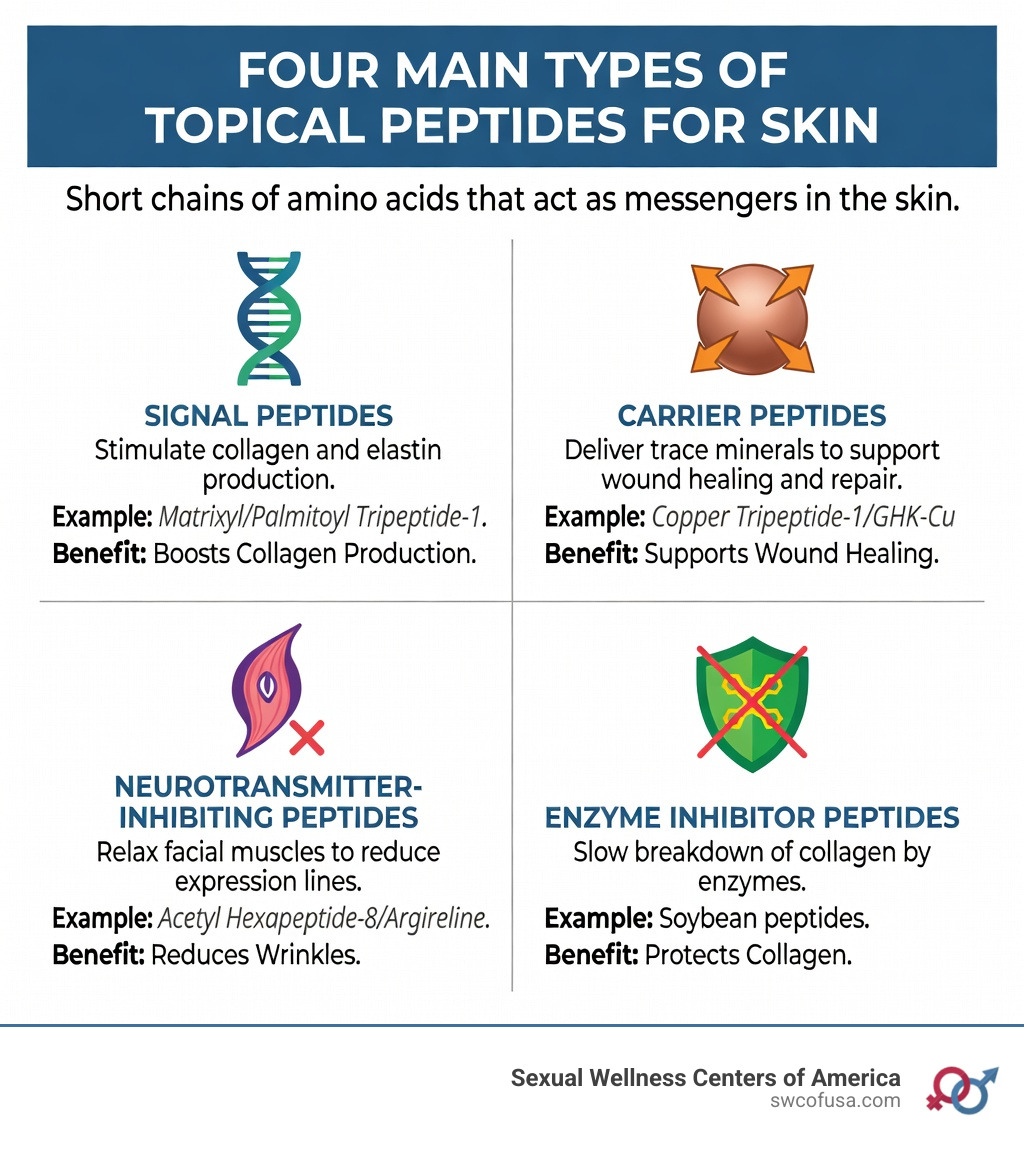
The Four Functional Categories of Peptides
Not all peptides are created equal. Depending on their chemical structure, they perform very different jobs for our skin. Understanding these categories helps us target our specific concerns more effectively.
- Signal Peptides: These are the “cheerleaders” of the skin. They encourage the production of collagen, elastin, and other structural proteins.
- Neurotransmitter-Inhibiting Peptides: These work on the surface level to relax facial muscles. If you’re worried about “11 lines” between your brows or crow’s feet, these are your best friends.
- Carrier Peptides: These act like a delivery service. They transport trace elements like copper or manganese to the skin cells to help with enzymatic processes and repair.
- Enzyme Inhibitor Peptides: These slow down the natural process of protein breakdown. They interfere with the enzymes that gobble up our collagen, helping us keep what we already have for longer.
Choosing Topical Peptides for Skin Concerns
Whether you are dealing with “tech neck” from staring at your phone or just want to maintain a healthy glow, there is a peptide for that. For wrinkle reduction, signal and neurotransmitter-inhibiting peptides are the gold standard. If your concern is firmness and sagging, you’ll want a collagen peptide serum that emphasizes elastin production.
If you struggle with chronic redness or inflammation, anti-inflammatory peptides can help quiet the skin’s immune response. According to a study on bioactive peptides in dermatology, these ingredients are increasingly used to improve conditions like eczema and dermatitis by repairing the skin barrier.
Key Benefits: Why Your Skin Needs Peptides
The benefits of topical peptides for skin extend far beyond just looking younger. They are essential for maintaining the health of the skin barrier, which is our first line of defense against the world.
| Skin Concern | Peptide Type | Expected Result |
|---|---|---|
| Fine Lines/Wrinkles | Signal & Neuro-inhibitor | Up to 30% reduction in wrinkle depth |
| Sagging/Loss of Firmness | Signal (Matrixyl) | Improved elasticity and “bounce” |
| Dehydration | Collagen Peptides | Acts as a humectant to bind moisture |
| Redness/Irritation | Anti-inflammatory | Strengthened barrier and calmer skin |
| Large Pores | Signal Peptides | Smoother texture and refined appearance |
Improving Skin Firmness and Elasticity
One of the most impressive feats of topical peptides for skin is their ability to boost elastin. While collagen provides the strength, elastin provides the “snap-back.” As we hit our mid-twenties, the production of these proteins slows down, leading to the first signs of sagging.
Peptides help by promoting cellular proliferation — essentially telling your skin to keep making new, healthy cells. This doesn’t happen overnight, though. While some people notice a “plumping” effect immediately due to the hydrating nature of peptide and collagen formulas, the real structural changes usually take about 4 to 12 weeks of consistent use.
Frequently Asked Questions about Peptides
When should I start using peptides?
We often get asked if it’s “too early” or “too late” to start. The short answer? It’s never too early for prevention. Since collagen synthesis begins to dip in your mid-twenties, starting then can help delay the visible signs of aging.
Washington, DC-based board-certified dermatologist Adam Friedman, MD, who co-authored a study on peptides, believes that even younger individuals can benefit from adding peptides to their routine if they want to focus on prevention. If you’re already seeing fine lines, peptides can help soften them, but the goal is always to maintain the skin’s health before the damage becomes deep-set.
Can I layer peptides with Vitamin C or Retinol?
Yes! In fact, we encourage it. Peptides are very “social” ingredients — they play well with others.
- With Retinol: Peptides can actually help buffer the irritating effects of retinol. Using them together is a powerhouse move for anti-aging.
- With Vitamin C: This is a great morning combination. Vitamin C protects against environmental damage, while peptides work on the structure. Just be careful with very low-pH (highly acidic) Vitamin C serums, as they can occasionally break down certain peptide bonds. A good rule of thumb is to apply your Vitamin C first, let it dry, and then follow with your peptide cream.
- With Hyaluronic Acid: This is a match made in heaven for hydration. Many peptide face cream products already include hyaluronic acid to help the peptides penetrate and keep the skin plump.
Are there any side effects to topical peptides?
Peptides are generally considered very safe. Because they are fragments of proteins already found in your body, the risk of an allergic reaction or irritation is much lower than with ingredients like AHAs or retinoids.
However, as with any new skincare product, we always recommend a patch test. While the peptides themselves are gentle, sometimes the other ingredients in a formula (like fragrances or preservatives) can cause a reaction. Keep your expectations realistic — while topical peptides for skin can do wonders for texture and fine lines, they won’t replace the dramatic results of professional in-office procedures. They are a long-term investment in your skin’s health.
Conclusion
At Sexual Wellness Centers of America, we believe that true wellness is comprehensive. It’s not just about how you feel on the inside; it’s about how your body functions as a whole, including your skin. Whether we are discussing what are peptide supplements for internal health or the benefits of topical peptides for skin, our goal is to provide you with the most effective, science-backed tools available.
For our patients in Colleyville, TX, we offer more than just advice. We specialize in personalized wellness plans that often include hormone and vitamin panels to ensure your body has everything it needs to thrive. From our innovative HEshot®™ and SHEshot®™ treatments to our advanced REGENmax® technology, we are dedicated to helping you achieve long-term vitality.
If you’re ready to take your health and skin to the next level, we invite you to visit us in Colleyville. Let’s work together to optimize your wellness from the inside out.
Ready to learn more about how peptides can support your journey? Explore our guides on peptide supplements and collagen peptides supplements to see the full picture of what these incredible amino acid chains can do for you.